


MHSA(Q&)A: Football Coaches Jim Ahern and Brad Weber
August 31, 2012
 Pewamo-Westphalia football coach Brad Weber and Lansing Catholic's Jim Ahern had experienced plenty of success long before the end of last season.
But this month marked the first time either had returned to the sideline after a trip to the MHSAA Finals.
Their teams faced off on opening night at Holt Junior High, the Cougars' home field. Gone were Lansing Catholic's all-state quarterback-receiver tandem that helped the Cougars finish Division 5 runner-up last fall, as well as the large group of standout se niors who guided the Pirates to the Division 7 Final.
 But the coaches are back for more, and we caught up briefly with both after Lansing Catholic's 45-21 win. (Lansing Catholic fell to 1-1 this week with a loss at Saginaw Nouvel, while P-W improved to 1-1 with a win over Potterville.)
This has to be the most unfamiliar group you've had at Lansing Catholic?
Ahern: They're a good group from the standpoint that they have a lot of team chemistry. They're a close-knit group, and they've worked extremely hard in the offseason. I know every coach says that. But this, probably of all the groups I've had, has really worked hard. We were a little nervous. We had a lot of kids playing in spots where they hadn't been there, but they settled down a little bit.
Have the players approached things differently because of how you ended up last year?
Weber: A little bit. But it's still football, and they've been playing football since sixth grade. It shouldn't be too different.
Are you (as a coach) approaching some things differently?
Weber: Yes and no. We're still getting down to business. Practices are the same. We still have a lot of energy at practice. But you do. You're looking for a little bit of the senior leadership to step up because it was so good last year. These guys kinda took it for granted, and they rode on their coat tails, and it's time for them to step up and be leaders of this team. It's 2012 now.
Ahern: Not really. Every year I tell everyone the same thing. Our goal is to win the league. If we do that, good things will happen. That's our goal -- to win the conference. ... We're still running the same stuff pretty much. We haven't changed a whole lot.
Do you have to say things to certain guys who are replacing (all-staters), like 'Do you know what you're stepping into?'"
Ahern: You don't have to remind them about it. They know it. They don't need to hear it. I think that's why they work so hard in the offseason. The bar's set pretty high for them, so they want to continue that.
Quick Study Central Lake Clinches 1st Title
November 18, 2017
By Geoff Kimmerly
Second Half editor
MARQUETTE – Central Lake may not have been totally sure what it got itself into switching to 8-player football heading into this fall.
 Clearly it didn’t take the Trojans long to figure things out.
A year after finishing 2-7 with 11 players on the field, Central Lake finished Saturday afternoon at the Superior Dome with its first football championship, downing Deckerville 32-30 in the inaugural 8-Player Division 1 Final.
The championship was the first for the school in any MHSAA tournament sport since claiming the Class D softball title in 1980. The Trojans also finished 13-0 this fall.
“Last year it was not even something. Or just growing up, you’re watching the Finals on TV … ‘I’m never going to be there,’ but it’s cool to watch,” Central Lake senior quarterback Gavin Mortensen said. “You dream about it. And then all of a sudden, you’re a state champion. It’s crazy.”
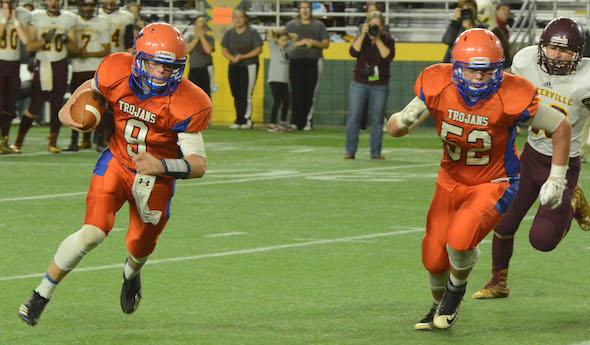
And so was the finish, as Mortensen put his team ahead to stay on a six-yard touchdown run with 2:49 to play. Central Lake came back from 10 points down with under a minute to play in the third quarter, riding a powerful running game to the final two of four rushing touchdowns on the day, while also halting two Deckerville fourth-quarter drives that reached the Trojans’ 21-yard line.
“Those get your heart pumping, don’t they, those stops? But what a great way to win,” Central Lake coach Rob Heeke said.
Junior running back Grant Papineau went over 2,000 yards rushing for the season, adding 183 for a final total of 2,067 while also rushing for his 26th touchdown of the fall. Junior Skyler Spangler had 101 yards and two scores on the ground to finish the season with 1,753 yards and 28 touchdowns rushing.
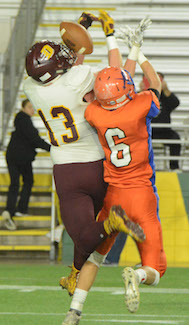 Mortensen, in addition to running the show, made it count when his number was called, adding a 49-yard touchdown pass to senior Jayce Hoogerhyde. And Hoogerhyde, who had 15 pass break-ups as a defensive back entering the game, made an equally significant play on that side of the ball batting down Deckerville’s final pass into the end zone.
Those are the guys who got most of the attention during the perfect run. But a most unlikely contributor deserved his share as well Saturday. Junior center Dalin Clark (6-foot, 265 pounds) left the game with an injury near the end of the first half. In came sophomore Vance Hoeksema (5-6, 140), who had played that position only a couple of times this fall. But the Central Lake attack just kept rolling.
“We just kinda rallied around Vance, and he did a great job,” Mortensen said. “After we got the first few bad snaps out of the way, exchange-wise, he did really well.
Guys on the line picked him up and told him what to do if he didn’t know, and it worked out.”
Hoogerhyde said it wasn’t until a 14-point Week 8 win over Onekama – that clinched for the Trojans the Midwest Central Michigan Conference championship – that he and his teammates started to realize what they might be capable of accomplishing this fall.
Deckerville had been to this level before, winning the 8-player championship in 2012 and finishing runner-up to two-time champion Powers North Central a year ago. That the Eagles (11-2) returned to the final game Saturday was impressive though, considering they replaced nearly their entire backfield from a year ago and then didn’t have injured leading rusher Cruz Ibarra for the last two games.
Senior Kenton Bowerman ran for 83 yards and also caught three passes for 93 yards and a score in the Final. Sophomore quarterback Isaac Keinath threw for three scores total.
“We’d love to win that state championship, but I think we overachieved maybe a little bit,” Deckerville coach Bill Brown said. “They really came together as a team midway through the season and as a head football coach, when you watch your kids and they come together and they’re playing as a team, and you’re getting those selfless acts … we have kids giving just everything they have out there. When you’re a coach, that’s all you ask for.
“I’m disappointed in the outcome of course. That doesn’t define this football team. We could play that game again, and we might win by two touchdowns.”
Spangler had 15 tackles, Mortensen 14, Papineau 13 and senior Dylan Michael 12 for Central Lake. Junior Curtis Vogel had 20 tackles and senior Wyatt Janowiak had 15 for the Eagles. Senior Zach Ostrowski also caught a touchdown pass, and senior Brendan Hadley ran for a score.
The MHSAA Playoffs are sponsored by the Michigan Army National Guard.
PHOTOS: (Top) Central Lake quarterback Gavin Mortensen begins to turn the corner on the way to scoring the go-head touchdown Saturday. (Middle) Deckerville’s Wyatt Janowiak hauls in a third-quarter touchdown pass over the tight coverage of Jayce Hoogerhyde. (Photos by John Johnson.)