


MHSA(Q&)A: Football Coaches Jim Ahern and Brad Weber
August 31, 2012
 Pewamo-Westphalia football coach Brad Weber and Lansing Catholic's Jim Ahern had experienced plenty of success long before the end of last season.
But this month marked the first time either had returned to the sideline after a trip to the MHSAA Finals.
Their teams faced off on opening night at Holt Junior High, the Cougars' home field. Gone were Lansing Catholic's all-state quarterback-receiver tandem that helped the Cougars finish Division 5 runner-up last fall, as well as the large group of standout se niors who guided the Pirates to the Division 7 Final.
 But the coaches are back for more, and we caught up briefly with both after Lansing Catholic's 45-21 win. (Lansing Catholic fell to 1-1 this week with a loss at Saginaw Nouvel, while P-W improved to 1-1 with a win over Potterville.)
This has to be the most unfamiliar group you've had at Lansing Catholic?
Ahern: They're a good group from the standpoint that they have a lot of team chemistry. They're a close-knit group, and they've worked extremely hard in the offseason. I know every coach says that. But this, probably of all the groups I've had, has really worked hard. We were a little nervous. We had a lot of kids playing in spots where they hadn't been there, but they settled down a little bit.
Have the players approached things differently because of how you ended up last year?
Weber: A little bit. But it's still football, and they've been playing football since sixth grade. It shouldn't be too different.
Are you (as a coach) approaching some things differently?
Weber: Yes and no. We're still getting down to business. Practices are the same. We still have a lot of energy at practice. But you do. You're looking for a little bit of the senior leadership to step up because it was so good last year. These guys kinda took it for granted, and they rode on their coat tails, and it's time for them to step up and be leaders of this team. It's 2012 now.
Ahern: Not really. Every year I tell everyone the same thing. Our goal is to win the league. If we do that, good things will happen. That's our goal -- to win the conference. ... We're still running the same stuff pretty much. We haven't changed a whole lot.
Do you have to say things to certain guys who are replacing (all-staters), like 'Do you know what you're stepping into?'"
Ahern: You don't have to remind them about it. They know it. They don't need to hear it. I think that's why they work so hard in the offseason. The bar's set pretty high for them, so they want to continue that.
Kalkaska Climbs Under 'Famed' Alum
September 28, 2016
By Dennis Chase
Special for Second Half
KALKASKA – It was a whirlwind weekend for Jeremy Wilkinson.
 The Kalkaska football coach led his unbeaten Blazers to a 35-0 victory over Cheboygan last Thursday. Then, 24 hours later, Wilkinson was inducted into the Northern Michigan University Sports Hall of Fame as part of the school’s Homecoming festivities.
“It’s a great honor,” the Kalkaska High School graduate said. “I remember 22 years ago looking at all the Hall of Fame plaques (in the Superior Dome) and thinking how cool it would be to be on that wall, too.”
Wilkinson, a wide receiver at Northern Michigan, still holds the career records for receiving yards (3,367) and touchdowns (35).
“This is a small town,” Kalkaska senior quarterback Hunter Suydam said. “Not too many (college) players come out of here, (certainly) not Hall of Famers. It’s pretty special.
“But he doesn’t really talk about it. It’s mainly, ‘Yeah, I played college football. Now, let’s get back to work.’”
That was Wilkinson’s mindset Monday as the Blazers began preparations for a big road task Friday at Boyne City.
With its 5-0 record, Kalkaska’s best start since the 1981 team went 9-0, the team’s generated quite a buzz in the community. But a difficult second half schedule includes games with Boyne City (3-2), Traverse City St. Francis (5-0) and Grayling (3-2).
It’s a stretch that promises to define the Blazers’ season.
“To be 5-0 is great, but our goal is the playoffs and we’ve got a tough schedule ahead of us,” Suydam said. “We need to focus on that. It doesn’t matter if you’re 5-0, if you can’t finish it off.”
Wilkinson has turned the program around since taking over in 2009. The Blazers are in the midst of a fourth winning season in five years – and a possible third playoff appearance during that span. One more win assures that.
“We know it takes one more win to make it into the playoffs,” Wilkinson said, ‘but we also know it’s not going to be easy. The next four weeks will be tough. We have quality opponents. We definitely have to clean up some mistakes we’ve been making the last couple weeks.”
 Wilkinson is not surprised by the 5-0 start, which includes a 21-18 win over Leroy Pine River, a 4-1 squad that is ranked No. 9 in this week’s Associated Press Division 6 rankings. After all, the Blazers finished 5-4 a year ago and returned several players with at least three years of varsity experience.
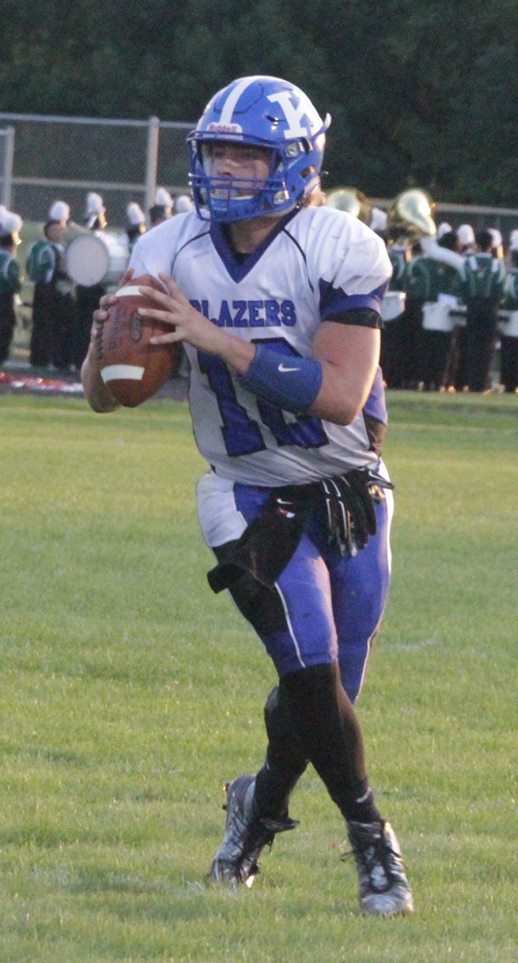
One key returner was Suydam, who has completed 36 of 69 passes for 636 yards and 10 touchdowns in four games (the Blazers won one game by forfeit). Two weeks ago, he threw for 292 yards and five touchdowns in a 40-21 triumph over Elk Rapids. He was 7 of 11 for 103 yards and two more scores against Cheboygan.
“Over the past few years we haven’t thrown the ball a ton,” Wilkinson said, “but this year we’ve opened it up a little more because of the speed and athleticism of our skills guys and the size in our line. It’s nice to be able to throw because it takes defenses out of their comfort zone. Now they’ve got to drop back and try to cover instead of loading seven to eight players in the box. “
Suydam, now in his second year at quarterback, is still learning the position as far as reads, Wilkinson said.
“But he’s starting to put it together,” the coach added.
Wilkinson is quick to credit Suydam’s receivers as well as a line that includes tackles Luke Sexton and Seth Riddle, guards Jake Disbrow and Brad Berger and center Ed Davidson. Nolan Mitchell is the leading receiver with 15 catches for 265 yards and four scores. Hayden Zimmerman has added 10 receptions for 301 yards and three touchdowns while tight end Jake Kies has contributed five receptions for 51 yards and two touchdowns.
“Our line has played well and our receivers are getting open,” Wilkinson said. “Once the ball is in their hands, they’re making plays. The last two weeks we’ve had plays where we’ve caught the ball within five to eight yards of the line of scrimmage and taken it 60, 70, 80 yards for touchdowns.’
Mitchell’s the leading rusher with 258 yards and three scores.
 Defensively, the Blazers are paced by linebacker Gavin Peterson, who has a team-high 32 tackles. Mitchell and Disbrow are next with 23 and 21 stops, respectively. Kies, a defensive end, has four sacks.
“Our defense has been playing great and that’s because they’re playing aggressively,” Wilkinson said. “They’re flying around. They want to hit.”
The Blazers’ roster features 18 seniors.
“Fifteen were on varsity as sophomores,” Suydam said. “Yes, we were 2-7 (two years ago), but that year of experience helped us.”
One of the seniors, receiver-linebacker Jacob Shier, broke his fibula early in the opening game. Shier, who has been on the varsity since his freshman season, still attends practice regularly to be around his teammates.
“I want to be here for the guys,” he said. “This class has been working together since third grade and it’s clicking right now. There’s a lot of talent on this team, more so than we’ve had in a long time. It’s looking good. Everybody’s buying in.”
The experience bleeds down into the junior class. Four juniors are in their third year on varsity.
“What we’re seeing on the football field is a credit to the program as a whole,” athletic director Justin Thorington said. “It starts at the top with the coaches creating a program that our student-athletes are really engaged and interested in, and working hard at.
“Plus, we have a giant senior class, which is always good.”
There are 29 players on varsity, 25 on JV.
“Those are good numbers for a school our size,” Thorington said. “But our participation numbers in general are pretty big. This year we added a JV soccer team, which, as far as I know, is the first time that’s happened here.”
Kalkaska coaches also participated this summer in a training program through Michigan State called Spartan Performance. The program, according to the school’s website, is designed to enhance athletic development and sports performance through a multidisciplinary approach that includes physical training, recovery, nutrition, mental skills and athletic health.
Michigan State conducted a two-day in-service with the coaching staff, then came back for a follow-up.
“It’s collegiate-level training based on research,” Thorington said. “It’s more than just strength training, it’s speed and agility, nutrition, sports psychology. They did training with our female sports coaches on ACL strength and tear prevention. We’re hitting all the facets.
“Our football staff really spearheaded it and ran with it. We only had a couple weeks to implement it, but this offseason we’ll have the entire year to do it. We’re always thinking of ways to get a competitive advantage.”
That said, Thorington added that wins and losses are not the only way to gauge success.
“Our slogan for this year (in the athletic department) is ‘Embrace the Process,’” he said. “We’re not going to concentrate on the results, the wins and losses. That’s not why we’re here. Instead of worrying about championships, we’re going to worry about developing champions.”
One can lead to the other, though, and that’s what the Blazers are hoping.
And as Thorington alluded, it all starts at the top with Wilkinson, who is all about team.
That was evident over the weekend when he first saw his Hall of Fame plaque that listed his individual accomplishments.
“It took a lot of people to make it happen – teammates, coaches, family, friends,” he said. “I didn’t do all the work myself. It’s (induction) an individual honor, but it doesn’t take into account that I had the MIFC Player of the Year at quarterback (Matt Hoard) in 1996. We also had the Defensive Player of the Year (Jovan Dewitt). A lot of people played a huge role in this.”
 Dennis Chase worked 32 years as a sportswriter at the Traverse City Record-Eagle, including as sports editor from 2000-14. He can be reached at [email protected] with story ideas for Manistee, Wexford, Missaukee, Roscommon, Ogemaw, Iosco, Alcona, Oscoda, Crawford, Kalkaska, Grand Traverse, Benzie, Leelanau, Antrim, Otsego, Montmorency, Alpena, Presque Isle, Cheboygan, Charlevoix and Emmet counties.
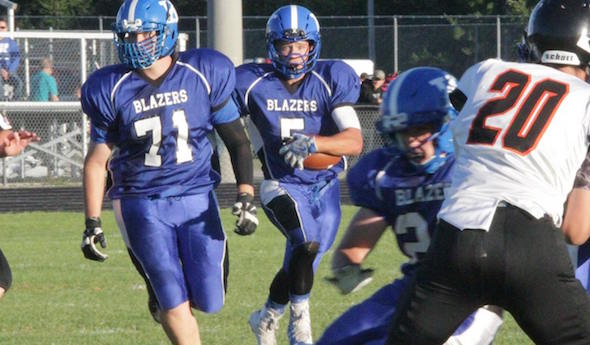
PHOTOS: (Top) Kalkaska junior Nolan Mitchell (5) looks for a hole against Elk Rapids this season, with Luke Sexton blocking. (Middle) Kalkaska football coach Jeremy Wilkinson. (Below) Senior quarterback Hunter Suydam rolls left looking for a receiver against Leroy Pine River. (Photos by Greg Fast.)