


MHSA(Q&)A: Mendon football coach John Schwartz
February 2, 2012
 John Schwartz didn’t really want the Mendon football head coaching job when a group of players convinced him to take it before the 1989 season. And his first contract started out on a napkin. The rest is history.
Mendon won its 11th MHSAA football championship this fall, downing Fowler 33-0 in the Division 8 Final, to tie for third-most football titles won by one program. Schwartz has coached in the program for all 11, including 10 as head coach, and his record of 236-39 gives him a winning percentage of .858, tops in the MHSAA record book. He recently was selected as this year’s recipient of the high school Duffy Daugherty Award, annually given for career contributions to the game. He follows recent winners Ralph Munger of Rockford and Herb Brogan of Jackson Lumen Christi.
His Mendon teams have had just one losing season. And although he retired a year ago after 36 teaching middle school science, and then fought off cancer over the summer, he has no plans to leave his post on the Hornets’ sideline.
How would you characterize your program?
I think we have very good coaches and I think the kids respect the coaches, and they know the coaches think more of them than just being football players. They care about them. We have their attention, and what we really try to do is form a team concept as soon as we can. We try to stay away from giving any one person too much recognition. We don't give out MVP awards at the end of the year. It's a program where we're all in it together: coaches, kids and community. We try to get the best out of the kids, give the kids the best shot we have at being the best we can be.
How does a small school continue to reload every season?
My first year there, the first thing I did as a head coach was I started the junior high program. I think that's where everything starts. We even have the younger kids called the rocket kids, and those coaches come in and talk about (football) terms so when kids move from one level to another there's no re-teaching. Everyone has an ego, coaches have egos, and they like to do some things differently. But we don't have that. They do what we do. We give them a lot of flexibility, but we have certain drills we want to run. By the time we get them, these kids are in tune with what we are doing. The summer program also is something I started my first year as head coach too. ... It means that during the season we can concentrate more on teaching than conditioning.
You went from 3-6 in 2006 to 12-0 in 2007. Explain how you bounced back.
The losing season we had, we didn't have a lot of kids, and our two best kids were hurt early in the season and couldn't play. We never did bounce back. Even in that season, we were ahead at halftime in all but one game. We just didn't have enough to come back and pull the game out, and we had some very tough games. It wasn't a good season, but I thought those kids played awfully hard for what we had. We got a lot of experience, and it paid off the following year.
Our JVs practice with the varsity. When I work with inside linebackers, I work with (grades) 9-12. Kids learn quicker from kids than from coaches, as far as I'm concerned. ... Football's really changed. It's become a lot more complex. I think we have to delegate more and more every year so we can stay with the changes. It's too much for one person. I remember my first three, four or five years it was just three of us at the varsity level. The other two, neither one taught at the school. We were pretty successful right off the bat, and we started getting more and more interest from people. Now 9-12 we have seven coaches, and we have three at the junior high, and all the coaches but two have played for me. They know what I expect, what I'm looking for, what I want. ... And they want to win. I'd be lost without those guys.
Are there certain seasons that have meant more than others?
The first year I took the job, in 1989, we went undefeated and won a state title. A lot of those kids are very good friends of mine yet, and they're pretty special to me. They were a big boost to my program. In the '95 year, my son was a sophomore on that state title team. I remember a lot about that team.
They all have something they did very well. They either threw the ball well or played great defense or had a big line. When I hear a year now, I think about those teams.
You grew up in a small town (Colon) and have taught and coached in a small town. Was that important for you to do?
I've never taught anywhere else. I never felt I really had a reason to leave. I've gone through at least six superintendents since I've been there. The fourth or fifth said to me, "The only thing that bothers me about Mendon is these people think an awful lot of winning. There are other things." He asked me, "How do you feel about it?" I said, if they didn't feel that way, I wouldn't be here.
Who was your biggest coaching influence?
I would say Morley (Fraser, Jr., under whom Schwartz was an assistant for three seasons). Years before I got there, Mendon was pretty good in the early 70s, and then in the mid 70s football wasn't very good. I was the JV coach the first year, and the second year after two games they brought me up to varsity. The best thing I did was I told them I would not take the head job, but I'll assist. I knew (Fraser) was the kind of person and personality we needed there. It wasn't necessarily all of his football knowledge, but his energy and excitement that he brought to the game.
You said during the Finals postgame press conference that you'd battled cancer during the summer. How did you come back, and did you ever think that might be time to step down?
Everything's fine. I had coaches that took over. At the same time that that happened, I was retiring. If you retire in Michigan, you can't be at the school for one month. So I couldn't be at summer weights all the way through June. So my coaches did all the summer weights. But I had no intention of stepping down. If something (bad) came down ... but once they said they got it, everything went as normal.
After a championship season, how do you ramp things back up for the next fall and a new group of players?
When we go to the playoffs, we take all the JVs unless there are couple who don't want to go. They experience that and get an extra five weeks of practice if we win a state title. And they're excited about it. They want to do that. They’ve' tasted it, and they want a part of that the next year. We remind them it's not what you did, it's what can you do for me now. ... This is your year.
We talk about winning state championships from day one. A lot of people say we shouldn't do that, but why not? Isn't that the ultimate goal? I can't imagine telling a team we think we could be 7-2 this year. We expect to be 9-0 every year. Of course, that's not going to happen. But at same time, I think the losses make you better the following week. We've won state titles where we haven't won the league title. ... You get better.
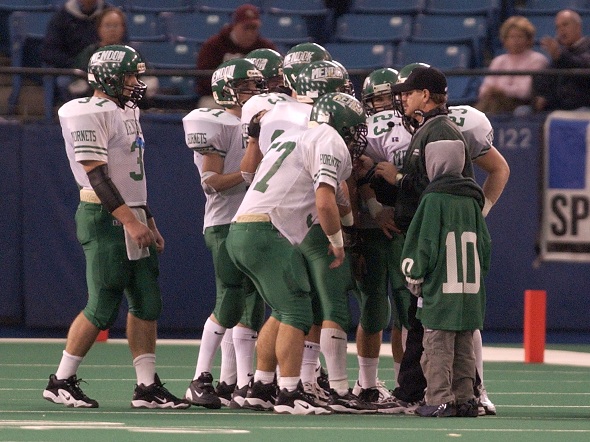
PHOTO: Mendon coach John Schwartz talks things over with his players during the Hornets' 21-14 win over Decatur in the 2002 Division 7 Final at the Pontiac Silverdome.
Longtime Leader Brodie Still Giving Back
February 10, 2016
By Chip Mundy
Special for Second Half
Joe Brodie played basketball for legendary River Rouge coach Loften Greene in the 1940s, he coached Olympic Trials swimmer Ray Martin in the 1950s and coached University of Michigan quarterback Dennis Brown in the 1960s.
 Brodie was the third winner of the MHSAA’s prestigious Vern Norris Award in 1994 for his service as an official.
So it should come as no surprise that Brodie, 87, is enjoying his retirement in Flat Rock with his wife of 62 years, Margo, their son and daughter and eight grandchildren.
There is, however, an impressive twist: Brodie still has an active connection with high school sports as he occasionally serves as a referee for swimming meets in the Downriver area. Forever humble, Brodie has a simple reply to the question, “Why are you still doing that?”
“I just want to give back,” he said. “Maybe it’s in my genes, I don’t know. Maybe it’s my heredity. I think it’s like playing cards; you have to go with the cards you’re dealt with. I still work out about three days a week.”
Early days
Greene built one of the greatest dynasties in the history of Michigan high school basketball. He coached 41 seasons and won 12 MHSAA Finals championships, including five in a row from 1961-65 and four in a row from 1969-72. Brodie, who also played football and ran track in high school, played on Greene’s third team in 1945-46.
Maybe sensing his calling as a coach, Brodie also helped the program by starting a summer league for younger players.
“There was a park that had an asphalt court, and when he won his first state championship team, those were kids I started in seventh grade dribbling around in circles,” Brodie said, “and the eighth-grader on that team was Blanche Martin, who played football at Michigan State. DeWayne Smith was on the team, too, and he ended up succeeding Greene as the coach.”
After graduating from River Rouge, Brodie went into the service and ended up in Japan. When he returned, Brodie enrolled at Michigan State Normal College (now Eastern Michigan University), where he played football for three years and basketball for two.
It was while at Michigan State Normal that Brodie became certified in Red Cross life-saving, and that not only led to a job at Torch Lake near Traverse City but paved the way for his involvement with swimming.
Brodie’s first job came as head basketball, head baseball and assistant football coach at Sebewaing High School in 1952. He wore many hats at Sebewaing.
“I made $2,800 and taught seventh-grade geography and eighth-grade science, two ninth-grade biology classes, a study hall and a phys ed class,” he said. “I didn’t get anything extra for coaching, but I met my honey up there. I fell in love and married her and came back downstate. It was instant love.”
In 1953, Lincoln Park High School hired Brodie as a physical education teacher and assistant coach in football, basketball and baseball. Lincoln Park had no idea what it was getting. In 1955, the athletic director asked Brodie to coach the swimming team because of his background with life-saving.
Within a couple of years, Lincoln Park had its first conference championship in swimming, so the athletic director then asked Brodie to take over the struggling basketball program, which had never won a conference championship.
Brodie led Lincoln Park to back-to-back conference championships and an appearance in the MHSAA Quarterfinals in 1961. No Lincoln Park boys basketball team has made it back to the Quarterfinals since that year.
On to administration
After 13 years at Lincoln Park, Brodie accepted a job as athletic director at Southgate High School. Eventually, the position also included duties at Schafer High School, which is closed.
 “It was strictly an administrative job, and that got me out of coaching,” Brodie said. “That’s when I had the time to do a little bit of officiating.”
Brodie, who had first registered as an MHSAA official for 1955-56, joined a football officiating crew that went on to work an MHSAA championship game, served on the MHSAA Representative Council from 1978-80 and 1981-83, and officiated swimming meets. And he was never afraid to let his voice be heard.
“Our crew was headed to Jackson to do a playoff game, and the athletic director there was my good friend Dennis Kiley,” Brodie said. “The guys on the crew were getting up there in age, and the game was getting tougher to do. They were going to pay four of us, but I wanted to have an extra official so we could cover the deep passes and said we would still take the pay for four and just split it among the five of us.
“They told us no, but we did it anyway. I was the umpire that night, and I was the deepest umpire you ever saw in high school football. Nobody said anything about it.”
Kiley chuckled at the mention of Brodie.
“Joe was one heck of an athlete; football, basketball, you name it,” Kiley said. “He is a heck of a good guy and was a very good official. He was excellent. I would have hired him anytime.”
Not one to take time off, Brodie found odd jobs in the summer to pick up a little extra cash.
“I’ve worked every summer doing all sorts of things,” he said. “I’ve jumped off milk trucks, things like that.”
No job was too big or too small for Brodie, whose next move was to Davison Middle School in Southgate, where he was principal when he retired in 1986 – 30 years ago.
He didn’t slow down much in retirement.
Every winter for 25 years, Brodie and his wife would go to Arizona, and he could not resist getting involved with athletics. He worked track meets, doing high school and AAU meets. He once was named the official of the year in Arizona and also had a chance to work the Pac-10 conference meet at Arizona State University.
“Here’s a little kid from River Rouge, and I’m lining up guys from Washington, Washington State, USC and Arizona. I felt so humbled being a starter. Where else other than this country can this happen?”
Legacy lives on
Brodie concedes he is slowing down at 87, but slowing down at 87 is a good thing. He and his wife no longer go to Arizona for the winter, so that has opened the door to do a few boys swimming meets in addition to girls meets he often works in the fall.
“I’m not going out and campaigning to referee,” he said. “This year I took the Riverview boys schedule, about four or five meets, and took six to eight middle-school meets – you can’t get officials for middle-school meets – and I had a couple of girls meets that I did.
“I just fill in for people, that’s what I do. I’m not going out and hustling, but I think I’m still sharp enough to do the job.”
 Brodie’s legacy lives on, not only in the continued work he is doing but in his son and daughter. Brodie’s son, Bob, has been the head basketball coach at Salem for 26 years and is in the Michigan High School Coaches Association Hall of Fame. He also has been an MHSAA registered official for 39 years in five sports.
Brodie’s daughter, Jann Stahr, is an MHSAA official in competitive cheer and swimming.
“They are why we don’t go to Arizona anymore,” Brodie said. “Both kids live in Flat Rock. My daughter is about seven houses away, and my son lives about three blocks away.”
The Brodie legacy has more meat to it. In addition to the Norris Award, Brodie is in the Michigan High School Coaches Association Hall of Fame, the Eastern Michigan University Hall of Fame and the Lincoln Park Hall of Fame, which has his bust on display at the Sportsmen’s Den in Riverview.
“I hate saying, ‘I did this,’ or ‘I did that,’” he said. “It’s never been about me. All I ever wanted to do was give back.”
Mission accomplished.
 Chip Mundy served as sports editor at the Brooklyn Exponent and Albion Recorder from 1980-86, and then as a reporter and later copy editor at the Jackson Citizen-Patriot from 1986-2011. He also co-authored Michigan Sports Trivia. E-mail him at [email protected] with story ideas for Jackson, Washtenaw, Hillsdale, Lenawee and Monroe counties.
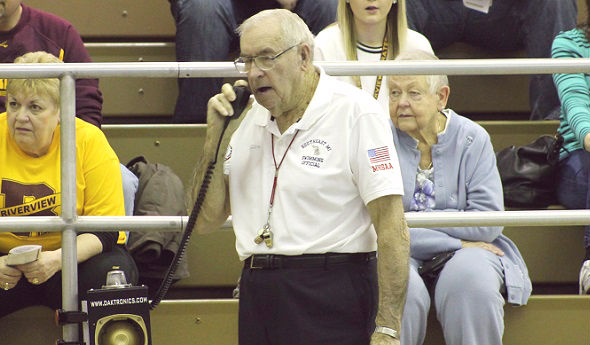
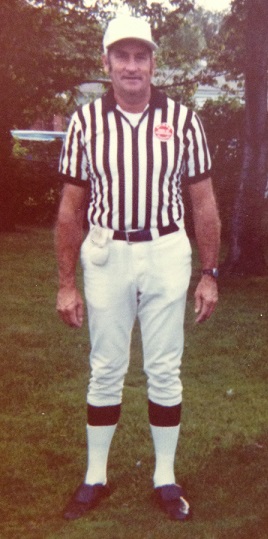
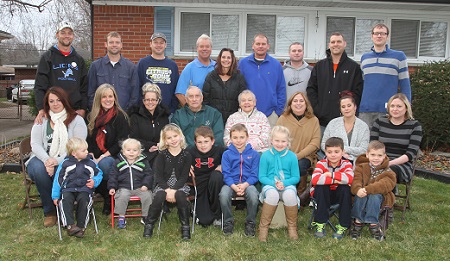
PHOTOS: (Top) Flat Rock's Joe Brodie officiates a swimming and diving meet Tuesday at Riverview. (Middle) Brodie, an official for 61 years, dresses for a football game during the 1970s. (Below) Brodie with the "Brodie Bunch," his family, which includes current officials, coaches, athletes and past coaches. (Photos courtesy of the Brodie/Stahr family.)