


MHSA(Q&)A: Mendon football coach John Schwartz
February 2, 2012
 John Schwartz didn’t really want the Mendon football head coaching job when a group of players convinced him to take it before the 1989 season. And his first contract started out on a napkin. The rest is history.
Mendon won its 11th MHSAA football championship this fall, downing Fowler 33-0 in the Division 8 Final, to tie for third-most football titles won by one program. Schwartz has coached in the program for all 11, including 10 as head coach, and his record of 236-39 gives him a winning percentage of .858, tops in the MHSAA record book. He recently was selected as this year’s recipient of the high school Duffy Daugherty Award, annually given for career contributions to the game. He follows recent winners Ralph Munger of Rockford and Herb Brogan of Jackson Lumen Christi.
His Mendon teams have had just one losing season. And although he retired a year ago after 36 teaching middle school science, and then fought off cancer over the summer, he has no plans to leave his post on the Hornets’ sideline.
How would you characterize your program?
I think we have very good coaches and I think the kids respect the coaches, and they know the coaches think more of them than just being football players. They care about them. We have their attention, and what we really try to do is form a team concept as soon as we can. We try to stay away from giving any one person too much recognition. We don't give out MVP awards at the end of the year. It's a program where we're all in it together: coaches, kids and community. We try to get the best out of the kids, give the kids the best shot we have at being the best we can be.
How does a small school continue to reload every season?
My first year there, the first thing I did as a head coach was I started the junior high program. I think that's where everything starts. We even have the younger kids called the rocket kids, and those coaches come in and talk about (football) terms so when kids move from one level to another there's no re-teaching. Everyone has an ego, coaches have egos, and they like to do some things differently. But we don't have that. They do what we do. We give them a lot of flexibility, but we have certain drills we want to run. By the time we get them, these kids are in tune with what we are doing. The summer program also is something I started my first year as head coach too. ... It means that during the season we can concentrate more on teaching than conditioning.
You went from 3-6 in 2006 to 12-0 in 2007. Explain how you bounced back.
The losing season we had, we didn't have a lot of kids, and our two best kids were hurt early in the season and couldn't play. We never did bounce back. Even in that season, we were ahead at halftime in all but one game. We just didn't have enough to come back and pull the game out, and we had some very tough games. It wasn't a good season, but I thought those kids played awfully hard for what we had. We got a lot of experience, and it paid off the following year.
Our JVs practice with the varsity. When I work with inside linebackers, I work with (grades) 9-12. Kids learn quicker from kids than from coaches, as far as I'm concerned. ... Football's really changed. It's become a lot more complex. I think we have to delegate more and more every year so we can stay with the changes. It's too much for one person. I remember my first three, four or five years it was just three of us at the varsity level. The other two, neither one taught at the school. We were pretty successful right off the bat, and we started getting more and more interest from people. Now 9-12 we have seven coaches, and we have three at the junior high, and all the coaches but two have played for me. They know what I expect, what I'm looking for, what I want. ... And they want to win. I'd be lost without those guys.
Are there certain seasons that have meant more than others?
The first year I took the job, in 1989, we went undefeated and won a state title. A lot of those kids are very good friends of mine yet, and they're pretty special to me. They were a big boost to my program. In the '95 year, my son was a sophomore on that state title team. I remember a lot about that team.
They all have something they did very well. They either threw the ball well or played great defense or had a big line. When I hear a year now, I think about those teams.
You grew up in a small town (Colon) and have taught and coached in a small town. Was that important for you to do?
I've never taught anywhere else. I never felt I really had a reason to leave. I've gone through at least six superintendents since I've been there. The fourth or fifth said to me, "The only thing that bothers me about Mendon is these people think an awful lot of winning. There are other things." He asked me, "How do you feel about it?" I said, if they didn't feel that way, I wouldn't be here.
Who was your biggest coaching influence?
I would say Morley (Fraser, Jr., under whom Schwartz was an assistant for three seasons). Years before I got there, Mendon was pretty good in the early 70s, and then in the mid 70s football wasn't very good. I was the JV coach the first year, and the second year after two games they brought me up to varsity. The best thing I did was I told them I would not take the head job, but I'll assist. I knew (Fraser) was the kind of person and personality we needed there. It wasn't necessarily all of his football knowledge, but his energy and excitement that he brought to the game.
You said during the Finals postgame press conference that you'd battled cancer during the summer. How did you come back, and did you ever think that might be time to step down?
Everything's fine. I had coaches that took over. At the same time that that happened, I was retiring. If you retire in Michigan, you can't be at the school for one month. So I couldn't be at summer weights all the way through June. So my coaches did all the summer weights. But I had no intention of stepping down. If something (bad) came down ... but once they said they got it, everything went as normal.
After a championship season, how do you ramp things back up for the next fall and a new group of players?
When we go to the playoffs, we take all the JVs unless there are couple who don't want to go. They experience that and get an extra five weeks of practice if we win a state title. And they're excited about it. They want to do that. They’ve' tasted it, and they want a part of that the next year. We remind them it's not what you did, it's what can you do for me now. ... This is your year.
We talk about winning state championships from day one. A lot of people say we shouldn't do that, but why not? Isn't that the ultimate goal? I can't imagine telling a team we think we could be 7-2 this year. We expect to be 9-0 every year. Of course, that's not going to happen. But at same time, I think the losses make you better the following week. We've won state titles where we haven't won the league title. ... You get better.
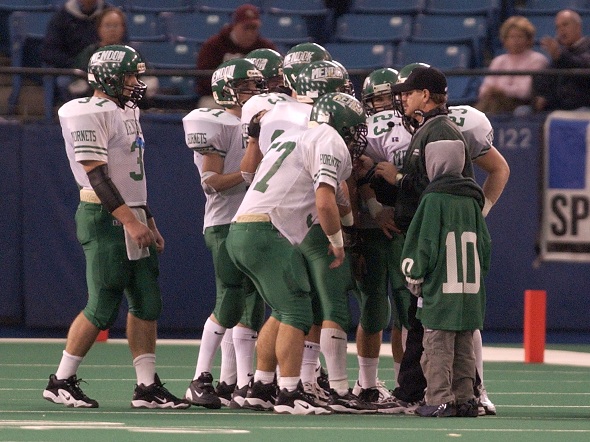
PHOTO: Mendon coach John Schwartz talks things over with his players during the Hornets' 21-14 win over Decatur in the 2002 Division 7 Final at the Pontiac Silverdome.
St. Mary's Repeats in St. Mary's Fashion
November 28, 2015
By Bill Khan
Special for Second Half
DETROIT — Glamorous moments come rarely for wide receivers in Orchard Lake St. Mary's offense.
 To play receiver for the Eaglets requires patience, a selfless attitude and a player who doesn't mind doing the little things that only get noticed within the inner circle of the team.
Junior K.J. Hamler would be the primary weapon in many offenses, but he knows his role with St. Mary’s — make the blocks that keep the chains moving for a pound-and-ground attack.
When his number is called, he needs to make the most of it — and he usually does.
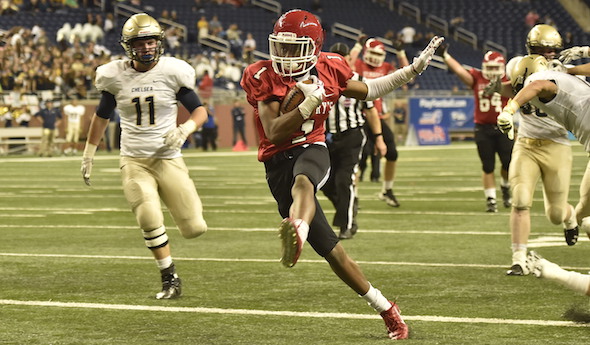
Hamler caught four passes for 63 yards and two touchdowns, as the Eaglets repeated as MHSAA Division 3 champions with a 29-12 victory over Chelsea on Saturday at Ford Field.
He hauled in a 34-yard pass from Brendan Tabone on a go route to give St. Mary's a 15-0 lead with 4:09 left in the first quarter. Hamler’s 16-yard catch-and-run of a screen pass from Tabone made it a 22-6 game with 7:31 to go in the third quarter.
"I'm always prepared for anything," Hamler said. "I know we're a running powerhouse team. I've just got to prepare to block better. As soon as coach (George) Porritt gives our team a chance to pass the ball, I try my best."
A year ago, Hamler didn't have a catch in the championship game. Tabone had a minimal role as a passer, going 3 for 11 for 31 yards in a 7-0 victory over Muskegon.
St. Mary's ran the ball on its first 15 plays of this game before Tabone got the green light to go deep to Hamler. The Eaglets ran eight more plays before the next pass was called. They finished with 293 rushing yards on 56 carries, while Tabone went 5 for 9 passing for 79 yards, two touchdowns and an interception.
"I look forward to every pass play, because we don't throw a ton," Tabone said. "We have such great backs. It was really special to be able to have an impact on the game; I'll remember it forever."
Tabone said Hamler has the right mental framework to play wide receiver in St. Mary's offense.
"K.J.'s such a great guy," he said. "He's selfless. Whenever his number gets called, our eyes light up and we do our best to make a big play when we can."
The flashes of brilliance in the passing game added to a championship performance that was typical for St. Mary's — grind down the opponent with the running game and stifle it with defense.
Justin Myrick had 108 yards and two touchdowns on 20 carries, Troy Marks had 105 yards on 17 carries, Rashawn Allen had 55 yards on 13 carries, and Ryan Johnson had 22 yards on three carries to lead the balanced ground game.
"We have depth in our running backs, so if somebody gets hurt we can put in somebody else," said Myrick, who missed the Semifinal victory over East Grand Rapids with an injured hamstring.
Brandon Adams, who ran for the only touchdown in last year's championship victory, missed the game because of an injury sustained on his only carry in the Semifinal.
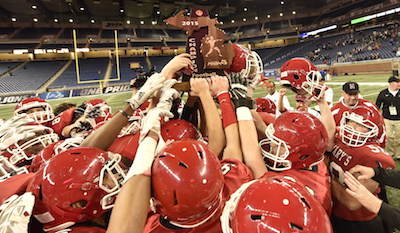 The Eaglets repeated as MHSAA champions for only the second time in 13 Finals appearances. They won back-to-back titles in 1999 and 2000, missing out on their three-peat bid in a 14-7 loss to Chesaning in 2001.
"At the beginning of the season, we were ranked No. 1 and all that good stuff," said junior linebacker Josh Ross, who had six tackles and an interception. "It was a lot of pressure. We had to come through it. We suffered a bad loss (31-8 to Warren DeLaSalle), which made us bond together as brothers. We came through all that adversity and won the state championship. I couldn't be prouder of our team."
It looked like St. Mary's might run away with it early. The Eaglets were leading 15-0 when they elected to go for a 33-yard field goal on fourth-and-inches from Chelsea's 17-yard line on their third possession. John Kwiecinski missed for only the second time in 10 field goal tries this season, opening the door for the Bulldogs (12-2) to get back in the game.
It took them only four plays to get into the end zone, as Graham Kuras took a reverse and heaved a 47-yard touchdown pass to Noah vanReesema with 8:22 left in the second quarter. Ralph Holley blocked the extra point, leaving the score at 15-6.
"That's our go-to trick play," Kuras said. "I was looking over for Noah. Usually, he's halfway across the field. This time, he wasn't. I was kind of lost on the play. I saw the safety get drawn up, so I knew he'd be open. I stepped up and threw it. I thought I overthrew it. I saw him step into second gear. That was probably one of the biggest plays in the game. Getting down 15-0 right away, we were kind of low on ourselves. Getting a score like that with the crowd behind us and boosting everyone's confidence was key to this game. Without that, it could've been much worse."
St. Mary's took that 15-6 lead into halftime, then expanded it to 22-6 on the 16-yard pass to Hamler following a shanked 11-yard punt.
Chelsea was held to only 13 yards rushing on 22 carries, but was able to do some damage through the air. A 14-yard touchdown pass from Jack Bush to Cameron Cooper with 5:07 left in the third quarter got the Bulldogs within 22-12. A 2-point pass that would've made it a one-possession margin was incomplete.
The response was a vintage St. Mary's drive, a 13-play, 80-yard march made up entirely of running plays. The Eaglets took 6:13 off the clock before Myrick scored on a 3-yard run to make it 29-12 with 8:44 left in the game.
The championship was within St. Mary's grasp once the defense came up with a big goal line stand on the following Chelsea drive. The Bulldogs had first-and-goal at the 3 but ended up with a turnover on downs with 5:39 left.
Chelsea would never touch the ball again, as St. Mary's ran out the final 5:39 with a 10-play, 48-yard drive.
"That's our football," Porritt said. "That last drive was big-time for us. The last drive and the defensive stop were our M.O. for the year. The defense has come up big in some goal line situations. Our offense running clock and having long sustained drives has been our football strategy all year."
Bush was 13 for 21 for 145 yards, one touchdown and one interception. He was sacked four times.
While St. Mary's is a regular visitor to the championship game, it was the first time Chelsea made it this far.
"As sad as it is to be over, I wouldn't want to end it anywhere else with any other guys or any other team," Kuras said. "It was the experience of a lifetime."
The MHSAA Football Finals are sponsored by the Michigan National Guard.
PHOTOS: (Top) K.J. Hamler beats the Chelsea defense for one of his two touchdowns Saturday. (Middle) The Eaglets celebrate their second straight Division 3 championship.