


MHSA(Q&)A: Mendon football coach John Schwartz
February 2, 2012
 John Schwartz didn’t really want the Mendon football head coaching job when a group of players convinced him to take it before the 1989 season. And his first contract started out on a napkin. The rest is history.
Mendon won its 11th MHSAA football championship this fall, downing Fowler 33-0 in the Division 8 Final, to tie for third-most football titles won by one program. Schwartz has coached in the program for all 11, including 10 as head coach, and his record of 236-39 gives him a winning percentage of .858, tops in the MHSAA record book. He recently was selected as this year’s recipient of the high school Duffy Daugherty Award, annually given for career contributions to the game. He follows recent winners Ralph Munger of Rockford and Herb Brogan of Jackson Lumen Christi.
His Mendon teams have had just one losing season. And although he retired a year ago after 36 teaching middle school science, and then fought off cancer over the summer, he has no plans to leave his post on the Hornets’ sideline.
How would you characterize your program?
I think we have very good coaches and I think the kids respect the coaches, and they know the coaches think more of them than just being football players. They care about them. We have their attention, and what we really try to do is form a team concept as soon as we can. We try to stay away from giving any one person too much recognition. We don't give out MVP awards at the end of the year. It's a program where we're all in it together: coaches, kids and community. We try to get the best out of the kids, give the kids the best shot we have at being the best we can be.
How does a small school continue to reload every season?
My first year there, the first thing I did as a head coach was I started the junior high program. I think that's where everything starts. We even have the younger kids called the rocket kids, and those coaches come in and talk about (football) terms so when kids move from one level to another there's no re-teaching. Everyone has an ego, coaches have egos, and they like to do some things differently. But we don't have that. They do what we do. We give them a lot of flexibility, but we have certain drills we want to run. By the time we get them, these kids are in tune with what we are doing. The summer program also is something I started my first year as head coach too. ... It means that during the season we can concentrate more on teaching than conditioning.
You went from 3-6 in 2006 to 12-0 in 2007. Explain how you bounced back.
The losing season we had, we didn't have a lot of kids, and our two best kids were hurt early in the season and couldn't play. We never did bounce back. Even in that season, we were ahead at halftime in all but one game. We just didn't have enough to come back and pull the game out, and we had some very tough games. It wasn't a good season, but I thought those kids played awfully hard for what we had. We got a lot of experience, and it paid off the following year.
Our JVs practice with the varsity. When I work with inside linebackers, I work with (grades) 9-12. Kids learn quicker from kids than from coaches, as far as I'm concerned. ... Football's really changed. It's become a lot more complex. I think we have to delegate more and more every year so we can stay with the changes. It's too much for one person. I remember my first three, four or five years it was just three of us at the varsity level. The other two, neither one taught at the school. We were pretty successful right off the bat, and we started getting more and more interest from people. Now 9-12 we have seven coaches, and we have three at the junior high, and all the coaches but two have played for me. They know what I expect, what I'm looking for, what I want. ... And they want to win. I'd be lost without those guys.
Are there certain seasons that have meant more than others?
The first year I took the job, in 1989, we went undefeated and won a state title. A lot of those kids are very good friends of mine yet, and they're pretty special to me. They were a big boost to my program. In the '95 year, my son was a sophomore on that state title team. I remember a lot about that team.
They all have something they did very well. They either threw the ball well or played great defense or had a big line. When I hear a year now, I think about those teams.
You grew up in a small town (Colon) and have taught and coached in a small town. Was that important for you to do?
I've never taught anywhere else. I never felt I really had a reason to leave. I've gone through at least six superintendents since I've been there. The fourth or fifth said to me, "The only thing that bothers me about Mendon is these people think an awful lot of winning. There are other things." He asked me, "How do you feel about it?" I said, if they didn't feel that way, I wouldn't be here.
Who was your biggest coaching influence?
I would say Morley (Fraser, Jr., under whom Schwartz was an assistant for three seasons). Years before I got there, Mendon was pretty good in the early 70s, and then in the mid 70s football wasn't very good. I was the JV coach the first year, and the second year after two games they brought me up to varsity. The best thing I did was I told them I would not take the head job, but I'll assist. I knew (Fraser) was the kind of person and personality we needed there. It wasn't necessarily all of his football knowledge, but his energy and excitement that he brought to the game.
You said during the Finals postgame press conference that you'd battled cancer during the summer. How did you come back, and did you ever think that might be time to step down?
Everything's fine. I had coaches that took over. At the same time that that happened, I was retiring. If you retire in Michigan, you can't be at the school for one month. So I couldn't be at summer weights all the way through June. So my coaches did all the summer weights. But I had no intention of stepping down. If something (bad) came down ... but once they said they got it, everything went as normal.
After a championship season, how do you ramp things back up for the next fall and a new group of players?
When we go to the playoffs, we take all the JVs unless there are couple who don't want to go. They experience that and get an extra five weeks of practice if we win a state title. And they're excited about it. They want to do that. They’ve' tasted it, and they want a part of that the next year. We remind them it's not what you did, it's what can you do for me now. ... This is your year.
We talk about winning state championships from day one. A lot of people say we shouldn't do that, but why not? Isn't that the ultimate goal? I can't imagine telling a team we think we could be 7-2 this year. We expect to be 9-0 every year. Of course, that's not going to happen. But at same time, I think the losses make you better the following week. We've won state titles where we haven't won the league title. ... You get better.
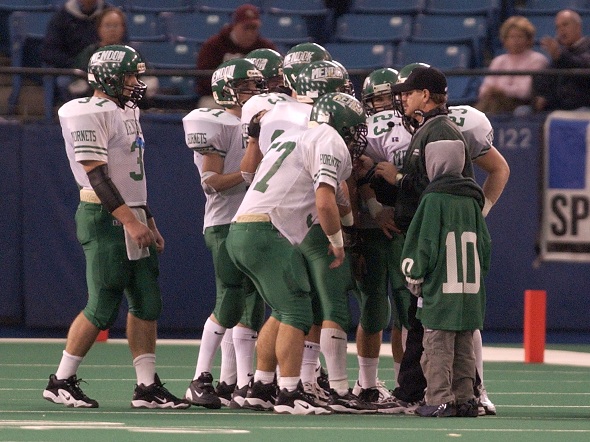
PHOTO: Mendon coach John Schwartz talks things over with his players during the Hornets' 21-14 win over Decatur in the 2002 Division 7 Final at the Pontiac Silverdome.
1st & Goal: Week 9 in Review
October 26, 2020
By Geoff Kimmerly
Second Half editor
Whether it’s 6-0, 0-6, or somewhere in between, your local football team deserves our admiration for a job well done this fall.
We started late, after not knowing if we’d play at all, and amid a once-in-a-lifetime pandemic. And regardless of the wins and losses on the field, every team contributed to a figure worth celebrating – every week of this abbreviated regular season, at least 96 percent of varsity teams were cleared to play, a credit to the work done by players, coaches, administrators and families statewide to ensure that continued opportunity.
Of course, there were other memorable numbers established this weekend on the field – perhaps none more incredible than Bridgman’s record 47-point comeback highlighted in our 8-player review.
Bay & Thumb
HEADLINER Midland 32, Midland Dow 6 The Chemics (6-0) nearly reversed last season’s 42-7 loss to Dow, in doing so clinching an outright Saginaw Valley League Blue title and their first perfect regular season since 2012. Midland held the Chargers (4-2) scoreless until the fourth quarter. With wins by both this week, they would meet again in a Division 2 District Semifinal. Click for more from the Midland Daily News and see highlights below from WJRT.
Midland wins the SVL North outright title with a 32-6 win over Midland Dow.@GoDowChargers @midlandchemics @midland_high https://t.co/4hGOYpb2hR
— ABC12WJRT (@ABC12WJRT) October 24, 2020
Watch list Grand Blanc 14, Saline 13 The Bobcats (5-1) finished runners-up in the SVL Red, but added to their intriguing playoff potential by handing Saline (5-1) its first loss.
Remember this one Davison 37, Lapeer 6 The Cardinals’ first regular-season win over Lapeer (3-3) since 2017 sealed the SVL Red championship. Davison (6-0) hosts Lapeer this week in Division 1 and has beaten the Lightning in the playoffs two of the last three seasons.
More shoutouts Fenton 33, Ortonville Brandon 21 The Tigers (6-0) remain undefeated after handing Brandon (5-1) its first defeat in this matchup of Flint Metro League divisional champions. Imlay City 28, Almont 14 The Spartans (4-2) defeated the reigning Division 5 runner-up Pirates (2-2) for the first time since 2008 and after losing 56-7 a year ago.
Greater Detroit
HEADLINER Macomb Dakota 42, Traverse City Central 16 The Cougars (5-1) are surging heading into the Division 1 playoffs, adding this win over Big North Conference champion Central to its shared Macomb Area Conference Red title. Dakota scored its season high and held the Trojans (5-1) to 36 points below their season average. Click for more from MLive-Detroit and see highlights below from State Champs Sports Network.
VIDEO: Check out the highlights of the Macomb Dakota (@DakotaFootball) vs. Traverse City Central football game from Friday night. @Djstepney3 @Dakota_Cougars#StateChamps X @LTUAthletics
For more information on Lawrence Tech Athletics. Go to https://t.co/Btu7FxQthw pic.twitter.com/5a5fQAV4VX— STATE CHAMPS! Michigan (@statechampsmich) October 24, 2020
Watch list Bloomfield Hills Brother Rice 23, Detroit Country Day 13 The Warriors (5-1) are on a roll heading into the Division 3 playoffs after handing Country Day (3-2) its first on-field loss of the fall.
Remember this one New Boston Huron 34, Dearborn Heights Crestwood 0 After tying for second in the Huron League, the Chiefs (5-1) are rolling into the Division 3 bracket as well after handing Western Wayne Athletic Conference champion Crestwood (5-1) its first defeat.
More shoutouts Rochester Hills Stoney Creek 40, Birmingham Groves 14 The Cougars (6-0) capped their first undefeated regular season by clinching the outright Oakland Activities Association White title against annual contender Groves (3-3). Detroit Catholic Central 45, Detroit Loyola 14 The Shamrocks (6-0) added the Prep Bowl Bishop championship to their Catholic League Central title, handing AA champ Loyola (5-1) its first loss.
Mid-Michigan
HEADLINER Mason 40, Williamston 10 The Capital Area Activities Conference Red title came down to these two undefeated teams, and more specifically to Mason’s offense vs. Williamston’s defense. The Bulldogs (6-0) prevailed to repeat as champs, scoring nearly half of the points Williamston has given up all season while also holding the Hornets (5-1) to their season low. Click for more from the Lansing State Journal and see highlights below from WLNS.
Mason (@MasonFootball2) achieved history tonight thanks to its 40-10 win over Williamston. The Bulldogs captured their second straight league title for the first time in the program's history.
WATCH: Highlights and reaction from the 5th Quarter! ??https://t.co/KxYdbq3dak— Audrey Dahlgren (@AudreyDahlgren) October 24, 2020
Watch list Lansing Catholic 28, Pewamo-Westphalia 13 The Cougars (4-2) haven’t grabbed as much attention as usual this season, but consider their losses were to teams that are a combined 11-1 – and that they are headed to the playoffs having ended P-W’s 19-game winning streak.
Remember this one Clare 26, Sanford Meridian 20 The Pioneers’ only single-digit regular-season game decided the Jack Pine Conference title, as Clare (6-0) earned it outright and denied Meridian (4-2) a chance to share.
More shoutouts DeWitt 43, Stevensville Lakeshore 6 The Panthers (5-0) have been on a tear from the start, holding five opponents to six or fewer points and putting up 43 against a Lakeshore defense that was giving up only 10 per game. Olivet 61, Stockbridge 12 The Eagles (5-1) bounced back from their lone defeat to close out their fourth-straight Greater Lansing Activities Conference title.
Northern Lower Peninsula
HEADLINER Charlevoix 19, Maple City Glen Lake 8 Playing the Lakers (4-2) for the Northern Michigan Football Conference Leaders championship for the second year in a row, the Red Rayders claimed their first league title in football since 2000. The win also gave Charlevoix (6-0) its first perfect regular season since 1977, according to Michigan-football.com. Click for more from the Petoskey News-Review and see highlights below from MI Sports Now.
Charlevoix recorded its first undefeated regular season since 1977 and won its first conference championship since 2000 with a 19-8 victory over Glen Lake in our Sports Overtime Game of the Week on Friday.https://t.co/cqjUwHJzip pic.twitter.com/eHtBBPgvw1
— MISportsNow (@MISportsNow) October 24, 2020
Watch list Johannesburg-Lewiston 60, Harbor Springs 29 The Cardinals (6-0) locked up their third-straight NMFC Legacy title and second-straight undefeated regular season by doubling up second-place Harbor Springs (3-3).
Remember this one Oscoda 24, Houghton Lake 6 The Owls (6-0) faced their toughest challenge this fall and answered it well, giving up their first points of the season but still holding Houghton Lake (4-2) to nearly 30 below their average.
More shoutouts Kingsley 36, Benzie Central 20 The Stags (6-0) closed out a second-straight NMFC Legends championship with their 20th-straight regular-season victory. Traverse City St. Francis 21, Jackson Lumen Christi 20 While reigning Division 7 runner-up Lumen (2-4) has had a tough run, this could end up a telling result as both head into the same division again and with St. Francis (4-2) a second seed while pursuing a seventh-straight District title.
Southeast & Border
HEADLINER Addison 56, Grass Lake 22 The Panthers (6-0) finished a second-straight perfect run through their Cascades Conference schedule and first undefeated regular season since 2006 while keeping Grass Lake (4-2) from earning a share of the championship. Addison has won three of its last four against the Warriors. Click for more from the Adrian Daily Telegram.
Watch list Chelsea 26, Monroe 17 The Bulldogs (6-0) finished a second-straight undefeated regular season with Monroe (4-2) their fifth opponent that finished .500 or better this fall.
Remember this one Clinton 21, Hillsdale 14 The Lenawee County Athletic Association title went to Blissfield, but Clinton (5-1) in its first season in the league won this matchup for second place, with the Hornets (4-2) ending in third.
More shoutouts Erie Mason 56, Pittsford 0 The Eagles (6-0) finished their first perfect regular season since 2003, and after last winning more than two games in a season in 2005. Monroe St. Mary Catholic Central 49, Detroit Southeastern 34 The Falcons (4-2) earned their most impressive win, handing Detroit Public School League 4 champion Southeastern (5-1) its only defeat.
Southwest Corridor
HEADLINER Buchanan 20, Niles Brandywine 6 The list of accomplishments is growing for the Bucks (6-0) – they won the Berrien-Cass-St. Joseph Conference title outright, with their first perfect regular season since 2015, and after winning a combined five games over the last three seasons. Brandywine (3-3) had won the last three meetings between these teams, and two straight league titles. Click for more from the Niles Daily Star.
Watch list Constantine 70, Coloma 32 The Falcons (5-1) finished a perfect run through the Southwestern Athletic Conference Lakeshore and earned the second seed in their Division 6 District opposite Buchanan.
Remember this one St. Joseph 22, Battle Creek Lakeview 14 There wasn’t a Southwestern Michigan Athletic Conference title on the line this time, but there very well could be next time and St. Joseph (5-1) will enter that game with two wins in its last three matchups with Lakeview (4-2).
More shoutouts Edwardsburg 60, Paw Paw 6 The Eddies (6-0) completed their third-consecutive undefeated regular season and will be the top seed in their Division 4 District with Paw Paw (4-2) the third. Lawton 19, Saugatuck 2 The Blue Devils locked up second place in the SAC Valley and the second seed in a Division 7 District where they could face league champ Schoolcraft in two weeks.
Upper Peninsula
HEADLINER Marquette 28, Calumet 6 Arguably the most impressive part of Marquette’s performance this fall has been its defense, which is giving up 13 points per game – a full seven points fewer than last year. Calumet (2-3) hadn’t been held to single digits since the 2018 playoffs, but Marquette (5-1) has held its last two opponents to six points apiece. Click for more from the Upbeat.
Watch list Bark River-Harris 28, L’Anse 0 After an 0-2 start, Bark River-Harris (3-2) won its final three regular-season games and hasn’t given up a point in its last two.
Remember this one Escanaba 20, Gladstone 12 The Eskymos (1-2) bounced back from their first on-field loss with a 10th-straight win over Gladstone (2-3), enough to earn the fifth seed in their Division 4 District.
More shoutouts West Iron County 36, St. Ignace 22 The Wykons (6-0) capped their first perfect regular season since 2013 with their best offensive output of this fall. Sault Ste. Marie 60, Cheboygan 0 The Blue Devils (4-2) secured second place in the NMFC Legends.
West Michigan
HEADLINER Grand Rapids Catholic Central 28, Grand Rapids South Christian 27 (OT) This was just about all that could be hoped for from a matchup of undefeated teams playing for a league championship. At the end, GRCC (6-0) had clinched its sixth-straight league title, back in the Ottawa-Kent Conference Gold, after winning outright or sharing the Blue championship the last four seasons. Click for more from WOOD TV.
VIDEO: Check out the highlights of the Grand Rapids Catholic Central (@grcccougars) at South Christian football game from Friday night. Courtesy: WXMI-TV#StateChamps X @hungryhowies pic.twitter.com/9F12lcC68A
— STATE CHAMPS! Michigan (@statechampsmich) October 24, 2020
Watch list Muskegon Mona Shores 35, Detroit Martin Luther King 21 This rematch of last season’s Division 2 Final ended with nearly the same score, great news for the reigning champion Sailors (3-3) and not necessarily bad for King (3-3) as it plays in Division 3 this time.
Remember this one Rockford 28, Grandville 8 The Rams (4-0) missed two weeks but came back in time to finish without a loss in the O-K Red while handing Grandville (5-1) its lone league defeat.
More shoutouts Hudsonville Unity Christian 42, Allendale 6 The Crusaders (6-0) finished a perfect run through the O-K Blue with their third single-digit defensive performance of the fall, holding Allendale (3-3) to a season-low points total. East Grand Rapids 12, Byron Center 8 The Pioneers (3-3) handed Byron Center (5-1) its only loss, allowing Forest Hills Central with its win over Lowell to share the O-K White championship with the Bulldogs.
8-Player
HEADLINER Bridgman 54, Wyoming Tri-unity Christian 53 (OT) The Bees set an MHSAA record – 8 and 11-player – for largest comeback winning this game after trailing by 47 points. With Martin having to forfeit a game to Lawrence, the Bees (5-1) joined the Clippers as one-loss teams atop the final Southwestern Michigan 8-Man Football League standings. Click for more from the St. Joseph Herald-Palladium.
Watch list Portland St. Patrick 52, Burr Oak 19 Handing Burr Oak (5-1) its only loss kept St. Patrick (6-0) undefeated and cemented the Shamrocks as the top seed in the Division 2 Playoffs.
Remember this one Morrice 58, Deckerville 30 The Orioles (6-0) also are a top seed, in Division 1, but Deckerville (4-2) is a possible Regional Semifinal opponent.
More shoutouts Mayville 48, Kinde North Huron 28 The matchup of North Central Thumb League champions went to the Stars winner as the Wildcats (6-0) handed Stripes champ North Huron its lone loss (5-1). Merrill 38, Indian River Inland Lakes 6 The Vandals (5-1) continue to look like contenders, bouncing back off a four-point loss to St. Patrick by handing Inland Lakes its only defeat.
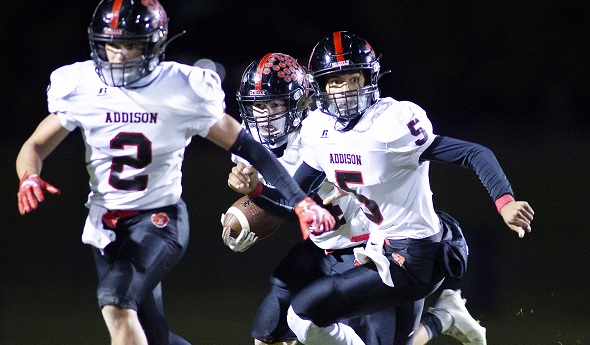
PHOTO: Addison blockers lead the way for a teammate during Friday's win over Grass Lake. (Photo by Scott Mapes.)