


MHSA(Q&)A: Mendon football coach John Schwartz
February 2, 2012
 John Schwartz didn’t really want the Mendon football head coaching job when a group of players convinced him to take it before the 1989 season. And his first contract started out on a napkin. The rest is history.
Mendon won its 11th MHSAA football championship this fall, downing Fowler 33-0 in the Division 8 Final, to tie for third-most football titles won by one program. Schwartz has coached in the program for all 11, including 10 as head coach, and his record of 236-39 gives him a winning percentage of .858, tops in the MHSAA record book. He recently was selected as this year’s recipient of the high school Duffy Daugherty Award, annually given for career contributions to the game. He follows recent winners Ralph Munger of Rockford and Herb Brogan of Jackson Lumen Christi.
His Mendon teams have had just one losing season. And although he retired a year ago after 36 teaching middle school science, and then fought off cancer over the summer, he has no plans to leave his post on the Hornets’ sideline.
How would you characterize your program?
I think we have very good coaches and I think the kids respect the coaches, and they know the coaches think more of them than just being football players. They care about them. We have their attention, and what we really try to do is form a team concept as soon as we can. We try to stay away from giving any one person too much recognition. We don't give out MVP awards at the end of the year. It's a program where we're all in it together: coaches, kids and community. We try to get the best out of the kids, give the kids the best shot we have at being the best we can be.
How does a small school continue to reload every season?
My first year there, the first thing I did as a head coach was I started the junior high program. I think that's where everything starts. We even have the younger kids called the rocket kids, and those coaches come in and talk about (football) terms so when kids move from one level to another there's no re-teaching. Everyone has an ego, coaches have egos, and they like to do some things differently. But we don't have that. They do what we do. We give them a lot of flexibility, but we have certain drills we want to run. By the time we get them, these kids are in tune with what we are doing. The summer program also is something I started my first year as head coach too. ... It means that during the season we can concentrate more on teaching than conditioning.
You went from 3-6 in 2006 to 12-0 in 2007. Explain how you bounced back.
The losing season we had, we didn't have a lot of kids, and our two best kids were hurt early in the season and couldn't play. We never did bounce back. Even in that season, we were ahead at halftime in all but one game. We just didn't have enough to come back and pull the game out, and we had some very tough games. It wasn't a good season, but I thought those kids played awfully hard for what we had. We got a lot of experience, and it paid off the following year.
Our JVs practice with the varsity. When I work with inside linebackers, I work with (grades) 9-12. Kids learn quicker from kids than from coaches, as far as I'm concerned. ... Football's really changed. It's become a lot more complex. I think we have to delegate more and more every year so we can stay with the changes. It's too much for one person. I remember my first three, four or five years it was just three of us at the varsity level. The other two, neither one taught at the school. We were pretty successful right off the bat, and we started getting more and more interest from people. Now 9-12 we have seven coaches, and we have three at the junior high, and all the coaches but two have played for me. They know what I expect, what I'm looking for, what I want. ... And they want to win. I'd be lost without those guys.
Are there certain seasons that have meant more than others?
The first year I took the job, in 1989, we went undefeated and won a state title. A lot of those kids are very good friends of mine yet, and they're pretty special to me. They were a big boost to my program. In the '95 year, my son was a sophomore on that state title team. I remember a lot about that team.
They all have something they did very well. They either threw the ball well or played great defense or had a big line. When I hear a year now, I think about those teams.
You grew up in a small town (Colon) and have taught and coached in a small town. Was that important for you to do?
I've never taught anywhere else. I never felt I really had a reason to leave. I've gone through at least six superintendents since I've been there. The fourth or fifth said to me, "The only thing that bothers me about Mendon is these people think an awful lot of winning. There are other things." He asked me, "How do you feel about it?" I said, if they didn't feel that way, I wouldn't be here.
Who was your biggest coaching influence?
I would say Morley (Fraser, Jr., under whom Schwartz was an assistant for three seasons). Years before I got there, Mendon was pretty good in the early 70s, and then in the mid 70s football wasn't very good. I was the JV coach the first year, and the second year after two games they brought me up to varsity. The best thing I did was I told them I would not take the head job, but I'll assist. I knew (Fraser) was the kind of person and personality we needed there. It wasn't necessarily all of his football knowledge, but his energy and excitement that he brought to the game.
You said during the Finals postgame press conference that you'd battled cancer during the summer. How did you come back, and did you ever think that might be time to step down?
Everything's fine. I had coaches that took over. At the same time that that happened, I was retiring. If you retire in Michigan, you can't be at the school for one month. So I couldn't be at summer weights all the way through June. So my coaches did all the summer weights. But I had no intention of stepping down. If something (bad) came down ... but once they said they got it, everything went as normal.
After a championship season, how do you ramp things back up for the next fall and a new group of players?
When we go to the playoffs, we take all the JVs unless there are couple who don't want to go. They experience that and get an extra five weeks of practice if we win a state title. And they're excited about it. They want to do that. They’ve' tasted it, and they want a part of that the next year. We remind them it's not what you did, it's what can you do for me now. ... This is your year.
We talk about winning state championships from day one. A lot of people say we shouldn't do that, but why not? Isn't that the ultimate goal? I can't imagine telling a team we think we could be 7-2 this year. We expect to be 9-0 every year. Of course, that's not going to happen. But at same time, I think the losses make you better the following week. We've won state titles where we haven't won the league title. ... You get better.
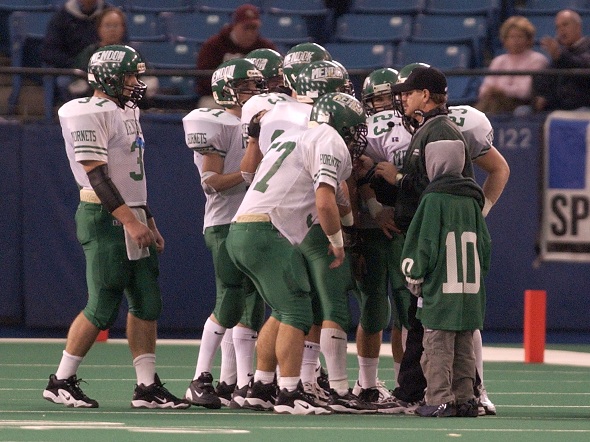
PHOTO: Mendon coach John Schwartz talks things over with his players during the Hornets' 21-14 win over Decatur in the 2002 Division 7 Final at the Pontiac Silverdome.
Drive for Detroit: 11-Player Semis Review
November 25, 2019
By Geoff Kimmerly
Special for Second Half
Buckle up. We’re headed for the home stretch.
 The final 16 contenders for this season’s MHSAA 11-player football championships were set over the weekend, and Detroit on Friday and Saturday will be the final stop to conclude another memorable season.
Below we discuss all 16 Semifinals just a bit, with more detailed previews of the championship games coming out Wednesday. We’ll also include this past weekend’s 8-Player Finals – congratulations to first-time champions Colon and Pickford! – when we wrap up our review of the MHSAA Football Finals as a whole next week.
“Drive for Detroit” is powered by MI Student Aid
Division 1
Brighton 22, Belleville 19
The Bulldogs (11-2) will play in their first MHSAA Final in football, while Belleville ended its season in the Semifinals for the second-straight year. Brighton scored with under a minute left to earn the first championship game trip, and also held Belleville (12-1) to its fewest points scored this season. Click for more from the Livingston Daily Press & Argus.
VIDEO: Check out the highlights of the Brighton (@godogs_football) vs. Belleville - Division 1 @MHSAA Football Semifinal from this afternoon. Brought to you by @hungryhowies pic.twitter.com/EBR6WSMk9Q
— STATE CHAMPS! Michigan (@statechampsnet) November 23, 2019
Davison 34, Sterling Heights Stevenson 27 (OT)
The Cardinals (11-2) also will play in their first MHSAA football championship game after outlasting Stevenson. Davison, playing its first Semifinal since 2008, trailed throughout but caught up before the end of regulation and then made a stop in overtime to finish the comeback. The Titans (8-5) had made the playoffs as an additional qualifier before reaching their first Semifinal since 2009. Click for more from the Flint Journal.
VIDEO: Check out the highlights of the Davison (@DavCardFootball) vs. Sterling Heights Stevenson - Division 1 @MHSAA Football Semifinal from this afternoon. @DavisonMade @davisonwc
Brought to you by @MHSAA pic.twitter.com/SHWMaXepTR— STATE CHAMPS! Michigan (@statechampsnet) November 24, 2019
Division 2
Muskegon Mona Shores 57, Walled Lake Western 56
The reigning Division 2 runner-up Sailors (11-2) booked their return to Ford Field with a touchdown with 17 seconds to play followed by a go-ahead 2-point conversion instead of kicking an extra point – making back-up quarterback Brady Rose one of the biggest stars of the weekend. Walled Lake Western (11-2) was playing in its fourth Semifinal this decade and tied its most points scored in a game this fall. Click for more from the Muskegon Chronicle.
VIDEO: Check out the highlights of the Mona Shores (@sailorathletics) vs. Walled Lake Western - Division 2 @MHSAA Semifinal from this afternoon. Brought to you by @MHSAA pic.twitter.com/mjhgCori9i
— STATE CHAMPS! Michigan (@statechampsnet) November 24, 2019
Detroit Martin Luther King 60, Birmingham Seaholm 17
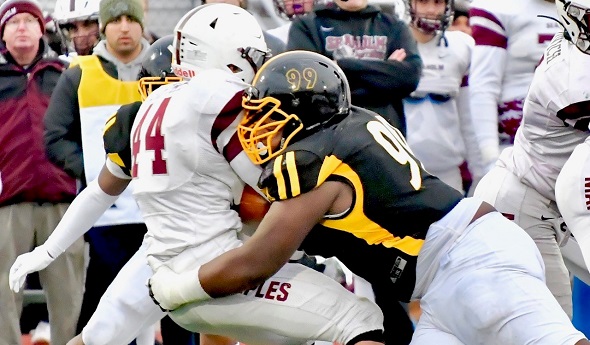
The Crusaders (11-2) will play for a second-straight MHSAA Finals championship to follow up last season’s won in Division 3. The reached 60 points for the first time since Week 5 of 2017 and held Seaholm (9-4) to nearly 20 points before its average. The Maples were playing in their first Semifinal since 1997. Click for more from MLive-Detroit.
VIDEO: Check out the highlights of the Detroit King (@DetKingFootball) vs. Seaholm - Division 2 @MHSAA Football Semifinal from this afternoon. Brought to you by @hungryhowies pic.twitter.com/6uH4H9Cp4P
— STATE CHAMPS! Michigan (@statechampsnet) November 24, 2019
Division 3
Muskegon 28, DeWitt 21
The Big Reds (13-0) outlasted DeWitt in their only playoff games decided by fewer than 38 points, and one of only two games they played decided by single digits this fall. Last season’s Division 3 runner-up, Muskegon went ahead to stay with just more than two minutes remaining and held off a final rally by the Panthers (10-3), who were playing in their fifth Semifinal this decade. Click for more from the Muskegon Chronicle.
VIDEO: Check out the highlights of the Muskegon (@OnMuskegon) vs. DeWitt - Division 3 @MHSAA Semifinal from this afternoon. @MuskCoFootball @CM240
Brought to you by @hungryhowies pic.twitter.com/hkf0kqHpQY— STATE CHAMPS! Michigan (@statechampsnet) November 24, 2019
River Rouge 14, Chelsea 7
The Panthers (12-1) likewise received their toughest challenge of the playoffs, as Chelsea gave them one of only three games decided by single digits this season. River Rouge scored both of its touchdowns during the fourth quarter after Chelsea (12-1) led for a quarter and a half. The Bulldogs were trying for their second-straight trip to the Finals after finishing Division 4 runner-up a year ago. Click for more from the Detroit News.
VIDEO: Check out the highlights of the River Rouge (@RougeFootball) vs. Chelsea - Division 3 @MHSAA Football Semifinal from this afternoon. Brought to you by @MHSAA pic.twitter.com/vn8myIIMIO
— STATE CHAMPS! Michigan (@statechampsnet) November 23, 2019
Division 4
Grand Rapids Catholic Central 56, Hudsonville Unity Christian 17
The Cougars (12-1) will play for their third Division 4 championship in four years after eliminating last season’s Division 5 title winner, Unity (9-4). It was the seventh time these teams met in the playoffs this decade, and fifth time the result went GRCC’s way. The Cougars scored their most points this season in earning the trip to Detroit. Click for more from the Grand Rapids Press.
VIDEO: Check out the highlights of the Grand Rapids Catholic Central (@GRCatholicCentr) vs. Unity Christian - Division 4 @MHSAA Semifinal from this afternoon.
Brought to you by @hungryhowies pic.twitter.com/ifsI5zUaSf— STATE CHAMPS! Michigan (@statechampsnet) November 24, 2019
Detroit Country Day 21, Flint Powers Catholic 0
Country Day (13-0) will return to Ford Field for the first time since 2016 (when it also faced GRCC) after posting its fourth shutout this season. It’s easy to marvel at the Yellowjackets’ defense, which is now giving up just 5.2 points per game. Powers (10-3) was playing in its third Semifinal this decade and capped its best run since 2015. Click for more from the Oakland Press.
VIDEO: Check out the highlights of the Detroit Country Day (@DCDSAthletics) vs. Flint Powers - Division 4 @MHSAA Football Semifinal from this afternoon. Courtesy: @MHSAA.tv
Brought to you by @MHSAA pic.twitter.com/3HrO0G1mfB— STATE CHAMPS! Michigan (@statechampsnet) November 24, 2019
Division 5
Lansing Catholic 28, Kingsley 14
The Cougars (12-1) are known for offense, but headed to Ford Field for the first time since 2014 as much thanks to a defensive effort that held Kingsley (12-1) nearly 32 points below its season average. Lansing Catholic is giving up only 13 points per game. Click for more from the Lansing State Journal.
See the video highlights from Lansing Catholic's state semifinal win: https://t.co/avSHBQ8r7e via @LSJnews
— Brian Calloway (@brian_calloway) November 24, 2019
Almont 36, Detroit Denby 8
In its third Semifinal this decade, Almont (13-0) advanced to its first football championship game also with another outstanding defensive performance. The Raiders lowered their points-given-up average to 10 with their best showing of the playoffs, halting Denby’s longest playoff run and most successful season at 10-3.
VIDEO: Check out the highlights of the @AlmontRaidersFB vs. Denby - Division 5 @MHSAA Football Semifinal from this afternoon. @AlmontAthletics
Brought to you by @hungryhowies pic.twitter.com/PLTPP73lGC— STATE CHAMPS! Michigan (@statechampsnet) November 23, 2019
Division 6
Maple City Glen Lake 31, Montague 30 (OT)
The Lakers (12-1) are headed to their second MHSAA Final in four seasons thanks to a mighty comeback against last season’s Division 6 runner-up. Glen Lake trailed by 14 with under five minutes left in regulation, but pushed the game to overtime with a touchdown pass on the last play of the fourth quarter. Montague (10-3) finished with three losses this fall by a combined 13 points. Click for more from the Traverse City Record-Eagle.
VIDEO: Check out the highlights of the Glen Lake (@GlenLakeSchools) vs. Montague - Division 6 @MHSAA Semifinal from this afternoon.
Brought to you by @hungryhowies pic.twitter.com/Anlw0EURkU— STATE CHAMPS! Michigan (@statechampsnet) November 24, 2019
Monroe St. Mary Catholic Central 17, Onsted 14
St. Mary will play in its third Final this decade and first since winning Division 6 in 2014 thanks to Wyatt Bergmoser’s 20-yard field goal on the game’s final play. The Falcons (11-1) held off an Onsted team that finished 10-3 and rallied after a 2-2 start to reach the Semifinals for the first time since 1993. The close win for SMCC came after its last two playoff runs ended in Regional Final losses by two and one point. Click for more from the Monroe News.
Onsted vs. Monroe St. Mary MHSAA Division 6 semifinal 11-23-19 | Photo Gallery https://t.co/bRwyZi3sGQ
— JTV Sports (@JTV_Sports) November 25, 2019
Division 7
Pewamo-Westphalia 43, Iron Mountain 7
Friday night at the Superior Dome at Northern Michigan University saw two undefeated teams meet and P-W (13-0) earn its fourth trip to Ford Field over the last five seasons. After giving up 35 points to reigning champ New Lothrop in a one-point win the week before, the Pirates’ defense bounced back to hold the Mountaineers (12-1) to their season low. Click for more from the Lansing State Journal.
VIDEO: Check out the highlights of the Pewamo-Westphalia (@PWGRIDIRON) vs. Iron Mountain - Division 7 @MHSAA Football Semifinal from tonight. Brought to you by @hungryhowies pic.twitter.com/5frtnZNIod
— STATE CHAMPS! Michigan (@statechampsnet) November 23, 2019
Jackson Lumen Christi 27, Cass City 0
Lumen Christi scored one point less than Cass City had given up over the last 10 weeks combined, finding enough openings against one of the state’s most accomplished defenses to reach a fourth-straight Final. The Titans (12-0) also posted their second shutout of the fall, like P-W bouncing back on that side of the ball after giving up 30 in a Regional Final. Cass City finished 11-2 in reaching the Semifinals for the first time. Click for more from the Jackson Citizen-Patriot.
VIDEO: Check out the highlights of the Lumen Christi (@Titan78378009) vs. Cass City - Division 6 @MHSAA Football Semifinal from this afternoon. Brought to you by @MHSAA pic.twitter.com/3mIv7mz4b6
— STATE CHAMPS! Michigan (@statechampsnet) November 23, 2019
Division 8
Beal City 21, Ubly 20
The Aggies (12-1) came back from an early 14-0 deficit to edge Ubly and reach the MHSAA Finals for the first time since back-to-back trips in 2012 and 2013. The Bearcats went for the win after a last-minute score, but Beal City made a stop on the conversion and again after Ubly (10-3) recovered the ensuing onside kick. Click for more from the Mount Pleasant Morning Sun.
VIDEO: Check out the highlights of the Beal City vs. Ubly - Division 8 @MHSAA Football Semifinal from this afternoon. Courtesy: @MHSAA.tv
Brought to you by @MHSAA pic.twitter.com/eotIVO5Ut6— STATE CHAMPS! Michigan (@statechampsnet) November 24, 2019
Reading 62, Fowler 18
The reigning champ has earned an opportunity to repeat, as Reading (12-1) put up 60 points for the third time this season and held the Eagles scoreless during the second half. Fowler, playing in its first Semifinal since 2011, finished with its best record since that fall at 11-2. Click for more from the Hillsdale Daily News.
VIDEO: Check out the highlights of the Reading vs. Fowler - Division 8 @MHSAA Football Semifinal from this afternoon. Courtesy: Hometown Media Network. Brought to you by @MHSAA pic.twitter.com/fImEPdoqSg
— STATE CHAMPS! Michigan (@statechampsnet) November 24, 2019
Second Half’s weekly “Drive for Detroit” previews are powered by MI Student Aid, a part of the Office of Postsecondary Financial Planning located within the Michigan Department of Treasury. MI Student Aid encourages students to pursue postsecondary education by providing access to student financial resources and information. MI Student Aid administers the state’s 529 college savings programs (MET/MESP), as well as scholarship and grant programs that help make college Accessible, Affordable and Attainable for you. Connect with MI Student Aid at www.michigan.gov/mistudentaid and find more information on Facebook and Twitter @mistudentaid.
PHOTO: Detroit King's Terence Maize (99) wraps up Birmingham Seaholm's Chaz Strecker during the Crusaders' Division 2 Semifinal win Saturday. (Photo by Terry Lyons.)