


MHSA(Q&)A: Mendon football coach John Schwartz
February 2, 2012
 John Schwartz didn’t really want the Mendon football head coaching job when a group of players convinced him to take it before the 1989 season. And his first contract started out on a napkin. The rest is history.
Mendon won its 11th MHSAA football championship this fall, downing Fowler 33-0 in the Division 8 Final, to tie for third-most football titles won by one program. Schwartz has coached in the program for all 11, including 10 as head coach, and his record of 236-39 gives him a winning percentage of .858, tops in the MHSAA record book. He recently was selected as this year’s recipient of the high school Duffy Daugherty Award, annually given for career contributions to the game. He follows recent winners Ralph Munger of Rockford and Herb Brogan of Jackson Lumen Christi.
His Mendon teams have had just one losing season. And although he retired a year ago after 36 teaching middle school science, and then fought off cancer over the summer, he has no plans to leave his post on the Hornets’ sideline.
How would you characterize your program?
I think we have very good coaches and I think the kids respect the coaches, and they know the coaches think more of them than just being football players. They care about them. We have their attention, and what we really try to do is form a team concept as soon as we can. We try to stay away from giving any one person too much recognition. We don't give out MVP awards at the end of the year. It's a program where we're all in it together: coaches, kids and community. We try to get the best out of the kids, give the kids the best shot we have at being the best we can be.
How does a small school continue to reload every season?
My first year there, the first thing I did as a head coach was I started the junior high program. I think that's where everything starts. We even have the younger kids called the rocket kids, and those coaches come in and talk about (football) terms so when kids move from one level to another there's no re-teaching. Everyone has an ego, coaches have egos, and they like to do some things differently. But we don't have that. They do what we do. We give them a lot of flexibility, but we have certain drills we want to run. By the time we get them, these kids are in tune with what we are doing. The summer program also is something I started my first year as head coach too. ... It means that during the season we can concentrate more on teaching than conditioning.
You went from 3-6 in 2006 to 12-0 in 2007. Explain how you bounced back.
The losing season we had, we didn't have a lot of kids, and our two best kids were hurt early in the season and couldn't play. We never did bounce back. Even in that season, we were ahead at halftime in all but one game. We just didn't have enough to come back and pull the game out, and we had some very tough games. It wasn't a good season, but I thought those kids played awfully hard for what we had. We got a lot of experience, and it paid off the following year.
Our JVs practice with the varsity. When I work with inside linebackers, I work with (grades) 9-12. Kids learn quicker from kids than from coaches, as far as I'm concerned. ... Football's really changed. It's become a lot more complex. I think we have to delegate more and more every year so we can stay with the changes. It's too much for one person. I remember my first three, four or five years it was just three of us at the varsity level. The other two, neither one taught at the school. We were pretty successful right off the bat, and we started getting more and more interest from people. Now 9-12 we have seven coaches, and we have three at the junior high, and all the coaches but two have played for me. They know what I expect, what I'm looking for, what I want. ... And they want to win. I'd be lost without those guys.
Are there certain seasons that have meant more than others?
The first year I took the job, in 1989, we went undefeated and won a state title. A lot of those kids are very good friends of mine yet, and they're pretty special to me. They were a big boost to my program. In the '95 year, my son was a sophomore on that state title team. I remember a lot about that team.
They all have something they did very well. They either threw the ball well or played great defense or had a big line. When I hear a year now, I think about those teams.
You grew up in a small town (Colon) and have taught and coached in a small town. Was that important for you to do?
I've never taught anywhere else. I never felt I really had a reason to leave. I've gone through at least six superintendents since I've been there. The fourth or fifth said to me, "The only thing that bothers me about Mendon is these people think an awful lot of winning. There are other things." He asked me, "How do you feel about it?" I said, if they didn't feel that way, I wouldn't be here.
Who was your biggest coaching influence?
I would say Morley (Fraser, Jr., under whom Schwartz was an assistant for three seasons). Years before I got there, Mendon was pretty good in the early 70s, and then in the mid 70s football wasn't very good. I was the JV coach the first year, and the second year after two games they brought me up to varsity. The best thing I did was I told them I would not take the head job, but I'll assist. I knew (Fraser) was the kind of person and personality we needed there. It wasn't necessarily all of his football knowledge, but his energy and excitement that he brought to the game.
You said during the Finals postgame press conference that you'd battled cancer during the summer. How did you come back, and did you ever think that might be time to step down?
Everything's fine. I had coaches that took over. At the same time that that happened, I was retiring. If you retire in Michigan, you can't be at the school for one month. So I couldn't be at summer weights all the way through June. So my coaches did all the summer weights. But I had no intention of stepping down. If something (bad) came down ... but once they said they got it, everything went as normal.
After a championship season, how do you ramp things back up for the next fall and a new group of players?
When we go to the playoffs, we take all the JVs unless there are couple who don't want to go. They experience that and get an extra five weeks of practice if we win a state title. And they're excited about it. They want to do that. They’ve' tasted it, and they want a part of that the next year. We remind them it's not what you did, it's what can you do for me now. ... This is your year.
We talk about winning state championships from day one. A lot of people say we shouldn't do that, but why not? Isn't that the ultimate goal? I can't imagine telling a team we think we could be 7-2 this year. We expect to be 9-0 every year. Of course, that's not going to happen. But at same time, I think the losses make you better the following week. We've won state titles where we haven't won the league title. ... You get better.
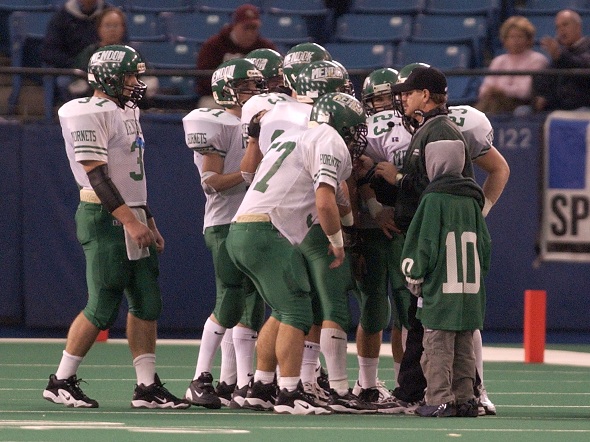
PHOTO: Mendon coach John Schwartz talks things over with his players during the Hornets' 21-14 win over Decatur in the 2002 Division 7 Final at the Pontiac Silverdome.
Glen Lake Plays for Weekends Like This
November 15, 2019
By Chris Dobrowolski
Special for Second Half
There’s nothing that could spoil Jerry Angers’ mood right now.
 When you love coaching football as much as Maple City Glen Lake’s varsity leader, being able to continue preparing your team deep into the playoffs trumps any tough situations that might come along.
That’s why an early-season snowstorm that hammered Leelanau County and shut down a number of schools in the area hardly registered as problematic for Angers, who is guiding his Lakers into a Division 6 Regional championship game against Calumet on Saturday — a clash of 10-1 squads aiming to advance to the Semifinal round.
“It’s totally awesome,” said Angers, in his 11th year in charge of the Lakers. “We’re getting pounded with snow up here, and we’ve got guys plowing our field off. We practiced in the gym today because it was snowing so bad. We were told we had to go home early. I wouldn’t trade that adversity for anything.”
This will be the second time in the last four years Glen Lake has ventured to the Upper Peninsula to face the Copper Kings. In 2016 the two teams met in the same round of the postseason, with the Lakers pulling out a 14-0 win on the way to reaching the Division 6 Final against Jackson Lumen Christi, which won the title with a 26-14 victory. Nearly all of the 16 seniors on Glen Lake’s roster were freshmen on the 2016 team and have the experience of an eight-hour bus trip to the Keweenaw Peninsula under their belts.
“That’s a really cool similarity because those kids have experienced this trip,” said Angers. “They weren’t playing, but they experienced what it took to get there.”
Angers makes the experience more than just playing the game. Getting in a practice on the way to Calumet, the team meals, the hotel stay — each aspect becomes part of the joy of the journey.
“It’s fun getting on the bus and basically spending two days with the kids and experience all the different things,” said Angers. “It’s like college football life on the high school level.”
There’s little doubt this is a business trip for the Lakers, though.
“When we got into film session on Sunday, Coach just told us it’s college football 101,” said senior running back/linebacker Johnathan Wright. “Long bus ride. We’ve got to stay focused.
“(They are) definitely a typical U.P. power team. They want to run downhill and run the clock out and just keep smashing you in the mouth.”
Angers admits to being superstitious enough that he’s trying to mimic as much of the trip this time to the one in 2016 in hopes that it can lead to a similar outcome. Just maybe not an exact mirror, however.
Right as the Lakers were getting ready to head from the hotel to the field in that Regional contest in 2016, they realized they had been locked out of their bus. Without panicking, players had to file into parents’ vehicles to transport them to the game in time. The Lakers managed to overcome that moment of turmoil by winning the game.
“So, if that’s what goes wrong and you still get to play a game? I was laughing about it,” said Angers. “How many other people are playing football right now?”
The seeds for this season were sown during an up-and-down 5-5 campaign a year ago that included a first-round playoff loss to Beaverton. The senior class — which showed its potential when it got significant playing time and performed well in a postseason victory against Roscommon as freshmen — wanted to leave its own legacy with a deep playoff run like the one the Lakers experienced three years ago.
“That was a huge motivation,” said senior lineman Ben Kroll. “We hated how we exited last year. We did not like the way we played. We do a boot camp every summer before the season starts. It was definitely the best boot camp I’ve been to, how close we all were and how we get along. We’ll fight for each other every day.”
Glen Lake has good athletes at the skill positions. Wright is in his second year starting on offense — he’s also been a three-year starter at linebacker — and is the leading rusher. Quarterback Reece Hazelton, at 6-foot-7, has a greater stature than a typical high school quarterback, though his best sport is basketball. He signed his letter of intent Wednesday to play hoops for Ferris State. His favorite target is junior receiver Finn Hogan.
The line, a position group near and dear to Angers’ heart, is the heartbeat of the team, with seniors Garrett Tremble, Dylan Kilinski, River Dallas and Kroll, and junior tackle Sam Keys.
“Without them nothing would happen,” said Wright.
Angers makes sure everyone on the roster knows they have key roles, whether it’s starting on offense, defense or special teams. Guys who make up the scout team are held in high value. Angers can go down the line and name off kids on his team and big plays they’ve been able to make at some point this season.
“There’s 31 kids I can turn to at any time, and I feel very comfortable and confident that they’re going to go in and get the job done,” said Angers. “Next man up. You’re one play away from being a starter. I think these kids also understand that.”
The Lakers have gone through a brutal schedule nearly unscathed. Five of the nine teams on the schedule qualified for the playoffs, and four of those teams won at least one postseason game. The schedule is specifically created that way for Glen Lake to be properly prepared to handle tough teams during the playoffs.
The one slip up came in the seventh week when Kingsley — which remains undefeated and is playing for a Regional crown in Division 5 — handed the Lakers a 53-14 loss. Angers shoulders the blame, saying he didn’t have the Lakers ready for a game of that magnitude and Glen Lake was uncharacteristically sloppy.
“That was a real wake-up call, and I think that was really good for our team because now in these playoff runs we know we can’t take any days off, any moments off,” said Kroll.
The ultimate goal, of course, is to win the Division 6 championship at Ford Field. Two more wins and Glen Lake will be back in the position it was in three years ago, playing in Detroit with a title on the line. Glen Lake’s last football championship came in 1994 when the Lakers won the Class DD crown with a 20-10 victory against Waterford Our Lady of the Lakes.
“There’s nothing like it,” said Wright. “All the lights are on you. You’re at the center of a huge dome, and it feels amazing. I just want to get back to that.”
The memory of being in Detroit for Thanksgiving weekend is still fresh in Angers’ mind — arriving at the stadium and feeling the electricity in the air as an earlier game unfolded.
“One of the coolest experiences was when we were all walking in from the bus into the tunnel and there was a big play made in the game before us,” said Angers. “The crowd just erupted, and it just ran down that tunnel. My kids, they were just starry eyed and they looked at me and I went, ‘You’re in the big time boys.’”
And nothing could be better than that.
 Chris Dobrowolski has covered northern Lower Peninsula sports since 1999 at the Ogemaw County Herald, Alpena News, Traverse City Record-Eagle and currently as sports editor at the Antrim Kalkaska Review since 2016. He can be reached at [email protected] with story ideas for Manistee, Wexford, Missaukee, Roscommon, Ogemaw, Iosco, Alcona, Oscoda, Crawford, Kalkaska, Grand Traverse, Benzie, Leelanau, Antrim, Otsego, Montmorency, Alpena, Presque Isle, Cheboygan, Charlevoix and Emmet counties.
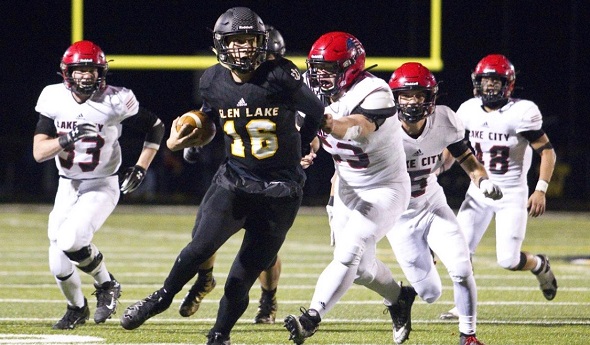
PHOTO: Maple City Glen Lake quarterback Reece Hazelton breaks free from Lake City defenders during a 30-19 Pre-District win. (Photo courtesy of the Traverse City Record-Eagle.)