


MHSA(Q&)A: Mendon football coach John Schwartz
February 2, 2012
 John Schwartz didn’t really want the Mendon football head coaching job when a group of players convinced him to take it before the 1989 season. And his first contract started out on a napkin. The rest is history.
Mendon won its 11th MHSAA football championship this fall, downing Fowler 33-0 in the Division 8 Final, to tie for third-most football titles won by one program. Schwartz has coached in the program for all 11, including 10 as head coach, and his record of 236-39 gives him a winning percentage of .858, tops in the MHSAA record book. He recently was selected as this year’s recipient of the high school Duffy Daugherty Award, annually given for career contributions to the game. He follows recent winners Ralph Munger of Rockford and Herb Brogan of Jackson Lumen Christi.
His Mendon teams have had just one losing season. And although he retired a year ago after 36 teaching middle school science, and then fought off cancer over the summer, he has no plans to leave his post on the Hornets’ sideline.
How would you characterize your program?
I think we have very good coaches and I think the kids respect the coaches, and they know the coaches think more of them than just being football players. They care about them. We have their attention, and what we really try to do is form a team concept as soon as we can. We try to stay away from giving any one person too much recognition. We don't give out MVP awards at the end of the year. It's a program where we're all in it together: coaches, kids and community. We try to get the best out of the kids, give the kids the best shot we have at being the best we can be.
How does a small school continue to reload every season?
My first year there, the first thing I did as a head coach was I started the junior high program. I think that's where everything starts. We even have the younger kids called the rocket kids, and those coaches come in and talk about (football) terms so when kids move from one level to another there's no re-teaching. Everyone has an ego, coaches have egos, and they like to do some things differently. But we don't have that. They do what we do. We give them a lot of flexibility, but we have certain drills we want to run. By the time we get them, these kids are in tune with what we are doing. The summer program also is something I started my first year as head coach too. ... It means that during the season we can concentrate more on teaching than conditioning.
You went from 3-6 in 2006 to 12-0 in 2007. Explain how you bounced back.
The losing season we had, we didn't have a lot of kids, and our two best kids were hurt early in the season and couldn't play. We never did bounce back. Even in that season, we were ahead at halftime in all but one game. We just didn't have enough to come back and pull the game out, and we had some very tough games. It wasn't a good season, but I thought those kids played awfully hard for what we had. We got a lot of experience, and it paid off the following year.
Our JVs practice with the varsity. When I work with inside linebackers, I work with (grades) 9-12. Kids learn quicker from kids than from coaches, as far as I'm concerned. ... Football's really changed. It's become a lot more complex. I think we have to delegate more and more every year so we can stay with the changes. It's too much for one person. I remember my first three, four or five years it was just three of us at the varsity level. The other two, neither one taught at the school. We were pretty successful right off the bat, and we started getting more and more interest from people. Now 9-12 we have seven coaches, and we have three at the junior high, and all the coaches but two have played for me. They know what I expect, what I'm looking for, what I want. ... And they want to win. I'd be lost without those guys.
Are there certain seasons that have meant more than others?
The first year I took the job, in 1989, we went undefeated and won a state title. A lot of those kids are very good friends of mine yet, and they're pretty special to me. They were a big boost to my program. In the '95 year, my son was a sophomore on that state title team. I remember a lot about that team.
They all have something they did very well. They either threw the ball well or played great defense or had a big line. When I hear a year now, I think about those teams.
You grew up in a small town (Colon) and have taught and coached in a small town. Was that important for you to do?
I've never taught anywhere else. I never felt I really had a reason to leave. I've gone through at least six superintendents since I've been there. The fourth or fifth said to me, "The only thing that bothers me about Mendon is these people think an awful lot of winning. There are other things." He asked me, "How do you feel about it?" I said, if they didn't feel that way, I wouldn't be here.
Who was your biggest coaching influence?
I would say Morley (Fraser, Jr., under whom Schwartz was an assistant for three seasons). Years before I got there, Mendon was pretty good in the early 70s, and then in the mid 70s football wasn't very good. I was the JV coach the first year, and the second year after two games they brought me up to varsity. The best thing I did was I told them I would not take the head job, but I'll assist. I knew (Fraser) was the kind of person and personality we needed there. It wasn't necessarily all of his football knowledge, but his energy and excitement that he brought to the game.
You said during the Finals postgame press conference that you'd battled cancer during the summer. How did you come back, and did you ever think that might be time to step down?
Everything's fine. I had coaches that took over. At the same time that that happened, I was retiring. If you retire in Michigan, you can't be at the school for one month. So I couldn't be at summer weights all the way through June. So my coaches did all the summer weights. But I had no intention of stepping down. If something (bad) came down ... but once they said they got it, everything went as normal.
After a championship season, how do you ramp things back up for the next fall and a new group of players?
When we go to the playoffs, we take all the JVs unless there are couple who don't want to go. They experience that and get an extra five weeks of practice if we win a state title. And they're excited about it. They want to do that. They’ve' tasted it, and they want a part of that the next year. We remind them it's not what you did, it's what can you do for me now. ... This is your year.
We talk about winning state championships from day one. A lot of people say we shouldn't do that, but why not? Isn't that the ultimate goal? I can't imagine telling a team we think we could be 7-2 this year. We expect to be 9-0 every year. Of course, that's not going to happen. But at same time, I think the losses make you better the following week. We've won state titles where we haven't won the league title. ... You get better.
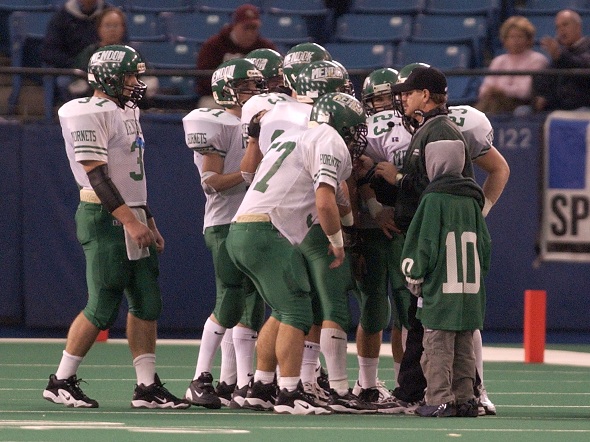
PHOTO: Mendon coach John Schwartz talks things over with his players during the Hornets' 21-14 win over Decatur in the 2002 Division 7 Final at the Pontiac Silverdome.

2018 Week 5 Football Playoff Listing
September 18, 2018
By Geoff Kimmerly
Second Half editor
Here is a list of Michigan High School Athletic Association football playing schools, displaying their win-loss records and playoff averages through the fourth week of the season.
Schools on this list are in enrollment order for 11-player teams, with 8-player teams ordered by playoff average. An asterisk (*) beside a record indicates a team has eight or fewer games scheduled.
Those schools with 11-player teams with six or more wins playing nine-game schedules, or five or more wins playing eight games or fewer, will qualify for the MHSAA Football Playoffs beginning Oct. 26. Schools with 5-4, 4-3 or 4-4 records may qualify if the number of potential qualifiers by win total does not reach the 256 mark. Schools with six or more wins playing nine-game schedules or five or more wins playing eight games or fewer may be subtracted from the field based on playoff average if the number of potential qualifiers exceeds the 256 mark.
Once the 256 qualifying schools are determined, they will be divided by enrollment groups into eight equal divisions of 32 schools, and then drawn into regions of eight teams each and districts of four teams each. Those schools with 8-player teams will be ranked by playoff average at season’s end, and the top 32 programs will then be divided into two divisions of 16 each based on enrollment. The playoff in that division also begins Oct. 26.
To review a list of all football playoff schools, individual school playoff point details and to report errors, visit the Football page of the MHSAA Website.
The announcement of the qualifiers and first-round pairings for both the 11 and 8-player playoffs will take place Oct. 21 on the Selection Sunday Show on FOX Sports Detroit. The playoff qualifiers and pairings will be posted to the MHSAA Website following the Selection Sunday Show.
11-Player Playoff Listing
1. Macomb Dakota, 3114, 4-0, 90.000
2. Dearborn Fordson, 2795, 4-0, 88.000
3. East Kentwood, 2651, 3-1, 70.750
4. Grand Blanc, 2637, 4-0, 94.000
5. Clarkston, 2548, 4-0, 96.000
6. Clinton Township Chippewa Valley, 2462, 4-0, 98.000
7. Detroit Cass Tech, 2432, 4-0, 90.000
8. Canton, 2260, 3-1, 68.250
9. Brighton, 2202, 3-1, 70.750
10. Holland West Ottawa, 2190, 3-1, 66.500
11. Oxford, 2170, 3-1, 74.500
12. Ann Arbor Pioneer, 2115, 3-1, 80.667
13. Detroit Catholic Central, 2020, 3-1, 76.750
14. West Bloomfield, 2005, 3-1, 72.750
15. Macomb L'Anse Creuse North, 1994, 3-1, 66.500
16. Monroe, 1949, 3-1, 69.550
17. Hudsonville, 1879, 4-0, 90.667
18. Saline, 1834, 3-1, 70.750
19. Romeo, 1779, 3-1, 72.500
20. Detroit Western International, 1773, 3-1, 54.750
21. Lapeer, 1772, 4-0, 86.000
22. Davison, 1687, 4-0, 88.000
23. Belleville, 1642, 4-0, 98.000
24. Brownstown Woodhaven, 1628, 4-0, 94.000
25. Grosse Pointe South, 1593, 4-0, 92.000
26. Warren Mott, 1585, 3-1, 72.750
27. Waterford Mott, 1558, 3-1, 66.500
28. Warren DeLaSalle, 1474, 3-1, 66.750
29. Jenison, 1464, 3-1, 64.250
30. Livonia Franklin, 1443, 3-1, 64.000
31. Dearborn Heights Crestwood, 1424, 4-0, 76.000
32. Traverse City Central, 1391, 3-1, 70.250
33. Birmingham Seaholm, 1376, 3-1, 68.750
34. Oak Park, 1349, 4-0, 90.000
35. Portage Central, 1349, 3-1, 70.250
36. Roseville, 1303, 3-1, 56.750
37. Port Huron Northern, 1295, 3-1, 70.500
38. St. Clair Shores Lake Shore, 1276, 3-1, 64.500
39. Swartz Creek, 1262, 4-0, 92.000
40. Walled Lake Western, 1258, 3-1, 66.500
41. Jackson, 1229, 4-0, 88.000
42. Ypsilanti Lincoln, 1226, 3-1, 56.500
43. South Lyon, 1225, 4-0, 92.000
44. Muskegon Mona Shores, 1215, 4-0, 90.000
45. Birmingham Brother Rice, 1168, 3-1, 73.567
46. Fenton, 1160, 3-1, 68.500
47. Mattawan, 1153, 3-1, 64.250
48. Detroit Martin Luther King, 1149, 3-1, 54.750
49. Warren Woods Tower, 1126, 4-0, 78.000
50. Auburn Hills Avondale, 1115, 3-1, 64.250
51. Gibraltar Carlson, 1114, 3-1, 70.750
52. East Lansing, 1111, 4-0, 88.667
53. Farmington, 1111, 4-0, 90.000
54. Allen Park, 1105, 3-1, 68.500
55. Garden City, 1080, 3-1, 62.000
56. South Lyon East, 1063, 3-1, 64.500
57. Mt. Pleasant, 1053, 4-0, 84.000
58. Muskegon, 1022, 4-0, 98.000
59. Battle Creek Central, 1014, 3-1, 66.500
60. Gaylord, 1002, 4-0, 80.000
61. DeWitt, 1001, 4-0, 94.000
62. Zeeland West, 997, 3-1, 68.500
63. Cedar Springs, 992, 3-1, 68.750
64. Zeeland East, 955, 3-1, 58.500
65. Detroit Mumford, 943, 3-1, 60.500
66. Trenton, 914, 3-1, 70.500
67. Riverview, 913, 3-1, 58.500
68. Middleville Thornapple Kellogg, 903, 4-0, 80.000
69. River Rouge, 897, 3-1, 58.750
70. Haslett, 895, 4-0, 84.000
71. Ortonville-Brandon, 887, 3-1, 70.250
72. Grand Rapids Christian, 886, 3-1, 66.750
73. Parma Western, 870, 3-1, 56.750
74. Chelsea, 851, 3-1, 70.500
75. Farmington Hills Harrison, 849, 3-1, 66.750
76. Spring Lake, 845, 4-0, 74.000
77. Edwardsburg, 838, 4-0, 76.000
78. Wayland Union, 829, 3-1, 64.750
79. Plainwell, 825, 3-1, 52.750
80. Bloomfield Hills Cranbrook Kingswood, 809, 3-1, 62.917
81. Milan, 761, 3-1, 54.500
82. Goodrich, 758, 3-1, 62.500
83. Detroit Cody, 755, 4-0, 84.000
84. Allendale, 749, 3-1, 56.750
85. North Branch, 726, 3-1, 52.750
86. Croswell-Lexington, 724, 3-1, 56.500
87. Battle Creek Pennfield, 709, 3-1, 62.500
88. Pontiac Notre Dame Prep, 702, 3-1, 52.500
89. Detroit Country Day *, 687, 3-1, 67.050
90. Three Rivers, 682, 4-0, 82.000
91. Holland Christian, 672, 3-1, 58.750
92. Paw Paw, 670, 3-1, 56.750
93. Whitehall, 669, 3-1, 50.750
94. Grand Rapids Catholic Central, 662, 3-1, 54.500
95. Alma, 643, 4-0, 68.000
96. Lake Odessa Lakewood, 643, 3-1, 62.500
97. Williamston, 619, 3-1, 62.250
98. Grand Rapids South Christian, 615, 3-1, 63.167
99. Grosse Ile, 609, 4-0, 74.000
100. Dearborn Heights Robichaud, 608, 4-0, 74.000
101. Hudsonville Unity Christian, 602, 4-0, 86.000
102. Harper Woods, 594, 3-1, 44.750
103. Freeland, 584, 3-1, 52.750
104. Saginaw Swan Valley, 573, 4-0, 90.000
105. Belding, 572, 3-1, 54.500
106. Muskegon Oakridge, 571, 4-0, 68.000
107. Macomb Lutheran North, 560, 4-0, 70.000
108. Birch Run, 552, 3-1, 58.500
109. St. Clair Shores South Lake, 551, 3-1, 50.500
110. Portland, 550, 4-0, 74.000
111. Frankenmuth, 549, 3-1, 60.750
112. Olivet, 542, 4-0, 72.000
113. Detroit Osborn, 537, 3-1, 44.750
114. Lansing Catholic, 531, 4-0, 70.000
115. Richmond, 524, 3-1, 56.000
116. Ida, 512, 3-1, 58.500
117. Hopkins, 507, 3-1, 58.750
118. Benzie Central, 505, 3-1, 52.750
119. Detroit Denby, 504, 4-0, 66.667
120. Reed City, 504, 4-0, 80.000
121. Almont, 503, 4-0, 68.000
122. Marine City, 503, 3-1, 56.750
123. Berrien Springs, 500, 3-1, 54.750
124. Dundee, 485, 3-1, 52.500
125. Manistee, 472, 4-0, 64.000
126. Durand, 468, 3-1, 46.250
127. Coloma, 460, 3-1, 48.500
128. Ovid-Elsie, 453, 3-1, 50.750
129. Kalamazoo Hackett, 450, 4-0, 66.000
130. Clare, 449, 3-1, 48.500
131. Montague, 445, 3-1, 42.750
132. Kingsley, 443, 3-1, 54.750
133. Hillsdale, 441, 4-0, 66.000
134. Tawas *, 418, 3-1, 38.750
135. Michigan Center, 412, 4-0, 56.000
136. Brooklyn Columbia Central, 410, 3-1, 58.500
137. Constantine, 400, 4-0, 64.000
138. Fennville, 400, 3-1, 48.750
139. Calumet, 392, 4-0, 70.800
140. Warren Michigan Collegiate, 392, 4-0, 74.000
141. Ishpeming Westwood, 391, 2-2, 37.417
142. Millington, 390, 3-1, 54.000
143. Ithaca, 388, 3-1, 50.750
144. Ecorse, 387, 3-1, 46.750
145. Blissfield, 383, 3-1, 60.750
146. Delton Kellogg, 378, 4-0, 68.000
147. Hemlock, 374, 3-1, 42.500
148. Morley Stanwood, 369, 3-1, 48.250
149. Elk Rapids, 366, 3-1, 42.500
150. Napoleon, 365, 3-1, 42.500
151. Beaverton, 362, 3-1, 46.750
152. Grass Lake, 357, 4-0, 56.000
153. Jackson Lumen Christi *, 356, 4-0, 84.000
154. Traverse City St. Francis, 355, 4-0, 84.000
155. Flint Hamady, 353, 4-0, 58.000
156. Schoolcraft, 353, 3-1, 50.500
157. Kent City, 351, 4-0, 58.000
158. Lake City, 348, 4-0, 64.000
159. Leroy Pine River, 348, 4-0, 56.000
160. L'Anse, 344, 3-1, 48.250
161. Ravenna, 344, 3-1, 40.500
162. Grand Rapids NorthPointe Christian, 332, 3-1, 42.500
163. Monroe St. Mary Catholic Central, 331, 3-1, 63.167
164. St. Louis, 331, 3-1, 48.500
165. Oscoda, 329, 3-1, 28.000
166. Hartford, 322, 4-0, 52.000
167. Roscommon, 319, 3-1, 58.500
168. Madison Heights Madison, 316, 4-0, 80.000
169. Pewamo-Westphalia, 315, 4-0, 56.000
170. Clinton, 313, 3-1, 42.500
171. Detroit Community, 308, 4-0, 48.000
172. Madison Heights Bishop Foley, 306, 3-1, 48.750
173. New Lothrop, 302, 4-0, 66.000
174. Springport, 302, 4-0, 54.000
175. Allen Park Cabrini, 300, 3-1, 42.750
176. Sandusky, 300, 4-0, 62.000
177. Iron Mountain, 298, 3-1, 54.400
178. Cass City, 291, 3-1, 48.250
179. Elkton-Pigeon-Bay Port Laker, 282, 3-1, 48.500
180. Harbor Springs, 280, 4-0, 50.000
181. Manton, 280, 3-1, 42.750
182. Centreville, 279, 4-0, 56.000
183. Saugatuck, 273, 3-1, 50.500
184. Sand Creek, 266, 3-1, 37.417
185. Cassopolis, 261, 4-0, 56.000
186. Concord, 255, 3-1, 42.750
187. Royal Oak Shrine Catholic, 252, 3-1, 40.250
188. Ottawa Lake Whiteford, 250, 4-0, 58.000
189. Carson City-Crystal, 248, 4-0, 46.000
190. Gwinn, 246, 4-0, 54.000
191. Iron River West Iron County, 246, 3-1, 40.750
192. Dansville, 244, 3-1, 42.000
193. Reading, 244, 4-0, 66.000
194. Holton, 234, 3-1, 42.500
195. Ishpeming, 233, 4-0, 52.800
196. Ubly, 232, 3-1, 44.750
197. Johannesburg-Lewiston, 226, 3-1, 42.500
198. Breckenridge, 224, 4-0, 60.000
199. Harbor Beach, 222, 3-1, 44.250
200. Rogers City, 220, 4-0, 56.000
201. Sterling Heights Parkway Christian, 220, 4-0, 52.000
202. Detroit Public Safety Academy, 206, 3-1, 37.167
203. Mendon, 193, 3-1, 32.750
204. Saginaw Michigan Lutheran Seminary, 193, 4-0, 50.000
205. Pittsford, 186, 4-0, 52.000
206. Athens *, 185, 3-0, 57.333
207. Adrian Lenawee Christian, 183, 4-0, 52.000
208. Martin, 183, 3-1, 40.000
209. Fowler, 170, 3-1, 36.750
210. Clarkston Everest Collegiate, 115, 4-0, 51.333
8-Player Playoff Listing
1. Colon, 162, 4-0, 50.000
2. Pickford, 156, 4-0, 48.000
3. Onekama, 131, 4-0, 46.667
4. Morrice, 182, 4-0, 46.000
5. AuGres-Sims, 160, 4-0, 44.000
6. Posen, 78, 4-0, 42.000
7. Wyoming Tri-unity Christian, 173, 4-0, 40.000
8. Mt. Pleasant Sacred Heart, 122, 3-1, 38.500
9. Brethren, 143, 3-1, 36.250
10. Kingston, 187, 4-0, 36.000
11. Stephenson, 159, 3-1, 35.450
12. Engadine, 102, 3-1, 34.750
13. Hillman, 140, 3-1, 34.750
14. Camden-Frontier, 176, 3-1, 34.500
15. Powers North Central, 109, 3-1, 34.500
16. Battle Creek St. Philip, 178, 3-1, 32.750
17. Suttons Bay, 189, 3-1, 32.750
18. Cedarville, 151, 3-1, 32.500
19. Eben Junction Superior Central, 121, 3-1, 32.500
20. Portland St. Patrick, 102, 3-1, 32.500
21. Genesee, 169, 3-1, 32.250
22. Bellevue, 185, 3-1, 30.750
23. Kinde-North Huron, 130, 3-1, 28.500
24. Manistee Catholic Central, 181, 3-1, 28.500
25. Peck, 136, 3-1, 28.000
26. Mayville, 185, 3-1, 26.750
27. Fife Lake Forest Area, 183, 2-2, 25.250
28. Crystal Falls Forest Park, 125, 2-2, 23.250
29. Deckerville, 175, 2-2, 23.250
30. Webberville, 176, 2-2, 23.000
31. Bellaire, 131, 2-2, 21.917
32. Onaway, 187, 2-2, 21.417
33. Marion, 139, 2-2, 19.250
34. Rapid River, 127, 2-2, 19.250
35. Tekonsha, 121, 2-2, 19.250
36. Rudyard, 159, 2-2, 19.000
37. Waldron, 65, 2-2, 16.750
38. New Haven Merritt Academy, 154, 1-3, 15.500
39. Pellston, 167, 1-3, 13.750
40. Caseville *, 95, 1-2, 13.417
41. Bay City All Saints, 77, 1-3, 11.750
42. Hale, 122, 1-3, 11.750
43. Central Lake *, 190, 1-2, 11.667
44. Atlanta, 74, 1-3, 11.250
45. North Adams-Jerome, 146, 1-3, 11.000
46. Owendale-Gagetown, 57, 1-3, 11.000
47. St. Helen Charlton Heston Academy, 156, 1-3, 10.250
48. Ashley, 94, 1-3, 10.000
49. Big Rapids Crossroads Academy, 201, 1-3, 9.500
50. Mesick, 202, 1-3, 9.500
51. Brimley, 154, 1-3, 9.250
52. Burr Oak, 74, 1-3, 9.250
53. Ontonagon, 173, 1-3, 9.250
54. Burton Madison Academy, 163, 1-3, 8.750
55. Lawrence, 171, 0-4, 2.750
56. Flint International Academy, 171, 0-4, 1.750
57. Bear Lake *, 94, 0-3, 1.250
58. Carney-Nadeau, 133, 0-4, 1.250
59. Felch North Dickinson, 83, 0-4, 1.250
60. Litchfield, 81, 0-4, 1.250
61. St. Joseph Michigan Lutheran, 100, 0-4, 1.250
62. Baldwin, 120, 0-3, 0.500