


MHSA(Q&)A: Mendon football coach John Schwartz
February 2, 2012
 John Schwartz didn’t really want the Mendon football head coaching job when a group of players convinced him to take it before the 1989 season. And his first contract started out on a napkin. The rest is history.
Mendon won its 11th MHSAA football championship this fall, downing Fowler 33-0 in the Division 8 Final, to tie for third-most football titles won by one program. Schwartz has coached in the program for all 11, including 10 as head coach, and his record of 236-39 gives him a winning percentage of .858, tops in the MHSAA record book. He recently was selected as this year’s recipient of the high school Duffy Daugherty Award, annually given for career contributions to the game. He follows recent winners Ralph Munger of Rockford and Herb Brogan of Jackson Lumen Christi.
His Mendon teams have had just one losing season. And although he retired a year ago after 36 teaching middle school science, and then fought off cancer over the summer, he has no plans to leave his post on the Hornets’ sideline.
How would you characterize your program?
I think we have very good coaches and I think the kids respect the coaches, and they know the coaches think more of them than just being football players. They care about them. We have their attention, and what we really try to do is form a team concept as soon as we can. We try to stay away from giving any one person too much recognition. We don't give out MVP awards at the end of the year. It's a program where we're all in it together: coaches, kids and community. We try to get the best out of the kids, give the kids the best shot we have at being the best we can be.
How does a small school continue to reload every season?
My first year there, the first thing I did as a head coach was I started the junior high program. I think that's where everything starts. We even have the younger kids called the rocket kids, and those coaches come in and talk about (football) terms so when kids move from one level to another there's no re-teaching. Everyone has an ego, coaches have egos, and they like to do some things differently. But we don't have that. They do what we do. We give them a lot of flexibility, but we have certain drills we want to run. By the time we get them, these kids are in tune with what we are doing. The summer program also is something I started my first year as head coach too. ... It means that during the season we can concentrate more on teaching than conditioning.
You went from 3-6 in 2006 to 12-0 in 2007. Explain how you bounced back.
The losing season we had, we didn't have a lot of kids, and our two best kids were hurt early in the season and couldn't play. We never did bounce back. Even in that season, we were ahead at halftime in all but one game. We just didn't have enough to come back and pull the game out, and we had some very tough games. It wasn't a good season, but I thought those kids played awfully hard for what we had. We got a lot of experience, and it paid off the following year.
Our JVs practice with the varsity. When I work with inside linebackers, I work with (grades) 9-12. Kids learn quicker from kids than from coaches, as far as I'm concerned. ... Football's really changed. It's become a lot more complex. I think we have to delegate more and more every year so we can stay with the changes. It's too much for one person. I remember my first three, four or five years it was just three of us at the varsity level. The other two, neither one taught at the school. We were pretty successful right off the bat, and we started getting more and more interest from people. Now 9-12 we have seven coaches, and we have three at the junior high, and all the coaches but two have played for me. They know what I expect, what I'm looking for, what I want. ... And they want to win. I'd be lost without those guys.
Are there certain seasons that have meant more than others?
The first year I took the job, in 1989, we went undefeated and won a state title. A lot of those kids are very good friends of mine yet, and they're pretty special to me. They were a big boost to my program. In the '95 year, my son was a sophomore on that state title team. I remember a lot about that team.
They all have something they did very well. They either threw the ball well or played great defense or had a big line. When I hear a year now, I think about those teams.
You grew up in a small town (Colon) and have taught and coached in a small town. Was that important for you to do?
I've never taught anywhere else. I never felt I really had a reason to leave. I've gone through at least six superintendents since I've been there. The fourth or fifth said to me, "The only thing that bothers me about Mendon is these people think an awful lot of winning. There are other things." He asked me, "How do you feel about it?" I said, if they didn't feel that way, I wouldn't be here.
Who was your biggest coaching influence?
I would say Morley (Fraser, Jr., under whom Schwartz was an assistant for three seasons). Years before I got there, Mendon was pretty good in the early 70s, and then in the mid 70s football wasn't very good. I was the JV coach the first year, and the second year after two games they brought me up to varsity. The best thing I did was I told them I would not take the head job, but I'll assist. I knew (Fraser) was the kind of person and personality we needed there. It wasn't necessarily all of his football knowledge, but his energy and excitement that he brought to the game.
You said during the Finals postgame press conference that you'd battled cancer during the summer. How did you come back, and did you ever think that might be time to step down?
Everything's fine. I had coaches that took over. At the same time that that happened, I was retiring. If you retire in Michigan, you can't be at the school for one month. So I couldn't be at summer weights all the way through June. So my coaches did all the summer weights. But I had no intention of stepping down. If something (bad) came down ... but once they said they got it, everything went as normal.
After a championship season, how do you ramp things back up for the next fall and a new group of players?
When we go to the playoffs, we take all the JVs unless there are couple who don't want to go. They experience that and get an extra five weeks of practice if we win a state title. And they're excited about it. They want to do that. They’ve' tasted it, and they want a part of that the next year. We remind them it's not what you did, it's what can you do for me now. ... This is your year.
We talk about winning state championships from day one. A lot of people say we shouldn't do that, but why not? Isn't that the ultimate goal? I can't imagine telling a team we think we could be 7-2 this year. We expect to be 9-0 every year. Of course, that's not going to happen. But at same time, I think the losses make you better the following week. We've won state titles where we haven't won the league title. ... You get better.
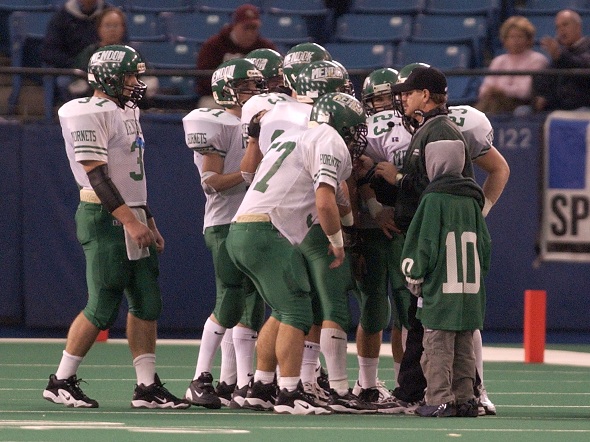
PHOTO: Mendon coach John Schwartz talks things over with his players during the Hornets' 21-14 win over Decatur in the 2002 Division 7 Final at the Pontiac Silverdome.
Fugate Carries CC On 1 More Trophy Run
By
Paul Costanzo
Special for MHSAA.com
November 24, 2017
DETROIT – As classmates and fans screamed his name from the Ford Field stands Friday night, Nolan Fugate put the focus on his teammates.
 “I cannot thank my offensive line and my outside receivers enough,” the Grand Rapids Catholic Central senior running back said. “Without them none of this would be possible, and I just can’t thank them enough. They’re the best offensive line in the state.”
That line paved the way for Fugate, who gained 306 yards on the ground and tied an MHSAA Finals record with five total touchdowns as the Cougars defeated Edwardsburg 42-31 in the Division 4 championship game.
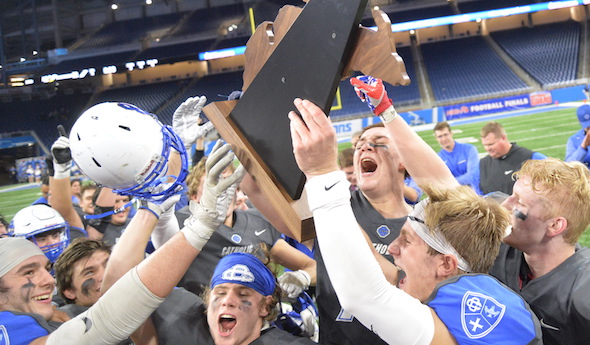
It was the second straight title for Catholic Central (14-0), and the program’s fourth overall. Coach Todd Kolster has led the Cougars to three of them (2010, 2016 and 2017).
“It has nothing to do with me,” Kolster said. “I’m the beneficiary of being the head coach for three of these, but it’s the kids that do all the work. They’re outstanding. This senior class, I love them so much. I’ve been so critical of them, and I say that all the time, because I came back here to Catholic Central with that class when they were freshmen and now they’re seniors. It’s really special to see these guys enjoy this, because they’ve earned every bit of it.”
This year’s title game was in stark contrast to last season’s when the Cougars eked out a 10-7 victory in a defensive struggle against Detroit Country Day. Big plays from both offenses highlighted Friday night’s game as Catholic Central had to battle to hold off a relentless Edwardsburg team down the stretch.
“They all mean the same,” Kolster said. “They all come in the right column, so we’ll take it.”
Seven of the game’s scoring plays were 20 yards or longer, including an MHSAA Finals record-tying 99-yard kick return touchdown by Edwardsburg’s Caden Goggins, and a MHSAA Finals record-tying 90-yard touchdown run by his teammate Nick Bradley.
On the night, the Eddies (12-2) averaged 9.7 yards per play and 10.8 yards per carry, while Catholic Central averaged 7.7 yards per play in managing to outgain Edwardsburg 448-369.
“Our defense, they played well -- we gave up a couple big plays, and Edwardsburg is a heck of a football team,” Kolster said. “We gave up three (big) kickoff returns and three big plays, but we handled them pretty well. That’s what they do, and that’s why they’re so good. That’s why they’re here, because they just keep at it, they keep at it and they’ll pop one, and they have confidence in that. But we have confidence in our guys.”
The Cougars’ defense did stiffen when it absolutely had to, as sophomore Ethan Lott came up with a tackle for loss on a 4th-and-1 play late in the fourth quarter to all but seal the game.
“Our guys did a great job on that 4th-and-1; it’s just a matter of reading their keys,” Kolster said. “I’m really proud of them.”
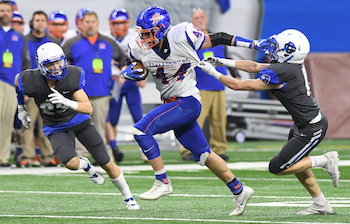 The game was absolutely put away when Fugate went 58 yards on a 3rd-and-10 in the final minute, barely getting tripped up at the Edwardsburg 10. It was another in a long line of huge plays for Fugate, who had touchdown runs of one, five, 54 and 32 yards, as well as a 20-yard touchdown reception from Jack Bowen.
Fugate also had 86 yards receiving and came down with a 38-yard catch along the sideline on a crucial 3rd-and-28 play midway through the fourth quarter with his team clinging to a 35-31 lead.
“The long third down, I saw (Bowen) leave the pocket and I was running my route and knew I had to get open,” Fugate said. “I just kind of boxed my guy out and said throw the ball, and I just did my best to make a play on the ball, and I was able to come down with it.”
The game put Fugate over 2,900 yards rushing for the season, and capped off a brilliant career that saw him set the school’s all-time career rushing record.
“Fugate is obviously a terrific runner,” Edwardsburg coach Kevin Bartz said. “I thought he ran as hard as I’ve ever seen him. We watched a good portion of film on him, and we knew he was fast, but I guess what I was more impressed with today is how hard he ran. He picked up lots of extra yards after contact. He’s an impressive athlete.”
Bartz was equally impressed with his team, which was playing in the title game for the first time and kept finding ways to hang around despite trailing by 16 midway through the third quarter.
On top of the record-tying touchdowns, the Eddies had scoring runs of 55 and 78 yards from Kyle Shrider, and 64 yards from Chase Sager. Shrider finished with 162 yards rushing, while Bradley had 96 and Sager had 73.
“Just to make it to this point, this was a team that was not expected to be here,” Bartz said. “With the number of kids we lost last year, we were kind of expected, I think, by most to be average at best. For them to come out here and perform against a top-level team like Grand Rapids CC, I’m extremely proud of these kids. They’ve now set the bar pretty high for everybody else at Edwardsburg.”
Bowen finished with 128 yards passing for the Cougars, while Erik Grabow had a 14-yard touchdown run.
The MHSAA Playoffs are sponsored by the Michigan Army National Guard.
PHOTOS: (Top) Grand Rapids Catholic Central players raise the winner's trophy after Friday night’s Division 4 championship game. (Middle) Edwardsburg’s Kyle Shrider pulls away from a Cougars defender.