


MHSA(Q&)A: Mendon football coach John Schwartz
February 2, 2012
 John Schwartz didn’t really want the Mendon football head coaching job when a group of players convinced him to take it before the 1989 season. And his first contract started out on a napkin. The rest is history.
Mendon won its 11th MHSAA football championship this fall, downing Fowler 33-0 in the Division 8 Final, to tie for third-most football titles won by one program. Schwartz has coached in the program for all 11, including 10 as head coach, and his record of 236-39 gives him a winning percentage of .858, tops in the MHSAA record book. He recently was selected as this year’s recipient of the high school Duffy Daugherty Award, annually given for career contributions to the game. He follows recent winners Ralph Munger of Rockford and Herb Brogan of Jackson Lumen Christi.
His Mendon teams have had just one losing season. And although he retired a year ago after 36 teaching middle school science, and then fought off cancer over the summer, he has no plans to leave his post on the Hornets’ sideline.
How would you characterize your program?
I think we have very good coaches and I think the kids respect the coaches, and they know the coaches think more of them than just being football players. They care about them. We have their attention, and what we really try to do is form a team concept as soon as we can. We try to stay away from giving any one person too much recognition. We don't give out MVP awards at the end of the year. It's a program where we're all in it together: coaches, kids and community. We try to get the best out of the kids, give the kids the best shot we have at being the best we can be.
How does a small school continue to reload every season?
My first year there, the first thing I did as a head coach was I started the junior high program. I think that's where everything starts. We even have the younger kids called the rocket kids, and those coaches come in and talk about (football) terms so when kids move from one level to another there's no re-teaching. Everyone has an ego, coaches have egos, and they like to do some things differently. But we don't have that. They do what we do. We give them a lot of flexibility, but we have certain drills we want to run. By the time we get them, these kids are in tune with what we are doing. The summer program also is something I started my first year as head coach too. ... It means that during the season we can concentrate more on teaching than conditioning.
You went from 3-6 in 2006 to 12-0 in 2007. Explain how you bounced back.
The losing season we had, we didn't have a lot of kids, and our two best kids were hurt early in the season and couldn't play. We never did bounce back. Even in that season, we were ahead at halftime in all but one game. We just didn't have enough to come back and pull the game out, and we had some very tough games. It wasn't a good season, but I thought those kids played awfully hard for what we had. We got a lot of experience, and it paid off the following year.
Our JVs practice with the varsity. When I work with inside linebackers, I work with (grades) 9-12. Kids learn quicker from kids than from coaches, as far as I'm concerned. ... Football's really changed. It's become a lot more complex. I think we have to delegate more and more every year so we can stay with the changes. It's too much for one person. I remember my first three, four or five years it was just three of us at the varsity level. The other two, neither one taught at the school. We were pretty successful right off the bat, and we started getting more and more interest from people. Now 9-12 we have seven coaches, and we have three at the junior high, and all the coaches but two have played for me. They know what I expect, what I'm looking for, what I want. ... And they want to win. I'd be lost without those guys.
Are there certain seasons that have meant more than others?
The first year I took the job, in 1989, we went undefeated and won a state title. A lot of those kids are very good friends of mine yet, and they're pretty special to me. They were a big boost to my program. In the '95 year, my son was a sophomore on that state title team. I remember a lot about that team.
They all have something they did very well. They either threw the ball well or played great defense or had a big line. When I hear a year now, I think about those teams.
You grew up in a small town (Colon) and have taught and coached in a small town. Was that important for you to do?
I've never taught anywhere else. I never felt I really had a reason to leave. I've gone through at least six superintendents since I've been there. The fourth or fifth said to me, "The only thing that bothers me about Mendon is these people think an awful lot of winning. There are other things." He asked me, "How do you feel about it?" I said, if they didn't feel that way, I wouldn't be here.
Who was your biggest coaching influence?
I would say Morley (Fraser, Jr., under whom Schwartz was an assistant for three seasons). Years before I got there, Mendon was pretty good in the early 70s, and then in the mid 70s football wasn't very good. I was the JV coach the first year, and the second year after two games they brought me up to varsity. The best thing I did was I told them I would not take the head job, but I'll assist. I knew (Fraser) was the kind of person and personality we needed there. It wasn't necessarily all of his football knowledge, but his energy and excitement that he brought to the game.
You said during the Finals postgame press conference that you'd battled cancer during the summer. How did you come back, and did you ever think that might be time to step down?
Everything's fine. I had coaches that took over. At the same time that that happened, I was retiring. If you retire in Michigan, you can't be at the school for one month. So I couldn't be at summer weights all the way through June. So my coaches did all the summer weights. But I had no intention of stepping down. If something (bad) came down ... but once they said they got it, everything went as normal.
After a championship season, how do you ramp things back up for the next fall and a new group of players?
When we go to the playoffs, we take all the JVs unless there are couple who don't want to go. They experience that and get an extra five weeks of practice if we win a state title. And they're excited about it. They want to do that. They’ve' tasted it, and they want a part of that the next year. We remind them it's not what you did, it's what can you do for me now. ... This is your year.
We talk about winning state championships from day one. A lot of people say we shouldn't do that, but why not? Isn't that the ultimate goal? I can't imagine telling a team we think we could be 7-2 this year. We expect to be 9-0 every year. Of course, that's not going to happen. But at same time, I think the losses make you better the following week. We've won state titles where we haven't won the league title. ... You get better.
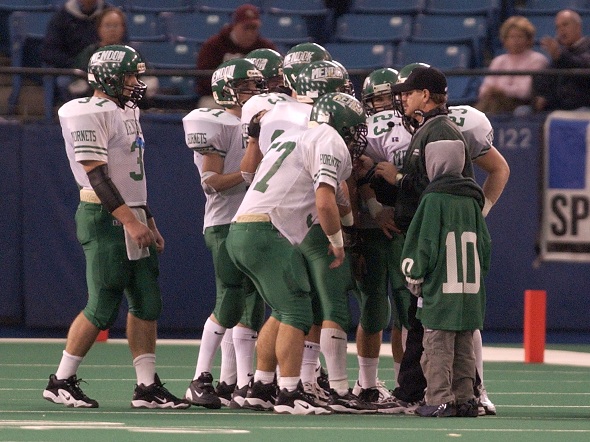
PHOTO: Mendon coach John Schwartz talks things over with his players during the Hornets' 21-14 win over Decatur in the 2002 Division 7 Final at the Pontiac Silverdome.
Grayling QB Takes Over at Crunch Time
October 27, 2017
By Dennis Chase
Special for Second Half
GRAYLING – For the Grayling Vikings, it was Just-in time.
 Propelled by senior quarterback Justin Nicholas, Grayling pulled out victories the last two weeks to secure an eighth MHSAA football playoff berth in the last nine years.
All the first-year starter at quarterback did was complete a staggering 66 of 120 passes for 995 yards and 15 touchdowns over the final eight quarters of the regular season to keep the 6-3 Vikings alive. Grayling travels to 8-1 Reed City tonight for a first-round Division 5 playoff game.
“We knew he had a golden arm,” Grayling coach Tim Sanchez said of Nicholas. “He just needed some reps, some time behind center. For quarterbacks, that first season can be tough. It doesn’t always come easy.
“But,” he added, “Justin’s made it look that way.”
In a wild 58-46 comeback win over Benzie Central in Week 8, Nicholas nearly set several MHSAA records by finishing 39 of 72 for 623 yards and eight scores. The 623 yards? Second to Omar Salih of Detroit Cesar Chavez Academy (674 yards in 2013). His 72 attempts? Second to Grayling’s Jimmy Osga (74 in 2008). His 39 completions? Two off the mark held by Osga, Jenison’s Steve Brander and Detroit Central’s Robert Hunt. The eight touchdowns? Second to Salih (nine in 2013).
It all came as a shock to Nicholas, who was more worried about a win than his stats that night. The Vikings trailed Benzie 46-30 after three quarters.
It was his older brother Darin, who was listening to the game on radio while watching from the stands, who alerted him afterwards.
“It’s still kind of surreal - 623 yards, that’s like video game stats,” Nicholas said. “When I came off the field, my brother said to me, ‘How does it feel to be in the record books?’ I kind of looked at him, not fully aware of what he was talking about. Then he said, ‘You just passed for more than 600 yards.’ I said, ‘C’mon, quit messing with me.’”
He wasn’t messing.
This past Friday, needing that all-important sixth win, Nicholas responded by completing 27 of 48 passes for 372 yards and seven more touchdowns in a 50-33 road triumph over Kalkaska.
“It was either win or go home,” Nicholas said. “We needed those last two games (to qualify), and I didn’t want to let anyone down.”
 Grayling started the season 4-0, then lost three in a row to playoff-bound Boyne City (9-0), Traverse City St. Francis (8-1) and Elk Rapids (7-2). In the Week 6 loss to St. Francis, the 6-foot, 230-pound Nicholas suffered a severe ankle sprain during the first half that ended his night. In addition, his go-to receiver, Nick Hunter, broke his right arm in the contest. Up to that point in the season, the junior receiver had hauled in more than 40 passes for close to 600 yards and six touchdowns.
The following Monday, Hunter’s older brother, Chris, another top receiver, started experiencing some pain. He confided in Nicholas, one of his best friends.
“Justin had an appendix scare earlier in the season, just before the Boyne game, and I was telling him my symptoms,” Hunter recalled. “He said, ‘Dude, that’s not good.’ I was like, ‘Nah, it’s probably just cramps.’”
Soon, Hunter said he could barely move. He ended up in the emergency room and had surgery the following morning to have his appendix removed.
Just like that, the spread-oriented Vikings had a quarterback with a bum ankle and were minus their two leading receivers.
But Nicholas did not intend to sit, even though he knew rest would be best.
“I wasn’t going to let my team down,” he said. “If I’m capable of playing, I’m going to play.”
That’s what he told Sanchez at the Sunday film session following the St. Francis loss.
“I said, ‘I don’t know about that,’” Sanchez said. “(His ankle) looked bad. In fact, I thought he broke it at first. But, he said, ‘Nope, I’m playing.’ It was literally a game-time decision.”
Nicholas did not practice all week and with personnel changes at the receiving positions the Vikings struggled in a homecoming loss to Elk Rapids.
“The chemistry was not there,” Sanchez said.
Grayling also missed Nicholas’s ability to run the ball. He had rushed for nearly 400 yards and 11 touchdowns prior to the injury. That put even more emphasis on the passing game.
The backup quarterback, Logan Joseph, became Nicholas’s No. 1 target. In the last three games of the regular season, Joseph caught 34 passes for nearly 500 yards and five touchdowns.
Still, the Vikings were on the verge of a fourth consecutive loss in Week 8 when Benzie Central had them on the ropes.
“We were down two scores starting the fourth quarter,” Sanchez said. “A lot of kids/adults put their heads down when adversity hits. But Justin wasn’t done. He led us to four straight touchdowns to keep us alive. That was huge. He carried us.”
Chris Hunter was watching it play out from the sidelines. He sensed the urgency in the fourth quarter when the situation appeared dire.
 “I remember looking at Justin and saying, ‘Dude, we’ve got three losses already. This is the season,’’ Hunter said. “He said, ‘I can do it. We’re going to win this game. And he went out and did it.’”
Two weeks after his surgery, Chris Hunter returned to action in the regular season finale at Kalkaska. He caught three passes for 67 yards and three touchdowns. The Vikings were back in the playoffs.
“When we won at Kingsford (in last year’s playoffs), that was hands down the most memorable game of our careers,”’ Hunter said. “We wanted another chance to do it again, make another little playoff run.”
For Nicholas, it was icing on the cake. This is his third year on varsity. Although he started at quarterback as a freshman on the JV team, the Vikings were set at that position with Cam Summers, a three-year starter, who earned all-state honors and played in the Michigan High School Football Coaches Association All-Star game last summer.
Nicholas found other ways to contribute. He played running back, linebacker, safety, defensive end.
“He was our best defensive lineman last year,” Sanchez said. “We played him there this year until he got hurt. He’s a tough, smart kid.”
Concordia University offered him a scholarship to play defensive end after he camped there this summer.
But with Summers graduating, Nicholas slid into the quarterback role and assumed a leadership position, something he had dreamed about since he was a ball boy in elementary school.
“Justin was behind a very good player (Summers), but he never complained,” Sanchez said. “He understood Cam was the guy. So he said, ‘Where else can I play? Where else can I help the team’?
“With Cam gone, Justin seized the opportunity this year.”
Through nine games, Nicholas is 216 of 379 for 2,965 yards and 28 touchdowns.
“I knew he had it in him, but I’d be lying if I told you I knew he would pass for 3,000 yards and almost 30 touchdowns,” Sanchez said. “It would be unfair to expect that from somebody.”
Unless you’re Justin Nicholas.
“It’s kind of our thing at Grayling,” Nicholas said. “We’ll throw the ball until you make us stop.”
Nicholas can rattle off the names of all the Grayling quarterbacks that preceded him – several are in the MHSAA record book.
“I thought those guys were gods,” the 17-year-old said. “I thought, I can’t wait to be there one day and get my chance.”
When it came, he was ready.
“He’s a great kid, a great teammate,” Hunter said. “He’s had a terrific year, maybe one of the top-five years in Michigan.”
 Dennis Chase worked 32 years as a sportswriter at the Traverse City Record-Eagle, including as sports editor from 2000-14. He can be reached at [email protected] with story ideas for Manistee, Wexford, Missaukee, Roscommon, Ogemaw, Iosco, Alcona, Oscoda, Crawford, Kalkaska, Grand Traverse, Benzie, Leelanau, Antrim, Otsego, Montmorency, Alpena, Presque Isle, Cheboygan, Charlevoix and Emmet counties.
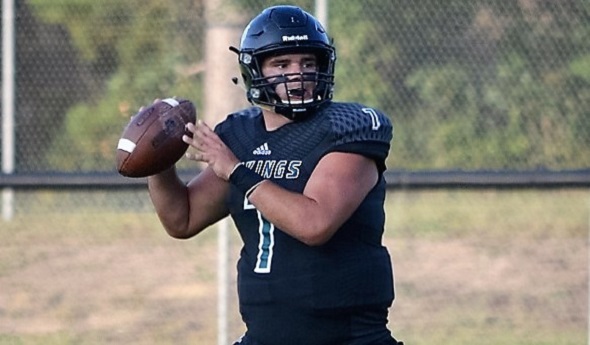
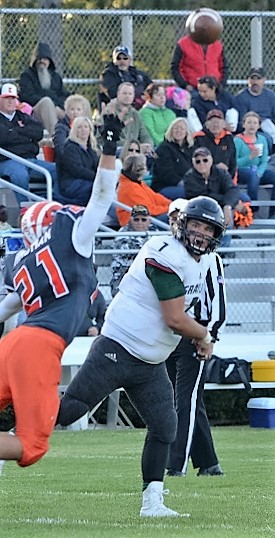
PHOTOS: (Top) Grayling quarterback Justin Nicholas surveys his options during a Week 1 win over Roscommon. (Middle) Nicholas prepares to run against Kalkaska last week. (Below) Nicholas unloads a pass during the Week 3 victory over Kingsley. (Photos courtesy of the Grayling football program.)