


MHSA(Q&)A: Mendon football coach John Schwartz
February 2, 2012
 John Schwartz didn’t really want the Mendon football head coaching job when a group of players convinced him to take it before the 1989 season. And his first contract started out on a napkin. The rest is history.
Mendon won its 11th MHSAA football championship this fall, downing Fowler 33-0 in the Division 8 Final, to tie for third-most football titles won by one program. Schwartz has coached in the program for all 11, including 10 as head coach, and his record of 236-39 gives him a winning percentage of .858, tops in the MHSAA record book. He recently was selected as this year’s recipient of the high school Duffy Daugherty Award, annually given for career contributions to the game. He follows recent winners Ralph Munger of Rockford and Herb Brogan of Jackson Lumen Christi.
His Mendon teams have had just one losing season. And although he retired a year ago after 36 teaching middle school science, and then fought off cancer over the summer, he has no plans to leave his post on the Hornets’ sideline.
How would you characterize your program?
I think we have very good coaches and I think the kids respect the coaches, and they know the coaches think more of them than just being football players. They care about them. We have their attention, and what we really try to do is form a team concept as soon as we can. We try to stay away from giving any one person too much recognition. We don't give out MVP awards at the end of the year. It's a program where we're all in it together: coaches, kids and community. We try to get the best out of the kids, give the kids the best shot we have at being the best we can be.
How does a small school continue to reload every season?
My first year there, the first thing I did as a head coach was I started the junior high program. I think that's where everything starts. We even have the younger kids called the rocket kids, and those coaches come in and talk about (football) terms so when kids move from one level to another there's no re-teaching. Everyone has an ego, coaches have egos, and they like to do some things differently. But we don't have that. They do what we do. We give them a lot of flexibility, but we have certain drills we want to run. By the time we get them, these kids are in tune with what we are doing. The summer program also is something I started my first year as head coach too. ... It means that during the season we can concentrate more on teaching than conditioning.
You went from 3-6 in 2006 to 12-0 in 2007. Explain how you bounced back.
The losing season we had, we didn't have a lot of kids, and our two best kids were hurt early in the season and couldn't play. We never did bounce back. Even in that season, we were ahead at halftime in all but one game. We just didn't have enough to come back and pull the game out, and we had some very tough games. It wasn't a good season, but I thought those kids played awfully hard for what we had. We got a lot of experience, and it paid off the following year.
Our JVs practice with the varsity. When I work with inside linebackers, I work with (grades) 9-12. Kids learn quicker from kids than from coaches, as far as I'm concerned. ... Football's really changed. It's become a lot more complex. I think we have to delegate more and more every year so we can stay with the changes. It's too much for one person. I remember my first three, four or five years it was just three of us at the varsity level. The other two, neither one taught at the school. We were pretty successful right off the bat, and we started getting more and more interest from people. Now 9-12 we have seven coaches, and we have three at the junior high, and all the coaches but two have played for me. They know what I expect, what I'm looking for, what I want. ... And they want to win. I'd be lost without those guys.
Are there certain seasons that have meant more than others?
The first year I took the job, in 1989, we went undefeated and won a state title. A lot of those kids are very good friends of mine yet, and they're pretty special to me. They were a big boost to my program. In the '95 year, my son was a sophomore on that state title team. I remember a lot about that team.
They all have something they did very well. They either threw the ball well or played great defense or had a big line. When I hear a year now, I think about those teams.
You grew up in a small town (Colon) and have taught and coached in a small town. Was that important for you to do?
I've never taught anywhere else. I never felt I really had a reason to leave. I've gone through at least six superintendents since I've been there. The fourth or fifth said to me, "The only thing that bothers me about Mendon is these people think an awful lot of winning. There are other things." He asked me, "How do you feel about it?" I said, if they didn't feel that way, I wouldn't be here.
Who was your biggest coaching influence?
I would say Morley (Fraser, Jr., under whom Schwartz was an assistant for three seasons). Years before I got there, Mendon was pretty good in the early 70s, and then in the mid 70s football wasn't very good. I was the JV coach the first year, and the second year after two games they brought me up to varsity. The best thing I did was I told them I would not take the head job, but I'll assist. I knew (Fraser) was the kind of person and personality we needed there. It wasn't necessarily all of his football knowledge, but his energy and excitement that he brought to the game.
You said during the Finals postgame press conference that you'd battled cancer during the summer. How did you come back, and did you ever think that might be time to step down?
Everything's fine. I had coaches that took over. At the same time that that happened, I was retiring. If you retire in Michigan, you can't be at the school for one month. So I couldn't be at summer weights all the way through June. So my coaches did all the summer weights. But I had no intention of stepping down. If something (bad) came down ... but once they said they got it, everything went as normal.
After a championship season, how do you ramp things back up for the next fall and a new group of players?
When we go to the playoffs, we take all the JVs unless there are couple who don't want to go. They experience that and get an extra five weeks of practice if we win a state title. And they're excited about it. They want to do that. They’ve' tasted it, and they want a part of that the next year. We remind them it's not what you did, it's what can you do for me now. ... This is your year.
We talk about winning state championships from day one. A lot of people say we shouldn't do that, but why not? Isn't that the ultimate goal? I can't imagine telling a team we think we could be 7-2 this year. We expect to be 9-0 every year. Of course, that's not going to happen. But at same time, I think the losses make you better the following week. We've won state titles where we haven't won the league title. ... You get better.
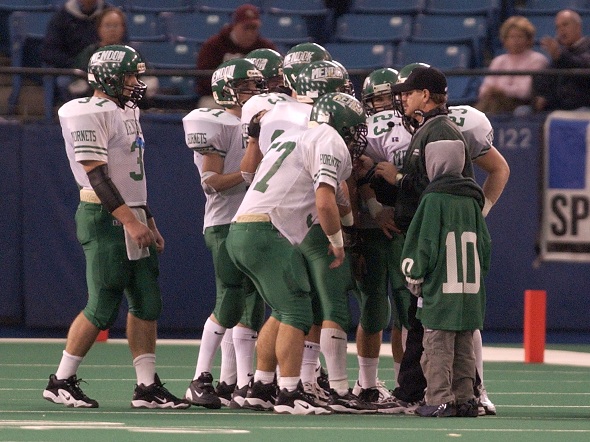
PHOTO: Mendon coach John Schwartz talks things over with his players during the Hornets' 21-14 win over Decatur in the 2002 Division 7 Final at the Pontiac Silverdome.
Drive for Detroit: Week 8 in Review
October 16, 2017
By Geoff Kimmerly
Second Half editor
We’re chewing on a lot of football numbers this week at the MHSAA office with this season’s playoff selection just days away.
 Some of the most important after Week 8 are 176 – as in the number of 11-player teams that have earned spots in that 256-team playoff field – and 78, the number of teams one win away from automatic qualification.
But this second-to-last weekend of the regular season gave us plenty of other numbers to enjoy as well. Like 431, the number of career wins and an MHSAA record for Farmington Hills Harrison coach John Herrington after his team defeated Berkley 39-0. Ionia also set an MHSAA record Friday, coming back from 32 points down at halftime to beat McBain 41-40 in the largest football comeback in MHSAA history.
How about 703, the number of running (238) and passing (465) yards combined for Essexville Garber’s Hunter Bridenbaugh in a 60-47 win over North Branch? That total, as reported by the Bay City Times, will rank third in the national record book once submitted and approved. Then there’s 616, the total passing yards for Grayling’s Justin Nicholas in a 58-46 win over Benzie Central as reported by the Traverse City Record-Eagle – which rank as the second-most passing yards in one game in MHSAA history.
Finally, 27. Congrats to Flat Rock, which clinched its first playoff berth since 1990 – 27 years ago – with a 14-7 win over New Boston Huron.
And if that’s not all … check out below the results that jumped out most from all of the statewide action in this week’s “Drive for Detroit” powered by MI Student Aid.
Bay & Thumb
Algonac 34, Richmond 14
One of the best stories statewide over the last few seasons, Algonac (7-1) clinched its first outright league title since 1972 by downing second-place Richmond in the Blue Water Area Conference after splitting the championship with the Blue Devils (7-1) in 2015. It’s key to recall Algonac was 1-8 in 2014 and hadn’t had a winning season since 2005 before rattling off a combined 28-5 record over the last three. Click for more from the Port Huron Times Herald.
Also noted:
Midland Dow 45, Flint Carman-Ainsworth 14 – Thanks to a one-point loss to Bay City Central in Week 2, Dow (7-1) trailed the Cavaliers (5-3) by a win in the Saginaw Valley League Red entering the conference finale before forcing a shared title.
Midland 35, Lapeer 14 – The Chemics (7-1) finished a perfect run through the SVL Blue while putting third-place Lapeer (5-3) into a must-win situation this week to guarantee a playoff spot.
Saginaw Swan Valley 36, Alma 19 – This was the final obstacle Swan Valley (7-1) needed to navigate to clinch the outright Tri-Valley Conference Central title; Alma (6-2) is one of three teams that tied for second.
Harbor Beach 26, Ubly 14 – The Pirates (7-1) came away with the Greater Thumb Conference East title by downing second-place Ubly (6-2) in their final league game of this season.
Greater Detroit
Detroit Martin Luther King 17, Detroit Cass Tech 7
With these rivals this season in different divisions of the Detroit Public School League, King (7-1) avenged a pair of 2016 losses to the rival Technicians while holding Cass Tech (5-2) to its fewest points since 2013. But while winning this matchup frequently makes the victor the best in the PSL, King still has a tough one ahead – the Crusaders will face undefeated East English on Friday in the PSL A championship game. Click for more from the Detroit News.
Cass Tech fumbles on the goal line. King leads 17-7 4th 2:48 pic.twitter.com/6ZnR8wsmeM
— Rico Beard (@RicoBeard) October 14, 2017
Also noted:
Warren DeLaSalle 20, Detroit Catholic Central 6 – The Pilots (6-2) finished a perfect run through the Catholic League Central, earning themselves a rematch this week with DCC (5-3) this time for the Prep Bowl A-B championship.
Warren Michigan Collegiate 46, Harper Woods Chandler Park 20 – The Charter School Conference title came down to this game as both teams entered undefeated in league play; Michigan Collegiate (8-0) remains undefeated overall while Chandler Park (5-3) must win this week to guarantee a playoff spot.
Grosse Pointe North 45, Roseville 28 – The Norsemen (5-2) and Port Huron both trailed Roseville (5-3) by a win in the Macomb Area Conference Blue entering the weekend, and all three will share the league title thanks to North’s win.
Ferndale 20, Hazel Park 17 (2OT) – Ferndale (7-1) also forced a three-way championship in the Oakland Activities Association Blue, giving Hazel Park (5-3) its first league loss to create a first-place tie between these two teams and Auburn Hills Avondale.
Mid-Michigan
Haslett 20, Williamston 14
Coming off a league title-deciding loss to rival DeWitt, Haslett bounced back to move to 6-2 – two wins better than a year ago and tying their most since 2006. The Vikings’ good fortune was accompanied by more hard luck for Williamston (5-3), which has three defeats by a combined 14 points and must win this week to guarantee a playoff spot against a Lake Fenton team that hasn’t lost since opening night. Click for more from the Lansing State Journal.
TD Halsett. Ben Brittain sweeps outside for the 5 yard score. The Hornets blocked the XP. Vikings 6, Hornets 0. pic.twitter.com/dytTY7Lvxi
— Jake Atnip (@JakeAtnip) October 13, 2017
Also noted:
Olivet 27, Berrien Springs 17 – The Eagles (8-0) moved to within one more win of their first perfect regular season since 2005 by avenging last season’s 61-7 playoff loss to the Shamrocks (6-2).
East Lansing 9, Lansing Sexton 7 – This shouldn’t result in Sexton (5-3) not earning a playoff bid with winless Eastern up next, but it got East Lansing (6-2) into the playoffs with a more precarious game coming up against playoff hopeful Okemos.
DeWitt 33, Linden 3 – The Panthers (7-1) have won six straight recent meetings with Linden (6-2), including the first two of this string in the playoffs.
Portland 29, Pontiac Notre Dame Prep 27 – In a great playoff prep game for both, Portland (7-1) survived its closest since a Week 2 loss while the Fighting Irish (6-2) have suffered their two defeats by a combined seven points.
Northern Lower Peninsula
Lake City 35, Lincoln Alcona 34
The Highland Conference champion Trojans (8-0) moved to within one more win of their first perfect regular-season since the start of the playoff era in 1975 and after going only 2-7 a year ago. Alcona (6-2) pulled within a score of the lead multiple times and should be a dangerous playoff team – the Tigers’ losses this season are by a combined three points. Click for more from the Cadillac News.
Also noted:
Boyne City 40, Elk Rapids 10 – The Ramblers (8-0) guaranteed the Northern Michigan Football League Leaders championship will come down to this week’s matchup with undefeated Traverse City St. Francis; Elk Rapids (6-2) can still this week get to seven wins for the first time since 2010.
Gaylord St. Mary 30, Harbor Springs 0 – The Snowbirds (8-0) secured a share of the NMFL Legacy title while sending Harbor Springs (4-4) into second place and hoping for both a split title and an at-large playoff bid.
Whittemore-Prescott 42, Hillman 41 – The Cardinals’ string of 10 straight playoff seasons got additional life as the team moved to 4-4, while Hillman’s streak of 11 straight postseason trips also now will hinge on an at-large bid as the Tigers fell to 4-4.
Oscoda 36, Muskegon Heights Academy 23 – The Owls (5-3) put themselves in position to clinch not only their second playoff berth in three seasons, but also their second over the last 17; Muskegon Heights (3-5) fell out of playoff contention but still has its best record since 2014.
Southeast & Border
Michigan Center 41, Grass Lake 14
The Cascades Conference ended with three teams sharing the championship, and Michigan Center joined Addison and Napoleon among the celebrators by downing reigning league title winner Grass Lake (4-4). The Cardinals also beat Grass Lake in 2016, but the Warriors were able to win the conference last year with that one defeat. The Cardinals (7-1) have their most wins since 2013 and one more than a year ago heading into this week’s crossover with Big 8 Conference champion Reading.
Also noted:
Adrian Lenawee Christian 21, Athens 20 (OT) – This was something of an undercard in the Southern Central Athletic Association, but key for both teams as Lenawee Christian (6-2) secured a playoff berth and forced Athens (5-3) to now beat Climax-Scotts this week if it is to make the postseason for the first time since 2000.
Ann Arbor Gabriel Richard 16, Detroit U-D Jesuit 14 – After falling to Dearborn Divine Child by a point in Week 7, the Fighting Irish (7-1) pulled out the close victory over a U-D Jesuit team that at 3-5 has four losses by 10 points or fewer.
Hillsdale 27, Ida 8 – The Hornets (4-4) kept themselves in the playoff hunt while dealing the Lenawee County Athletic Association race an unexpected shuffle; Ida was tied for first with Hudson and looking good to share the title, but now the Tigers can clinch it outright this week.
Ypsilanti Lincoln 23, Temperance Bedford 19 – After two straight four-win seasons and two losses to start this one, Lincoln (6-2) is headed back to the playoffs while Bedford (6-2) already had secured a second straight berth.
Southwest Corridor
Mendon 34, Cassopolis 24
Mendon (8-0) never really went away, but is looking more and more like the dominant teams that won at least 10 games eight straight seasons from 2007-14. Beating Cassopolis (7-1) cemented that observation, as both teams were undefeated heading into the weekend and a share of the Southwest 10 Conference title was on the line. Mendon had fallen to Cassopolis the last two seasons. Even after giving up 24 points to the Rangers, the Hornets still have allowed just 45 over eight games this fall. Click for more from JoeInsider.com.
Also noted:
Pittsford 28, Climax-Scotts 14 – The Wildcats (7-1) clinched the Southern Central Athletic Association title outright by breaking an 11-game losing streak, including playoffs, to the rival Panthers (6-2).
Ottawa Lake Whiteford 52, Clinton 21 – The Bobcats (8-0) clinched a share of the Tri-County Conference title while sending Clinton (5-3) from a second-place tie into third and needing a win this week to make the playoffs for the sixth straight season.
Edwardsburg 54, Vicksburg 27 – This took the Wolverine B Conference race from three first-place teams down to two with a game to play and Edwardsburg (7-1) sure to watch closely as Vicksburg (6-2) takes on co-leader Three Rivers this week.
Watervliet 36, Schoolcraft 14 – Watervliet (8-0) secured a Southwestern Athletic Conference Valley title even as second-place Schoolcraft (5-3) became the first this season to hold the Panthers to fewer than 50 points.
Upper Peninsula
Iron River West Iron County 30, Hancock 13
For the second straight season Hancock has been a contender in the Western Peninsula Athletic Conference, but the Wykons (7-1) are again the team to beat. West Iron clinched the league title outright with its sixth straight win over the Bulldogs, who also tied for second in the league last season behind champion Calumet. Hancock (6-2) remains a win better than a year ago with its most victories since 2006, while West Iron can get to eight wins this week for the first time since 2014. Click for more from the Iron Mountain Daily News.
Also noted:
Kingsford 42, Menominee 21 – The Flivvers (6-1) did their part to turn this week’s meeting with Escanaba into a Great Northern Conference championship game as both are undefeated in the league; Kingsford hadn’t beaten Menominee (5-3) since 2012.
Marquette 35, Negaunee 19 – The Redmen (4-4) have a chance at an at-large playoff bid still if they can beat Menominee this weekend, and regardless have as many wins this fall as the last two seasons combined; Negaunee must beat Ishpeming Westwood this weekend to have a chance at extending its five-season playoff streak.
Norway 21, Lake Linden-Hubbell 11 – The Knights (7-1) secured a shared Mid-Eastern Conference title with Newberry; the Lakes (3-4) face winless Manistique this week with a chance still at an at-large playoff bid.
Calumet 30, Bessemer Gogebic – The Miners (3-5) had upset the playoff chances of two hopefuls two weeks in a row, but Calumet (5-3) hung on to earn a chance to clinch a spot this week.
West Michigan
Grand Rapids Catholic Central 35, Grand Rapids West Catholic 33
Of course it’s rare to have a pair of reigning MHSAA champions meet with a league title on the line. And this time there even was a little revenge to be had. Last year’s Division 4 title winner GRCC (8-0) claimed its second straight game this month by seven points or fewer to clinch a share of the Ottawa-Kent Conference Blue title. The Cougars moved into the Blue last season and finished second to eventual Division 5 champion West Catholic (6-2), which handed GRCC its only loss last season. The Falcons scored late this time to pull within two, but could get no closer. Click for more from the Grand Rapids Press.
Huge touchdown by Catholic Central. Leads West Catholic 35-26. 3:09 left. Catholic Central crowd loving it! #frenzy8 @woodtv pic.twitter.com/XnOOAjdJHx
— Luke Stier (@LukeStier) October 14, 2017
Also noted:
Grand Rapids Forest Hills Central 35, Cedar Springs 20 – The Rangers (8-0) finished a perfect run through the O-K White by handing second-place Cedar Springs (5-3) its first league loss in what also ended up Forest Hills Central’s closest league game.
Muskegon 35, Muskegon Mona Shores 24 – Ladarius Jefferson ran 34 times for 285 yards and four touchdowns as the Big Reds (8-0) earned a share of the O-K Black title by downing rival Mona Shores (7-1) for the third time in a row.
Rockford 24, East Kentwood 10 – The Rams (5-3) have a chance to make it to the playoffs for the 23rd straight season thanks to this bounce-back win over the Falcons (5-3), who also can earn an automatic berth this week.
Wyoming Kelloggsville 27, Belding 3 – The Rockets (8-0) faced what have ended up the second, third and fourth-best teams in the O-K Silver three weeks in a row and claimed a share of the league title by knocking Belding (6-2) out of their tie for first.
8-Player
Central Lake 42, Onekama 28
As noted in Friday’s preview, these two both could end up in MHSAA Finals at the Superior Dome, but Central Lake has claimed the first of their possible championships this fall with this win deciding the Midwest Central Michigan Conference title. New to 8-player this season, the Trojans (8-0) were 2-7 last season in 11-player and last won a league title in 2008. Onekama moved to 7-1 after going 6-4 in 11-player last season. Click for more from the Traverse City Record-Eagle.
Also noted:
Pickford 47, Cedarville 8 – Pickford (8-0) claimed a share of the Bridge Alliance championship after finishing second last season and while dealing Cedarville (6-2) a second straight defeat.
Mayville 46, Bay City All Saints 34 – Mayville (5-3) can’t win the North Central Thumb League Stars championship, but dealt a loss to the Stripes’ co-leading Cougars (6-2).
Powers North Central 36, Rapid River 0 – Just when it looked like reigning MHSAA champion North Central (5-2) might go quietly into the offseason, the Jets stunned the state’s 8-player scene handing Western Eight Conference leader Rapid River (7-1) its first defeat a week after the Rockets handed a first loss to Stephenson.
Portland St. Patrick 24, Marion 8 – The Shamrocks (7-1) are playing in a two-team league but now also have a win over Marion (6-2), which ran the table in the West Michigan Conference.
Second Half’s weekly “Drive for Detroit” previews and reviews are powered by MI Student Aid, a part of the Student Financial Services Bureau located within the Michigan Department of Treasury. MI Student Aid encourages students to pursue postsecondary education by providing access to student financial resources and information, including various student financial assistance programs to help make college more affordable for Michigan students. MI Student Aid administers the state’s 529 savings programs (MET/MESP) and eight additional aid programs within its Student Scholarships and Grants division. Click for more information and connect with MI Student Aid on Facebook and Twitter @mistudentaid.
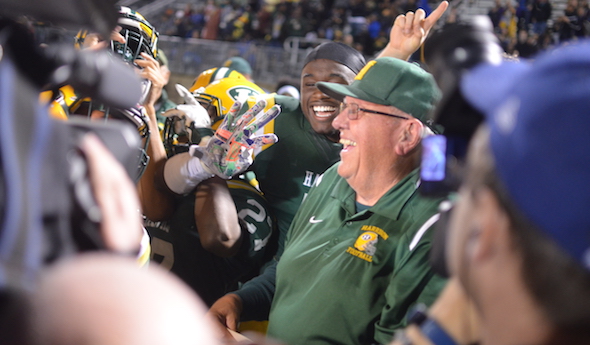
PHOTO: Farmington Hills Harrison coach John Herrington enjoys the postgame fanfare with his team after setting the MHSAA record with his 431st career victory. (Click for more from HighSchoolSportsScene.com.)