


MHSA(Q&)A: Menominee football coach Ken Hofer
June 28, 2012
By Brian Spencer
Second Half
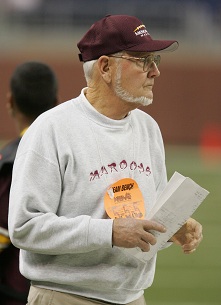
Ken Hofer has been nothing short of legendary during more than three decades as Menominee’s head football coach -- a tenure that came to an end earlier this month when he announced his retirement.
In 41 seasons -- including his first two, at Stephenson -- he won three MHSAA championships (1998, 2006, and 2007) and built a record of 342-136-3. He is one of nine coaches in MHSAA football history with at least 300 wins.
He guided more than a thousand athletes, and that influence extended to league rival Kingsford -- where his son Chris Hofer is the football coach. Ken also is known statewide as the guru of the single wing offense, a rarely-used but for the Maroons frequently unstoppable attack that does not utilize a traditional quarterback.
Hofer is a member of the Michigan High School Football Coaches Association and Upper Peninsula Sports Halls of Fame. He also served as the Menominee athletic director, principal, and assistant principal. He grew up in Stephenson, where he was an all-stater in football and track and field, and later competed in both sports at the University of Wisconsin.
Did you always want to become a football coach?
I was predicted to be a coach somewhere in our (Stephenson) annual (yearbook). So I suppose I was always predetermined to coach. However, before coaching I was in the service as a Lieutenant and spent two years in Germany. After Germany, I spent another five years working for Wilson Sporting Goods before I finally came back in 1964 to coach football and teach social studies for Stephenson.
How did you decide it was time to hang up the whistle?
Well, I’m 77 years old, so age was definitely a determinant. The biggest factor was that as much as my mind said I could continue, my body said “slow down.” So I guess age and my inability to continually go full throttle and stay energetic helped me make my decision.
In your 45 seasons, what is the most helpful piece of advice you are going to take away?
The best advice I will take away is to treat young people the way I like to be treated.
 What do you plan to do with your free time, now that your schedule has opened up slightly?
I am going to try and catch up on stuff that should have been done a long time ago. I’m sure that my wife will give me plenty of stuff to do, too. I also want to try to travel more and visit my kids. I now have a grandson who will be playing for Kingsford, so I will become a fan of my grandson’s at his Kingsford games.
Now that your grandson and son both have affiliations with Kingsford, will you become a Kingsford man?
No (chuckling), I will cheer for my son and grandson, but I will forever be connected with Menominee and Stephenson.
What was it like to be recognized by both the Michigan High School Football Coaches Association and Upper Peninsula Sports Halls of Fame?
It was like a utopia for coaching. When your peers give that honor it is a pretty special time. As a coach you don’t strive for that kind of accolade; however, it is definitely a special honor to receive.
What has been, in your opinion, your greatest achievement as Menominee’s head football coach?
My greatest achievement will always be working with younger people; I think that is the most important thing that most coaches would like to have, is the ability to stay young by working with these young men. You don’t always have to win to have that experience. Winning on the field doesn’t always correlate winning in other aspects of your life.
What advice can you give aspiring or current coaches who look to share similar successes as a head coach?
The biggest thing is to make sure that you treat the players like you like to be treated. Using that approach will get a great response.
Of your 300-plus career wins, is there any one that you find particularly special?
I always found that whenever I could beat Kingsford when my son was coaching (he said, followed by a bellowing laugh). My son Chris will like that one.
There are so many that I consider to be special. There were a ton of close games, too many to count. Two years ago, we had one of those close games where we played Morley-Stanwood, and won 41-40 in overtime (in a 2010 Regional Final). The young men played very hard. It was very special.
Do you think that your son will follow in your footsteps and coach for 45-plus seasons?
I think Chris has that type of coaching in his blood. He’s struggling physically with a knee injury; however he has a coaching mind that is as strong as ever. I think he’ll coach until he won’t be able to.
Drive for Detroit: Week 1 Preview
August 22, 2018
By Geoff Kimmerly
Second Half editor
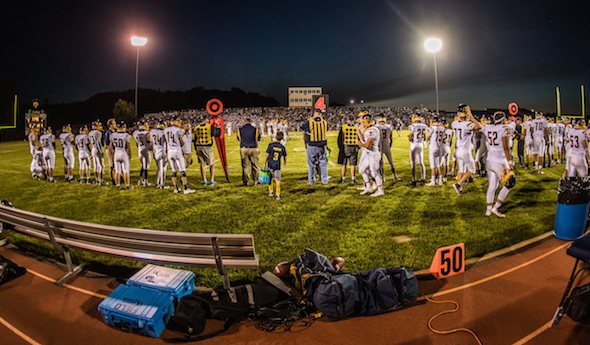
The lights are ready to shine again at high school football stadiums all over Michigan.
 We kick off the 2018 season this weekend with anticipation – not to mention multiple matchups of reigning MHSAA Finals champions and a third game between teams that closed last fall at Ford Field.
Below is the first of 14 “Drive for Detroit” weekly previews aimed at providing a glance at the most intriguing games in every corner of the state through November’s 11-Player Finals at Ford Field. No matter where you’re located in Michigan, we’ll provide at least a handful of local games sure to be worth a trip.
Varsity games this week and next will be played Thursday, Friday and Saturday. Check out the MHSAA Score Center for the full schedule and results as games are completed.
Be sure to check out as well the list of 15 games this weekend being broadcast on MHSAA.tv, including all three from the Vehicle City Gridiron Classic at Flint’s Atwood Stadium, four games from the Prep Kickoff Classic at Wayne State University, two games from the Battle at the Big House at University of Michigan and two games from the GRidiron Classic at Grand Valley State University.
“Drive for Detroit” previews are powered by MI Student Aid. Please click the adjacent linked logo and read below for more information on how MI Student Aid is providing Michigan’s high school students with money to help pay for college.
Bay & Thumb
Linden (9-3) at Flushing (9-3), Thursday
All but one team in the nine-team Flint Metro League opens with a league game, and Linden’s 27-22 win over Flushing on opening night 2017 meant the eventual difference between second and third place behind champion Fenton. With all three anticipating being in the hunt again, tonight’s rematch could have similar significance. The Eagles have won the last three games in this series.
Other that caught my eye: THURSDAY Grand Blanc (7-3) at Midland Dow (7-3), Hudson (9-2) at Elkton-Pigeon-Bay Port Laker (10-2) FRIDAY Muskegon Catholic Central (8-2) at Algonac (10-2), Ubly (7-3) at Unionville-Sebewaing (5-5).
Greater Detroit
River Rouge (10-3) vs. Detroit Cass Tech (9-3), Saturday at Wayne State University
This 3 p.m. Saturday kickoff is the premier game of this season’s Prep Kickoff Classic, with both coming off MHSAA Semifinal runs – Cass Tech in Division 1 and River Rouge in Division 4. Both are expected to again contend for spots playing during the final weekend of this season at Ford Field – with a number of their players going on to play Saturdays at the college level as well.
Others that caught my eye: THURSDAY Oak Park (9-3) vs. Utica Eisenhower (11-1) at Wayne State, West Bloomfield (11-3) at Birmingham Groves (7-3) FRIDAY Detroit Mumford (7-4) at Detroit Country Day (4-5), Macomb Dakota (7-4) at Orchard Lake St. Mary's (2-6).
Mid-Michigan
Pewamo-Westphalia (13-1) vs. Ithaca (13-1), Friday at Alma College
Both played at Ford Field to close the 2017 season, Pewamo-Westphalia as the Division 7 champion and Ithaca as Division 6 runner-up. Many of the standouts who led the Pirates to back-to-back MHSAA titles are gone as the next group looks to build on a 40-2 run over the last three seasons. The Yellowjackets also are debuting some important new faces – and guarding a 73-game regular-season winning streak.
Others that caught my eye: THURSDAY Portland (10-2) at Ovid-Elsie (7-3), Beaverton (8-2) at Breckenridge (10-2), Belleville (10-1) at Brighton (4-5), Grand Rapids Christian (7-3) at DeWitt (10-2).
Northern Lower Peninsula
New Lothrop (10-1) at Maple City Glen Lake (7-3), Thursday
A pair of league champions match up with some historical significance on the line. New Lothrop has only one league loss over the last eight seasons. The Lakers haven’t lost a season opener since 2003. The Hornets’ new league schedule also is bookended with another tough test this fall – Traverse City St. Francis in Week 9.
Others that caught my eye: THURSDAY Midland (8-2) at Traverse City West (9-2), Oscoda (6-4) at Houghton Lake (7-4) FRIDAY Newberry (6-3) at Frankfort (8-3), Johannesburg-Lewiston (6-4) at Manton (4-5).
Southeast & Border
Grand Rapids West Catholic (12-2) at Jackson Lumen Christi (12-1), Friday
As West Catholic has won the last five Division 5 championships, and Lumen Christi has won the last two in Division 6, this will be the second straight season they’ll open meeting as reigning title winners. Last season’s chapter went Lumen Christi’s way, 27-24, and the Titans have won two of three in their recent series.
Others that caught my eye: THURSDAY Clinton Township Chippewa Valley (10-2) at Saline (7-2), FRIDAY Clarkston (12-2) vs. Grandville (6-4) at University of Michigan, Homer (6-4) at Michigan Center (9-2), Morenci (6-4) at Pittsford (9-2).
Southwest Corridor
Battle Creek Harper Creek (12-1) at Benton Harbor (5-5), Friday
Harper Creek’s only defeat of 2017 came in a Division 3 Semifinal against Muskegon, the division’s eventual champion. The Beavers start over again with an intriguing matchup. Benton Harbor has a new coach and is hoping to keep the same momentum that led to the Tigers’ first three playoff appearances ever over the last three seasons.
Others that caught my eye: THURSDAY Three Rivers (8-3) at Plainwell (8-3), Berrien Springs (6-4) at Kalamazoo United (8-3), Williamston (7-5) at Battle Creek Pennfield (4-5) FRIDAY Freeland (6-4) at Marshall (4-5).
Upper Peninsula
Norway (9-2) at Lake Linden-Hubbell (4-5), Saturday
The expanded Western Peninsula Athletic Conference gets going right away, with these former Mid-Eastern Conference rivals the most notable opener. Lake Linden-Hubbell suffered its first regular-season loss in three years last season but still made the playoffs at 4-4. Norway is coming off its second straight nine-win season and shared the final M-EC title.
Others that caught my eye: FRIDAY Traverse City St. Francis (11-2) at Marquette (4-5), Hancock (7-3) at L'Anse (4-5), Munising (4-5) at Iron River West Iron County (11-2) SATURDAY Menominee (8-4) at Marinette, Wis. (3-6).
West Michigan
Warren DeLaSalle (12-2) at Muskegon (14-0), Friday
From an area always loaded with top opening-weekend matchups, it’s hard to argue with the reigning Division 3 champion hosting the reigning Division 2 winner. Both are replacing graduated star quarterbacks, but also return talented casts – the Pilots should be strong defensively, while Muskegon remains huge up front and likely to pile up rush yards again this fall.
Others that caught my eye: THURSDAY Stevensville Lakeshore (9-2) at Holland West Ottawa (10-2) FRIDAY Newaygo (7-3) at Kent City (10-1), Montague (11-1) at Reed City (11-2) SATURDAY Zeeland East (9-1) vs. East Grand Rapids (9-1) at Grand Valley State
8-Player
Stephenson (9-3) at Cedarville (8-3), Friday
Did you know: Cedarville has 13 straight winning seasons and 14 straight playoff appearances (finishing 5-5 in 2004). The Trojans will begin their march to extend those streaks against a Stephenson team coming off its winningest season since 2003 and having ended Cedarville’s 2017 in a Division 1 Regional Final.
Others that caught my eye: FRIDAY Deckerville (11-2) at Flint International Academy (8-3), *Mount Pleasant Sacred Heart (6-4) at Hillman (6-5), Pickford (11-1) at Mesick (5-5), Marion (7-3) at Onekama (9-2) (*both played 11-player last season).
Second Half’s weekly “Drive for Detroit” previews are powered by MI Student Aid, a part of the Student Financial Services Bureau located within the Michigan Department of Treasury. MI Student Aid encourages students to pursue postsecondary education by providing access to student financial resources and information, including various student financial assistance programs to help make college more affordable for Michigan students. MI Student Aid administers the state’s 529 savings programs (MET/MESP) and eight additional aid programs within its Student Scholarships and Grants division. Click for more information and connect with MI Student Aid on Facebook and Twitter @mistudentaid.
PHOTO: Grand Ledge’s sideline takes in a Friday night view during last season's game against rival DeWitt. (Click to see more from HighSchoolSportsScene.com.)