


MHSA(Q&)A: NFL official Ronald J. Winter
July 19, 2012
By Brian Spencer
Second Half
 Kalamazoo's Ron Winter has officiated in the National Football League for nearly two decades, and became a referee in 1999. But long before he joined the highest level of the game, he got his start on Michigan's high school fields.
Winter has officiated that sport at all three levels and also high school and college basketball. He's also served as a source of knowledge for officials around the state -- and an example for those hoping to start at the high school level and climb to the pros.
Winter remains registered as an MHSAA official, as he's been for 42 years. An associate professor emeritus of human performance and health education at Western Michigan University, Winter was appointed earlier this month to serve a two-year term on the Governor's Council on Physical Fitness, Health and Sports. The council focuses on increasing physical activity and health improvements.
He served on the WMU faculty first beginning in 1969 and then again from 1992-2008. Winter earned bachelor and master's degrees at Michigan State University.
Did you play any sports in high school or college?
I played football, basketball, baseball, and track in high school. However, once I got to Michigan State University, I started playing lacrosse. A couple guys that lived near me played lacrosse and asked me to come out to throw the ball around. After throwing with them a couple times they asked me to come out for the team. I ended up playing lacrosse for MSU for four years.
How did you decide to choose football as the sport you would officiate?
I started officiating as a student at MSU in their intramural program, officiating touch football and basketball. The next logical step was to then officiate in the high school leagues. From there, I began to proceed to all the different levels.
Are there specific requirements for becoming an NFL official?
The biggest requirement is experience. The progression that I went through went like this:
After officiating high school games, I went to the MIAA (Michigan Intercollegiate Athletic Association). They (MIAA) were looking for people that had 3-5 years of experience at the high school level. From there I went to the Mid-Continent conference. I wasn’t able to go to the Mid-American Conference because I was employed at Western Michigan University.
From there I went to the Big Ten. The Big Ten was looking for people with 5 to 10 years of experience in high school and people that had experience at different positions as an official. I ended up officiating in as a Big Ten football official for 10 years and a Big Ten basketball official for 15 years. I then submitted an application to the National Football League. Coincidentally, the NFL was scouting officials, and had followed me for four years before they finally asked me to be a part of the staff. The NFL decides on who they want to pursue through recommendations and personal interest. They look for personality traits as well as how (officials) carry themselves through different situations.
What has been your favorite level to officiate; High school, college or professional?
I enjoyed officiating all of them, but for different reasons.
I found high school to be the most fascinating because it’s all about the kids; they are playing the game for the love of the game. That is the purest sense of the sport. I loved being involved with kids simply because they love the game.
I found the Big Ten to be most exciting because of the kind of atmosphere that exists on a Big Ten campus on a Saturday afternoon. It’s electric. You don’t get that same sense or the same feel on Sunday afternoon in a pro stadium.
I found the NFL to be most intense. The NFL really has three or four different levels of play during the season. There is preseason play, the first third of the season, the second third of the season, and the last five games of the season. Each level is ramped up another notch as the season progresses. Playoffs are entirely different all together. In terms of the intensity and pure speed of the game, there is nothing like the NFL playoffs.
How important is getting along with your fellow officials on the field?
It’s imperatively important if you want to have a smooth and well-run game. This doesn’t mean that you have to buddy-buddy off the field, but on the field you have to be committed to one goal. We spend two or three hours on meetings Saturday afternoon to go over rules tests, tape, and more to prepare for the next game (and) to get over rough patches that develop on a personal level in a previous week. I need to know that the other six guys are focused and thinking about football like me. Everyone has to have confidence in one another. We spend plenty of time on Saturday to get to the point that we need to on Sunday.
What has been the most exciting game you’ve officiated?
I’ve been in plenty of exciting games from NFL playoff games, to the first Orange Bowl game, to the Rose Bowl, to the Division III Hope vs. Calvin basketball game, to when Indiana played Purdue in basketball. All of them were incredible to be a part of. During the Indiana vs. Purdue game, the arena was electric. The players, coaches, fans were intense. Everybody is totally focused on the game. Each coach had a tremendous respect for one another. Neither one wanted to show up or embarrass their counterpart. This game wasn’t that drastically different at the Division III level, however. The intensity of both was very similar.
Are there games that you get excited to officiate more than others, presently?
Not in terms of specific teams. It really just depends on the circumstances, of course. Pittsburgh vs. Baltimore is an intense game. The Jets vs. Patriots game is great. There are clearly rivalries that are very exciting to be a part of. The level of play and intensity of the athletes in the NFL is unmatched and can provide excitement every week.
What is the most difficult aspect of being a NFL official?
I would say that preparation and being able to maintain intensity on the field on Sunday are key aspects. The preparation is difficult because it’s time-consuming. It is a misconception that we simply show up on Sunday to work the game. By the time Sunday rolls around, I’ve spent over 20 hours during the week trying to prepare for a Sunday game. It isn’t hard in terms of physical labor, but difficult in terms of a time commitment. You have to have an understanding family to be in the occupational field that I am in.
Do you have any advice for aspiring officials who hope to make it to the league?
Practice, practice, practice. Be able to work any game at any level and get as much experience as you can. Be a good partner on the field. It takes time; it isn’t something that just happens. Like anything else, it takes practicing your trade to be able to make it to the top level.

Back to Building Boys Into Men, Munger Bringing Newfound Success to Newaygo
By
Tom Kendra
Special for MHSAA.com
November 6, 2024
NEWAYGO – After a long, physical practice Tuesday, as the light rain started to intensify, Newaygo coach Ralph Munger decided to squeeze in a quick game of “Simon Says.”
 Within a few minutes, players were laughing, making fun of each other for clapping their hands when Munger didn’t say the magic words (and doing five push-ups as punishment) – and learning mental focus in the process.
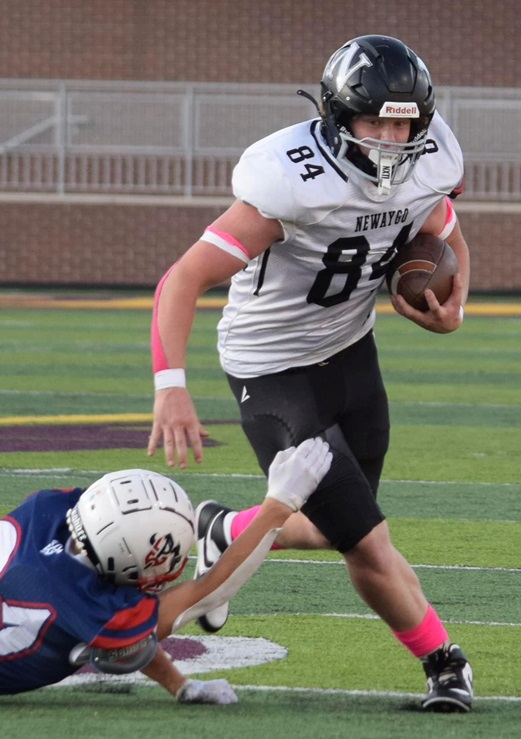
“He’s an old-style coach,” said Newaygo senior Henry Wood, a senior captain and two-way starter. “But he has a crazy passion for the sport, and his football IQ is insane.”
Simon Says is just one of proven techniques the longtime coach is using to teach and motivate his players at Newaygo, which is 8-2 and hosting Central Montcalm on Friday for a Division 6 District championship in just his second year as coach.
Munger, 72, is having a ball at his latest coaching stop and is up to 11 wins over his two years at Newaygo, a small, rural school northwest of Grand Rapids – after winning 80 games in 11 years at Frankenmuth and 255 games over 28 years at Rockford, the latter tenure including five Finals appearances and three titles. He entered this season the sixth-winningest coach in state football history, and heading into this weekend his career record is 343-117.
“We’re making strides, and things are starting to click,” said Munger, who was an all-state football player in his own right at Frankenmuth in the late 1960s. “I feel pretty good, and I thank God every day that he has allowed me to coach again.”
 Newaygo knocked off traditional Division 6 power Montague, 30-17, last week for the school’s first playoff win since 2018.
The Lions are doing it with Munger’s beloved power game, led by senior quarterback Blake Kerr (55-of-99 passing for 805 yards and 10 TDs), junior running back Porter Slominski (130 rushes for 934 yards and 13 TDs) and senior running back Ethan Reyburn (104 rushes for 673 yards and 8 TDs).
Kerr, who has good size at 6-foot-2 and 200 pounds, has thrown primarily to his two fellow senior captains in split end Hunter Yearsovich (18 catches for 255 yards and 3 TDs) and Wood (9 catches for 140 yards and 3 TDs).
Luis Ceja Alvarez (5-10, 155), is a crafty, undersized linebacker who leads the defense with 34 solo tackles and 52 assists. Fellow linebacker Xavier Stroud has 17 solos and 32 assists.
Yearsovich, a team leader and two-way starter with a 4.4 GPA, said he and his senior teammates had an immediate connection with their Hall of Fame coach.
“I’ll never forget when we met him in the gym last year because he talked to us like we were men,” said Yearsovich. “With him, we don’t ever have the mentality that we’re going to lose, no matter who we’re playing. It hasn’t always been like that around here.”
As the Lions broke into groups in the middle of Tuesday’s practice, Munger headed off with the defensive backs.
The joy of hands-on coaching was apparent as he schooled them on back-pedaling and cutting on what could be a muddy playing surface Friday night, and then concentrating and catching a wet ball.
Munger, who had quadruple-bypass, open-heart surgery in the summer of 2019 and has undergone three separate spine surgeries, is thankful to still be able to stalk the sidelines with a whistle around his neck. He endured one long autumn away from coaching, during the COVID year of 2020, which is when he knew he wasn’t done.
“I was going stir crazy,” said Munger with a grin. “I needed my football fix, anywhere.”
 That led him to tiny Mancelona High School, which is near his cabin in northern Michigan, where he helped coach the offensive and defensive lines in 2021 and 2022. He then in 2023 pursued and landed the Newaygo head coaching job, which is a 30-minute drive from his home in Rockford.
He led Newaygo to a fairly typical 3-6 record last year. But with a full year of his coaching under their belts, the Lions are enjoying a breakthrough fall.
Newaygo finished the regular season 7-2, with the only losses coming against Reed City and Big Rapids, who are both still alive in the playoffs. One of the wins came against this week’s playoff opponent, Central Montcalm, 21-12, in Week 2.
Another victory over CM would earn the Lions yet another home game, against the winner of Ovid-Elsie at Lansing Catholic, this time for a Regional championship. Newaygo has never won a football Regional title, and 2012 was the only year it won more than one playoff game, losing to Grand Rapids West Catholic in a Division 5 Regional Final.
Munger said, at this point in his life, his only goals are to bring some positive energy to Newaygo and help his players make the transition from boys to men – the same thing he has been doing for almost 50 years.
“I am enjoying myself, very much so,” said Munger, who is a member of six Halls of Fame for his coaching achievements. “I find it fun getting after all the challenges out here. That’s what drives me.
“That’s the calling that the Good Lord has given me.”
 Tom Kendra worked 23 years at The Muskegon Chronicle, including five as assistant sports editor and the final six as sports editor through 2011. E-mail him at [email protected] with story ideas for Muskegon, Oceana, Mason, Lake, Oceola, Mecosta and Newaygo counties.
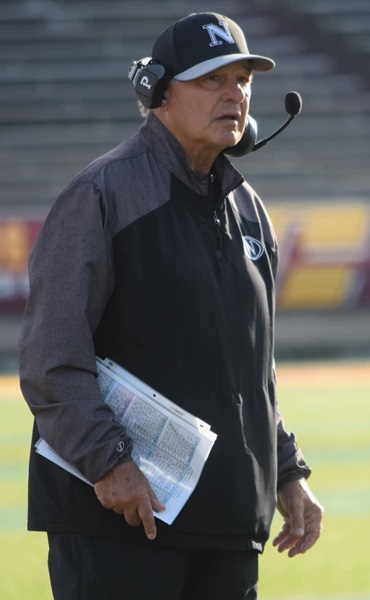
PHOTOS (Top) Newaygo varsity football coach Ralph Munger, right, talks things over with his senior quarterback Blake Kerr during a 53-26 win over Lake Odessa Lakewood on Oct. 18 at Central Michigan’s Kelly-Shorts Stadium. (Middle) Senior tight end Henry Wood (84) works to get past an outstretched defender. (Below) Munger, play sheet in hand, has led the Lions to an 8-2 record. (Photos by Tashina Kerr.)