


MHSA(Q&)A: NFL official Ronald J. Winter
July 19, 2012
By Brian Spencer
Second Half
 Kalamazoo's Ron Winter has officiated in the National Football League for nearly two decades, and became a referee in 1999. But long before he joined the highest level of the game, he got his start on Michigan's high school fields.
Winter has officiated that sport at all three levels and also high school and college basketball. He's also served as a source of knowledge for officials around the state -- and an example for those hoping to start at the high school level and climb to the pros.
Winter remains registered as an MHSAA official, as he's been for 42 years. An associate professor emeritus of human performance and health education at Western Michigan University, Winter was appointed earlier this month to serve a two-year term on the Governor's Council on Physical Fitness, Health and Sports. The council focuses on increasing physical activity and health improvements.
He served on the WMU faculty first beginning in 1969 and then again from 1992-2008. Winter earned bachelor and master's degrees at Michigan State University.
Did you play any sports in high school or college?
I played football, basketball, baseball, and track in high school. However, once I got to Michigan State University, I started playing lacrosse. A couple guys that lived near me played lacrosse and asked me to come out to throw the ball around. After throwing with them a couple times they asked me to come out for the team. I ended up playing lacrosse for MSU for four years.
How did you decide to choose football as the sport you would officiate?
I started officiating as a student at MSU in their intramural program, officiating touch football and basketball. The next logical step was to then officiate in the high school leagues. From there, I began to proceed to all the different levels.
Are there specific requirements for becoming an NFL official?
The biggest requirement is experience. The progression that I went through went like this:
After officiating high school games, I went to the MIAA (Michigan Intercollegiate Athletic Association). They (MIAA) were looking for people that had 3-5 years of experience at the high school level. From there I went to the Mid-Continent conference. I wasn’t able to go to the Mid-American Conference because I was employed at Western Michigan University.
From there I went to the Big Ten. The Big Ten was looking for people with 5 to 10 years of experience in high school and people that had experience at different positions as an official. I ended up officiating in as a Big Ten football official for 10 years and a Big Ten basketball official for 15 years. I then submitted an application to the National Football League. Coincidentally, the NFL was scouting officials, and had followed me for four years before they finally asked me to be a part of the staff. The NFL decides on who they want to pursue through recommendations and personal interest. They look for personality traits as well as how (officials) carry themselves through different situations.
What has been your favorite level to officiate; High school, college or professional?
I enjoyed officiating all of them, but for different reasons.
I found high school to be the most fascinating because it’s all about the kids; they are playing the game for the love of the game. That is the purest sense of the sport. I loved being involved with kids simply because they love the game.
I found the Big Ten to be most exciting because of the kind of atmosphere that exists on a Big Ten campus on a Saturday afternoon. It’s electric. You don’t get that same sense or the same feel on Sunday afternoon in a pro stadium.
I found the NFL to be most intense. The NFL really has three or four different levels of play during the season. There is preseason play, the first third of the season, the second third of the season, and the last five games of the season. Each level is ramped up another notch as the season progresses. Playoffs are entirely different all together. In terms of the intensity and pure speed of the game, there is nothing like the NFL playoffs.
How important is getting along with your fellow officials on the field?
It’s imperatively important if you want to have a smooth and well-run game. This doesn’t mean that you have to buddy-buddy off the field, but on the field you have to be committed to one goal. We spend two or three hours on meetings Saturday afternoon to go over rules tests, tape, and more to prepare for the next game (and) to get over rough patches that develop on a personal level in a previous week. I need to know that the other six guys are focused and thinking about football like me. Everyone has to have confidence in one another. We spend plenty of time on Saturday to get to the point that we need to on Sunday.
What has been the most exciting game you’ve officiated?
I’ve been in plenty of exciting games from NFL playoff games, to the first Orange Bowl game, to the Rose Bowl, to the Division III Hope vs. Calvin basketball game, to when Indiana played Purdue in basketball. All of them were incredible to be a part of. During the Indiana vs. Purdue game, the arena was electric. The players, coaches, fans were intense. Everybody is totally focused on the game. Each coach had a tremendous respect for one another. Neither one wanted to show up or embarrass their counterpart. This game wasn’t that drastically different at the Division III level, however. The intensity of both was very similar.
Are there games that you get excited to officiate more than others, presently?
Not in terms of specific teams. It really just depends on the circumstances, of course. Pittsburgh vs. Baltimore is an intense game. The Jets vs. Patriots game is great. There are clearly rivalries that are very exciting to be a part of. The level of play and intensity of the athletes in the NFL is unmatched and can provide excitement every week.
What is the most difficult aspect of being a NFL official?
I would say that preparation and being able to maintain intensity on the field on Sunday are key aspects. The preparation is difficult because it’s time-consuming. It is a misconception that we simply show up on Sunday to work the game. By the time Sunday rolls around, I’ve spent over 20 hours during the week trying to prepare for a Sunday game. It isn’t hard in terms of physical labor, but difficult in terms of a time commitment. You have to have an understanding family to be in the occupational field that I am in.
Do you have any advice for aspiring officials who hope to make it to the league?
Practice, practice, practice. Be able to work any game at any level and get as much experience as you can. Be a good partner on the field. It takes time; it isn’t something that just happens. Like anything else, it takes practicing your trade to be able to make it to the top level.
1st & Goal: 2024 Playoffs Week 1 Review
By
Geoff Kimmerly
MHSAA.com senior editor
November 4, 2024
The ability to play another day obviously is the best reward for 288 teams that qualify for the MHSAA Football Playoffs.
 But another of the greatest gifts is the chance to make up for a missed opportunity from the regular season.
We highlight below 40 of our 144 first-round games from this past weekend. Of those 40, 15 were rematches – and of those rematches, nine were won the second time by the team that lost the first.
11-Player Division 1
HEADLINER Grandville 24, Rockford 14 For the second-straight season, Grandville (6-4) opened the playoffs with a win – and this time with its first over the Rams since 2019. Rockford (7-3) had defeated Grandville 37-20 in Week 3, but with Tank Terry scoring twice during the third quarter the Bulldogs brought a lead into the second half of this rematch and never trailed again. Click for more from the Grand Rapids Press.
🏈 GRANDVILLE WITH THE UPSET OVER ROCKFORD🔥
Check out the highlights of Grandville beating Rockford 24-14 in the Division 1 @MHSAA Football District Semifinal on November 1st, 2024@GrandvilleFB
🎥 WXMI-TV pic.twitter.com/v9dcweL43k— STATE CHAMPS! Michigan (@statechampsmich) November 2, 2024
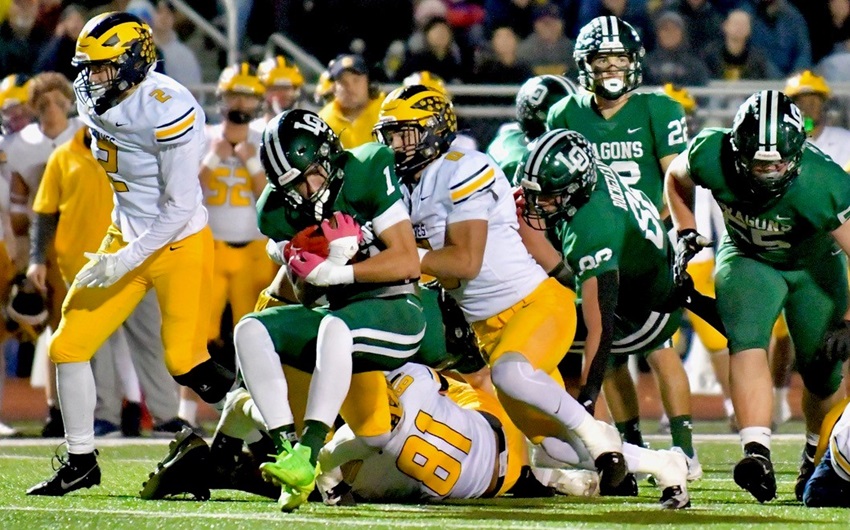
District Digest Hudsonville 25, East Kentwood 23 On the other side for Grandville in their District bracket, Ottawa-Kent Conference Red champion Hudsonville (9-1) held off a strong challenge from the Falcons (5-5) after having defeated them 35-6 in their Week 5 meeting. Oxford 21, Davison 14 Oxford (7-3) went on the road, and coming off a Week 9 loss, to win its first playoff game since 2021 and guarantee its best record since 2018 – when the Wildcats also opened the playoffs with a win over Davison (7-3). Clarkston 34, Lake Orion 16 The Wolves (7-3) are surging with five wins over their last six gams and this avenging their only loss during that string, a 20-13 defeat to the Dragons (6-4) in Week 7.
11-Player Division 2
HEADLINER Byron Center 38, Grand Rapids Northview 17 Byron Center (9-1) just missed on a league championship this fall but will play for a second-straight District title after pulling away to hand O-K Black champion Northview (9-1) its only loss this fall. The Bulldogs earned a rematch this week with O-K Green rival Muskegon Mona Shores, which won their Week 4 meeting 14-12. Northview closed its first winning season since 2019 with more victories than the last two combined. Click for more from FOX 17.
Byron Center with a 38-17 win over Northview in the Division 2 District Semifinal on November 1st, 2024. Powered by @Reactiontech @BCCoachCisco | @gobcbulldogs pic.twitter.com/UvbmwLHmQp
— STATE CHAMPS! Michigan (@statechampsmich) November 3, 2024
District Digest Grosse Pointe South 27, Roseville 26 South (10-0) at one point led 24-6 and held on to reach double-digit wins for the first time – and after going 9-2 a year ago and losing to Roseville (7-3) in a District Final, 24-17. Mattawan 27, Lansing Everett 21 Mattawan (7-3) is enjoying its winningest season since 2017, with this its first playoff victory since 2012. Everett (6-4) improved a win from a year ago to tie its highest total since 2014. Farmington 39, White Lake Lakeland 13 Farmington (7-3) earned its first playoff win since 2019 – continuing a rebound from 2-7 a year ago – and defeated a Lakeland team (6-4) that made the playoffs for the seventh time over the last eight seasons.
11-Player Division 3
HEADLINER Linden 42, Fenton 14 Linden (5-5) opened this season 0-2 and finished the regular season with two defeats and three over its last four games. But all of that may have paid off with this win to avenge a 24-21 Week 6 loss to the Tigers (7-3) that ended up deciding the Flint Metro League Stripes championship. That loss to Fenton was one of four three-point heartbreakers the Eagles endured this fall, but they will play for a District title this week. Click for more from the Tri-County Times.
District Digest Riverview 22, Trenton 21 Riverview quarterback Lucas Thompson put his team ahead to stay with a 2-point conversion run with 20 seconds to play, giving the Pirates (9-1) a close playoff win over Trenton for the second-straight season after they defeated the Trojans (6-4) by two in a District opener a year ago. Grand Rapids Forest Hills Central 7, East Grand Rapids 0 The reigning Division 3 champion Rangers (8-2) followed up a 24-0 win over EGR in Week 9 by just getting past the Pioneers (5-5) again. Walled Lake Western 49, Garden City 7 The Warriors (10-0) are expected to be top contenders in this division and reached 10 wins for the second straight season, but Garden City (7-3) deserves recognition as well for completing its winningest campaign since 2000.
11-Player Division 4
HEADLINER Dearborn Divine Child 42, Madison Heights Lamphere 6 Lamphere (8-2) entered the postseason No. 3 in the coaches poll and completed its third eight-win season over the last five. But Divine Child will play on after freshman quarterback Drew Sheridan threw five touchdown passes to send the Falcons (7-3) into a District Final matchup with reigning Division 4 champion Harper Woods. Click for more from the Dearborn Press & Guide.
Dearborn Divine Child starts the 2024 Division 4 Football Playoffs with a BIG 42-6 win over Lamphere in the District Semifinal on November 1st, 2024. Freshman quarterback Drew Sheridan threw 5 touchdown passes in the victory. Powered by @altaequipment @DCHS_Football14 |… pic.twitter.com/iZABbYwEse
— STATE CHAMPS! Michigan (@statechampsmich) November 2, 2024
District Digest Edwardsburg 29, Battle Creek Harper Creek 8 Edwardsburg (7-3) has shown plenty of times over the last 15 years why it is a scary playoff opponent, and this became another example as Harper Creek (8-2) entered the weekend coming off a league title and finished with its best record since 2017. Niles 42, Paw Paw 14 The two teams that finished ahead of Edwardsburg in the Wolverine Conference met for the second week in a row, with Niles (9-1) adding to its 21-0 win from Week 9 to end Paw Paw’s season at 8-2. Harper Woods 46, Redford Union 6 Harper Woods (7-3) entered the playoffs ranked No. 5 by the coaches, and Redford Union (8-2) was No. 2 and also had lost to the Pioneers in their season opener 43-21.
11-Player Division 5
HEADLINER Gladwin 18, Kingsford 15 When a team moves to 7-3 with all three of its losses to league champions, it’s difficult to call it a stunner. But Gladwin can claim it as Kingsford (9-1) also was a league champion, undefeated and ranked No. 3 entering this District Semifinal. Eric Roggow’s fourth-quarter field goal was the decider for the Flying Gs. Click for more from the Bay City Times.
District Digest Ogemaw Heights 21, Clare 13 Just as the Week 5 matchup went to Ogemaw Heights, 41-34, so too did the rematch between the Jack Pine Conference Division 1 co-champions. Clare finished 7-3 for the second-straight year after completing its 19th-straight winning regular season. Romulus 26, Detroit Lincoln-King 24 Romulus (5-5) earned its first playoff win since 2016, and in doing so handed Lincoln-King (9-1) its only loss of what was by far the most successful season of its three-year varsity history. Lincoln-King was 0-9 two seasons ago and 3-6 last fall. Flat Rock 40, Detroit Denby 22 Flat Rock (8-2) advanced by defeating a league title winner in Detroit Public School League Gold co-champion Denby (6-4), putting the Rams in position to play for a third-straight District trophy.
11-Player Division 6
HEADLINER Ovid-Elsie 44, Almont 21 The Mid-Michigan Activities Conference saw its undefeated champion fall (see below) but its runner-up down another undefeated league title winner as Ovid-Elsie handed No. 2 Almont its only loss. This was a rematch of a 2023 Semifinal won by the Raiders 45-21, but this time the Marauders put up their most points since mid-September and the most Blue Water Area Conference champ Almont (9-1) had given up in a game since 2021. Click for more from Lansing State Journal.
District Digest Lansing Catholic 36, Chesaning 29 The Cougars (7-3) have won at least one playoff game now eight seasons in a row, and this one came against MMAC champion Chesaning (9-1) and a defense that otherwise gave up just 12 points per game this fall. Detroit Central 34, Detroit Edison 16 Central (7-3) shared the PSL Gold title with Denby and then won the PSL Gold City championship, and this victory over No. 9 Edison (6-4) ranks right up there as well. Constantine 39, Parchment 14 Just because Constantine (7-3) found itself outside a league title race this fall for the first time in a while doesn’t mean the Falcons were going to go quietly – and they made some serious noise in avenging a 51-30 loss to Parchment (7-3) from Week 7.
11-Player Division 7
HEADLINER Union City 42, Hanover-Horton 13 Big 8 Conference champ Union City (9-1) has scored nearly 36 points per game during its winningest season since 2011, and this was the Chargers’ fourth time reaching 42 as they bounced back from a Week 9 loss to Buchanan. Hanover-Horton (8-2) closed this season with two losses to teams a combined 18-2 but must be celebrated for its best showing since 2014, a run which included a Cascades Conference West title. Click for more from the Coldwater Daily Reporter.
District Digest Clinton 38, Ottawa Lake Whiteford 32 The former Tri-County Conference rivals met for the first time since 2019, Clinton’s last season in the TCC, and this time the Redwolves (7-3) came back from two straight losses to end the regular season to end Whiteford’s fall at 5-5. Traverse City St. Francis 41, Charlevoix 16 The Gladiators (7-3) won this matchup of Northern Michigan Football League divisional champions, having also defeated the Rayders (6-4) in the season opener 67-22. McBain 49, Harrison 6 McBain (9-1) bounced back from a Week 9 loss to reach a second-straight District Final. Harrison (7-3) finished this fall with three straight defeats to playoff teams but with its best record since 2015 and after going 2-7 both of the last two seasons.
11-Player Division 8
HEADLINER Saginaw Michigan Lutheran Seminary 21, Saginaw Nouvel Catholic Central 20 These neighbors have played one-point games three of the last five seasons, and Nouvel (8-2) actually won their regular-season meeting in Week 4, 23-14, and led this time 6-0 into the third quarter. But MLS (7-3) found its stride thereafter to earn its second trip to the District Finals in three seasons. Click for more from the Saginaw News.
District Digest Saugatuck 24, White Pigeon 22 After having three of its last four seasons ended by White Pigeon (8-2) in the playoffs, Saugatuck advanced to a second-straight District Final by winning the closest game for both this fall. Beal City 47, Frankfort 0 Beal City (8-2) faced Frankfort (7-3) in a playoff opener for the second-straight season, adding this win to last year’s 42-7 victory that started a Semifinal run. Harbor Beach 35, Ubly 0 The Pirates (10-0) posted their second-straight shutout and fifth of the season in ending this year’s run and a six-game winning streak for last fall’s Division 8 champion Bearcats (6-4).
8-Player Division 1
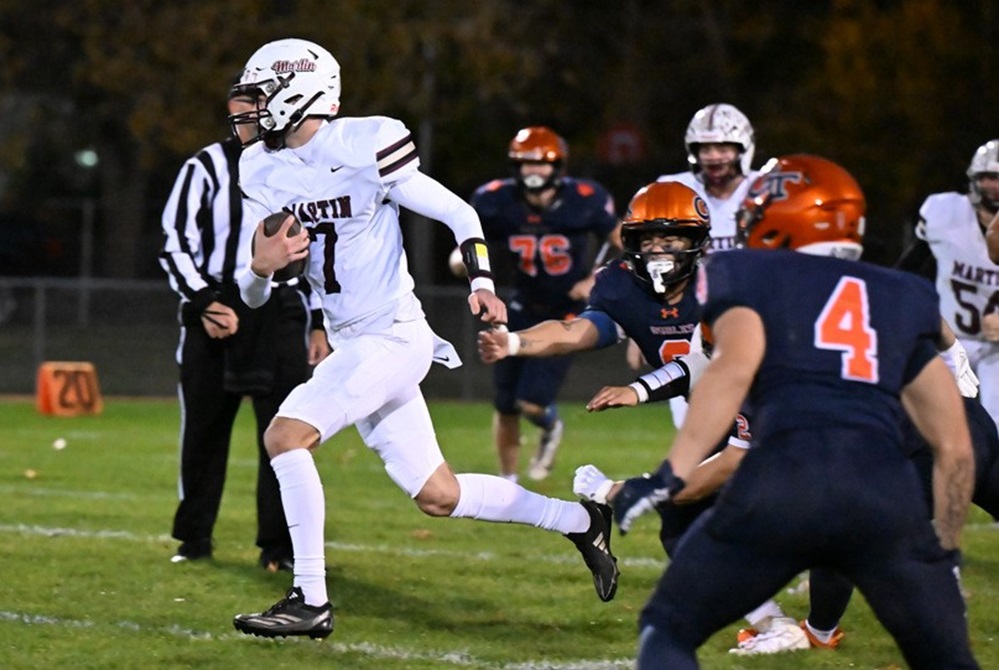
HEADLINER Martin 52, Gobles 22 The two-time reigning champion Clippers appear to be in playoff form again, as this avenged a 20-14 loss to Gobles from just three weeks earlier. This made it two seasons in a row that Martin (9-1) avenged a regular-season loss to the Tigers (9-1). The Clippers broke away with 30 second-half points to Gobles’ eight. Click for more from the Kalamazoo Gazette.
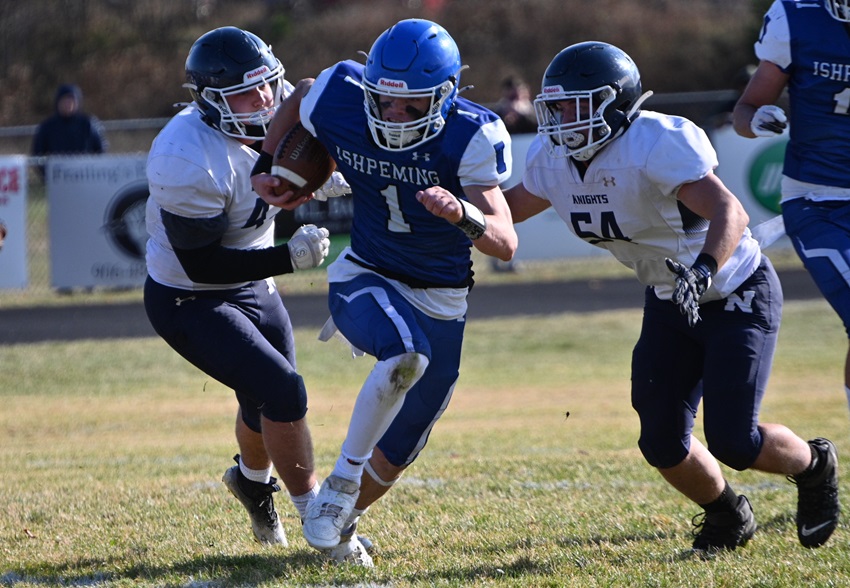
Regional Roundup Mendon 58, Climax-Scotts 50 Mendon’s Owen Gorham ran for 231 yards and five touchdowns, the last a four-yarder with three seconds to play followed by his 2-point conversion to push the Hornets (9-1) past Climax-Scotts just two weeks after losing to the Panthers (8-2) 46-44. Kingston 16, Fulton 14 The Cardinals (8-2) earned a rematch with rival Deckerville by handing the Pirates (8-2) just their second loss of their winningest season since 2010 in 11-player. Ishpeming 44, Norway 38 The Hematites’ first run into an 8-player bracket is off to the right start, with this win over the Knights (7-3) earning Ishpeming (6-2) a rematch with Week 4 opponent Pickford.
8-Player Division 2
HEADLINER Onekama 22, Marion 20 Both finalists for last season’s Division 2 championship were eliminated from this year’s bracket, and we’ll start with the reigning runner-up Marion (8-2) – which had defeated Onekama 44-8 in Week 2. The Eagles ended their season with two losses by a combined six points. But the Portagers improved to 9-1, one more win than their last four seasons’ totals combined. Click for more from the Manistee News Advocate.
Regional Roundup Mount Pleasant Sacred Heart 24, Grand Rapids Sacred Heart 21 After debuting in varsity play last season with a win by forfeit and two losses, Grand Rapids Sacred Heart (9-1) established itself with a perfect regular season and No. 1 ranking heading into this playoffs. But Mount Pleasant Sacred Heart (7-3) had seen plenty of top competition with its three losses to teams that all finished the regular season 8-1. Morrice 28, Portland St. Patrick 22 Two of those one-loss teams that had defeated MP Sacred Heart met on the other side of the bracket, with Morrice (9-1) avenging a 29-12 Week 4 defeat to the Shamrocks (8-2). Britton Deerfield 58, Adrian Lenawee Christian 15 The Patriots (9-1) reached nine wins for the second time in four seasons – and after finishing just 2-7 a year ago – completing a 2024 sweep of the 2023 Division 2 champion Cougars (4-6).
MHSAA.com's weekly “1st & Goal” previews and reviews are powered by MI Student Aid, a division within the Department of Lifelong Education, Advancement, and Potential (MiLEAP). MI Student Aid encourages students to pursue postsecondary education by providing access to student financial resources and information. MI Student Aid administers the state’s scholarship and grant programs that help make college Accessible, Affordable and Attainable for you. Click to connect with MI Student Aid and find more information on Facebook and Twitter @mistudentaid.
PHOTOS (Top) Martin’s Gavin Meyers (7) breaks through a gap in the Gobles defense Friday. (Middle) Clarkston’s Griffin Boman (0) wraps up Lake Orion’s Jayden Borrero. (Below) Ishpeming's Caden Luoma breaks away from Norway's Carter Cazzola (43) and Keith Burar, Jr. (54). (Top photo by Gary Shook. Clarkston/Lake Orion photo by Terry Lyons. Ishpeming/Norway photo by Cara Kamps.)