


MHSA(Q&)A: NFL official Ronald J. Winter
July 19, 2012
By Brian Spencer
Second Half
 Kalamazoo's Ron Winter has officiated in the National Football League for nearly two decades, and became a referee in 1999. But long before he joined the highest level of the game, he got his start on Michigan's high school fields.
Winter has officiated that sport at all three levels and also high school and college basketball. He's also served as a source of knowledge for officials around the state -- and an example for those hoping to start at the high school level and climb to the pros.
Winter remains registered as an MHSAA official, as he's been for 42 years. An associate professor emeritus of human performance and health education at Western Michigan University, Winter was appointed earlier this month to serve a two-year term on the Governor's Council on Physical Fitness, Health and Sports. The council focuses on increasing physical activity and health improvements.
He served on the WMU faculty first beginning in 1969 and then again from 1992-2008. Winter earned bachelor and master's degrees at Michigan State University.
Did you play any sports in high school or college?
I played football, basketball, baseball, and track in high school. However, once I got to Michigan State University, I started playing lacrosse. A couple guys that lived near me played lacrosse and asked me to come out to throw the ball around. After throwing with them a couple times they asked me to come out for the team. I ended up playing lacrosse for MSU for four years.
How did you decide to choose football as the sport you would officiate?
I started officiating as a student at MSU in their intramural program, officiating touch football and basketball. The next logical step was to then officiate in the high school leagues. From there, I began to proceed to all the different levels.
Are there specific requirements for becoming an NFL official?
The biggest requirement is experience. The progression that I went through went like this:
After officiating high school games, I went to the MIAA (Michigan Intercollegiate Athletic Association). They (MIAA) were looking for people that had 3-5 years of experience at the high school level. From there I went to the Mid-Continent conference. I wasn’t able to go to the Mid-American Conference because I was employed at Western Michigan University.
From there I went to the Big Ten. The Big Ten was looking for people with 5 to 10 years of experience in high school and people that had experience at different positions as an official. I ended up officiating in as a Big Ten football official for 10 years and a Big Ten basketball official for 15 years. I then submitted an application to the National Football League. Coincidentally, the NFL was scouting officials, and had followed me for four years before they finally asked me to be a part of the staff. The NFL decides on who they want to pursue through recommendations and personal interest. They look for personality traits as well as how (officials) carry themselves through different situations.
What has been your favorite level to officiate; High school, college or professional?
I enjoyed officiating all of them, but for different reasons.
I found high school to be the most fascinating because it’s all about the kids; they are playing the game for the love of the game. That is the purest sense of the sport. I loved being involved with kids simply because they love the game.
I found the Big Ten to be most exciting because of the kind of atmosphere that exists on a Big Ten campus on a Saturday afternoon. It’s electric. You don’t get that same sense or the same feel on Sunday afternoon in a pro stadium.
I found the NFL to be most intense. The NFL really has three or four different levels of play during the season. There is preseason play, the first third of the season, the second third of the season, and the last five games of the season. Each level is ramped up another notch as the season progresses. Playoffs are entirely different all together. In terms of the intensity and pure speed of the game, there is nothing like the NFL playoffs.
How important is getting along with your fellow officials on the field?
It’s imperatively important if you want to have a smooth and well-run game. This doesn’t mean that you have to buddy-buddy off the field, but on the field you have to be committed to one goal. We spend two or three hours on meetings Saturday afternoon to go over rules tests, tape, and more to prepare for the next game (and) to get over rough patches that develop on a personal level in a previous week. I need to know that the other six guys are focused and thinking about football like me. Everyone has to have confidence in one another. We spend plenty of time on Saturday to get to the point that we need to on Sunday.
What has been the most exciting game you’ve officiated?
I’ve been in plenty of exciting games from NFL playoff games, to the first Orange Bowl game, to the Rose Bowl, to the Division III Hope vs. Calvin basketball game, to when Indiana played Purdue in basketball. All of them were incredible to be a part of. During the Indiana vs. Purdue game, the arena was electric. The players, coaches, fans were intense. Everybody is totally focused on the game. Each coach had a tremendous respect for one another. Neither one wanted to show up or embarrass their counterpart. This game wasn’t that drastically different at the Division III level, however. The intensity of both was very similar.
Are there games that you get excited to officiate more than others, presently?
Not in terms of specific teams. It really just depends on the circumstances, of course. Pittsburgh vs. Baltimore is an intense game. The Jets vs. Patriots game is great. There are clearly rivalries that are very exciting to be a part of. The level of play and intensity of the athletes in the NFL is unmatched and can provide excitement every week.
What is the most difficult aspect of being a NFL official?
I would say that preparation and being able to maintain intensity on the field on Sunday are key aspects. The preparation is difficult because it’s time-consuming. It is a misconception that we simply show up on Sunday to work the game. By the time Sunday rolls around, I’ve spent over 20 hours during the week trying to prepare for a Sunday game. It isn’t hard in terms of physical labor, but difficult in terms of a time commitment. You have to have an understanding family to be in the occupational field that I am in.
Do you have any advice for aspiring officials who hope to make it to the league?
Practice, practice, practice. Be able to work any game at any level and get as much experience as you can. Be a good partner on the field. It takes time; it isn’t something that just happens. Like anything else, it takes practicing your trade to be able to make it to the top level.
1st & Goal: 2023 Week 5 Preview
By
Geoff Kimmerly
MHSAA.com senior editor
September 22, 2023
Over the last decade we’ve previewed intriguing football matchups every week from every region of the state, detailing one and highlighting four others. We usually choose from six or seven possibilities in each area that really stand out.
 But as we reach the midpoint of the 2023 football regular season, an abundance of matchups will be worth your time and trip this weekend.
We could have put together a Week 5 list 10 deep in the Detroit area – any other week we may have included Rochester Adams (3-1) at West Bloomfield (3-1), Macomb Dakota (4-0) at Clinton Township Chippewa Valley (2-2), Grosse Pointe South (3-1) at Roseville (3-1), Dearborn Heights Robichaud (3-1) at Redford Union (3-1) or Clarkston Everest Collegiate (2-2) at Grosse Pointe Woods University Liggett (3-1) in that group.
Head just west, and Dexter (2-2) at Ann Arbor Huron (3-1) has potential. Go farther west and Hudsonville (4-0) at Grandville (3-1) is in the conversation. In the Thumb, Marlette (3-1) at Harbor Beach (3-1) likely will be important down the road, and Houghton Lake (3-1) at McBain (3-1) would make the Northern Lower Peninsula top five most of the time.
And those are just some of the few that also caught our attention as we dive into many more below.
There’s plenty to enjoy, either in person or watching on MHSAA.tv. Check in as well with the MHSAA Scores page for all of them as they come in. (Games below are Friday unless noted.)
Bay & Thumb
Chesaning (3-1) at Montrose (4-0) - MHSAA.tv
Chesaning’s continued improvement and Montrose’s excellent start have given the Mid-Michigan Activities Conference a fuller field of contenders, and these two are the only ones undefeated in league play. The Rams have defeated both the reigning champion (Durand) and runner-up (Ovid-Elsie) from a year ago – by eight and seven points, respectively – and also have defeated Chesaning all six times (including once in the playoffs) since the two schools began playing in this league together. Chesaning also has an impressive victory this fall, as it provided a loud statement to start the league schedule with a 27-22 win over New Lothrop in Week 2.
Keep an eye on these FRIDAY Armada (2-2) at Almont (4-0) - MHSAA.tv, East Lansing (2-2) at Grand Blanc (3-1), Corunna (4-0) at Lake Fenton (3-1) - MHSAA.tv, Marine City (3-1) at Marysville (3-1).
Greater Detroit
Belleville (4-0) at Livonia Franklin (3-1) - MHSAA.tv
Belleville has won 29 straight games and the last two Division 1 titles, and after getting past River Rouge 35-28 in its season opener has won its first three Kensington Lakes Activities Association East games this fall by a combined score of 165-7. In fact, the Tigers are a combined 36-1 against KLAA East teams since joining the league in 2018. But this weekend’s matchup starts an intriguing month as Belleville pursues big goals again. Franklin has won two straight Division 2 District titles and had the most success among league teams against the Tigers last season, although that still ended with a 42-14 Belleville win.
Keep an eye on these FRIDAY Flat Rock (4-0) at Riverview (3-1), White Lake Lakeland (3-1) at Walled Lake Western (4-0) - MHSAA.tv, Detroit Catholic Central (3-1) at Warren De La Salle Collegiate (2-2) - MHSAA.tv. SATURDAY Detroit Edison (4-0) at Warren Michigan Collegiate (4-0).
Mid-Michigan
Lansing Everett (3-1) at Grand Ledge (4-0) - MHSAA.tv
The Capital Area Activities Conference Blue title race could fall a number of ways, but at this moment these two and East Lansing are undefeated in league play with Grand Ledge also the reigning co-champion and with a win already over last year’s other title winner, Holt. Everett bounced back from an opening 23-20 loss to still-undefeated Sexton and has generated some buzz – the Vikings were just 2-6 a year ago, but their defense especially has impressed this fall giving up a combined 37 points over four games. Grand Ledge won last year’s meeting 34-6 – but also just got past Lansing Waverly last week by a point, after Everett had downed the Warriors by 20 in Week 3.
Keep an eye on these FRIDAY Lake City (3-1) at Beal City (4-0) - MHSAA.tv, Battle Creek Harper Creek (4-0) at Hastings (2-2), Haslett (3-1) at Mason (4-0), Lansing Catholic (2-2) at Portland (4-0).
Northern Lower Peninsula
Whitehall (4-0) at Manistee (4-0) - MHSAA.tv
This might be Manistee’s biggest game since it finished its perfect regular season in 2018, as the Mariners welcome Whitehall in what eventually may determine the West Michigan Conference Lakes champion. Whitehall won last year’s meeting 55-0 – but Manistee already has avenged a 46-19 loss to Muskegon Oakridge and improved on last season’s results over Mason County Central and Muskegon Orchard View as well. A strong defense (35 points allowed over four games) will get its best challenge yet as Whitehall has scored 34 or more in all four of its games.
Keep an eye on these FRIDAY Gaylord (4-0) at Cadillac (3-1), Charlevoix (3-1) at Benzie Central (2-2) - MHSAA.tv, Traverse City St. Francis (2-2) at Kingsley (3-1) - MHSAA.tv, East Jordan (3-1) at Maple City Glen Lake (3-1) - MHSAA.tv.
Southeast & Border
Adrian (4-0) at Chelsea (3-1) - MHSAA.tv
Chelsea saw its three-year Southeastern Conference White title streak end at three last fall, but the Bulldogs are shaping up as favorites again – especially after they followed an opening loss to Grand Rapids Northview by nearly doubling up Edwardsburg the next week. The Bulldogs won a 10-game winning streak against Adrian, including 31-7 a year ago. But this Maples team is resembling more those that made the playoffs all but one season during the first decade of the 2000s, with the 4-0 start their best since 2010. They handed reigning league champion Tecumseh a 29-7 defeat last week.
Keep an eye on these FRIDAY Blissfield (3-1) at Clinton (3-1), Napoleon (4-0) at Grass Lake (4-0), Dearborn Divine Child (3-1) at Jackson Lumen Christi (4-0) - MHSAA.tv, Monroe (3-1) at Saline (4-0) - MHSAA.tv.
Southwest Corridor
Portage Central (3-1) at St. Joseph (3-1) - MHSAA.tv
St. Joseph has bounced back well from an opening-week loss to Niles and can put that first game further out of mind over the next three weeks as the Bears face Central, then Portage Northern and Stevensville Lakeshore – the other three teams that have started 2-0 in the Southwestern Michigan Athletic Conference. St. Joseph has won five of its last six against Central, but only 13-12 a year ago. The Mustangs are rebounding from last season’s 4-5 finish, with a nice win over East Lansing to start and their only loss the closest game Division 3 top-ranked Grand Rapids Forest Hills Central has played this season.
Keep an eye on these FRIDAY Benton Harbor (2-2) at Dowagiac (3-1), Parchment (3-1) at Kalamazoo United (2-2), Centreville (2-2) at White Pigeon (4-0) - MHSAA.tv, Niles (3-1) at Sturgis (2-2) - MHSAA.tv.
Upper Peninsula
Menominee (4-0) at Houghton (2-2) - MHSAA.tv
The Maroons have started well with their move to the Western Peninsula Athletic Conference Copper, outscoring their first three league opponents by a combined 154-6 after opening the season with another shutout of century-old rival Marinette, Wis. But things get only more challenging from here. Houghton has won two straight as it looks to build off last season’s best finish in a decade. Menominee then will face Gladstone, Negaunee and Kingsford over the final three weeks of the league schedule. Those three have been dealing each other losses over the last three weeks but remain in the title hunt.
Keep an eye on these FRIDAY Calumet (1-3) at Kingsford (3-1) - MHSAA.tv, Sault Ste. Marie (3-1) at Marquette (1-2) - MHSAA.tv, Negaunee (3-1) at Hancock (1-3), Ishpeming (1-3) at Bark River-Harris (2-0).
West Michigan
Byron Center (4-0) at Grand Rapids Forest Hills Central (4-0)
Anticipation of this rematch goes back to last season as their Ottawa-Kent Conference White opener ended up deciding the championship in FHC’s favor thanks to its 21-13 win. Byron Center didn’t lose again over the final six weeks of league play, and the Rangers went on to finish Division 2 runners-up at Ford Field. Forest Hills Central is Division 3 this season and, as noted above, top-ranked. Both can boast large average margins of victory and impressive wins over Division 4 No. 3 Grand Rapids Christian. The main difference perhaps is that East Grand Rapids, Grand Rapids Northview and Lowell also are looking like O-K White contenders – and the winner of this matchup surely will have an important edge when considering the full league picture.
Keep an eye on these FRIDAY East Grand Rapids (4-0) at Grand Rapids Northview (3-1) - MHSAA.tv, Spring Lake (4-0) at Grand Rapids West Catholic (4-0), North Muskegon (4-0) at Hart (4-0) - MHSAA.tv, Zeeland West (4-0) at Zeeland East (4-0) - MHSAA.tv.
8-Player
Gaylord St. Mary (3-1) at Onaway (3-1)
Onaway followed a 2-7 finish in 2021 with a 1-8 run a year ago and a forfeit of this fall’s season opener after a late-breaking coaching change. But the Cardinals' immediate resurgence has been awe-inspiring. With boys basketball coach Eddy Szymoniak also taking over this program, Onaway has outscored its last three opponents by a combined 132-38. Gaylord St. Mary has bounced back nicely as well from an opening loss to Pickford, shutting out its first two Ski Valley Conference opponents (and receiving a forfeit from a third). The Snowbirds join Indian River Inland Lakes – which received that Week 1 forfeit from Onaway – as the teams undefeated in league play.
Keep an eye on these FRIDAY Climax-Scotts (4-0) at Bellevue (3-1), Lake Linden-Hubbell (2-2) at Powers North Central (4-0) - MHSAA.tv, Marion (3-0) at Rudyard (3-1), St. Ignace (4-0) at Rogers City (2-2).
Second Half’s weekly “1st & Goal” previews and reviews are powered by MI Student Aid, a part of the Office of Postsecondary Financial Planning located within the Michigan Department of Treasury. MI Student Aid encourages students to pursue postsecondary education by providing access to student financial resources and information. MI Student Aid administers the state’s 529 college savings programs (MET/MESP), as well as scholarship and grant programs that help make college Accessible, Affordable and Attainable for you. Connect with MI Student Aid at www.michigan.gov/mistudentaid and find more information on Facebook and X (Twitter) @mistudentaid.
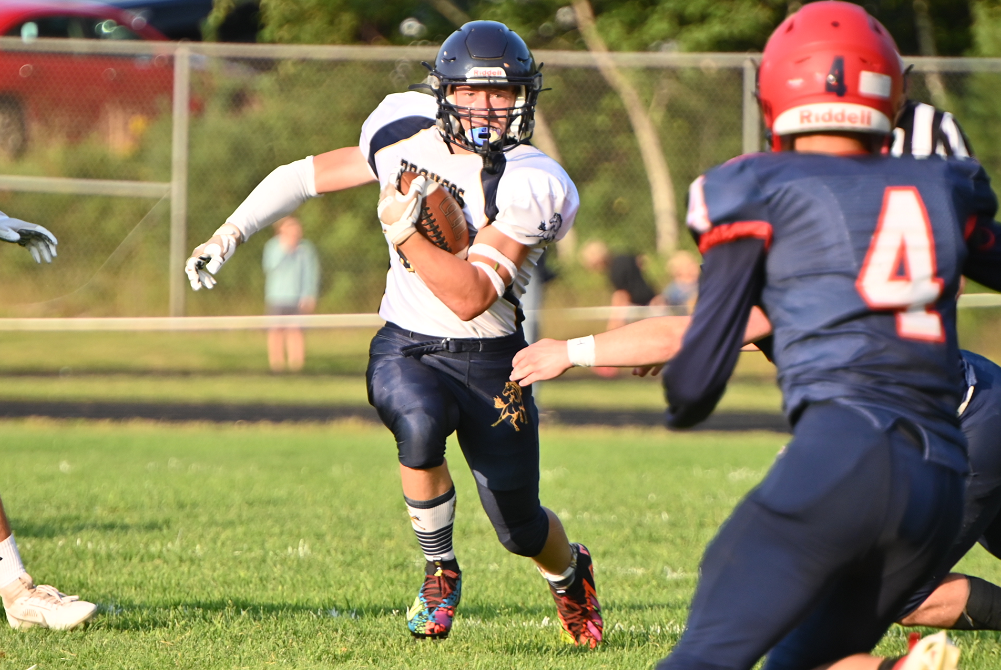
PHOTO Bark River-Harris's Dominick Lantagne (13) finds a big hole and gains several yards during his team’s opening day win over Ishpeming Westwood. (Photo by Cara Kamps.)