


MHSA(Q&)A: NFL official Ronald J. Winter
July 19, 2012
By Brian Spencer
Second Half
 Kalamazoo's Ron Winter has officiated in the National Football League for nearly two decades, and became a referee in 1999. But long before he joined the highest level of the game, he got his start on Michigan's high school fields.
Winter has officiated that sport at all three levels and also high school and college basketball. He's also served as a source of knowledge for officials around the state -- and an example for those hoping to start at the high school level and climb to the pros.
Winter remains registered as an MHSAA official, as he's been for 42 years. An associate professor emeritus of human performance and health education at Western Michigan University, Winter was appointed earlier this month to serve a two-year term on the Governor's Council on Physical Fitness, Health and Sports. The council focuses on increasing physical activity and health improvements.
He served on the WMU faculty first beginning in 1969 and then again from 1992-2008. Winter earned bachelor and master's degrees at Michigan State University.
Did you play any sports in high school or college?
I played football, basketball, baseball, and track in high school. However, once I got to Michigan State University, I started playing lacrosse. A couple guys that lived near me played lacrosse and asked me to come out to throw the ball around. After throwing with them a couple times they asked me to come out for the team. I ended up playing lacrosse for MSU for four years.
How did you decide to choose football as the sport you would officiate?
I started officiating as a student at MSU in their intramural program, officiating touch football and basketball. The next logical step was to then officiate in the high school leagues. From there, I began to proceed to all the different levels.
Are there specific requirements for becoming an NFL official?
The biggest requirement is experience. The progression that I went through went like this:
After officiating high school games, I went to the MIAA (Michigan Intercollegiate Athletic Association). They (MIAA) were looking for people that had 3-5 years of experience at the high school level. From there I went to the Mid-Continent conference. I wasn’t able to go to the Mid-American Conference because I was employed at Western Michigan University.
From there I went to the Big Ten. The Big Ten was looking for people with 5 to 10 years of experience in high school and people that had experience at different positions as an official. I ended up officiating in as a Big Ten football official for 10 years and a Big Ten basketball official for 15 years. I then submitted an application to the National Football League. Coincidentally, the NFL was scouting officials, and had followed me for four years before they finally asked me to be a part of the staff. The NFL decides on who they want to pursue through recommendations and personal interest. They look for personality traits as well as how (officials) carry themselves through different situations.
What has been your favorite level to officiate; High school, college or professional?
I enjoyed officiating all of them, but for different reasons.
I found high school to be the most fascinating because it’s all about the kids; they are playing the game for the love of the game. That is the purest sense of the sport. I loved being involved with kids simply because they love the game.
I found the Big Ten to be most exciting because of the kind of atmosphere that exists on a Big Ten campus on a Saturday afternoon. It’s electric. You don’t get that same sense or the same feel on Sunday afternoon in a pro stadium.
I found the NFL to be most intense. The NFL really has three or four different levels of play during the season. There is preseason play, the first third of the season, the second third of the season, and the last five games of the season. Each level is ramped up another notch as the season progresses. Playoffs are entirely different all together. In terms of the intensity and pure speed of the game, there is nothing like the NFL playoffs.
How important is getting along with your fellow officials on the field?
It’s imperatively important if you want to have a smooth and well-run game. This doesn’t mean that you have to buddy-buddy off the field, but on the field you have to be committed to one goal. We spend two or three hours on meetings Saturday afternoon to go over rules tests, tape, and more to prepare for the next game (and) to get over rough patches that develop on a personal level in a previous week. I need to know that the other six guys are focused and thinking about football like me. Everyone has to have confidence in one another. We spend plenty of time on Saturday to get to the point that we need to on Sunday.
What has been the most exciting game you’ve officiated?
I’ve been in plenty of exciting games from NFL playoff games, to the first Orange Bowl game, to the Rose Bowl, to the Division III Hope vs. Calvin basketball game, to when Indiana played Purdue in basketball. All of them were incredible to be a part of. During the Indiana vs. Purdue game, the arena was electric. The players, coaches, fans were intense. Everybody is totally focused on the game. Each coach had a tremendous respect for one another. Neither one wanted to show up or embarrass their counterpart. This game wasn’t that drastically different at the Division III level, however. The intensity of both was very similar.
Are there games that you get excited to officiate more than others, presently?
Not in terms of specific teams. It really just depends on the circumstances, of course. Pittsburgh vs. Baltimore is an intense game. The Jets vs. Patriots game is great. There are clearly rivalries that are very exciting to be a part of. The level of play and intensity of the athletes in the NFL is unmatched and can provide excitement every week.
What is the most difficult aspect of being a NFL official?
I would say that preparation and being able to maintain intensity on the field on Sunday are key aspects. The preparation is difficult because it’s time-consuming. It is a misconception that we simply show up on Sunday to work the game. By the time Sunday rolls around, I’ve spent over 20 hours during the week trying to prepare for a Sunday game. It isn’t hard in terms of physical labor, but difficult in terms of a time commitment. You have to have an understanding family to be in the occupational field that I am in.
Do you have any advice for aspiring officials who hope to make it to the league?
Practice, practice, practice. Be able to work any game at any level and get as much experience as you can. Be a good partner on the field. It takes time; it isn’t something that just happens. Like anything else, it takes practicing your trade to be able to make it to the top level.
Onekama Celebrates New Stadium, Legends Past with Eyes on Another Playoff Run
By
Tom Spencer
Special for MHSAA.com
October 23, 2026
Pretty much every player who has put on the Portagers football jersey over more than six decades of Onekama High School football knows the name Jim Taylor.
 And if they didn’t know it before the team’s 52-8 win over Holton on Oct. 10, they do now.
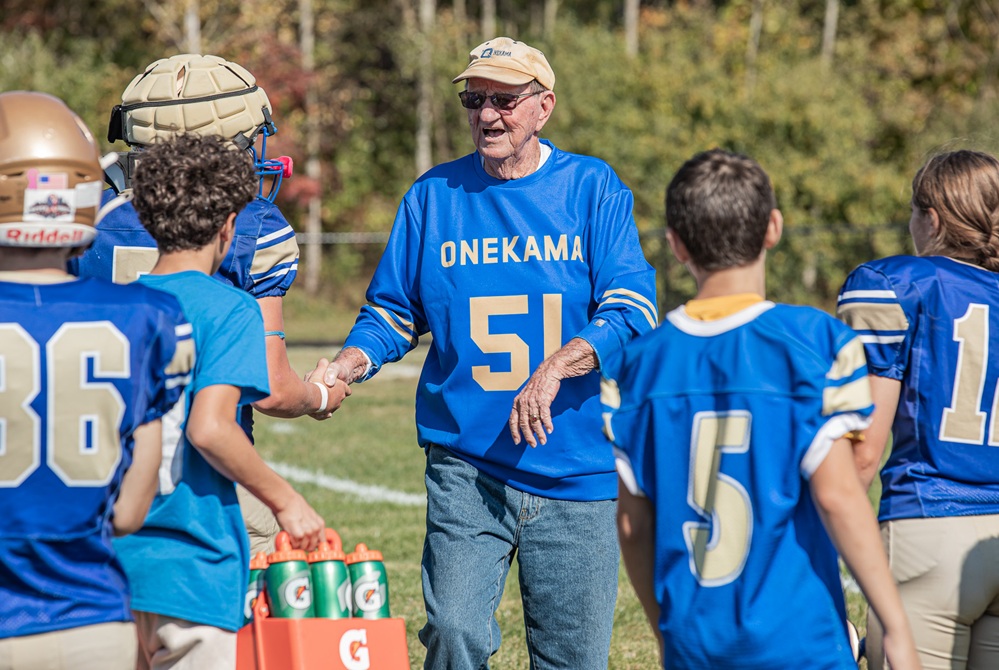
The community of Onekama honored their former coach, celebrated the 50th anniversary of the only undefeated squad in the Portagers’ history and dedicated the district’s new football stadium during the win over Holton – which also helped keep Onekama’s playoff hopes alive this fall.
The Portagers enter this weekend’s regular-season finale at Merrill ranked No. 14 on the 8-Player Division 2 playoff-points list. The top 16 qualify for the postseason, which begins next week.
“We love our history and traditions – all of the generations have just supported each other and built it into what it is today,” said fourth-year coach Justin Sedelmaier. “The former coaches are still involved, mentoring me. … Coach Jim Hunter and Coach Jim Taylor … still coming and seeing and saying hi to the team and stuff every now and then. The ’76 team, a lot of them like Jerry Brown, are always around supporting us.”
Brown, the quarterback of the only Onekama team to finish undefeated, was the primary organizer of the reunion. He was on hand for the celebration, along with Hunter and Taylor, and was even more excited about honoring Taylor than he was about the reunion.
“The motivation behind it for me anyway, personally, was to throw as much light on our coaching staff, and most specifically, the head coach, Coach Taylor, who had such a huge impact on so many lives – mine for sure,” Brown said. “This was all about shining a light on Coach Taylor and his wife, Lora – what a team. She's been right there with him all the way, supporting him.”
Lora Tayler was the school’s cheerleading coach during the first decade of football at Onekama. She was also on hand for the Oct. 10 festivities.
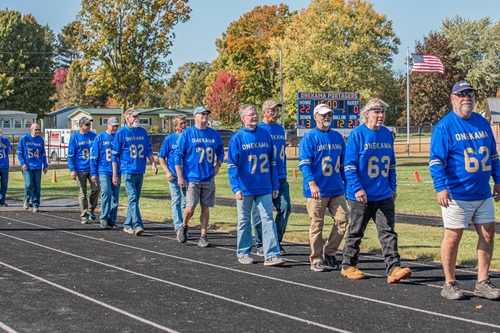
Brown was one of 14 players in attendance to honor the 1976 team, which finished 8-0 and won the Northwest Conference title but did not qualify for the MHSAA Playoffs, which were in only their second year and included only four teams statewide per Class at that time. (Other Onekama teams have since finished perfect for the regular season but lost in the playoffs.)
Taylor started the football program in 1964 and served as head coach until 1988. During his time guiding Onekama, Taylor compiled a 124–58–3 record with only two losing seasons over 22 years. He returned to coaching as an assistant at Onekama from 1997-2008 and was inducted into the Michigan High School Coaches Association Hall of Fame in 2005.
During Taylor’s early years, the Portagers played their home games at nearby Manistee High School while waiting for a home field of their own. The new stadium was built thanks to support of a successful 2024 bond proposal which also provided enhanced security technology, an updated gym, new playground equipment, pickleball courts, team rooms and a modernized press box.
The press box replaced the original built by students in a shop class at Onekama, including the grandfather of the current – and only fourth – coach in the Portagers’ history.
“The press box that just came down was built by the assistant coach, Mr. Foster's shop class, and my grandfather was part of that,” said Sedelmaier, who was the defensive coordinator for four years under John Neph, who with Taylor and Hunter has been the only other head coach Onekama varsity football. “The shop class built the press box and stuff on the first field and just finally now, 60 years later, we're able to make all these field upgrades. It's really been a vision for a long time, and something that I fought for, past players have fought for, the community fought for, and it's a vision that finally came together.”
Sedelmaier was a 2007 graduate of Onekama. Taylor was an assistant coach then. Sedelmaier’s grandfather, Phil Sedelmaier Sr., father Phil Sedelmaier, Jr. and uncle Todd Sedelmaier all played for Onekama during Taylor’s head coaching days.
Justin Sedelmaier has the Portagers primed for another playoff run. They are 6-2, a win tonight should guarantee them a spot in the playoffs and potentially an opportunity to host a game at the new stadium. A loss also won’t necessarily end the season for Onekama, which has reached the 8-Player Division 2 Semifinals the past two seasons. The Portagers’ strength of schedule is expected to boost their playoff chances, no matter the outcome in the regular-season finale.
Bennett Zeller leads the offense. The sophomore quarterback has completed 32 passes for 683 yards and eight touchdowns and picked up 762 yards and 12 touchdowns running the ball. His favorite target is junior Jason Sedelmaier, who has 11 catches for 260 yards and three touchdowns. The next rushing leader behind Bennett is Caleb Porter, also a junior, with five touchdowns while averaging 54 yards per game.
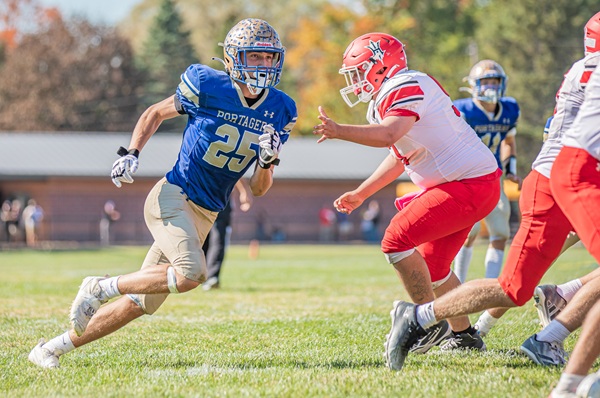
On the other side of the ball, Onekama is led once again by senior Ryan Hrachovina, an all-state defensive linemen last season. He has been credited 103.5 tackles this year – with 22 tackles for a loss and 18 sacks. He blocked a kick and ran it in for a touchdown earlier this fall. He’s also forced a fumble and recovered another.
Jason Sedelmaier also has been a big contributor defensively with 37 tackles, including four for a loss and one sack. He leads the team with 11 pass breakups and has an interception and a fumble recovery, along with a forced fumble.
The Portagers’ only loss last season came in a Division 2 Semifinal to Felch North Dickinson. Coach Sedelmaier is ready to build on the support of Onekama’s former players and coaches as his team prepares to make another run.
“To get to see them all coming back, wearing their replica jerseys and supporting us while we get a look back at some of the history and honoring that history was great for the kids to see,” Sedelmaier said. “That team was the first team to ever go undefeated in the regular season, and they're still the only team that's ever went the entire season total undefeated.”

Tom Spencer is a longtime MHSAA-registered basketball and soccer official, and former softball and baseball official, and he also has coached in the northern Lower Peninsula area. He previously has written for the Saginaw News, Bay County Sports Page and Midland Daily News. He can be reached at [email protected] with story ideas for Manistee, Wexford, Missaukee, Roscommon, Ogemaw, Iosco, Alcona, Oscoda, Crawford, Kalkaska, Grand Traverse, Benzie, Leelanau, Antrim, Otsego, Montmorency, Alpena, Presque Isle, Cheboygan, Charlevoix and Emmet counties.
PHOTOS (Top) Longtime Onekama coach Jim Taylor shakes hands with current players during the football program’s reunion and recognition night Oct. 10. (Middle) Ryan Hrachovina (25) works to get around a Holton blocker. (Below) Members of the 1976 Onekama team walk toward the field at the new stadium. (Photos by Meredith McNabb Photography.)