


MHSA(Q&)A: NFL official Ronald J. Winter
July 19, 2012
By Brian Spencer
Second Half
 Kalamazoo's Ron Winter has officiated in the National Football League for nearly two decades, and became a referee in 1999. But long before he joined the highest level of the game, he got his start on Michigan's high school fields.
Winter has officiated that sport at all three levels and also high school and college basketball. He's also served as a source of knowledge for officials around the state -- and an example for those hoping to start at the high school level and climb to the pros.
Winter remains registered as an MHSAA official, as he's been for 42 years. An associate professor emeritus of human performance and health education at Western Michigan University, Winter was appointed earlier this month to serve a two-year term on the Governor's Council on Physical Fitness, Health and Sports. The council focuses on increasing physical activity and health improvements.
He served on the WMU faculty first beginning in 1969 and then again from 1992-2008. Winter earned bachelor and master's degrees at Michigan State University.
Did you play any sports in high school or college?
I played football, basketball, baseball, and track in high school. However, once I got to Michigan State University, I started playing lacrosse. A couple guys that lived near me played lacrosse and asked me to come out to throw the ball around. After throwing with them a couple times they asked me to come out for the team. I ended up playing lacrosse for MSU for four years.
How did you decide to choose football as the sport you would officiate?
I started officiating as a student at MSU in their intramural program, officiating touch football and basketball. The next logical step was to then officiate in the high school leagues. From there, I began to proceed to all the different levels.
Are there specific requirements for becoming an NFL official?
The biggest requirement is experience. The progression that I went through went like this:
After officiating high school games, I went to the MIAA (Michigan Intercollegiate Athletic Association). They (MIAA) were looking for people that had 3-5 years of experience at the high school level. From there I went to the Mid-Continent conference. I wasn’t able to go to the Mid-American Conference because I was employed at Western Michigan University.
From there I went to the Big Ten. The Big Ten was looking for people with 5 to 10 years of experience in high school and people that had experience at different positions as an official. I ended up officiating in as a Big Ten football official for 10 years and a Big Ten basketball official for 15 years. I then submitted an application to the National Football League. Coincidentally, the NFL was scouting officials, and had followed me for four years before they finally asked me to be a part of the staff. The NFL decides on who they want to pursue through recommendations and personal interest. They look for personality traits as well as how (officials) carry themselves through different situations.
What has been your favorite level to officiate; High school, college or professional?
I enjoyed officiating all of them, but for different reasons.
I found high school to be the most fascinating because it’s all about the kids; they are playing the game for the love of the game. That is the purest sense of the sport. I loved being involved with kids simply because they love the game.
I found the Big Ten to be most exciting because of the kind of atmosphere that exists on a Big Ten campus on a Saturday afternoon. It’s electric. You don’t get that same sense or the same feel on Sunday afternoon in a pro stadium.
I found the NFL to be most intense. The NFL really has three or four different levels of play during the season. There is preseason play, the first third of the season, the second third of the season, and the last five games of the season. Each level is ramped up another notch as the season progresses. Playoffs are entirely different all together. In terms of the intensity and pure speed of the game, there is nothing like the NFL playoffs.
How important is getting along with your fellow officials on the field?
It’s imperatively important if you want to have a smooth and well-run game. This doesn’t mean that you have to buddy-buddy off the field, but on the field you have to be committed to one goal. We spend two or three hours on meetings Saturday afternoon to go over rules tests, tape, and more to prepare for the next game (and) to get over rough patches that develop on a personal level in a previous week. I need to know that the other six guys are focused and thinking about football like me. Everyone has to have confidence in one another. We spend plenty of time on Saturday to get to the point that we need to on Sunday.
What has been the most exciting game you’ve officiated?
I’ve been in plenty of exciting games from NFL playoff games, to the first Orange Bowl game, to the Rose Bowl, to the Division III Hope vs. Calvin basketball game, to when Indiana played Purdue in basketball. All of them were incredible to be a part of. During the Indiana vs. Purdue game, the arena was electric. The players, coaches, fans were intense. Everybody is totally focused on the game. Each coach had a tremendous respect for one another. Neither one wanted to show up or embarrass their counterpart. This game wasn’t that drastically different at the Division III level, however. The intensity of both was very similar.
Are there games that you get excited to officiate more than others, presently?
Not in terms of specific teams. It really just depends on the circumstances, of course. Pittsburgh vs. Baltimore is an intense game. The Jets vs. Patriots game is great. There are clearly rivalries that are very exciting to be a part of. The level of play and intensity of the athletes in the NFL is unmatched and can provide excitement every week.
What is the most difficult aspect of being a NFL official?
I would say that preparation and being able to maintain intensity on the field on Sunday are key aspects. The preparation is difficult because it’s time-consuming. It is a misconception that we simply show up on Sunday to work the game. By the time Sunday rolls around, I’ve spent over 20 hours during the week trying to prepare for a Sunday game. It isn’t hard in terms of physical labor, but difficult in terms of a time commitment. You have to have an understanding family to be in the occupational field that I am in.
Do you have any advice for aspiring officials who hope to make it to the league?
Practice, practice, practice. Be able to work any game at any level and get as much experience as you can. Be a good partner on the field. It takes time; it isn’t something that just happens. Like anything else, it takes practicing your trade to be able to make it to the top level.
North Central Builds On High-Flying Fame with Repeat Title
By
Adam Niemi
Special for Second Half
November 20, 2021
MARQUETTE — In the end, the encore wasn't that much different than the first title run for the latest Powers North Central powerhouse team.
The Jets got off to a fast start en route to a 63-0 win against Colon to repeat as MHSAA 8-player Division 2 champions Saturday. Last season, many of the same standouts led North Central to a 70-48 championship game win over Portland St. Patrick.
"Oh gosh, it just feels great," Powers North Central head coach Leo Gorzinski said. "Like I've been telling these guys all week, we come this far, we work this hard and let's finish it. And that's been the rallying point all week. We talked about all the time people didn't work. They were in a weight room since February, two-a-days in August. So they weren't going to let this one slip away. But it's a great feeling."
Saturday's title adds to the Jets' 8-player football championship pedigree with go-to athletes. This championship also was the their fourth in seven years.
The Jets (13-0) won these two with Luke Gorzinski at quarterback. The Jets also won back-to-back championships in 2015 and 2016, led by quarterback Jason Whitens, now a redshirt senior basketball player at Michigan State, with then-head coach Kevin Bellefeuil.
"I want to thank all the guys that come before us," Gorzinski said. "Once they showed it can be done, everybody started believing that it was possible. And then once they believed it, now they want to be the ones to let it go. We've got a pretty good thing going right now."
The 2021 season will go down as one of the most dominant in Michigan 8-player history. Through 13 games, the Jets outscored opponents 745-43, an average game score of 57 to 3.
The details of Saturday's win hinted at the athleticism and depth that spurred the Jets on. They had 520 yards of offense. Colon had 126.
Colon received the kickoff to start the game, and the Jets' defense set the tone with three straight tackles for loss and forced a three-and-out from Colon's 4-yard line.
The Jets' potent defense went on to hold the Magi rushing game to minus-14 yards on 20 carries.
Saturday also spelled the end to Colon's Cinderella run. The Magi had beaten undefeated teams in every round of the playoffs except Saturday.
Junior quarterback Simon Vinson went down with an injury with 1:01 remaining in the first quarter. Magi head coach Robbie Hattan said Vinson's injury changed the mood on the sidelines.
"Losing Simon, when Simon went down, some kids put their heads down and they couldn't bounce back from that," Hattan said. "I'll give my kids credit. The second half they battled, we played much better in the second half defensively. A lot of the kids struggled getting used to the heat here. Right away they're cramping, and somehow our Gatorade was left on the bus and the kids couldn't refuel. It just was a weird day for us."
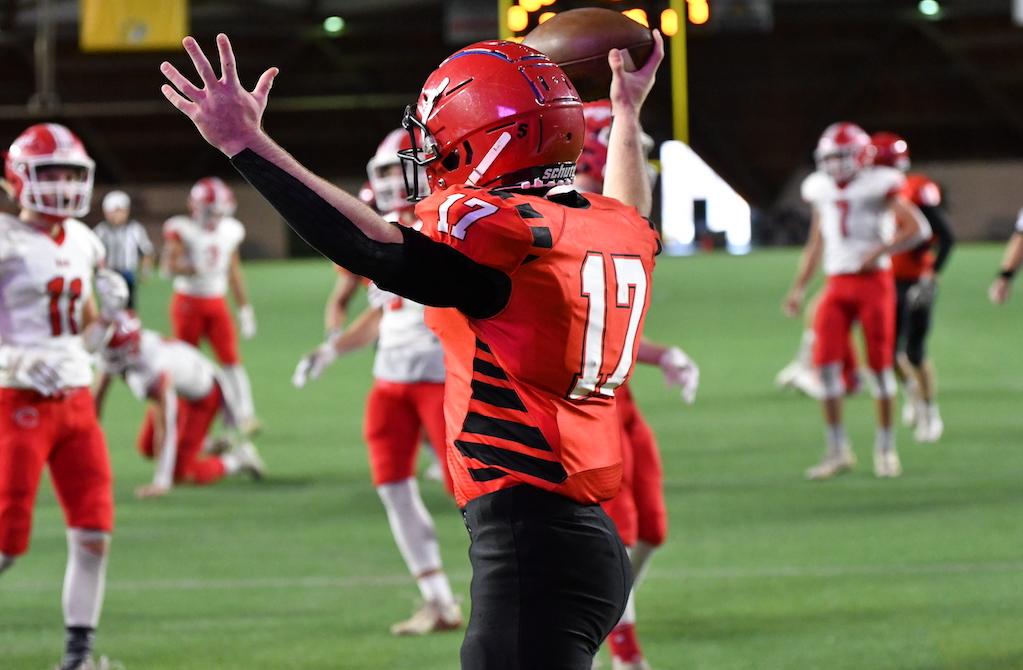
Powers North Central senior running back Wyatt Raab scored both touchdowns to open the game, from 15 and 30 yards out, respectively. He finished the day with 101 yards on five carries (20.2 yards per carry).
Luke Gorzinski led with a game-high 125 yards on 15 carries (8.3 yards per carry) and a touchdown.
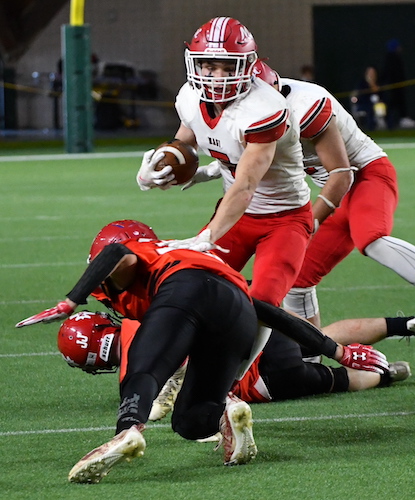 Colon (11-2) started drives deep in its own territory early on, and were forced to punt. Their average field position to start a drive was their own 27-yard line.
Holding the Magi deep in their territory meant the Jets had a short field for most of the day, leading to a quick succession of scores. North Central had 369 yards of total offense in the first half alone.
Powers North Central rushed for 236 yards on 20 carries with four TDs in the first half and led 49-0.
North Central executed as efficiently as it had all season. The Jets moved the chains all game while their defense prevented Colon's offense from doing the same.
Gorzinski had two sacks and 10 tackles. Drew Webber had six tackles. Caden Tietz, Drew Allgeyer and Lane Nehring each had a sack. Owen Eichmeier had an interception.
Tucker Lafler had 11 tackles to lead Colon's defense. Owen Wilson had eight and Kaleb Johnson had six.
"They're so competitive with one another — it's our depth" Leo Gorzinski said of the defense. "We've got so many kids that are the same caliber, same type of athlete. So day in and day out they're fighting for every single position. They want to show Coach 'l caught it over so-and-so, tackle over so-and-so.’"
Saturday was the Magi's second Finals appearance in three seasons after winning the 2019 Division 1 championship against Suttons Bay. The Magi lost in the Regional Finals in 2020 to Portland St. Patrick, which then lost to the Jets in the Final.
Hattan said there were naysayers even within Colon as the team made its playoff run. That, and falling a game short of a championship, is a motivator for next year, he said.
"Nobody expected us to be here. Even some people in our community were 'It's a rebuilding year,'” he said. "We lost, we only had two returning starters on offense, two returning starters on defense. Nobody expected us to be here. We return a lot of players (next season). We graduate like six seniors, three of them that were starters. We have some holes to replace, but we return a lot of kids. Now, this is motivation for some of our guys to get bigger, faster, stronger.
"They understand where they’ve got to work now to bring us back here and get to the next step, which is winning the state championship."
PHOTOS (Top) Powers North Central’s Wyatt Raab (17) celebrates a touchdown during Saturday’s Division 2 Final at Superior Dome. (Middle) Colon’s Kodey Dovey (5) works to elude the Jets’ Carter Tietz (32). (Photos by Cara Kamps. Click for more.)