


MHSA(Q&)A: NFL official Ronald J. Winter
July 19, 2012
By Brian Spencer
Second Half
 Kalamazoo's Ron Winter has officiated in the National Football League for nearly two decades, and became a referee in 1999. But long before he joined the highest level of the game, he got his start on Michigan's high school fields.
Winter has officiated that sport at all three levels and also high school and college basketball. He's also served as a source of knowledge for officials around the state -- and an example for those hoping to start at the high school level and climb to the pros.
Winter remains registered as an MHSAA official, as he's been for 42 years. An associate professor emeritus of human performance and health education at Western Michigan University, Winter was appointed earlier this month to serve a two-year term on the Governor's Council on Physical Fitness, Health and Sports. The council focuses on increasing physical activity and health improvements.
He served on the WMU faculty first beginning in 1969 and then again from 1992-2008. Winter earned bachelor and master's degrees at Michigan State University.
Did you play any sports in high school or college?
I played football, basketball, baseball, and track in high school. However, once I got to Michigan State University, I started playing lacrosse. A couple guys that lived near me played lacrosse and asked me to come out to throw the ball around. After throwing with them a couple times they asked me to come out for the team. I ended up playing lacrosse for MSU for four years.
How did you decide to choose football as the sport you would officiate?
I started officiating as a student at MSU in their intramural program, officiating touch football and basketball. The next logical step was to then officiate in the high school leagues. From there, I began to proceed to all the different levels.
Are there specific requirements for becoming an NFL official?
The biggest requirement is experience. The progression that I went through went like this:
After officiating high school games, I went to the MIAA (Michigan Intercollegiate Athletic Association). They (MIAA) were looking for people that had 3-5 years of experience at the high school level. From there I went to the Mid-Continent conference. I wasn’t able to go to the Mid-American Conference because I was employed at Western Michigan University.
From there I went to the Big Ten. The Big Ten was looking for people with 5 to 10 years of experience in high school and people that had experience at different positions as an official. I ended up officiating in as a Big Ten football official for 10 years and a Big Ten basketball official for 15 years. I then submitted an application to the National Football League. Coincidentally, the NFL was scouting officials, and had followed me for four years before they finally asked me to be a part of the staff. The NFL decides on who they want to pursue through recommendations and personal interest. They look for personality traits as well as how (officials) carry themselves through different situations.
What has been your favorite level to officiate; High school, college or professional?
I enjoyed officiating all of them, but for different reasons.
I found high school to be the most fascinating because it’s all about the kids; they are playing the game for the love of the game. That is the purest sense of the sport. I loved being involved with kids simply because they love the game.
I found the Big Ten to be most exciting because of the kind of atmosphere that exists on a Big Ten campus on a Saturday afternoon. It’s electric. You don’t get that same sense or the same feel on Sunday afternoon in a pro stadium.
I found the NFL to be most intense. The NFL really has three or four different levels of play during the season. There is preseason play, the first third of the season, the second third of the season, and the last five games of the season. Each level is ramped up another notch as the season progresses. Playoffs are entirely different all together. In terms of the intensity and pure speed of the game, there is nothing like the NFL playoffs.
How important is getting along with your fellow officials on the field?
It’s imperatively important if you want to have a smooth and well-run game. This doesn’t mean that you have to buddy-buddy off the field, but on the field you have to be committed to one goal. We spend two or three hours on meetings Saturday afternoon to go over rules tests, tape, and more to prepare for the next game (and) to get over rough patches that develop on a personal level in a previous week. I need to know that the other six guys are focused and thinking about football like me. Everyone has to have confidence in one another. We spend plenty of time on Saturday to get to the point that we need to on Sunday.
What has been the most exciting game you’ve officiated?
I’ve been in plenty of exciting games from NFL playoff games, to the first Orange Bowl game, to the Rose Bowl, to the Division III Hope vs. Calvin basketball game, to when Indiana played Purdue in basketball. All of them were incredible to be a part of. During the Indiana vs. Purdue game, the arena was electric. The players, coaches, fans were intense. Everybody is totally focused on the game. Each coach had a tremendous respect for one another. Neither one wanted to show up or embarrass their counterpart. This game wasn’t that drastically different at the Division III level, however. The intensity of both was very similar.
Are there games that you get excited to officiate more than others, presently?
Not in terms of specific teams. It really just depends on the circumstances, of course. Pittsburgh vs. Baltimore is an intense game. The Jets vs. Patriots game is great. There are clearly rivalries that are very exciting to be a part of. The level of play and intensity of the athletes in the NFL is unmatched and can provide excitement every week.
What is the most difficult aspect of being a NFL official?
I would say that preparation and being able to maintain intensity on the field on Sunday are key aspects. The preparation is difficult because it’s time-consuming. It is a misconception that we simply show up on Sunday to work the game. By the time Sunday rolls around, I’ve spent over 20 hours during the week trying to prepare for a Sunday game. It isn’t hard in terms of physical labor, but difficult in terms of a time commitment. You have to have an understanding family to be in the occupational field that I am in.
Do you have any advice for aspiring officials who hope to make it to the league?
Practice, practice, practice. Be able to work any game at any level and get as much experience as you can. Be a good partner on the field. It takes time; it isn’t something that just happens. Like anything else, it takes practicing your trade to be able to make it to the top level.
1st & Goal: 8-Player Finals Preview
By
Geoff Kimmerly
MHSAA.com senior editor
January 15, 2021
Four undefeated teams will be the first to play for championships to cap the longest football season in MHSAA history.
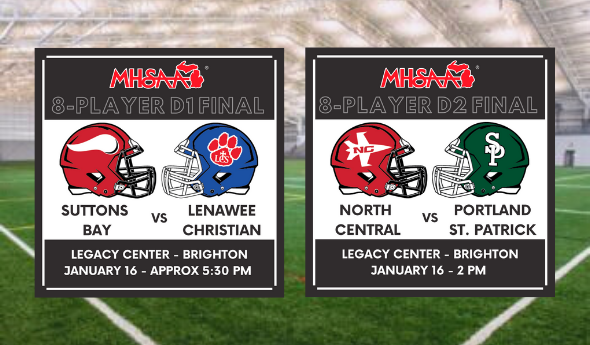
Adrian Lenawee Christian and Suttons Bay in Division 1 and Portland St. Patrick and Powers North Central in Division 2 will take the field at Brighton’s Legacy Center on Saturday with this season’s two 8-player titles on the line. They returned to action last week after a nearly two-month pause due to COVID-19.
Suttons Bay and Portland St. Patrick are the 2019 runners-up in Divisions 1 and 2, respectively. Adrian Lenawee Christian is new to the format this season and like Suttons Bay is playing for its first football title. North Central, meanwhile, is the only program to win multiple 8-player championships since the format was added in 2011, and the Jets are back at the Finals for the first time since their repeat run in 2016.
Kickoff for the Division 2 game is 2 p.m., with the Division 1 game following approximately 5:30 p.m. Spectators remain limited, but both games will be broadcast live on the FOX Sports Detroit Facebook page, and replayed on FOX Sports Detroit’s primary channel Jan. 21 beginning at 8 p.m. Audio of both games will be streamed live on MHSAANetwork.com.
Below is a look at all four finalists. Team “rankings” are based on their playoff-point averages heading into the postseason.
Division 1
ADRIAN LENAWEE CHRISTIAN
Record/rank: 10-0, No. 3
Coach: Bill Wilharms, eighth season (59-21)
League finish: First in Southern Central Athletic Association A
Championship history: Has never played in an MHSAA Final.
Best wins: 49-0 over No. 1 Morrice in Regional Final, 47-12 over No. 8 Martin in Semifinal, 78-14 over No. 4 Mayville in Regional Semifinal, 24-6 over Division 2 No. 5 Colon.
Players to watch: RB/LB Jameson Chesser, 5-10/170, sr. (1,179 yards/29 TDs rushing, 506 yards/4 TDs receiving); QB/CB Landon Gallant, 5-10/155, sr. (1,331 yards/23 TDs passing, 388 yards/6 TDs rushing); OG/NG Coby Kegerreis, 5-8/185, jr.; C/DE Joey Breckel, 6-1/240, sr.
Outlook: Lenawee Christian’s 8-player debut couldn’t have gone better on the field, as the Cougars have won only one game by fewer than 35 points. That was an 18-point victory over league foe Colon, last season’s Division 1 champion, and Saturday the Cougars can make it a repeat for the SCAA Division A. Chesser – who also has thrown for 178 yards and two touchdowns on 17 attempts – made the all-state first team and scored five times against Martin in the Semifinal. Kegerreis also made the all-state first team, as did junior kicker Clay Ayers (41 of 48 XP), and Breckel earned honorable mention. Those four and Gallant also start on a defense that’s given up only 46 points over 10 games.
SUTTONS BAY
Record/rank: 10-0, No. 1
Coach: Garrick Opie, third season (30-2)
League finish: Does not play in a league.
Championship history: 8-player Division 1 runner-up 2019, 11-player Division 6 runner-up 2004.
Best wins: 38-22 over No. 8 Gaylord St. Mary in Regional Final, 35-0 over Brethren, 39-20 and 44-0 (Regional Semifinal) over Whittemore-Prescott.
Players to watch: RB/DB Hugh Periard, 6-0/175, jr. (799 yards/13 TDs rushing, 217 yards/3 TDs receiving); QB/DB Nate Devol, 6-0/175, sr. (901 yards/15 TDs passing, 301 yards/2 TDs rushing, 4 interceptions on defense); RB/LB Shawn Bramer, 6-2/195, jr. (622 yards/11 TDs rushing, 60 yards/1 TD receiving); OL/LB Michael Wittman, 6-4/230, sr.
Outlook: Suttons Bay is returning to the Division 1 championship game after falling short in a 26-14 defeat to Colon in 2019. The Norsemen have won all of their games by double digits, with a defense giving up only 7.6 points per game and a rushing attack that has piled up 2,506 yards over nine games (last week’s Semifinal win was a forfeit by Indian River Inland Lakes). Wittman made the all-state first team as a linebacker. Starting tight ends Jake Murphy and Brayden Opie add another element to the attack – both have caught 15 passes, with Murphy scoring on five and Opie on six.
Division 2
PORTLAND ST. PATRICK
Record/rank: 10-0, No. 1
Coach: Patrick Russman, 13th season (96-39)
League finish: Does not play in the league.
Championship history: 8-player Division 2 runner-up 2019 and 2017, 11-player Class D champion 1992, runner-up 1997 and 1991.
Best wins: 44-34 over No. 5 Colon in Regional Final, 34-12 over No. 7 Kinde North Huron in Semifinal, 52-19 over No. 4 Burr Oak, 26-22 over Division 1 No. 6 Merrill.
Players to watch: QB/DB Connor Cross, 6-3/190, sr. (1,245 yards/21 TDs passing, 429 yards/9 TDs rushing, 4 interceptions on defense); RB/LB Derec Fedewa, 5-10/185, jr. (1,369 yards/19 TDs, 311 yards/5 TDs receiving); WR/LB Braxton Teachworth, 6-3/190, jr. (193 yards/3 TDs receiving); OL/DL Chase Fitzsimmons, 6-3/240, sr.
Outlook: The Shamrocks have come within a win of the Division 2 championship twice over the last four seasons, and will make a run at it again with an offense featuring all-state first teamers at quarterback and running back. Cross and Fedewa have piled up big numbers this fall, as has leading receiving Shane Cook (502 yards/9 TDs), for a team scoring 43.5 points per game. But the key Saturday could be an opportunistic defense that has taken advantage of 28 turnovers – including 19 fumble recoveries – and allowed conversions on only 19 percent of opponent third downs. Fitzsimmons and Teachworth earned all-state honorable mentions, Teachworth at linebacker.
POWERS NORTH CENTRAL
Record/rank: 10-0, No. 2
Coach: Leo Gorzinski, third season (28-3)
League finish: First in Great Lakes Eight Conference West
Championship history: 8-player champion 2016 and 2015.
Best wins: 55-8 over No. 3 Cedarville in Regional Final, 50-2 over No. 8 Marion in Semifinal, 50-8 over Stephenson, 52-8 over Lake Linden-Hubbell in Regional Semifinal.
Players to watch: QB/LB Luke Gorzinski, 5-9/170, soph. (1,163 yards/18 TDs passing, 909 yards/20 TDs rushing); WR/LB Ian Gorzinski, 5-11/165, sr. (362 yards/5 TDs receiving, 101 yards/3 TDs rushing); RB/LB Alex Naser, 5-8/165, jr. (312 yards/7 TDs rushing, 301 yards/7 TDs receiving, 2 TDs on kickoff returns); OL/DL Carter Eichmeier, 6-2/190, sr.
Outlook: The Jets will match St. Patrick’s all-state quarterback with the other all-state first-team signal-caller this season in Luke Gorzinski, who is coming off four touchdown runs and a scoring pass in the Semifinal. He keys an offense that has outscored opponents 280-8 in the first quarter alone and 539-60 in nine games overall (one win was a forfeit). Eichmeier also made the all-state first team as North Central won all but one of its games by more than 40 points. In addition to the sparse points given up, the Jets are allowing only 114 yards per game.