


MHSA(Q&)A: NFL official Ronald J. Winter
July 19, 2012
By Brian Spencer
Second Half
 Kalamazoo's Ron Winter has officiated in the National Football League for nearly two decades, and became a referee in 1999. But long before he joined the highest level of the game, he got his start on Michigan's high school fields.
Winter has officiated that sport at all three levels and also high school and college basketball. He's also served as a source of knowledge for officials around the state -- and an example for those hoping to start at the high school level and climb to the pros.
Winter remains registered as an MHSAA official, as he's been for 42 years. An associate professor emeritus of human performance and health education at Western Michigan University, Winter was appointed earlier this month to serve a two-year term on the Governor's Council on Physical Fitness, Health and Sports. The council focuses on increasing physical activity and health improvements.
He served on the WMU faculty first beginning in 1969 and then again from 1992-2008. Winter earned bachelor and master's degrees at Michigan State University.
Did you play any sports in high school or college?
I played football, basketball, baseball, and track in high school. However, once I got to Michigan State University, I started playing lacrosse. A couple guys that lived near me played lacrosse and asked me to come out to throw the ball around. After throwing with them a couple times they asked me to come out for the team. I ended up playing lacrosse for MSU for four years.
How did you decide to choose football as the sport you would officiate?
I started officiating as a student at MSU in their intramural program, officiating touch football and basketball. The next logical step was to then officiate in the high school leagues. From there, I began to proceed to all the different levels.
Are there specific requirements for becoming an NFL official?
The biggest requirement is experience. The progression that I went through went like this:
After officiating high school games, I went to the MIAA (Michigan Intercollegiate Athletic Association). They (MIAA) were looking for people that had 3-5 years of experience at the high school level. From there I went to the Mid-Continent conference. I wasn’t able to go to the Mid-American Conference because I was employed at Western Michigan University.
From there I went to the Big Ten. The Big Ten was looking for people with 5 to 10 years of experience in high school and people that had experience at different positions as an official. I ended up officiating in as a Big Ten football official for 10 years and a Big Ten basketball official for 15 years. I then submitted an application to the National Football League. Coincidentally, the NFL was scouting officials, and had followed me for four years before they finally asked me to be a part of the staff. The NFL decides on who they want to pursue through recommendations and personal interest. They look for personality traits as well as how (officials) carry themselves through different situations.
What has been your favorite level to officiate; High school, college or professional?
I enjoyed officiating all of them, but for different reasons.
I found high school to be the most fascinating because it’s all about the kids; they are playing the game for the love of the game. That is the purest sense of the sport. I loved being involved with kids simply because they love the game.
I found the Big Ten to be most exciting because of the kind of atmosphere that exists on a Big Ten campus on a Saturday afternoon. It’s electric. You don’t get that same sense or the same feel on Sunday afternoon in a pro stadium.
I found the NFL to be most intense. The NFL really has three or four different levels of play during the season. There is preseason play, the first third of the season, the second third of the season, and the last five games of the season. Each level is ramped up another notch as the season progresses. Playoffs are entirely different all together. In terms of the intensity and pure speed of the game, there is nothing like the NFL playoffs.
How important is getting along with your fellow officials on the field?
It’s imperatively important if you want to have a smooth and well-run game. This doesn’t mean that you have to buddy-buddy off the field, but on the field you have to be committed to one goal. We spend two or three hours on meetings Saturday afternoon to go over rules tests, tape, and more to prepare for the next game (and) to get over rough patches that develop on a personal level in a previous week. I need to know that the other six guys are focused and thinking about football like me. Everyone has to have confidence in one another. We spend plenty of time on Saturday to get to the point that we need to on Sunday.
What has been the most exciting game you’ve officiated?
I’ve been in plenty of exciting games from NFL playoff games, to the first Orange Bowl game, to the Rose Bowl, to the Division III Hope vs. Calvin basketball game, to when Indiana played Purdue in basketball. All of them were incredible to be a part of. During the Indiana vs. Purdue game, the arena was electric. The players, coaches, fans were intense. Everybody is totally focused on the game. Each coach had a tremendous respect for one another. Neither one wanted to show up or embarrass their counterpart. This game wasn’t that drastically different at the Division III level, however. The intensity of both was very similar.
Are there games that you get excited to officiate more than others, presently?
Not in terms of specific teams. It really just depends on the circumstances, of course. Pittsburgh vs. Baltimore is an intense game. The Jets vs. Patriots game is great. There are clearly rivalries that are very exciting to be a part of. The level of play and intensity of the athletes in the NFL is unmatched and can provide excitement every week.
What is the most difficult aspect of being a NFL official?
I would say that preparation and being able to maintain intensity on the field on Sunday are key aspects. The preparation is difficult because it’s time-consuming. It is a misconception that we simply show up on Sunday to work the game. By the time Sunday rolls around, I’ve spent over 20 hours during the week trying to prepare for a Sunday game. It isn’t hard in terms of physical labor, but difficult in terms of a time commitment. You have to have an understanding family to be in the occupational field that I am in.
Do you have any advice for aspiring officials who hope to make it to the league?
Practice, practice, practice. Be able to work any game at any level and get as much experience as you can. Be a good partner on the field. It takes time; it isn’t something that just happens. Like anything else, it takes practicing your trade to be able to make it to the top level.
Older, Wiser MCC Ranks with Elite Again
By
Tom Kendra
Special for MHSAA.com
October 21, 2020
Max Price is right – Muskegon Catholic Central football is back.
 Not that the Crusaders ever went too far away. But after winning four consecutive Division 8 titles from 2013 to 2016, failing to make it out of Districts the past three seasons felt like a 100-year drought to Price and his teammates.
“I feel like this is the way we should be playing here at Muskegon Catholic,” said Price, the three-year starting senior quarterback who has his team at 5-0 and ranked No. 2 in the latest Associated Press Division 6 state poll.
“We were down, no doubt, but now we’re back up and ready for the playoffs.”
MCC has one more hurdle to clear to complete its first unbeaten regular season since 2016 when it hosts Holton at 4 p.m. Friday.
The Crusaders are doing it with defense, allowing a total of 18 points over five games. But even that low number is misleading, as the defense has only allowed one TD from scrimmage (a 79-yard run against Ludington), with the other points coming on an interception return and a kickoff return.
While the defense has been reminiscent of those MCC championship teams, one big change is that the Crusaders are now competing in Division 6 because of a cooperative agreement with nearby Muskegon Western Michigan Christian.
As a result, MCC appears on a collision course to host top-ranked Montague in a Division 6 District championship game next month – which would be a showdown between a pair of three-year starting quarterbacks in Price and Montague’s Drew Collins.
Ironically, MCC’s recent gridiron struggles can be traced back to its first-ever meeting with Montague during the 2017 regular-season finale. The Crusaders came into that game with a 27-game winning streak, but suffered a humbling 34-10 home loss. That game was followed by a lackluster 42-20 win over Decatur in the Pre-District, before a season-ending 26-15 loss at Mendon the following week.
The bad news continued that offseason, when three key sophomores transferred, leaving behind the youngest varsity team in MCC school history.
“We started 10 underclassmen and five freshmen in 2018,” said eighth-year MCC coach Steve Czerwon, whose team finished 3-6 that season. “There’s a lot of JV teams that don’t start five freshmen. I’m as proud of that team as any I’ve coached because of how they hung in there, and now we’re seeing the fruits of that this season.”
Price was thrust into the starting quarterback role as a sophomore and took a pounding behind a small and inexperienced offensive line. He played at less than full strength most of that season and missed the final three games when it was discovered that he had three fractured vertebrae in his spine.
“Looking back, I was scared back there and really didn’t understand the quarterback position,” said Price, who helped MCC flip its record to 6-3 last season. “I was new, and the game was so fast. I am very comfortable now, and that’s a huge thing.”
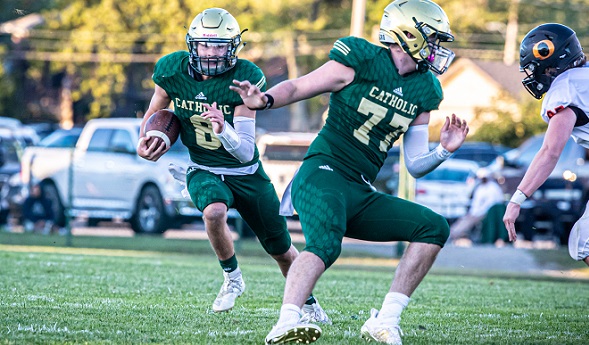
 Price (5-foot-11, 175 pounds) came out this fall flinging the ball around in the Crusaders’ opening win over Ludington, completing 10-of-13 passes for 212 yards and three touchdowns.
But for those worrying that the quintessential running football team has gone pass-happy, no worries. Since that game, MCC has settled into its running ways, with Price passing for just 235 yards and one touchdown over the past four games.
The Crusaders are back to pounding teams on the ground behind an offensive line that has grown bigger and more experienced under the direction of veteran line coaches Mike Ribecky, Joe Perri and Mike Hornak. Guard AJ Lock (6-1, 220) is still the lone senior starter on the interior line, with the other four being juniors – tackles Jaden Johnson (6-4, 235) and Alex Barnhill (6-0, 260), guard Jack Heminger (5-10, 210) and center Landon Patterson (6-0, 220).
The real secret of this year’s team is a stable of talented and interchangeable backs, led by senior Tommy Kartes and junior Joe Waller. The other backs getting significant touches are all underclassmen – juniors Nick Powell, Dane Rutz and Eliot Riegler.
“We were still in the first quarter last week against Orchard View, and seven different kids had touched the football,” said Czerwon. “I don’t think this team has any superstar on it. Quite frankly, we have a lot of kids of equal ability – we have a lot of good, solid players.”
The first to touch the ball each play is Price, who then distributes the ball around.
Price is thankful to be playing at all, after the COVID lockdown wiped out his junior baseball season this spring and a team that many believed was poised to make a run at an MHSAA Finals championship.
He is also thankful to be healthy. Price likely appreciates his health more than most his age because of the health issues of his father, Paul, who was paralyzed in 2015 after a fall at their home.
“I was in middle school when that happened, and I wondered if I should even play football with all the risks,” said Price. “But I know he wants me to follow my passion and be out there. He is a motivation for me, and I love seeing him on the sidelines at our games.”
 Tom Kendra worked 23 years at The Muskegon Chronicle, including five as assistant sports editor and the final six as sports editor through 2011. E-mail him at [email protected] with story ideas for Muskegon, Oceana, Mason, Lake, Oceola, Mecosta and Newaygo counties.
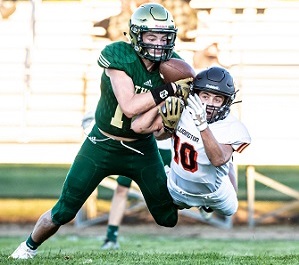
PHOTOS: (Top) Muskegon Catholic Central senior quarterback Max Price runs behind the block of junior tackle Jaden Johnson during the Crusaders' 30-6 season-opening victory over visiting Ludington on Sept. 18. (Middle) MCC senior slot receiver Tommy Kartes hauls in this reception from Price while an Orioles defender works to break it up. (Photos by Tim Reilly.)