


Michigan’s Football Numbers Game – Corrected
September 1, 2017
Today’s blog was written by MHSAA Second Half Editor Geoff Kimmerly
The demise of Michigan high school football has been greatly exaggerated – or, at least, recently misreported by one of the U.S.’s most recognizable newspapers that noted as part of a larger story on football decline that Michigan has seen a “net loss of 57 teams in the past five years.”
It’s easy to understand how this error took place – especially when a reporter is not familiar with the football landscape in our state – but that doesn’t make this statement any less misleading, or harmful considering the story since has been picked up by multiple large news organizations. So let’s quickly clear up the misinterpreted information:
-
The data that led to this error came from an annual participation report released by the National Federation of State High School Associations (NFHS). Every spring, state associations (like the MHSAA) from every state and Washington, D.C., tally up how many of their member schools have a sport and how many athletes play it.
-
For 2016-17, the MHSAA submitted to the NFHS a total of 580 schools with 11-player football – that number actually includes all schools that reported having at least one football player, including primary and secondary schools in co-ops. And yes, that 580 is 57 fewer than the 637 11-player schools the MHSAA submitted for 2012-13.
-
But saying Michigan has lost 57 football programs misses out on something incredibly significant – the MHSAA also submitted 60 schools with 8-player football last year, up from 16 in 2012-13, making that net decrease in football schools over five years 13 – far fewer than 57.
And with a few more brush strokes, the picture of football in our state actually shows a healthy landscape:
-
The 640 schools in Michigan with at least one football player for 2016-17, 11 and 8-player combined, is actually eight more than we reported to the NFHS four years ago and 10 more than three years ago.
-
A better picture of Michigan’s football consistency is shown by how many varsity programs are taking the field. This fall, that number is 616 – 555 11-player varsities and 61 8-player – and we also had 616 for most of the 2016 season, 616 in 2015 and 615 in 2014.
-
We’ve had programs bring back varsity teams this year, and in one case a school has a team on its own for the first time. Benzonia Benzie Central and Suttons Bay were unable to field varsities in 2016, but Benzie Central is back playing 11-player and Suttons Bay is back with an 8-player team. Brimley, an 8-player school going back to 2010, also is fielding a team again after being unable to do so last year. Mount Clemens played only two varsity games in 2016 and forfeited a third, but has seven scheduled for this fall and lost close in its opener last week. And Bear Lake, previously a secondary school in a co-op program, now has a team all its own for the first time and is playing at the 8-player level.
-
Yes, there has been a decrease in Michigan high school football participation when it comes to the number of players – for reasons we discuss frequently, including more extracurricular/entertainment options than ever for students, more who are specializing in other sports and safety fears that often are misplaced. But we’ve also seen a three percent drop in enrollment at MHSAA member schools over the last five years. And despite that trend, Michigan again had the sixth-highest 11-player football participation in the nation in 2016-17 (and seventh-highest in 8-player) while ranking 10th nationally in number of residents of high school age.
-
So yes, while a nine percent drop in the number of football players over the last five years in Michigan clearly is troubling, and something we’re working with the Michigan High School Football Coaches Association to reverse, let’s also put those numbers in perspective. At medium-sized to bigger schools, it could mean a roster of 40 might have only 36 players. A roster of 20 at an 8-player school might go down to 18. Neither would signal the need to eliminate a football program.
-
And that move by so many schools to 8-player? It definitely started as a way for low-participation programs to keep football (and has worked for most of them). While that still may be the driving force as schools move from 11 to 8, others have made the switch because most of their former opponents did and joining them makes scheduling easier and travel shorter. Michigan has a multitude of small towns, and you’ll find most of these 8-player programs in pockets in the thumb, southwest or northern Lower Peninsula, or Upper Peninsula. And keep in mind, only Class D teams remain eligible for the 8-player playoffs – and only two of 61 teams playing 8-player this fall are larger than Class D and its enrollment limit of 203 students for 2017-18.
The story behind “a decrease of 57 schools” clearly is a little complex to explain and explain away, but it’s necessary to do so.
Yes, Michigan’s total number of football players is down a few percent. But the sport’s prominence and importance in our schools and communities remains high.
Grisdale to be Honored for 40 Seasons on Call for Cheboygan Football
By
Tom Spencer
Special for MHSAA.com
September 13, 2024
When Jason Friday was in high school, there were two types of football fans in Cheboygan.
 Folks either went to watch the Cheboygan Chiefs play under the lights, or they listened to the game on the radio called by play-by-play announcer Mike Grisdale.
Well, not much has changed. Friday, a 1992 Cheboygan grad, is now the school’s athletic director. And Grisdale is in the middle of his 40th season on the air.
What is changing tonight, though, is Cheboygan will officially dedicate the stadium press box to Grisdale in a special pregame ceremony before the Chiefs (1-1) take on Elk Rapids (1-1).
Former Cheboygan coaches, Grisdale’s family and people who have worked with him on the radio over the years will be on hand for the ceremony.
“We were able to get Dan Miller, George Blaha, Ken Kal and Dan Dickerson — radio broadcasters for all four Detroit sports — to record statements that we will play over the public address system,” said Friday. “Mike will be presented a smaller version of the plaque that we will be hanging in the press box, and he will have a chance to talk.”
Naming the press box after Grisdale has been in the works for more than a year, Friday noted. Grisdale first learned of the plan when he was interviewing Friday during halftime of a football game last year.
“Jason surprised me on the air,” Grisdale recalled. “I was shocked, but honored and thankful.”
 Grisdale, a 1979 Cheboygan grad, is humbled noting there are so many people who contribute to the radio broadcasts and football program. He remembers listening with his father to Jorden James and Bob Martin call Chiefs games when some of the older kids from the neighborhood were playing high school football.
“I have just been so fortunate to do it for this long and have become the go-to guy for historical information and perspective,” Grisdale said.
Grisdale, who has also done nearly 1,000 Chiefs basketball games on the air, along with some hockey and soccer, said his interest in sports goes back to his childhood.
Grisdale grew up in Cheboygan with three brothers in a neighborhood full of kids. Sports were a big part of their lives — collecting baseball cards, listening to the Detroit Tigers on the radio, and playing basketball, kickball and wiffle ball.
Grisdale, who also hosts a Saturday morning radio show from a local restaurant called “Coaches Corner,” vividly recalls trying to keep a scorebook while listening to high school basketball games on WCBY radio and dreaming of becoming the next Blaha, or Ernie Harrell, Bob Ufer, or Bruce Martin - four legendary broadcasters of Michigan professional and college sports.
While at Central Michigan University earning a broadcasting degree, Grisdale got extensive of on-air experience on student stations. He worked on Cheboygan radio stations during summers.
Some of his fondest memories of Chiefs broadcasts have come from the locations where they’ve played.
“I have enjoyed having the opportunity to cover games at places like the Pontiac Silverdome, Palace of Auburn Hills, Crisler Arena and the Breslin Center,” Grisdale said. “You remember the exciting moments and big games”
 The 40 years on the air, along with earlier turns covering Marshall and Albion football and basketball games, are really just a blur to the highly-revered radio personality.
“The seasons just seemed to run together,” Grisdale said. “There were many, many times when the weather and the long road trips took their toll.”
Grisdale played football at Cheboygan High School and was an offensive end and a defensive safety on a 9-0 squad his senior year in 1978. He caught three touchdown passes that season. He also held for extra points, collecting snaps from his brother Mark, the Chiefs’ long-snapper.
Mike Grisdale doesn’t hesitate to point out the best player he covered was fullback Shannon Scarborough from the 1991 team that reached the Silverdome – “The all-stater was strong and fast and played both ways,” he noted. But Grisdale has loved all the players and teams over the years. “I do it because I enjoy promoting the kids, keeping the traditions alive, seeing the community come together, good sportsmanship, and being part of a team.”
Friday, who also has broadcast multiple games alongside Grisdale over the years, has enjoyed Grisdale’s efforts to promote every player.
“Kids always love to hear their name on the radio,” Friday said. “What I think he does better than anyone is to make sure the offensive and defensive linemen are consistently mentioned — those boys in the trenches often get overlooked, but not with Mike on the call.”
When Cheboygan installed NFHS Network cameras, the athletic department sought to successfully connect Grisdale’s radio broadcast through the video feed.
“That has been a huge bonus and something that many community members have told me they appreciate,” Friday said.
Grisdale, who also works part-time for Black Diamond Broadcasting in its Cheboygan studios and serves Mackinaw Health System based in St. Ignace as its marketing director, has no plans to end his broadcasting career.
“As long as our local radio station can keep the tradition alive and I am still around, it would be my privilege to keep it going,” Grisdale said.
Cheboygan High School games are carried on WCBY (Cheboygan) 1240 AM, 100.7 FM and 98.1 FM, and streaming at BigCountryGold.com.
 Tom Spencer is a longtime MHSAA-registered basketball and soccer official, and former softball and baseball official, and he also has coached in the northern Lower Peninsula area. He previously has written for the Saginaw News, Bay County Sports Page and Midland Daily News. He can be reached at [email protected] with story ideas for Manistee, Wexford, Missaukee, Roscommon, Ogemaw, Iosco, Alcona, Oscoda, Crawford, Kalkaska, Grand Traverse, Benzie, Leelanau, Antrim, Otsego, Montmorency, Alpena, Presque Isle, Cheboygan, Charlevoix and Emmet counties.
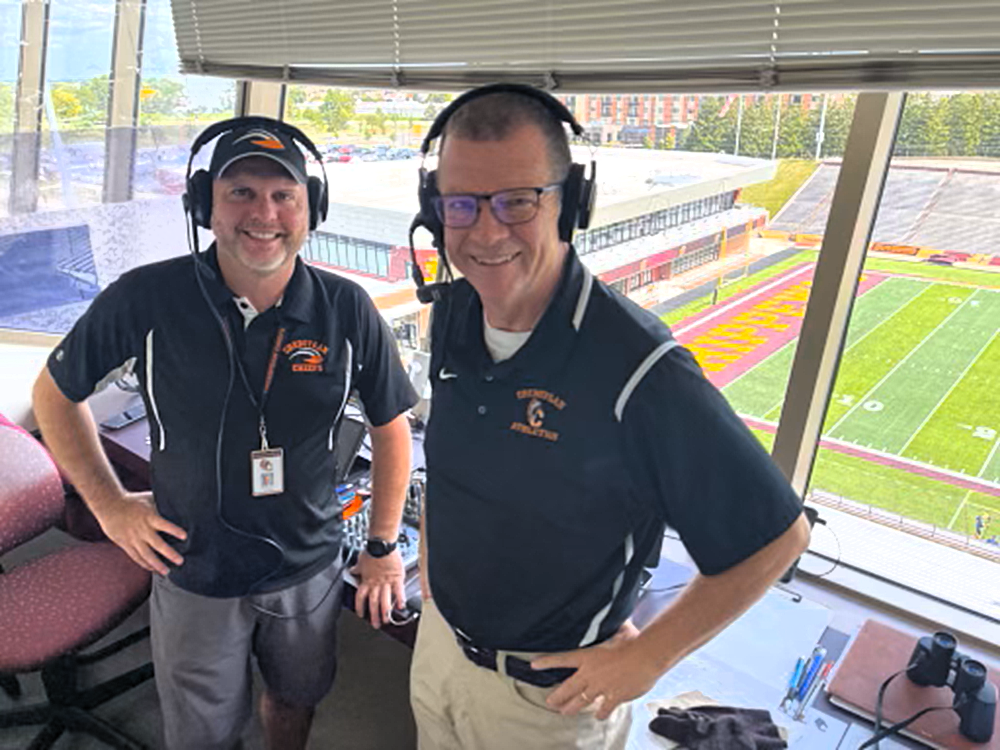
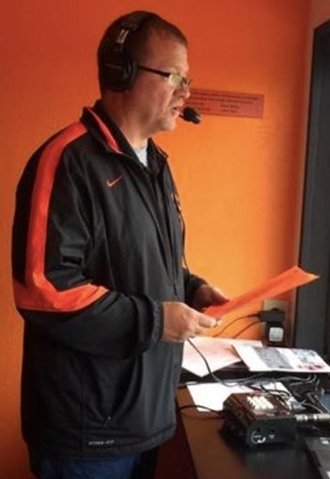
PHOTOS (Top) Mike Grisdale, right, and partner Nate King broadcast a Cheboygan game from Central Michigan University. (Middle) The Cheboygan stadium press box will be dedicated to the longtime broadcaster. (Below) Grisdale is on the call for another Chiefs game. (Photos provided by Grisdale and the Cheboygan athletic department.)