


Michigan’s Football Numbers Game – Corrected
September 1, 2017
Today’s blog was written by MHSAA Second Half Editor Geoff Kimmerly
The demise of Michigan high school football has been greatly exaggerated – or, at least, recently misreported by one of the U.S.’s most recognizable newspapers that noted as part of a larger story on football decline that Michigan has seen a “net loss of 57 teams in the past five years.”
It’s easy to understand how this error took place – especially when a reporter is not familiar with the football landscape in our state – but that doesn’t make this statement any less misleading, or harmful considering the story since has been picked up by multiple large news organizations. So let’s quickly clear up the misinterpreted information:
-
The data that led to this error came from an annual participation report released by the National Federation of State High School Associations (NFHS). Every spring, state associations (like the MHSAA) from every state and Washington, D.C., tally up how many of their member schools have a sport and how many athletes play it.
-
For 2016-17, the MHSAA submitted to the NFHS a total of 580 schools with 11-player football – that number actually includes all schools that reported having at least one football player, including primary and secondary schools in co-ops. And yes, that 580 is 57 fewer than the 637 11-player schools the MHSAA submitted for 2012-13.
-
But saying Michigan has lost 57 football programs misses out on something incredibly significant – the MHSAA also submitted 60 schools with 8-player football last year, up from 16 in 2012-13, making that net decrease in football schools over five years 13 – far fewer than 57.
And with a few more brush strokes, the picture of football in our state actually shows a healthy landscape:
-
The 640 schools in Michigan with at least one football player for 2016-17, 11 and 8-player combined, is actually eight more than we reported to the NFHS four years ago and 10 more than three years ago.
-
A better picture of Michigan’s football consistency is shown by how many varsity programs are taking the field. This fall, that number is 616 – 555 11-player varsities and 61 8-player – and we also had 616 for most of the 2016 season, 616 in 2015 and 615 in 2014.
-
We’ve had programs bring back varsity teams this year, and in one case a school has a team on its own for the first time. Benzonia Benzie Central and Suttons Bay were unable to field varsities in 2016, but Benzie Central is back playing 11-player and Suttons Bay is back with an 8-player team. Brimley, an 8-player school going back to 2010, also is fielding a team again after being unable to do so last year. Mount Clemens played only two varsity games in 2016 and forfeited a third, but has seven scheduled for this fall and lost close in its opener last week. And Bear Lake, previously a secondary school in a co-op program, now has a team all its own for the first time and is playing at the 8-player level.
-
Yes, there has been a decrease in Michigan high school football participation when it comes to the number of players – for reasons we discuss frequently, including more extracurricular/entertainment options than ever for students, more who are specializing in other sports and safety fears that often are misplaced. But we’ve also seen a three percent drop in enrollment at MHSAA member schools over the last five years. And despite that trend, Michigan again had the sixth-highest 11-player football participation in the nation in 2016-17 (and seventh-highest in 8-player) while ranking 10th nationally in number of residents of high school age.
-
So yes, while a nine percent drop in the number of football players over the last five years in Michigan clearly is troubling, and something we’re working with the Michigan High School Football Coaches Association to reverse, let’s also put those numbers in perspective. At medium-sized to bigger schools, it could mean a roster of 40 might have only 36 players. A roster of 20 at an 8-player school might go down to 18. Neither would signal the need to eliminate a football program.
-
And that move by so many schools to 8-player? It definitely started as a way for low-participation programs to keep football (and has worked for most of them). While that still may be the driving force as schools move from 11 to 8, others have made the switch because most of their former opponents did and joining them makes scheduling easier and travel shorter. Michigan has a multitude of small towns, and you’ll find most of these 8-player programs in pockets in the thumb, southwest or northern Lower Peninsula, or Upper Peninsula. And keep in mind, only Class D teams remain eligible for the 8-player playoffs – and only two of 61 teams playing 8-player this fall are larger than Class D and its enrollment limit of 203 students for 2017-18.
The story behind “a decrease of 57 schools” clearly is a little complex to explain and explain away, but it’s necessary to do so.
Yes, Michigan’s total number of football players is down a few percent. But the sport’s prominence and importance in our schools and communities remains high.
River Rouge Ends 2019 with Stunning Finish
November 30, 2019
By Tom Kendra
Special for Second Half
DETROIT – River Rouge wasn’t intimidated by Muskegon’s national acclaim or 859 football victories, the most by any Michigan high school.
If anything, the chance to knock off the unbeaten and top-ranked Big Reds brought out the absolute best in the Panthers.
After spotting Muskegon a 7-0 lead, Rouge scored the final 30 points to claim a 30-7 victory in the Division 3 championship game Saturday night at Ford Field.
“We are known for basketball, but now we have a football title,” said 10th-year Rouge coach Corey Parker, who lauded his team for playing fearlessly on both sides of the ball. “Now we have a football title, and 20 years from now these guys are going to be talking about it.”
All the talk coming into the game centered on Muskegon senior quarterback Cameron Martinez, the two-time MLive Player of the Year who had rushed for more than 2,000 yards. But the talk afterward was about a different QB – River Rouge’s Mareyohn Hrabowski.
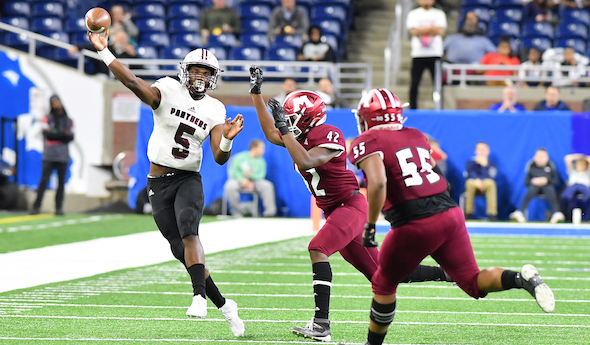
Hrabowski, a 6-foot-3, 205-pound junior, answered an early score by Martinez with three rushing touchdowns of his own, finishing with 15 carries for 175 yards – an average of nearly 12 yards per carry. He also completed 6-of-12 passes for 45 yards.
“I just had to follow my blocks,” said Hrabowski. “I had faith in myself and my team, and we came out on top.”
It was the first Finals appearance and championship for Rouge, which has qualified for the playoffs all 10 years under Parker. Rouge lost its opener this fall to Friday’s Division 4 champion Grand Rapids Catholic Central before reeling off 13 straight wins. The Panthers were ranked No. 5 in Division 3 entering the playoffs
The other storyline Saturday was the Rouge defense, which held a Muskegon team averaging 49 points per game to a season-low seven.
The Panthers did it with an ultra-aggressive strategy, sometimes with all 11 defensive players within three yards of the line of scrimmage just daring Martinez to throw the ball.
Instead, Muskegon kept trying to find a way to break Martinez through the initial wall and into the clear, but it never happened.
Martinez, a 5-11, 190-pound senior who has committed to Ohio State, finished with 108 rushing yards, but it took him 34 carries to get there – at 3.2 yards per carry. He also did not complete a single pass, going 0-for-5 through the air.
“We just didn’t play our game, really,” said Martinez, who faced relentless pressure every time he dropped back to throw. “We have played great for 13 weeks, and we picked a bad time to play bad.”
Hrabowski scored on runs of one and 40 yards in the second quarter, as the Panthers took a 14-7 lead into halftime.
 Rouge (13-1) kept its foot on the accelerator during the second half, with Rmontaye Caldwell returning the third-quarter kickoff 36 yards to the Muskegon 35-yard line. On the next play, Hrabowski went 35 yards on a keeper and the lead was 21-7.
The score remained the same until the fourth quarter, when Rouge rounded out the scoring on a 31-yard field goal by Avery Burch and a 33-yard run by Deandre Bulley.
Bulley, a 6-2, 245-pound senior who is being heavily recruited by schools at the Division I level, came into the game needing just 80 yards to reach 2,000 for the season. He came up five yards short, with 15 carries for 75 yards, but Hrabowski more than made up the difference.
Rouge used extremely wide splits on the offensive line to open up running lanes for Hrabowski, who stunned the stingy Big Reds’ defense with his vision and deceptive speed in the open field. On two of his scoring runs he faked a jet sweep handoff and ran straight ahead behind guard Deshawn Smith and tackle Chance Moore through the left side of the line and eventually into the end zone.
The final stats bear out Rouge’s dominance.
The Panthers held a 330-180 edge in total yards, including a 45-0 edge passing. Rouge outrushed Muskegon 285-180.
Darieon Jones, a 5-8, 190-pound senior defensive back, was everywhere for Rouge, registering a game-high 14 tackles, including 10 solos. Linebacker Deshawn Walker had eight tackles, and Tyron Jones and Chastin Cross each made six stops.
River Rouge has been known around the state as a basketball school, winning 12 Class B state titles under legendary coach Lofton Greene during the 1960s and 1970s. But now the Panthers, who are part of the Michigan Metro Athletic Conference, are making a name for themselves on the gridiron.
Rouge made a statement by dominating Orchard Lake St. Mary’s 49-14 in the Regional Final, then overcame a 7-0 fourth-quarter deficit in last week’s Semifinal to knock off Chelsea 14-7.
The Panthers rode that momentum into the Final.
Muskegon, led by senior linebacker Tarran Walker and senior safety Tyreese Oakes with nine tackles apiece, added another layer of frustration to its Ford Field troubles.
The Big Reds have played in a championship game at Ford Field seven of the last eight years. But the lone victory, and the lone Finals title for 10th-year head coach Shane Fairfield, came with a 28-10 victory over Farmington Hills Harrison in 2017 for the Division 3 championship.
“That’s the way it happens,” said Fairfield, who last week became the second-winningest coach in Muskegon High School history. “We won 13 games and made 13 other teams feel this way. This is the risk you take. You could lose early or not even make the playoffs and never experience this.”
Muskegon, which had won 40 of its past 41 games entering Saturday night, is the winningest program in state history with 859 victories, a total which also ranks seventh nationally.
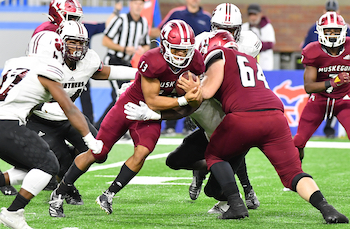
PHOTOS: (Top) River Rouge quarterback Mareyohn Hrabowski rolls out and finds a receiver as Muskegon’s Billy Johnson Jr. (42) and Dwight McKinney close in. (Middle) River Rouge defenders including Rmontaye Caldwell (17) surround Big Reds quarterback Cameron Martinez.