


Michigan’s Football Numbers Game – Corrected
September 1, 2017
Today’s blog was written by MHSAA Second Half Editor Geoff Kimmerly
The demise of Michigan high school football has been greatly exaggerated – or, at least, recently misreported by one of the U.S.’s most recognizable newspapers that noted as part of a larger story on football decline that Michigan has seen a “net loss of 57 teams in the past five years.”
It’s easy to understand how this error took place – especially when a reporter is not familiar with the football landscape in our state – but that doesn’t make this statement any less misleading, or harmful considering the story since has been picked up by multiple large news organizations. So let’s quickly clear up the misinterpreted information:
-
The data that led to this error came from an annual participation report released by the National Federation of State High School Associations (NFHS). Every spring, state associations (like the MHSAA) from every state and Washington, D.C., tally up how many of their member schools have a sport and how many athletes play it.
-
For 2016-17, the MHSAA submitted to the NFHS a total of 580 schools with 11-player football – that number actually includes all schools that reported having at least one football player, including primary and secondary schools in co-ops. And yes, that 580 is 57 fewer than the 637 11-player schools the MHSAA submitted for 2012-13.
-
But saying Michigan has lost 57 football programs misses out on something incredibly significant – the MHSAA also submitted 60 schools with 8-player football last year, up from 16 in 2012-13, making that net decrease in football schools over five years 13 – far fewer than 57.
And with a few more brush strokes, the picture of football in our state actually shows a healthy landscape:
-
The 640 schools in Michigan with at least one football player for 2016-17, 11 and 8-player combined, is actually eight more than we reported to the NFHS four years ago and 10 more than three years ago.
-
A better picture of Michigan’s football consistency is shown by how many varsity programs are taking the field. This fall, that number is 616 – 555 11-player varsities and 61 8-player – and we also had 616 for most of the 2016 season, 616 in 2015 and 615 in 2014.
-
We’ve had programs bring back varsity teams this year, and in one case a school has a team on its own for the first time. Benzonia Benzie Central and Suttons Bay were unable to field varsities in 2016, but Benzie Central is back playing 11-player and Suttons Bay is back with an 8-player team. Brimley, an 8-player school going back to 2010, also is fielding a team again after being unable to do so last year. Mount Clemens played only two varsity games in 2016 and forfeited a third, but has seven scheduled for this fall and lost close in its opener last week. And Bear Lake, previously a secondary school in a co-op program, now has a team all its own for the first time and is playing at the 8-player level.
-
Yes, there has been a decrease in Michigan high school football participation when it comes to the number of players – for reasons we discuss frequently, including more extracurricular/entertainment options than ever for students, more who are specializing in other sports and safety fears that often are misplaced. But we’ve also seen a three percent drop in enrollment at MHSAA member schools over the last five years. And despite that trend, Michigan again had the sixth-highest 11-player football participation in the nation in 2016-17 (and seventh-highest in 8-player) while ranking 10th nationally in number of residents of high school age.
-
So yes, while a nine percent drop in the number of football players over the last five years in Michigan clearly is troubling, and something we’re working with the Michigan High School Football Coaches Association to reverse, let’s also put those numbers in perspective. At medium-sized to bigger schools, it could mean a roster of 40 might have only 36 players. A roster of 20 at an 8-player school might go down to 18. Neither would signal the need to eliminate a football program.
-
And that move by so many schools to 8-player? It definitely started as a way for low-participation programs to keep football (and has worked for most of them). While that still may be the driving force as schools move from 11 to 8, others have made the switch because most of their former opponents did and joining them makes scheduling easier and travel shorter. Michigan has a multitude of small towns, and you’ll find most of these 8-player programs in pockets in the thumb, southwest or northern Lower Peninsula, or Upper Peninsula. And keep in mind, only Class D teams remain eligible for the 8-player playoffs – and only two of 61 teams playing 8-player this fall are larger than Class D and its enrollment limit of 203 students for 2017-18.
The story behind “a decrease of 57 schools” clearly is a little complex to explain and explain away, but it’s necessary to do so.
Yes, Michigan’s total number of football players is down a few percent. But the sport’s prominence and importance in our schools and communities remains high.

Monroe SMCC Wins Championship Grind
November 29, 2019
By Geoff Kimmerly
Second Half editor
DETROIT – If Monroe St. Mary Catholic Central could draw up the perfect game for its preferred style of play, it might look a lot like Friday’s Division 6 Final.
Yes, the Falcons defeated Maple City Glen Lake to win their first championship since 2014, so that makes it memorable no matter what. And sure, SMCC would’ve loved to score more – the offense averaged 34 points per game heading into the night.
But look past all of that and consider: The Falcons had 63 plays to Glen Lake’s 32, and ran the ball 58 times. They had 22 first downs to Glen Lake’s six. They had the ball nearly twice as long – 31:17 to 16:43 – and didn’t have one penalty called against them. And the defense posted its first shutout of the season.
Offensive efficiency and defensive prowess have been hallmarks of a program that was playing in its eighth MHSAA Final – and the victory was proof again that the workmanlike approach remains a viable a championship approach during an era dominated by wide-open and fast-paced attacks.
“It’s not really the score that we anticipated, but it’s OK – we’re a grinding team, we have faith in our defense and our offense to eat up time on the clock,” SMCC senior quarterback Wyatt Bergmoser said. “We just rep our plays, and if it does come down to the defense we let them do their thing and it’s not a big deal – we have trust in the other players on the field.
“We were on different teams (before high school) but we knew we’d come together and play together in the future, and that’s something we dreamed of and hoped for forever. As a kid, I went to the 2014 state championship game. I just remember sitting in the stands and thinking to myself, I want to be here one day. I want to be here with my friends, with my other players and grind it out and get a state championship for myself. And that’s what we did, and I love all my players and teammates for that.”
The Falcons finished 12-1, their only defeat this season 28-21 to Division 4 Milan in Week 3.
 That close loss, which eventually decided the Huron League title, provided a lesson that would serve St. Mary as it worked to finish off its mission for the ultimate playoff prize.
SMCC led in the fourth quarter by a point, and punted on 4th-and-4 with just under seven minutes to play. Milan went ahead on the next possession, and the Falcons ran out of time.
On Friday, SMCC punted only twice and converted on four of five fourth-down tries, including two during a 14-play, 55-yard fourth-quarter possession that didn’t result in a score but did drain 7:48 off the clock. That possession also left Glen Lake to try to tie beginning at its own 7-yard line with 2:27 to play.
“Earlier in the year we were hitting some big runs, but three, four, five yards are great plays for our offense,” SMCC coach Adam Kipf said. “We don’t need to hit a home run. We don’t need to get 10 yards every time we touch it. But if we’re getting three yards a pop … 2½ yards, we’re in great position. We like to do that, and we’ll chew up 35, 36, 37 seconds on the play clock too, and that’s by design. We want to keep it out of their hands.”
The game’s lone score came on a Bergmoser six-yard touchdown run just under five minutes into the second quarter, which capped a 10-play, 94-yard drive lasting 5:22.
The Falcons ran for 249 yards total, led by senior Alex Morgan’s 123 on 22 carries. They held Glen Lake (12-2) to 127 yards total, 75 of it coming through the air on passes by senior quarterback Reece Hazelton. The Lakers got no deeper into SMCC territory than the 36-yard line.
“They were probably the biggest team we faced all year, since we’re pretty big ourselves,” Glen Lake junior receiver/defensive back Finn Hogan said. “It was a little different change of pace for us. It took a drive or two for us to get used to, and they capitalized.”
The seven points tied the fewest Glen Lake gave up in a game this season – seven times the Lakers gave up seven, and they allowed a solid 16.2 on average over the entire fall. Hogan and senior linebacker Jonathan Wright led Friday’s effort with 12 tackles apiece, and as a team Glen Lake had six tackles for loss.
Bergmoser also was his team’s high tackler with seven.
Glen Lake had last appeared in a Final in 2016, also finishing Division 6 runner-up that year. The Falcons, meanwhile, finished a rare 4-5 that fall, but came back with seven wins in 2017 and nine last season to set up this year’s run.
“Going into high school my freshman year, I knew we had a special group in our class. I think everyone knew we were special,” Morgan said. “My sophomore year we had 11 starters on the team that made the playoff run. Our junior year we had a ton of juniors starting on that team. So we had one goal in mind this senior year, and it was to be right where we are right now.”
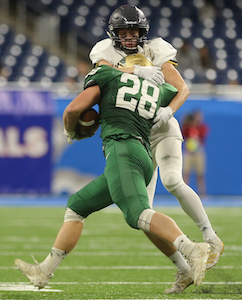
PHOTOS: (Top) St. Mary’s Alex Morgan (26) is slowed by Glen Lake’s C.J. Helfrich (2) and Finn Hogan. (Middle) A Glen Lake defender works to bring down the Falcons’ Samuel Cousino.