


Michigan’s Football Numbers Game – Corrected
September 1, 2017
Today’s blog was written by MHSAA Second Half Editor Geoff Kimmerly
The demise of Michigan high school football has been greatly exaggerated – or, at least, recently misreported by one of the U.S.’s most recognizable newspapers that noted as part of a larger story on football decline that Michigan has seen a “net loss of 57 teams in the past five years.”
It’s easy to understand how this error took place – especially when a reporter is not familiar with the football landscape in our state – but that doesn’t make this statement any less misleading, or harmful considering the story since has been picked up by multiple large news organizations. So let’s quickly clear up the misinterpreted information:
-
The data that led to this error came from an annual participation report released by the National Federation of State High School Associations (NFHS). Every spring, state associations (like the MHSAA) from every state and Washington, D.C., tally up how many of their member schools have a sport and how many athletes play it.
-
For 2016-17, the MHSAA submitted to the NFHS a total of 580 schools with 11-player football – that number actually includes all schools that reported having at least one football player, including primary and secondary schools in co-ops. And yes, that 580 is 57 fewer than the 637 11-player schools the MHSAA submitted for 2012-13.
-
But saying Michigan has lost 57 football programs misses out on something incredibly significant – the MHSAA also submitted 60 schools with 8-player football last year, up from 16 in 2012-13, making that net decrease in football schools over five years 13 – far fewer than 57.
And with a few more brush strokes, the picture of football in our state actually shows a healthy landscape:
-
The 640 schools in Michigan with at least one football player for 2016-17, 11 and 8-player combined, is actually eight more than we reported to the NFHS four years ago and 10 more than three years ago.
-
A better picture of Michigan’s football consistency is shown by how many varsity programs are taking the field. This fall, that number is 616 – 555 11-player varsities and 61 8-player – and we also had 616 for most of the 2016 season, 616 in 2015 and 615 in 2014.
-
We’ve had programs bring back varsity teams this year, and in one case a school has a team on its own for the first time. Benzonia Benzie Central and Suttons Bay were unable to field varsities in 2016, but Benzie Central is back playing 11-player and Suttons Bay is back with an 8-player team. Brimley, an 8-player school going back to 2010, also is fielding a team again after being unable to do so last year. Mount Clemens played only two varsity games in 2016 and forfeited a third, but has seven scheduled for this fall and lost close in its opener last week. And Bear Lake, previously a secondary school in a co-op program, now has a team all its own for the first time and is playing at the 8-player level.
-
Yes, there has been a decrease in Michigan high school football participation when it comes to the number of players – for reasons we discuss frequently, including more extracurricular/entertainment options than ever for students, more who are specializing in other sports and safety fears that often are misplaced. But we’ve also seen a three percent drop in enrollment at MHSAA member schools over the last five years. And despite that trend, Michigan again had the sixth-highest 11-player football participation in the nation in 2016-17 (and seventh-highest in 8-player) while ranking 10th nationally in number of residents of high school age.
-
So yes, while a nine percent drop in the number of football players over the last five years in Michigan clearly is troubling, and something we’re working with the Michigan High School Football Coaches Association to reverse, let’s also put those numbers in perspective. At medium-sized to bigger schools, it could mean a roster of 40 might have only 36 players. A roster of 20 at an 8-player school might go down to 18. Neither would signal the need to eliminate a football program.
-
And that move by so many schools to 8-player? It definitely started as a way for low-participation programs to keep football (and has worked for most of them). While that still may be the driving force as schools move from 11 to 8, others have made the switch because most of their former opponents did and joining them makes scheduling easier and travel shorter. Michigan has a multitude of small towns, and you’ll find most of these 8-player programs in pockets in the thumb, southwest or northern Lower Peninsula, or Upper Peninsula. And keep in mind, only Class D teams remain eligible for the 8-player playoffs – and only two of 61 teams playing 8-player this fall are larger than Class D and its enrollment limit of 203 students for 2017-18.
The story behind “a decrease of 57 schools” clearly is a little complex to explain and explain away, but it’s necessary to do so.
Yes, Michigan’s total number of football players is down a few percent. But the sport’s prominence and importance in our schools and communities remains high.
March to Marquette: 8-Player Preview
November 22, 2019
By Geoff Kimmerly
Second Half editor
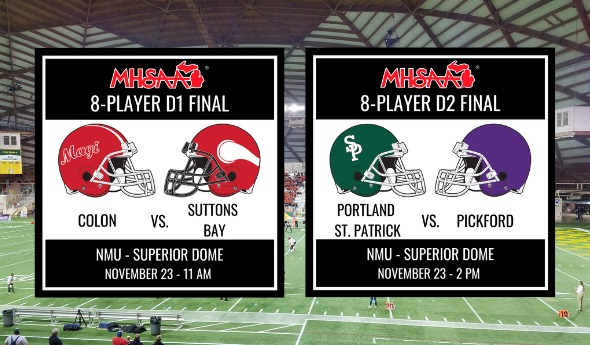
For the second straight season, the majority of teams making the trip to the 8-Player Finals at Northern Michigan University’s Superior Dome will come seeking their first MHSAA football championship.
Colon, Suttons Bay and Pickford will be first-time title hopefuls Saturday. Portland St. Patrick is seeking its first football title since 1992, long before any of these current players was born.
Kickoff for the Division 1 game is 11 a.m., with the Division 2 game following at 2 p.m. Tickets cost $10 and one is good for admittance to both games. Both games also will be broadcast live on FOXSportsDetroit.com and the FOX Sports app, and replayed on FOX Sports Detroit’s primary channel on Nov. 26 – Division 1 at 8 p.m. and Division 2 at 11 p.m. Audio of both games will be streamed live on MHSAANetwork.com.
Below is a look at all four finalists. Team “rankings” are based on their playoff-point averages heading into the postseason.
 Division 1
COLON
Record/rank: 12-0, No. 2
Coach: Robbie Hattan, fourth season (28-13)
League finish: First in Southern Central Athletic Association A
Championship history: Has never played in an MHSAA Final.
Best wins: 27-8 over No. 6 Morrice in Semifinal, 56-12 over No. 3 Martin in Regional Final, 60-12 (Pre-Regional) and 55-0 over No. 13 Camden-Frontier, 43-8 over No. 11 Bellevue, 42-0 over Division 2 No. 5 Climax-Scotts.
Players to watch: RB/DL Brandon Crawford, 6-2/240, jr. (1,491 yards/22 TDs rushing); SL/DB/P Jonathan West, 6-2/160, sr. (653 yards/7 TDs rushing, 498 yards/12 TDs receiving); QB/DB Phillip Alva, 5-9/140, sr. (954 yards/19 TDs passing, 903 yards/17 TDs rushing).
Outlook: Colon moved to 8-player before the 2018 season after a nice recent run in 11-player that had included eight playoff appearances over the previous 14 seasons. But the Magi have succeeded at a higher level since making the switch, putting up double-digit wins last season for the first time and again this fall. Last season’s champion Morrice was the first opponent to hold Colon to under 34 points and also the first to come within 34 of catching the Magi this fall. Crawford and West both earned all-state honorable mentions in 2018, and 6-4 junior Brayden Ireland gives Alva another big target in the passing game. West also has scored off interceptions and punt and kickoff returns this season.
SUTTONS BAY
Record/rank: 12-0, No. 4
Coach: Garrick Opie, second season (21-2)
League finish: First in Midwest Central Michigan Conference West
Championship history: Division 6 runner-up 2004 (11-player).
Best wins: 45-14 over No. 8 Kingston in Semifinal, 36-30 over No. 14 Gaylord St. Mary in Regional Final, 36-14 over No. 16 Brimley in Pre-Regional, 20-14 and 29-18 over Division 2 No. 9 Onekama.
Players to watch: RB/DB Lucas Mikesell, 5-11/175, sr. (1,259 yards/29 TDs rushing, 501 yards/9 TDs receiving), QB/DB Bryce Opie, 6-4/194, sr. (1,167 yards/15 TDs passing, 692 yards/13 TDs rushing); OG/DT Gavyn Shananaquet, 6-0/230, sr.
Outlook: Suttons Bay has run its record over three seasons of 8-player to a combined 28-6 after being forced to end its final 11-player season early in 2016. The Norsemen had only three games decided by single digits this fall. The first was a six-point win over Onekama, and Suttons Bay won the rematch by 11, and the other two were against Gaylord St. Mary – a one-point loss on the field that became a forfeit win and a six-point win in the Regional Final. The defense has been especially impressive, giving up 16.7 points per game on the season but more than 18 only twice (both times to St. Mary). Bryce Opie also has five interceptions, and the team had a 23-14 turnover advantage heading into last week’s Semifinal.
 Division 2
PORTLAND ST. PATRICK
Record/rank: 12-0, No. 3
Coach: Patrick Russman, 13th season (88-48)
League finish: Does not play in a league.
Championship history: Division 2 runner-up 2017 (8-player), Class D champion 1992, runner-up 1991 and 1997 (11-player).
Best wins: 49-6 over No. 5 Climax-Scotts in Semifinal, 51-16 over No. 11 Kinde North Huron in Regional Final, 45-0 over No. 16 Bay City All-Saints in Pre-Regional, 42-24 over No. 9 Onekama.
Players to watch: RB/DL Ned Smith, 5-10/195, sr. (1,510 yards/24 TDs rushing); QB/DB Connor Cross, 6-2/175, jr. (1,688 yards/36 TDs passing); WR/DB Zach Spitzley, 6-2/180, sr. (1,133 yards/19 TDs receiving).
Outlook: The Shamrocks have made at least the Semifinals the last three seasons and four times since switching to 8-player in 2012, and this has been their most successful run of all four. St. Patrick has won all of its games by at least 18 points (not counting a 2-0 forfeit in Week 3) and by an average score of 52-10. Senior linebacker Alex Kissane, sophomore linebacker Derec Fedewa, senior defensive back Riley Kissane and senior lineman Jeff Davlin are among leaders of a defense that has given up more than 16 points only twice and a combined 22 points over three playoff games.
PICKFORD
Record/rank: 11-1, T-No. 1
Coach: Josh Rader, 16th season (110-55)
League finish: First in Great Lakes Eight Conference East
Championship history: Division 1 runner-up 2018 (8-player).
Best wins: 22-14 over T-No. 1 Powers North Central in Regional Finals, 40-8 over No. 4 Hillman in Semifinal, 57-12 (Pre-Regional) and 58-15 over No. 6 Engadine, 48-16 over No. 7 Crystal Falls Forest Park, 64-20 over No. 12 Cedarville, 46-23 over Division 1 No. 14 Gaylord St. Mary.
Players to watch: QB/LB Jimmy Storey, 6-0/185, sr. (1,400 yards/19 TDs passing, 1,809 yards/24 TDs rushing); TE/DE Nick Edington, 6-7/220, sr. (307 yards/3 TDs receiving); RB/DB Stephen Lamothe, 5-10/175, sr. (752 yards/11 TDs rushing, 813 yards/11 TDs receiving).
Outlook: After reaching last season’s Division 1 championship game with a junior-heavy roster, Pickford is back playing for its first Finals championship with many of the same standouts. Edington, Storey and senior lineman Isaiah May all made the all-state team last season, and Storey was the statewide Player of the Year for 8-player by The Associated Press. The team’s only loss this fall came in Week 3, by six points, to Powers North Central – and the Panthers avenged the defeat in the Regional Final. The Jets also were the only team able to hold Pickford under 40 points this fall. Senior running back Isaac Brown provides another valuable option on offense with 613 yards and 12 touchdowns rushing.