


Michigan’s Football Numbers Game – Corrected
September 1, 2017
Today’s blog was written by MHSAA Second Half Editor Geoff Kimmerly
The demise of Michigan high school football has been greatly exaggerated – or, at least, recently misreported by one of the U.S.’s most recognizable newspapers that noted as part of a larger story on football decline that Michigan has seen a “net loss of 57 teams in the past five years.”
It’s easy to understand how this error took place – especially when a reporter is not familiar with the football landscape in our state – but that doesn’t make this statement any less misleading, or harmful considering the story since has been picked up by multiple large news organizations. So let’s quickly clear up the misinterpreted information:
-
The data that led to this error came from an annual participation report released by the National Federation of State High School Associations (NFHS). Every spring, state associations (like the MHSAA) from every state and Washington, D.C., tally up how many of their member schools have a sport and how many athletes play it.
-
For 2016-17, the MHSAA submitted to the NFHS a total of 580 schools with 11-player football – that number actually includes all schools that reported having at least one football player, including primary and secondary schools in co-ops. And yes, that 580 is 57 fewer than the 637 11-player schools the MHSAA submitted for 2012-13.
-
But saying Michigan has lost 57 football programs misses out on something incredibly significant – the MHSAA also submitted 60 schools with 8-player football last year, up from 16 in 2012-13, making that net decrease in football schools over five years 13 – far fewer than 57.
And with a few more brush strokes, the picture of football in our state actually shows a healthy landscape:
-
The 640 schools in Michigan with at least one football player for 2016-17, 11 and 8-player combined, is actually eight more than we reported to the NFHS four years ago and 10 more than three years ago.
-
A better picture of Michigan’s football consistency is shown by how many varsity programs are taking the field. This fall, that number is 616 – 555 11-player varsities and 61 8-player – and we also had 616 for most of the 2016 season, 616 in 2015 and 615 in 2014.
-
We’ve had programs bring back varsity teams this year, and in one case a school has a team on its own for the first time. Benzonia Benzie Central and Suttons Bay were unable to field varsities in 2016, but Benzie Central is back playing 11-player and Suttons Bay is back with an 8-player team. Brimley, an 8-player school going back to 2010, also is fielding a team again after being unable to do so last year. Mount Clemens played only two varsity games in 2016 and forfeited a third, but has seven scheduled for this fall and lost close in its opener last week. And Bear Lake, previously a secondary school in a co-op program, now has a team all its own for the first time and is playing at the 8-player level.
-
Yes, there has been a decrease in Michigan high school football participation when it comes to the number of players – for reasons we discuss frequently, including more extracurricular/entertainment options than ever for students, more who are specializing in other sports and safety fears that often are misplaced. But we’ve also seen a three percent drop in enrollment at MHSAA member schools over the last five years. And despite that trend, Michigan again had the sixth-highest 11-player football participation in the nation in 2016-17 (and seventh-highest in 8-player) while ranking 10th nationally in number of residents of high school age.
-
So yes, while a nine percent drop in the number of football players over the last five years in Michigan clearly is troubling, and something we’re working with the Michigan High School Football Coaches Association to reverse, let’s also put those numbers in perspective. At medium-sized to bigger schools, it could mean a roster of 40 might have only 36 players. A roster of 20 at an 8-player school might go down to 18. Neither would signal the need to eliminate a football program.
-
And that move by so many schools to 8-player? It definitely started as a way for low-participation programs to keep football (and has worked for most of them). While that still may be the driving force as schools move from 11 to 8, others have made the switch because most of their former opponents did and joining them makes scheduling easier and travel shorter. Michigan has a multitude of small towns, and you’ll find most of these 8-player programs in pockets in the thumb, southwest or northern Lower Peninsula, or Upper Peninsula. And keep in mind, only Class D teams remain eligible for the 8-player playoffs – and only two of 61 teams playing 8-player this fall are larger than Class D and its enrollment limit of 203 students for 2017-18.
The story behind “a decrease of 57 schools” clearly is a little complex to explain and explain away, but it’s necessary to do so.
Yes, Michigan’s total number of football players is down a few percent. But the sport’s prominence and importance in our schools and communities remains high.
Drive for Detroit: Playoff Week 2 Review
November 5, 2018
By Geoff Kimmerly
Second Half editor
The postseason in any sport is a time mostly for celebrating success, as teams achieve first-time milestones or finish by bringing home the ultimate MHSAA prize.
 Sadly, every week also means the end to seasons and high school careers. Two more 2017 champions saw their repeat attempts conclude this weekend, and a handful of title favorites just a few weeks ago also saw their runs halted.
We glance below at many of those storylines from the second round of the MHSAA Playoffs – noting as always that any football team making it to early November should be proud, whenever its run is done. “Drive for Detroit” is powered by MI Student Aid.
Division 1
HEADLINER: Dearborn Fordson 41, Detroit Cass Tech 14 That Fordson won surely stunned some statewide, and especially by this margin. But the Tractors (10-1) entered the playoffs last month with just one loss for the third straight season and fell to Cass Tech (10-1) by only five points in their 2017 District Final matchup. That said, this was the eighth playoff meeting over the last decade between these two – and the Technicians won the first seven. Click for more from the Detroit Free Press and see highlights below from The D Zone.
Video Highlights: #6 Fordson beat #1 Cass Tech 41-14 for the District Championship??
?? https://t.co/AtRzbQL3lZ— The D Zone (@TheD_Zone) November 5, 2018
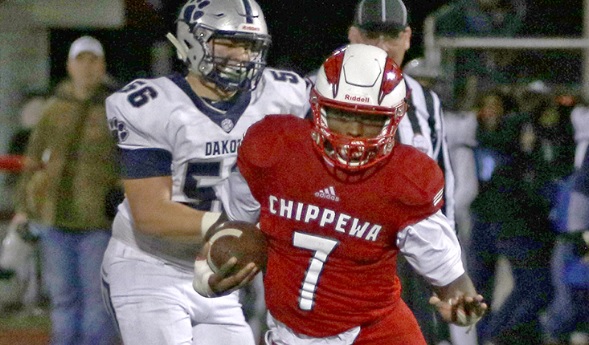
More shoutouts: Saline 42, East Kentwood 7 The Southeastern Conference Red champ Hornets (10-1) scored 21 points in the third quarter and got near-perfect passing from quarterback Andrew Arbaugh to down the Ottawa-Kent Conference Red champ Falcons (9-2). Clinton Township Chippewa Valley 51, Macomb Dakota 10 The Macomb Area Conference Red champion Big Reds (11-0) made this much more comfortable than when they edged league co-runner-up Dakota (8-3) by seven in Week 5. West Bloomfield 20, Detroit Catholic Central 17 (OT) Last season’s Division 1 runner-up Lakers moved to 9-2 by answering the overtime field goal by DCC (7-4) with a touchdown pass from CJ Harris to Lance Dixon.
Division 2
HEADLINER: Warren DeLaSalle 35, Oak Park 7 The Pilots’ ability to shut down Oak Park again sticks out immediately – the Knights entered averaging 29 points per game, but DeLaSalle also defeated Oak Park (9-2) in their 2017 Regional Final 14-7 on the way to winning Division 2. With this victory, the Pilots (9-2) improved to a combined 21-4 over the last two seasons. Click for more from the Macomb Daily and see highlights below from State Champs Sports Network.
??VIDEO: Check out the highlights of the Warren De La Salle at Oak Park - 2018 @MHSAA Division 2 District Final from last night. @delasallehs @dls_broadcast @DLSBrozone pic.twitter.com/iEi9U3GsvG
— STATE CHAMPS! (@statechampsnet) November 3, 2018
More shoutouts: Port Huron Northern 14, St. Clair Shores Lakeview 7 (OT) The Huskies (10-1) tied their program record for wins by getting past Lakeview (7-4) for the second time this fall. Birmingham Groves 38, Birmingham Brother Rice 24 The Falcons (9-2) avenged last season’s District-opening 24-21 loss to the Warriors (7-4), improving to 2-1 in their playoff matchups over the last three seasons. Walled Lake Western 35, South Lyon 14 South Lyon (10-1) won the Lakes Valley Conference in part with a 29-19 Week 8 win over Western, but Western (8-3) will play for its third Regional title in four years.
Division 3
HEADLINER: Cedar Springs 44, Mount Pleasant 14 Overshadowed by the many Grand Rapids-area powers during the regular season, Cedar Springs couldn’t be missed this weekend. The Red Hawks (10-1) handed Mount Pleasant (10-1) its lone loss to claim their first District title since 2000, adding to the O-K White championship clinched earlier this fall. Cedar Springs has given up a combined 21 points over the last five weeks and now will get to challenge reigning champion Muskegon. Click for more from the Mount Pleasant Morning Sun and see highlights below from FOX 17.
Cedar Springs 44, Mt. Pleasant 14 https://t.co/19oVdqZ2rH pic.twitter.com/JL3X7QjD6D
— FOX 17 (@FOX17) November 3, 2018
More shoutouts: Zeeland East 42, Zeeland West 24 Getting by the rival Dux (8-3) for the second time in four weeks earned the Chix (10-1) their first District title since 2010. Parma Western 44, Battle Creek Central 21 The Panthers (10-1) reached double-digit wins and won a District title for the first time in their history, ending Central’s best finish since 2004 at 7-4. DeWitt 9, East Lansing 7 The Panthers (11-0) withstood their biggest scare this season and after winning 37-0 in their Week 5 meeting with the Trojans (9-2).
Division 4
HEADLINER: Farmington Hills Harrison 13, Detroit Country Day 10 (OT) A bobbled field goal attempt turned into a backpedaling game-winning touchdown pass that extended Harrison’s final season another week. The Yellowjackets (7-3) had opened overtime with a field goal, and the Hawks (8-3) had lined up to try to tie the score. Click for more from the Oakland Press.
??VIDEO: Check out the highlights of the Farmington Hills Harrison vs. Country Day - 2018 @MHSAA Division 4 District Final from last night. @FHHarrisonFB pic.twitter.com/YdjNEQe2wr
— STATE CHAMPS! (@statechampsnet) November 3, 2018
More shoutouts: Holland Christian 22, Grand Rapids South Christian 19 The Maroons (8-3) won their first District title since 2009, ending the Sailors’ run at 6-5. Escanaba 14, Alma 13 The Eskymos (9-2) will face reigning champion Grand Rapids Catholic Central for the third straight season after beating Alma (9-2) for a District title for the third straight year. Chelsea 35, Milan 14 The Bulldogs (8-3) won their fourth District title in five seasons, defeating Milan (8-3) for the second straight playoffs.
Division 5
HEADLINER: Hudsonville Unity Christian 40, Muskegon Oakridge 37 The Crusaders (9-2), playing for their third District title in four seasons, came back from 27 points down to edge the Eagles (9-2) as the latter was looking to repeat as District champs. Unity went on a 32-2 second-half run, taking the lead with just more than three minutes to play. Click for more from the Grand Rapids Press and see highlights below from WZZM.
Unity Christian overcomes 27-point deficit https://t.co/FqmEt9RnwI pic.twitter.com/SWDlAeqeaU
— 13 On Your Side (@wzzm13) November 3, 2018
More shoutouts: Marine City 41, Harper Woods 27 The Mariners (9-2) won their first District title since 2013 by piling up the most points Harper Woods (8-3) gave up this season. Kalamazoo United 46, Hopkins 35 The Titans, made up of students from Hackett and Kalamazoo Christian, won the first District title for either since Christian’s in 2008 by downing the O-K Silver champion Vikings (9-2). Frankenmuth 28, Almont 22 The Tri-Valley Conference East-winning Eagles (9-2) won this matchup of league champions, handing Blue Water Area Conference leader Almont (10-1) its lone loss.
Division 6
HEADLINER: Traverse City St. Francis 42, Calumet 6 St. Francis (11-0) won this matchup of unbeatens to clinch a fifth straight District title and earn a rematch with rival Kingsley in the Regional Final. Calumet (10-1) capped its second 10-win season in three years but gave up a season-high in points while scoring a season-low six for the second straight week. Click for more from the Traverse City Record-Eagle and see highlights below from MI Sports Now.
HS Football: @TCSFAthletics earns 5th straight district title with victory over Calumet - https://t.co/ukxgOsUkHY pic.twitter.com/Ka4bRHUiBz
— MISportsNow (@MISportsNow) November 3, 2018
More shoutouts: Blissfield 41, Brooklyn Columbia Central 40 In two weeks of playoffs, fourth-place Blissfield (7-4) has beaten both co-champions of the Lenawee County Athletic Association, this time avenging a Week 4 loss to the Golden Eagles (9-2). Flint Hamady 47, Ecorse 22 The Genesee Area Conference Blue-winning Hawks (11-0) added their first District title to their best run ever, eliminating Michigan Metro Athletic Conference Black champ Ecorse (8-3) Kingsley 44, Beaverton 14 The Stags (10-1) reached double-digit victories for the first time since winning the Division 6 title in 2005, ending Beaverton’s run at 8-3.
Division 7
HEADLINER: Pewamo-Westphalia 42, Saugatuck 20 This rematch of last season’s Division 7 Final went the two-time champion’s way again. This was the fifth time in six seasons these teams met, and as expected Saugatuck’s offense gave the Pirates (11-0) one of its more significant challenges. But P-W also became the first team since Week 4 to score more than 40 points on the Indians (9-2). Click for more from the Ionia Sentinel-Standard.
??VIDEO: Check out the highlights of the Saugatuck at Pewamo-Westphalia - 2018 @MHSAA Division 7 District Final from last night. @PWGRIDIRON @CoachWeber_PW pic.twitter.com/cci3xnVDsj
— STATE CHAMPS! (@statechampsnet) November 3, 2018
More shoutouts: Madison Heights Madison 38, Detroit Loyola 0 The MAC Silver champ Eagles (11-0) earned their third straight shutout, stopping Loyola (7-4) as it sought to win its seventh District title in eight seasons. New Lothrop 44, Cass City 20 The Mid-Michigan Activities Conference champ Hornets (10-1) earned a playoff rematch with P-W by doubling up Greater Thumb Conference West champ Cass City (8-3). Cassopolis 35, Centreville 0 The Rangers (11-0) won the Southwest 10 Conference title with a 21-0 Week 9 victory over the Bulldogs (9-2), and this time held them to 147 yards.
Division 8
HEADLINER: Reading 28, Ottawa Lake Whiteford 6 Reigning Division 8 champion Whiteford (10-1) hadn’t lost in two years, and hadn’t scored fewer than 36 points since falling in the 2016 championship game. This was arguably the most impressive of a great run of victories for the Rangers (11-0), who have beaten three league champions and a runner-up over the last month. Click for more from the Hillsdale Daily News and see highlights below from BCSN.
Whiteford would battle hard all throughout this game but Reading would be just to much, Final 28-6 #BCSNnation pic.twitter.com/Tw8q6IcB8l
— BCSN (@BCSNsports) November 3, 2018
More shoutouts: Harbor Beecher 28, Ubly 26 (3OT) The GTC East co-champion Pirates (10-1) held off the revenge-minded Bearcats (8-3), who finished third in the league after also falling to Harbor Beach in Week 5. Flint Beecher 22, Clarkston Everest Collegiate 14 The Bucs (8-3) clinched their first District title since 2012 by edging the Catholic League C-D champion Mountaineers (9-2). Detroit Southeastern 24, Dansville 22 Southeastern (8-3) outscored Dansville (7-4) 16-0 in the second half to win its first football District title since 2009 and after six straight sub-.500 finishes heading into this fall.
8-Player Division 1
HEADLINER: AuGres-Sims 72, Deckerville 28 The Wolverines (11-0) added to their first season in 8-player and best run in football ever by beating reigning Division 1 runner-up Deckerville (8-3) to claim their first Regional title in the sport. AuGres-Sims countered giving up their most points in a game this season by going over 70 for the second time this fall. Click for more from the Huron Daily Tribune and see highlights below from WBKB.
The @AGSschools advances to their first State Semifinal in school history! Here’s the Regional Final highlights against @DHSAthletics_. pic.twitter.com/si6JOyJQRk
— Larissa Liska (@LarissaLiska) November 4, 2018
Other Regional Final shoutouts: Pickford 48, Suttons Bay 42 The Panthers (11-0) survived their toughest challenge of this season, holding off Suttons Bay (9-2) with quarterback Jimmy Storey’s touchdown run with 37 seconds to play. Morrice 44, Wyoming Tri-unity Christian 14 The Orioles (11-0) won their first Regional title since 1996 by dealing the Defenders (10-1) their only loss this season. Colon 40, Bellevue 22 The Magi (10-1) are Regional champs for the first time thanks to a second win this season over the league rival Broncos (9-2).
8-Player Division 2
HEADLINER: Rapid River 40, Crystal Falls Forest Park 34 The reigning Division 2 champ Trojans (6-5) opened the playoffs by stunning Powers North Central, and Rapid River (8-3) followed up this week by downing Forest Park to make the Semifinals for the first time since 2013. Rapid River actually handed Forest Park one of its two defeats in 2017 as well. The Rockets will look next to make the Finals for the third time in eight seasons. Click for more from the Escanaba Daily Press.
More Regional shoutouts: Portland St. Patrick 20, Tekonsha 6 The reigning Division 2 runner-up Shamrocks (7-4) have rattled off four straight wins, this one over Southern Central Athletic Association B champ Tekonsha (6-5). Cedarville 44, Posen 0 The Trojans join Rapid River among three Great Lakes Conference East teams still alive after running their winning streak against Posen (8-3) to four straight. Onekama 52, Brethren 0 The Portagers (9-2) won their first Regional title by also downing a conference champion in the West Michigan D League’s Bobcats (7-4).
Second Half’s weekly “Drive for Detroit” previews and reviews are powered by MI Student Aid, a part of the Student Financial Services Bureau located within the Michigan Department of Treasury. MI Student Aid encourages students to pursue postsecondary education by providing access to student financial resources and information, including various student financial assistance programs to help make college more affordable for Michigan students. MI Student Aid administers the state’s 529 savings programs (MET/MESP) and eight additional aid programs within its Student Scholarships and Grants division. Click for more information and connect with MI Student Aid on Facebook and Twitter @mistudentaid.
PHOTO: Clinton Township Chippewa Valley remained undefeated with a second win over Macomb Dakota this season. (Click for more from C&G Newspapers.)