


Michigan’s Football Numbers Game – Corrected
September 1, 2017
Today’s blog was written by MHSAA Second Half Editor Geoff Kimmerly
The demise of Michigan high school football has been greatly exaggerated – or, at least, recently misreported by one of the U.S.’s most recognizable newspapers that noted as part of a larger story on football decline that Michigan has seen a “net loss of 57 teams in the past five years.”
It’s easy to understand how this error took place – especially when a reporter is not familiar with the football landscape in our state – but that doesn’t make this statement any less misleading, or harmful considering the story since has been picked up by multiple large news organizations. So let’s quickly clear up the misinterpreted information:
-
The data that led to this error came from an annual participation report released by the National Federation of State High School Associations (NFHS). Every spring, state associations (like the MHSAA) from every state and Washington, D.C., tally up how many of their member schools have a sport and how many athletes play it.
-
For 2016-17, the MHSAA submitted to the NFHS a total of 580 schools with 11-player football – that number actually includes all schools that reported having at least one football player, including primary and secondary schools in co-ops. And yes, that 580 is 57 fewer than the 637 11-player schools the MHSAA submitted for 2012-13.
-
But saying Michigan has lost 57 football programs misses out on something incredibly significant – the MHSAA also submitted 60 schools with 8-player football last year, up from 16 in 2012-13, making that net decrease in football schools over five years 13 – far fewer than 57.
And with a few more brush strokes, the picture of football in our state actually shows a healthy landscape:
-
The 640 schools in Michigan with at least one football player for 2016-17, 11 and 8-player combined, is actually eight more than we reported to the NFHS four years ago and 10 more than three years ago.
-
A better picture of Michigan’s football consistency is shown by how many varsity programs are taking the field. This fall, that number is 616 – 555 11-player varsities and 61 8-player – and we also had 616 for most of the 2016 season, 616 in 2015 and 615 in 2014.
-
We’ve had programs bring back varsity teams this year, and in one case a school has a team on its own for the first time. Benzonia Benzie Central and Suttons Bay were unable to field varsities in 2016, but Benzie Central is back playing 11-player and Suttons Bay is back with an 8-player team. Brimley, an 8-player school going back to 2010, also is fielding a team again after being unable to do so last year. Mount Clemens played only two varsity games in 2016 and forfeited a third, but has seven scheduled for this fall and lost close in its opener last week. And Bear Lake, previously a secondary school in a co-op program, now has a team all its own for the first time and is playing at the 8-player level.
-
Yes, there has been a decrease in Michigan high school football participation when it comes to the number of players – for reasons we discuss frequently, including more extracurricular/entertainment options than ever for students, more who are specializing in other sports and safety fears that often are misplaced. But we’ve also seen a three percent drop in enrollment at MHSAA member schools over the last five years. And despite that trend, Michigan again had the sixth-highest 11-player football participation in the nation in 2016-17 (and seventh-highest in 8-player) while ranking 10th nationally in number of residents of high school age.
-
So yes, while a nine percent drop in the number of football players over the last five years in Michigan clearly is troubling, and something we’re working with the Michigan High School Football Coaches Association to reverse, let’s also put those numbers in perspective. At medium-sized to bigger schools, it could mean a roster of 40 might have only 36 players. A roster of 20 at an 8-player school might go down to 18. Neither would signal the need to eliminate a football program.
-
And that move by so many schools to 8-player? It definitely started as a way for low-participation programs to keep football (and has worked for most of them). While that still may be the driving force as schools move from 11 to 8, others have made the switch because most of their former opponents did and joining them makes scheduling easier and travel shorter. Michigan has a multitude of small towns, and you’ll find most of these 8-player programs in pockets in the thumb, southwest or northern Lower Peninsula, or Upper Peninsula. And keep in mind, only Class D teams remain eligible for the 8-player playoffs – and only two of 61 teams playing 8-player this fall are larger than Class D and its enrollment limit of 203 students for 2017-18.
The story behind “a decrease of 57 schools” clearly is a little complex to explain and explain away, but it’s necessary to do so.
Yes, Michigan’s total number of football players is down a few percent. But the sport’s prominence and importance in our schools and communities remains high.
Memphis Tastes Victory, Plays for More
By
Paul Costanzo
Special for MHSAA.com
September 12, 2018
Winning was such an unfamiliar feeling for the Memphis varsity football team that when the Yellowjackets picked up a victory in Week 1, coach Pat Connell had to give some of his players a push when it came to enjoying it.
 “We call (the victory formation), they take a knee and nobody knows what to do,” Connell said. “The kids on the field are starting to celebrate, and I looked at the kids behind me and said, ‘Hey, this is when you celebrate.’”
Memphis’ 14-12 win against Burton Bentley on Aug. 23 snapped a 26-game losing streak for the Yellowjackets, who hadn’t been victorious since Week 1 of the 2015 season. It was a cathartic moment for the players, coaching staff, school and community – one that won’t soon be forgotten.
“Honestly, I’d say it was the best feeling I’ve ever felt on that field,” senior wingback and defensive tackle Cole Myers said. “My entire time playing football at my school, we hadn’t gotten a win in the last two to three years. It felt like the turning point of our program.”
One win was great, and something Memphis desperately needed. But while everyone involved in the Memphis program knows things are looking up, they also know there is plenty of work still to be done to turn things completely around. That was evident in 44-0 and 42-0 losses to Ubly and Brown City, respectively, in the following weeks.
But it’s work the coaches and players are now willing to put in.
“I enjoyed it; it was nice to have my first Memphis football win,” senior quarterback and safety Cale Shivers said. “I’ve played football my whole life and been on winning teams my whole life, so I know that if we want to win more games, we have to keep working.”
When Connell and his staff took over, Memphis had just finished its first 0-9 season in 2016, which came on the heels of back-to-back 1-8 seasons.
During those struggles, numbers had gotten so low for the Yellowjackets that there were talks of prematurely ending a season -- not to end the losing, but to keep kids safe.
To build the program, Connell first needed players, and to get players, he needed to be recruiting in the hallways. Unfortunately for him, he teaches at Port Huron Northern, a good 30-minute drive from Memphis, as does his assistant Casey Kucsera. Assistant coach Pete Fox teaches at St. Clair, which is closer, but clearly not in the building.
“That first year when we took over in April or May, we were trying to get any kids, but it was a slow process,” Connell said. “We were taking personal days to set up in the school to go meet kids.”
The idea of simply playing a junior varsity schedule was brought up, but Connell said that if there was just one senior who wanted to play, the Yellowjackets would play as a varsity team so that player could have that experience. They wound up with 10, and while it was another 0-9 season, that fall was a building block.
“That first year was just about making it fun,” Connell said. “It isn’t us coming in to yell and scream at you; we want you to come out and enjoy football. It was opening the weight room, and sometimes kids would stumble in, and we were developing that trust. Then the word started getting out.”
 When comparing 0-9 seasons, it can be hard to find tangible improvement. But Memphis scored more points (60-39) and allowed fewer (427-538) while playing a similar schedule in 2017.
Most importantly, though, the players were noticing that things were different.
“Kids didn’t really see the progression until other coaches and players from teams were saying, ‘Even though you guys lost, we can tell you really look like a football team now,’’ Shivers said. “And we were hearing from the public that we actually looked good out there.”
Despite not winning a game, Memphis did pick up some momentum.
“When I first got out to Memphis, I would ask kids, ‘Are you interested in playing football?’ and it was, ‘I don’t know, maybe,’” said Connell, who is up to 28 players on his roster. “This offseason, it was, ‘Are you playing,’ and they were like, ‘Yes sir, I’m playing.’ We had like 20 kids who were all in on football. Now, that didn’t mean that they realized they had to be there three days a week in the winter lifting, but they were excited.”
The excitement grew after the opening win against Burton Bentley, a game that was filled with drama. After Memphis took a 14-12 lead on Shivers’ second touchdown pass of the evening and his ensuing 2-point conversion run, it had a chance to ice the game by running out the clock with a few first downs. Before that could happen, however, the lights -- which were set on a timer -- went out in the stadium.
When they came back on about 20 minutes later, Burton Bentley forced a Memphis punt to give itself one more chance.
Fortunately for the Yellowjackets, that drive ended with a turnover, and Memphis was able to run a play out of the victory formation for the first time in three years.
“I wouldn’t even call it remembering how to win,” Myers said. “Because I’ve never been on a winning team for football. It was something new.”
The feeling, Myers said, made him want to win more. And while Weeks 2 and 3 were a return to Earth for the Yellowjackets, those defeats haven’t dampened their spirits or their outlook. Connell knows there is still plenty of work to be done in the weight room and on the field to have his team competing with its Greater Thumb Conference East opponents.
But his players believe in what he and his staff are doing, and they are now starting to believe in themselves.
“It might take a couple more wins before people (in the school) start realizing this is a different program from past years,” Myers said. “(A successful season would be) to put in everything that we possibly can and have more wins than losses at this point. I would say five to six wins would be what I would hope out of this season.”
 Paul Costanzo served as a sportswriter at The Port Huron Times Herald from 2006-15, including three years as lead sportswriter, and prior to that as sports editor at the Hillsdale Daily News from 2005-06. He can be reached at [email protected] with story ideas for Genesee, Lapeer, St. Clair, Sanilac, Huron, Tuscola, Saginaw, Bay, Arenac, Midland and Gladwin counties.
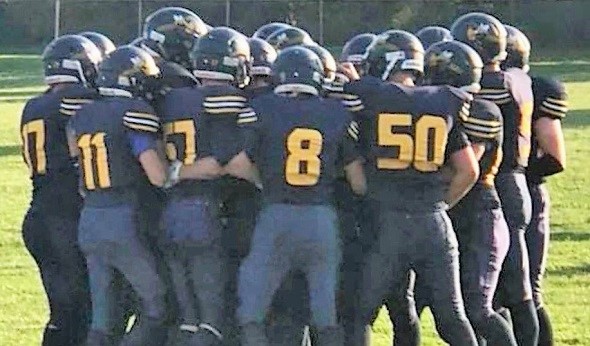
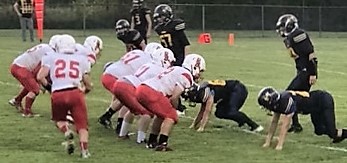
PHOTOS: (Top) Memphis players huddle up before a game this season. (Middle) The Yellowjackets defense held Burton Bentley to 12 points. (Photos courtesy of the Memphis football program.)