


Michigan’s Football Numbers Game – Corrected
September 1, 2017
Today’s blog was written by MHSAA Second Half Editor Geoff Kimmerly
The demise of Michigan high school football has been greatly exaggerated – or, at least, recently misreported by one of the U.S.’s most recognizable newspapers that noted as part of a larger story on football decline that Michigan has seen a “net loss of 57 teams in the past five years.”
It’s easy to understand how this error took place – especially when a reporter is not familiar with the football landscape in our state – but that doesn’t make this statement any less misleading, or harmful considering the story since has been picked up by multiple large news organizations. So let’s quickly clear up the misinterpreted information:
-
The data that led to this error came from an annual participation report released by the National Federation of State High School Associations (NFHS). Every spring, state associations (like the MHSAA) from every state and Washington, D.C., tally up how many of their member schools have a sport and how many athletes play it.
-
For 2016-17, the MHSAA submitted to the NFHS a total of 580 schools with 11-player football – that number actually includes all schools that reported having at least one football player, including primary and secondary schools in co-ops. And yes, that 580 is 57 fewer than the 637 11-player schools the MHSAA submitted for 2012-13.
-
But saying Michigan has lost 57 football programs misses out on something incredibly significant – the MHSAA also submitted 60 schools with 8-player football last year, up from 16 in 2012-13, making that net decrease in football schools over five years 13 – far fewer than 57.
And with a few more brush strokes, the picture of football in our state actually shows a healthy landscape:
-
The 640 schools in Michigan with at least one football player for 2016-17, 11 and 8-player combined, is actually eight more than we reported to the NFHS four years ago and 10 more than three years ago.
-
A better picture of Michigan’s football consistency is shown by how many varsity programs are taking the field. This fall, that number is 616 – 555 11-player varsities and 61 8-player – and we also had 616 for most of the 2016 season, 616 in 2015 and 615 in 2014.
-
We’ve had programs bring back varsity teams this year, and in one case a school has a team on its own for the first time. Benzonia Benzie Central and Suttons Bay were unable to field varsities in 2016, but Benzie Central is back playing 11-player and Suttons Bay is back with an 8-player team. Brimley, an 8-player school going back to 2010, also is fielding a team again after being unable to do so last year. Mount Clemens played only two varsity games in 2016 and forfeited a third, but has seven scheduled for this fall and lost close in its opener last week. And Bear Lake, previously a secondary school in a co-op program, now has a team all its own for the first time and is playing at the 8-player level.
-
Yes, there has been a decrease in Michigan high school football participation when it comes to the number of players – for reasons we discuss frequently, including more extracurricular/entertainment options than ever for students, more who are specializing in other sports and safety fears that often are misplaced. But we’ve also seen a three percent drop in enrollment at MHSAA member schools over the last five years. And despite that trend, Michigan again had the sixth-highest 11-player football participation in the nation in 2016-17 (and seventh-highest in 8-player) while ranking 10th nationally in number of residents of high school age.
-
So yes, while a nine percent drop in the number of football players over the last five years in Michigan clearly is troubling, and something we’re working with the Michigan High School Football Coaches Association to reverse, let’s also put those numbers in perspective. At medium-sized to bigger schools, it could mean a roster of 40 might have only 36 players. A roster of 20 at an 8-player school might go down to 18. Neither would signal the need to eliminate a football program.
-
And that move by so many schools to 8-player? It definitely started as a way for low-participation programs to keep football (and has worked for most of them). While that still may be the driving force as schools move from 11 to 8, others have made the switch because most of their former opponents did and joining them makes scheduling easier and travel shorter. Michigan has a multitude of small towns, and you’ll find most of these 8-player programs in pockets in the thumb, southwest or northern Lower Peninsula, or Upper Peninsula. And keep in mind, only Class D teams remain eligible for the 8-player playoffs – and only two of 61 teams playing 8-player this fall are larger than Class D and its enrollment limit of 203 students for 2017-18.
The story behind “a decrease of 57 schools” clearly is a little complex to explain and explain away, but it’s necessary to do so.
Yes, Michigan’s total number of football players is down a few percent. But the sport’s prominence and importance in our schools and communities remains high.
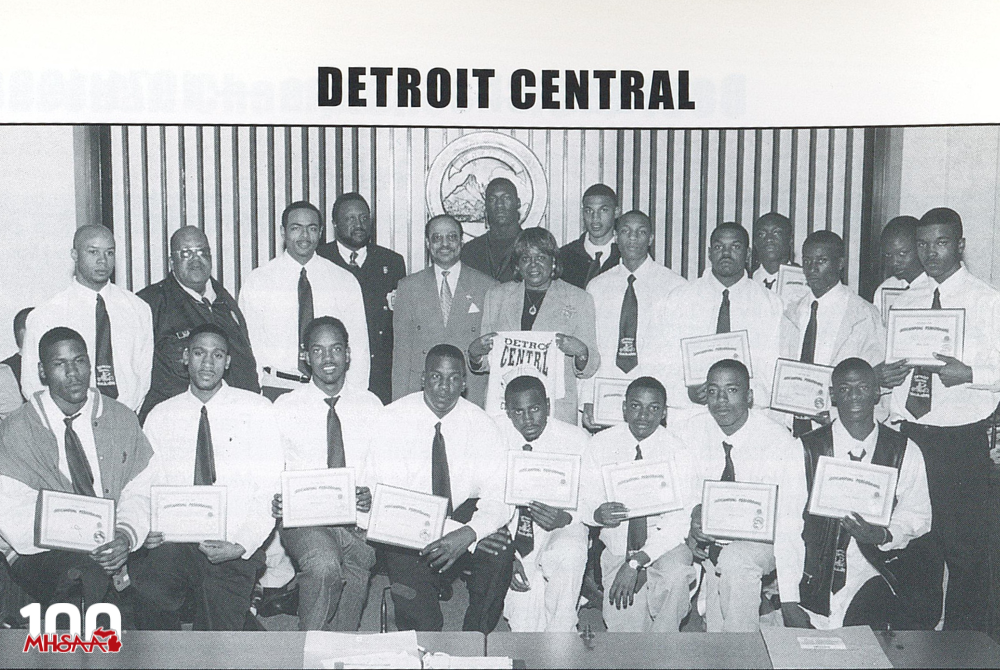
Flashback 100: Detroit Central Star Voted into Pro Football Hall of Fame
February 14, 2025
The recently-announced 2025 Pro Football Hall of Fame Class includes Detroit Central’s Antonio Gates, an extraordinary athlete who never played college football.
At Central, Gates excelled in both football and basketball. He led the Trailblazers to the 1998 Class A basketball championship, delivering a standout performance with 17 points, nine rebounds, and six assists in a 63-47 victory over Belleville in the Final. (Watch it on YouTube.)
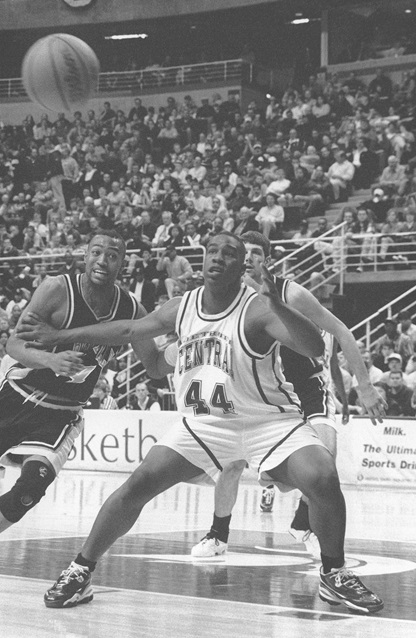 On the football field, Gates was a three-year starter at tight end and linebacker. As a senior in 1997, he helped lead Detroit Central to a 7-3 record before falling to Birmingham Groves in the Regional Semifinals.
Opting to play college basketball, Gates finished his career at Kent State, where he played a pivotal role in the Golden Flashes’ first two Mid-American Conference regular-season titles. In 2002, he led Kent State to the Elite Eight in the NCAA Tournament. His impact was so profound that the school retired his No. 44 jersey — the same number he wore at Detroit Central.
Despite never playing football at the collegiate level, Gates took a chance after college, working out for NFL scouts. The San Diego Chargers saw his potential, signing him as an undrafted free agent. Sixteen years later, Gates is regarded as one of the greatest tight ends in NFL history. He holds the career record for the most touchdown receptions by a tight end (116) and remains the Chargers’ all-time leader in receptions (955) and receiving yards (11,841). His accolades included eight Pro Bowl selections, three first-team All-Pro honors, a spot on the NFL 2000s All-Decade Team, and recognition on the San Diego Chargers’ 50th Anniversary Team.
Joining Gates in the 2025 Hall of Fame class are Eric Allen, Jared Allen, and Sterling Sharpe.
Previous "Flashback 100" Features
Feb. 6: Multi-Sport Star Look Becomes Super Bowl Officiating Legend - Read
Jan. 31: Johnson Family Put Magical Stamp on Michigan High School Hoops - Read
Jan. 24: Future Hall of Famers Face Off First in MHSAA Class A Final - Read
Jan. 17: First-Ever WNBA Draft Pick Rocked at Salem, Won Titles at Tennessee - Read
Jan. 10: Despite Launching Before 3-Point Line, Smith Still Tops Scoring List - Read
Jan. 3: Edison's Jackson Earns Place Among State's All-Time Elite - Read
Dec. 20: Future Olympian Piper Leads Grosse Pointe North to Historic Heights - Read
Dec. 13: The Other Mr. Forsythe in Michigan School Sports - Read
Dec. 6: Coleman's Legendary Heroics Carry Harrison Through Repeat - Read
Nov. 29: Harbaugh Brothers' Football Roots Planted in Part at Pioneer - Read
Nov. 22: 8-Player Football Finals Right at Home at Superior Dome - Read
Nov. 15: Leland Career Helps Set Stage for Glass' International Stardom - Read
Nov. 8: Future Baseball Pro Led Escanaba's Legendary Football Title Run - Read
Nov. 1: Michigan High School Baseball Trio Provide World Series Voices - Read
Oct. 25: Before Leading Free World, Ford Starred for Champion GR South - Read
Oct. 18: Mercy Links Legend Becomes World Golf Hall of Famer - Read
Oct. 11: Fisher Races to Finals Stardom on Way to U.S. Olympic First - Read
Oct. 4: Lalas Leaves High School Legacies on Ice & Pitch - Read
Sept. 27: Tamer's History-Making Run Starts in Dexter, Continues to Paris - Read
Sept. 20: Todd Martin’s Road to Greatness Starts at East Lansing - Read
Sept. 13: James Earl Jones, Dickson High Hoops to Hollywood Legend - Read
Sept. 6: Pioneers' Unstoppable Streak Stretches 9 Seasons - Read
Aug. 30: Detroit dePorres Rushes to 1995 Class CC Football Championship - Read
PHOTOS (Top) The 1998 Detroit Central boys basketball team, including Antonio Gates (front row, fourth from left). (Middle) Gates (44) gets in position to receive a pass in the post. (MHSAA file photos.)