

Michigan's Football Past: A Must Read
By
Ron Pesch
MHSAA historian
September 27, 2016
By Ron Pesch
Special for Second Half
This week, the contents of my mailbox reminded me about one of my favorite items to collect – booklets and programs celebrating the history of Michigan high school football.
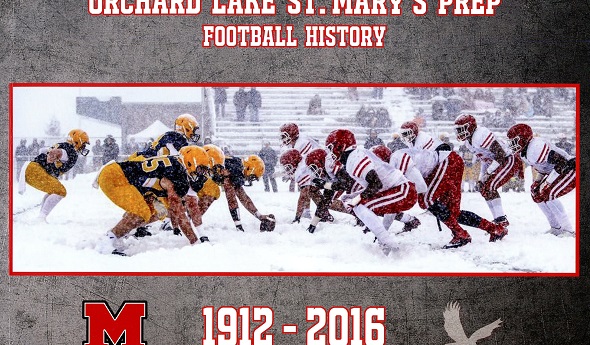
Contained within was the 2016 edition of the book, “Orchard Lake St. Mary’s Prep Football History.” Featuring a glorious image on the cover, it’s a delight to flip through. Rob Goddard and crew are to be commended on the fantastic job they’ve done with this 104-page chronicle.
The package recalled the first in my collection – a publication I helped create.
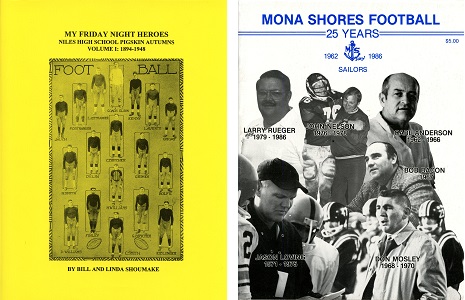
The 25-year celebration of Muskegon Mona Shores football was a modest piece, created before the days of desktop publishing. Because I had assembled the scores of the district’s games, I approached the school and found an individual willing to take a chance. Jerry Fitzpatrick, Sailors athletic director at the time, approved the idea of a booklet celebrating the school’s Silver Football Anniversary.
With gusto, we tapped into a host of resources and dove into digging out photos and details designed to capture everything we could on the years 1962 through 1985, with room for fans to collect details on the coming season. We even included a page on cheerleaders and Homecoming Kings and Queens in hopes of broadening our market.
My second acquisition was a document on Battle Creek Central football, created by MHSAA historian Dick Kishpaugh. It totaled 42 pages in length and included most everything there was to know about the Bearcats, Kishpaugh’s alma mater.
A souvenir football program celebrating Kalamazoo Central’s history followed, also heavily influenced by the work of Kishpaugh. A 60-year history of all sports at Gaylord St. Mary soon landed in my hands, passed on to me by sportswriter and historian Jay Soderberg, editor of the publication. A history of little Grant High School football, published, I believe, in 1979, was the next to arrive.
 In 1993, I partnered with baseball historian Marc Okkonen to produce “100 Years of Muskegon Big Red Football 1895-1994,” a 90-page history of our alma mater. That publication was marketed by the school’s Athletic Foundation as a fundraiser and sold well. To my delight, it seemed to spark the publication by a number of other districts of their football histories. Grand Haven and Escanaba followed a similar format and were both quick to market. Each book also celebrated a centennial of gridiron action. Other publications began to surface.
Riding a string of gridiron championships, Farmington Hills Harrison produced a 108-page program, highlighting the accomplishments from their 25-year football history, in 1994. Additional histories from Cadillac, Frankenmuth, Lowell, Negaunee, Boyne City, Niles, Sturgis and Traverse City appeared, some focused on football, others on all sports. So too did one highlighting the Centennial football game between Saginaw and Saginaw Arthur Hill, as did one a few years later celebrating the M & M game, among the nation’s oldest cross-border battles staged between Menominee and Marinette, Wisconsin.
But since then, things seem to have fallen silent. I believe a lengthy history on Grand Rapids Catholic Central made it to press, although I don’t possess a copy. I’ve seen, but have yet to acquire, a football booklet on Sparta High School football.
Do others exist? Enquiring minds want to know.
 During the gap, John Hulsebus has created, and continues to maintain and enhance a dream website, Michigan-football.com, containing an exhaustive collection of scores, season win-loss marks and records versus opponents for games played since 1950. The site lists schools, past and present for every high school in the state. Like many, I reference it often. Yet, for many schools in the state, that means as many as 55 years of gridiron action remains unrecorded.
Also missing are the stories that sit behind the scores: the players, the coaches, the drama, the locals and pageantry of a Friday night or a Saturday afternoon at the stadium. In the meantime, scrapbooks containing news clippings, game programs, and photographs, once prepared for our fathers, grandfathers and great-grandfathers, gather dust or disappear.
Tell me please, we haven’t forgotten to capture those details from our past?
 Ron Pesch has taken an active role in researching the history of MHSAA events since 1985 and began writing for MHSAA Finals programs in 1986, adding additional features and "flashbacks" in 1992. He inherited the title of MHSAA historian from the late Dick Kishpaugh following the 1993-94 school year, and resides in Muskegon. Contact him at [email protected] with ideas for historical articles.
PHOTOS: (Top) Orchard Lake St. Mary's annually produces an updated history of the school's football program. (Middle) Niles and Muskegon Mona Shores are among other programs that have documented their histories in book form. (Below) The program for the 100th game between Menominee and Marinette, Wis., was a keeper as well.
Generations of Jonesville Reunite to Say Good-Bye to Old Field, Await New
By
Doug Donnelly
Special for MHSAA.com
November 11, 2025
As the old saying, and more recent song lyric goes, "Every new beginning comes from some other beginning's end."
 A new era of Jonesville football will begin next fall when the Comets begin playing on a new field at a new sports complex on the high school campus.
It’s a new beginning. But, before that new era was launched, the Comets had one final game on its old football field this fall – a nearly 75-year-old relic that sits just outside Jonesville Middle School.
“I have a lot of memories of playing on that field,” said Comets football coach Frank Keller. “It’s been home to a lot of big games, good times.”
The final home game on the field was Week 8 against Vandercook Lake. Keller temporarily relinquished his play-calling duties when his former head coach – and recent Michigan High School Football Coaches Association Hall of Fame inductee – Greg Morrison came to the sidelines for a series after some convincing from his former player.
Morrison showed he hadn’t lost his touch. The third and final play he called – “tight end delay” – went for a touchdown.
“It was one of his favorite plays,” Keller said. “He called it, and we scored. It couldn’t have gone any better. He got to call the last touchdown on the old field.”
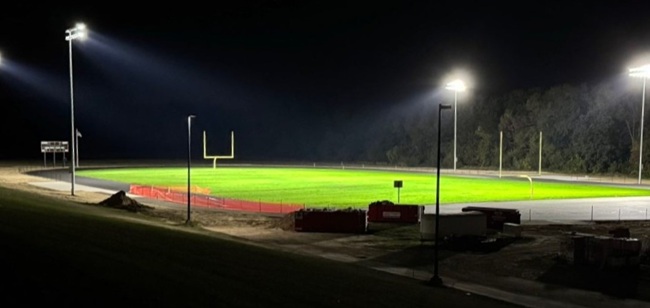
About a year ago, an anonymous donor gave a $4 million donation to the school to build a new track and football field, along with an accompanying concession stand and restrooms. The field is in a picturesque spot, tucked among trees.
 The donation came from a Jonesville family that has had four generations of athletes play sports for the Comets. Athletic director Jeff Turner said the family stepped forward when it became apparent it would be difficult for the district to pass a bond issue or a new tax to fund such a large-scale project.
"We are certainly grateful for them coming forward," Turner said. "We couldn't have done this without them. They wanted to help the school district and the community, and we are fortunate that we are able to build such a nice facility."
The track will be ready for events this spring. Sod was laid on the football field, inside the track, this fall and has been mowed a few times. New bleachers were constructed on both sides of the field recently, and the concession building is almost ready for business.
It’s a dramatic change for the district.
The current football field has been in use for decades and was home to league championship teams, playoff games and more great Jonesville memories.
“Growing up as a kid I always watched football games, there and I played there,” Keller said. “I have mixed feelings about it. It’s great to get a new facility, but sad to see the old one go.”
Morrison recalled a game during his coaching tenure when the opposing team hid in the nearby woods, and then just before kickoff came running onto the field.
Jonesville won by several touchdowns. Clearly the ploy didn’t exactly work out as intended.
“It was a great field to play,” Morrison said. “It was unique.”
These days, Jonesville is a Division 7 football school with an enrollment of 299 students. The Comets play in the Cascades Conference West and went 6-4 this season, falling in the first round of the playoffs.
 The football team has been in the playoffs four of the past seven seasons, went 9-0 during the regular season in 2019 and has 16 playoff appearances.
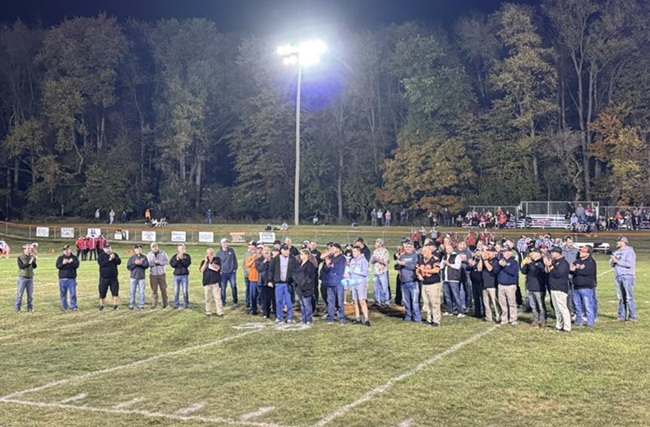
Keller graduated from Jonesville in 1999. He was on the Comets varsity for three seasons, from 1996-1998. Turner is a Jonesville graduate as well. He said several past players, cheerleaders and band members returned to the field for its final game, stirring a lot of memories.
“I don’t know how much of the game I got to watch that night,” Turner said. “It was great to catch up with a lot of people I may not have seen in quite a while. It was great.”
Turner said the athletic complex will be great for the district.
“It looks wonderful,” he said. “Our kids are excited about running track this spring and playing on the new field. Everyone is excited about it.”
As with any new facility, the complex is creating a buzz around athletics at Jonesville.
“We’re hoping we get more kids out just because they want to play on the new field, maybe even get new kids to the school,” Keller said. “We’re hoping it helps bring in more kids. Track looks awesome. The whole facility looks great.
“For us to get a new facility like that is unbelievable.”
 Doug Donnelly has served as a news and sports reporter at the Adrian Daily Telegram and the Monroe News for 30 years, including 10 years as city editor in Monroe. He's written a book on high school basketball in Monroe County and compiles record books for various schools in southeast Michigan. He is now publisher and editor of The Blissfield Advance, a weekly newspaper. E-mail him at [email protected] with story ideas for Jackson, Washtenaw, Hillsdale, Lenawee and Monroe counties.
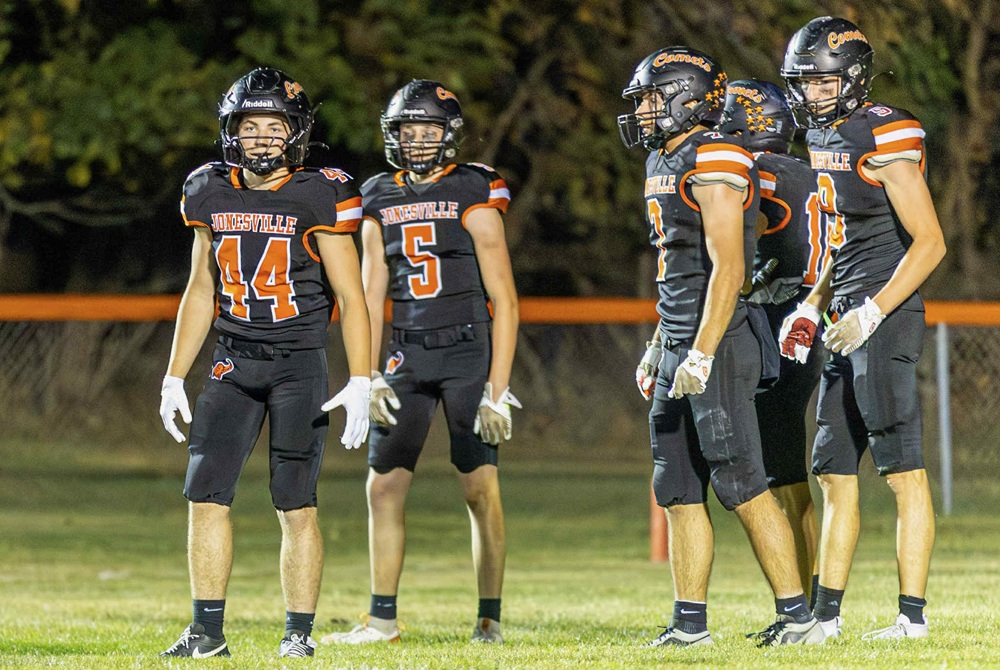
PHOTOS (Top) Jonesville players take the field for their final home game last month at their now former field. (Middle) Past Jonesville players line up with retired coach Greg Morrison during the final game. (Below) Jonesville’s new stadium sits under the lights and will be ready for the spring track & field season. (Photos courtesy of the Jonesville football program.)