

Michigan's Football Past: A Must Read
By
Ron Pesch
MHSAA historian
September 27, 2016
By Ron Pesch
Special for Second Half
This week, the contents of my mailbox reminded me about one of my favorite items to collect – booklets and programs celebrating the history of Michigan high school football.
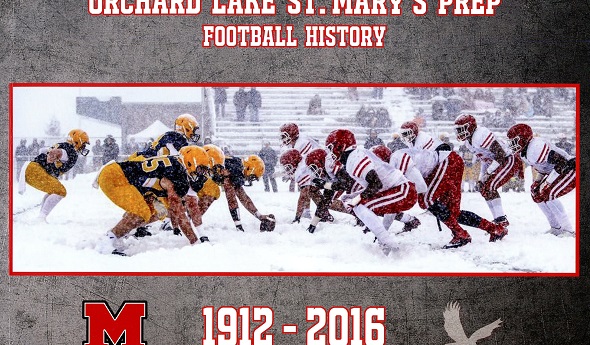
Contained within was the 2016 edition of the book, “Orchard Lake St. Mary’s Prep Football History.” Featuring a glorious image on the cover, it’s a delight to flip through. Rob Goddard and crew are to be commended on the fantastic job they’ve done with this 104-page chronicle.
The package recalled the first in my collection – a publication I helped create.
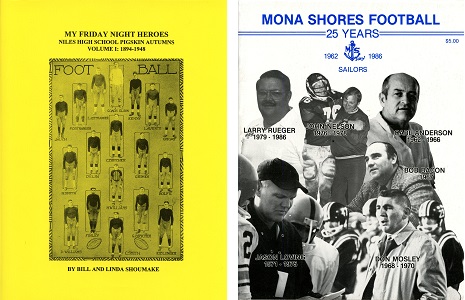
The 25-year celebration of Muskegon Mona Shores football was a modest piece, created before the days of desktop publishing. Because I had assembled the scores of the district’s games, I approached the school and found an individual willing to take a chance. Jerry Fitzpatrick, Sailors athletic director at the time, approved the idea of a booklet celebrating the school’s Silver Football Anniversary.
With gusto, we tapped into a host of resources and dove into digging out photos and details designed to capture everything we could on the years 1962 through 1985, with room for fans to collect details on the coming season. We even included a page on cheerleaders and Homecoming Kings and Queens in hopes of broadening our market.
My second acquisition was a document on Battle Creek Central football, created by MHSAA historian Dick Kishpaugh. It totaled 42 pages in length and included most everything there was to know about the Bearcats, Kishpaugh’s alma mater.
A souvenir football program celebrating Kalamazoo Central’s history followed, also heavily influenced by the work of Kishpaugh. A 60-year history of all sports at Gaylord St. Mary soon landed in my hands, passed on to me by sportswriter and historian Jay Soderberg, editor of the publication. A history of little Grant High School football, published, I believe, in 1979, was the next to arrive.
 In 1993, I partnered with baseball historian Marc Okkonen to produce “100 Years of Muskegon Big Red Football 1895-1994,” a 90-page history of our alma mater. That publication was marketed by the school’s Athletic Foundation as a fundraiser and sold well. To my delight, it seemed to spark the publication by a number of other districts of their football histories. Grand Haven and Escanaba followed a similar format and were both quick to market. Each book also celebrated a centennial of gridiron action. Other publications began to surface.
Riding a string of gridiron championships, Farmington Hills Harrison produced a 108-page program, highlighting the accomplishments from their 25-year football history, in 1994. Additional histories from Cadillac, Frankenmuth, Lowell, Negaunee, Boyne City, Niles, Sturgis and Traverse City appeared, some focused on football, others on all sports. So too did one highlighting the Centennial football game between Saginaw and Saginaw Arthur Hill, as did one a few years later celebrating the M & M game, among the nation’s oldest cross-border battles staged between Menominee and Marinette, Wisconsin.
But since then, things seem to have fallen silent. I believe a lengthy history on Grand Rapids Catholic Central made it to press, although I don’t possess a copy. I’ve seen, but have yet to acquire, a football booklet on Sparta High School football.
Do others exist? Enquiring minds want to know.
 During the gap, John Hulsebus has created, and continues to maintain and enhance a dream website, Michigan-football.com, containing an exhaustive collection of scores, season win-loss marks and records versus opponents for games played since 1950. The site lists schools, past and present for every high school in the state. Like many, I reference it often. Yet, for many schools in the state, that means as many as 55 years of gridiron action remains unrecorded.
Also missing are the stories that sit behind the scores: the players, the coaches, the drama, the locals and pageantry of a Friday night or a Saturday afternoon at the stadium. In the meantime, scrapbooks containing news clippings, game programs, and photographs, once prepared for our fathers, grandfathers and great-grandfathers, gather dust or disappear.
Tell me please, we haven’t forgotten to capture those details from our past?
 Ron Pesch has taken an active role in researching the history of MHSAA events since 1985 and began writing for MHSAA Finals programs in 1986, adding additional features and "flashbacks" in 1992. He inherited the title of MHSAA historian from the late Dick Kishpaugh following the 1993-94 school year, and resides in Muskegon. Contact him at [email protected] with ideas for historical articles.
PHOTOS: (Top) Orchard Lake St. Mary's annually produces an updated history of the school's football program. (Middle) Niles and Muskegon Mona Shores are among other programs that have documented their histories in book form. (Below) The program for the 100th game between Menominee and Marinette, Wis., was a keeper as well.
Drive for Detroit: Week 4 in Review
September 17, 2018
By Geoff Kimmerly
Second Half editor
Sometimes the “big games” that everyone’s talking about before Friday night don’t end up meaning as much as some of the surprises that take place during an unpredictable weekend of Michigan high school football.
 That certainly was the case in Week 4, as a decent share of the 45 we chose to break out below probably weren’t on many radars just a few days ago.
Check out those 45 results and some of what they mean today and could mean down the road as we head into the middle week of the regular season.
“Drive for Detroit” is powered by MI Student Aid.
Bay & Thumb
HEADLINER: Cass City 36, Elkton-Pigeon-Bay Port Laker 12 The Red Hawks broke their nine-game losing streak to the rival Lakers (3-1) in a big way and after falling to them twice last season. Heading into this season’s midpoint, Cass City (3-1) has a nice edge in the Greater Thumb Conference West race; all four of its final league opponents have at least one conference defeat. Click for more from the Huron Daily Tribune.
Also of note: Grand Blanc 42, Flint Carman-Ainsworth 14 The Bobcats (4-0) are continuing to impress in their move this fall to the Saginaw Valley League, this time extending a four-game winning streak over Carman-Ainsworth (2-2), last season’s SVL Red co-champion. This season both teams are in the Blue division; Grand Blanc formerly played in the Kensington Lakes Activities Association.
Remember this one: Flushing 59, Ortonville Brandon 39 Undefeated Swartz Creek leads the Flint Metro League race all alone with Brandon (3-1) suffering its first loss, and Fenton and Flushing (2-2) are also in the mix with one league defeat apiece.
More shoutouts: Goodrich 34, Pontiac Notre Dame Prep 17 The Martians (3-1) added a third win over a 2017 playoff team in handing the Fighting Irish (3-1) their first defeat. Hemlock 42, St. Louis 0 The Huskies (3-1) moved into a tie for third in the Tri-Valley Conference West after knocking St. Louis (3-1) out of a tie for the top spot.
Greater Detroit
HEADLINER: Madison Heights Madison 21, Marine City 15 Reigning Macomb Area Conference Silver champion Madison (4-0) has a nice hold on the league lead again with wins over two of three teams tied for second place. Marine City (3-1), last season’s MAC Gold champion, is one of those three second-place teams. After a two-week break in league play, Madison can clinch a share of the title Week 7 against St. Clair Shores South Lake, which is also tied for second. Click for more from C&G Newspapers.
Also of note: Warren Michigan Collegiate 34, Harper Woods 33 It was easy to circle Week 6 against River Rouge as the most intriguing date coming up for Harper Woods (3-1) as it opened with three huge wins. But instead, Michigan Collegiate (4-0) earned one of the most impressive victories of its 21-game regular-season winning streak.
Remember this one: Riverview 38, Milan 20 Grosse Ile is the only team still undefeated in Huron League play, but reigning champion Riverview (3-1) looks ready to challenge again after taking down the Big Reds (3-1).
More shoutouts: South Lyon 31, Birmingham Seaholm 28 Both teams deserve one after both finished 1-8 a year ago; this close win moved South Lyon to 4-0 and left Seaholm at 3-1. Warren DeLaSalle 13, Birmingham Brother Rice 0 Three of the Detroit Catholic League Central’s four teams are 3-1, and reigning champion DeLaSalle has the first hold of first place this fall.
Mid-Michigan
HEADLINER: East Lansing 30, Portage Northern 20 The Trojans (4-0) did everything they could’ve hoped heading into this week’s league showdown with DeWitt. East Lansing went on the road to defeat the Huskies (2-2), looking at this point like one of the better teams from the Kalamazoo area, and put up more points than Portage Northern had given up in its first three games combined (27). Click for more from East Lansing Info.
Also of note: St. Johns 34, Williamston 20 The Redwings (2-2) have come back nicely from an 0-2 start, especially by handing the impressive Hornets (3-1) their first loss.
Remember this one: Carson City-Crystal 14, Merrill 8 The Eagles held on to a share of first place in the Mid-State Activities Conference and continued their best start since enjoying a perfect regular season in 2013, while Merrill’s two losses have been both by six points.
More shoutouts: Haslett 41, Fowlerville 13 The Vikings’ Capital Area Activities Conference Red hopes will rest on back-to-back games against Williamston and St. Johns the next two weeks, but the Gladiators (2-2) were a dangerous spoiler in the making during a mostly even first half. Fowler 25, Laingsburg 21 The Eagles (3-1) kept pace with two other Central Michigan Athletic Conference leaders and after falling to the Wolfpack (1-3) the last two seasons.
Northern Lower Peninsula
HEADLINER: Roscommon 46, Clare 40 It’s a rare occurrence when Clare loses in the Jack Pine Conference – the Pioneers (3-1) were 49-2 in league games this decade before Roscommon (3-1) stirred up the league race, and after trailing by 12 at halftime. It was the Bucks’ first win in this series since 2006. Both teams are among four now tied for second behind league leader Beaverton.
Also of note: Traverse City West 21, Traverse City Central 14 The Titans (2-2) won another “Patriot Game” classic, making it two straight regular-season wins over the Trojans (3-1) while avenging last season’s playoff loss to their rival.
Remember this one: Maple City Glen Lake 28, Frankfort 14 The Lakers and Panthers, both 2-2 overall, have traded league titles the last two seasons, and this puts reigning champion Glen Lake in a nice spot in the Northern Michigan Football League Leaders division.
More shoutouts: Benzie Central 36, Elk Rapids 30 The Huskies (3-1) could benefit in a few ways from this win over the Elks (3-1) as they play for their first playoff berth since 2011. Traverse City St. Francis 43, Kingsley 8 Both were undefeated heading into the weekend, and St. Francis (4-0) earned a nice foothold in the NMFL Legends division.
Southeast & Border
HEADLINER: Ypsilanti Lincoln 26, Chelsea 16 The Railsplitters also defeated Chelsea last season but ended up third in the Southeastern Conference White as Chelsea went on to share the title. Lincoln (3-1) sits in a first-place tie with Jackson this time, while the Bulldogs (3-1) will be ready to pounce at another opening. Click for more from the Ann Arbor News.
Also of note: Blissfield 34, Brooklyn Columbia Central 28 The Royals (3-1) took a key step in what’s stacking up as another competitive Lenawee County Athletic Association race, especially after Columbia Central (3-1) handed Ida a defeat in Week 3.
Remember this one: Ida 20, Dundee 3 Continuing the LCAA conversation, this win over the much-improved Vikings (3-1) could end up being key if the Bluestreaks (3-1) find their way back to the top of the standings.
More shoutouts: Adrian Lenawee Christian 16, Detroit Edison 0 The Cougars are 4-0 for the first time in their 11 seasons of varsity football. Pittsford 44, Waterford Our Lady 6 The Wildcats (4-0) have now outscored their opponents by a combined 124-13, and this was arguably their best win yet as Our Lady is 2-2 but riding a six-year playoff streak.
Southwest Corridor
HEADLINER: Schoolcraft 49, Saugatuck 48 (2OT) Schoolcraft stopped Saugatuck on a 2-point conversion attempt to seal perhaps the most intriguing back-and-forth game in the state Friday night. The teams were tied 14-14 at halftime. Both are 3-1 and possible champions of their respective divisions of the Southwestern Athletic Conference. Click for more from the Kalamazoo Gazette and see below for highlights from JoeInsider.com.
VIDEO: Highlights from @SCSEagles1's 2OT win over Saugatuck. https://t.co/2oXfaH7DK9 pic.twitter.com/59t8MZrort
— Wes Morgan (@JoeInsider) September 15, 2018
Also of note: Fennville 34, Watervliet 30 The Blackhawks are 3-1 for the first time since 2008 after holding Watervliet (2-2) to its fewest regular-season points in two years.
Remember this one: Stevensville Lakeshore 13, St. Joseph 10 (OT) If Lakeshore (2-2) comes back from an 0-2 start to make the playoffs for the 21ststraight season, this victory will almost assuredly be a major reason why. The Bears also are 2-2, with those two defeats by a combined 10 points.
More shoutouts: Portage Central 45, Battle Creek Central 35 These two, both 3-1 overall, are possible champs in their respective Southwestern Michigan Athletic Conference divisions. Edwardsburg 51, Dowagiac 7 The Eddies (4-0) may have given up their first points of the season, but will take it after coming out on top of a much closer meeting with the Chieftains (2-2) in 2017.
Upper Peninsula
HEADLINER: Ishpeming 44, Ishpeming Westwood 36 These teams are in different divisions of the newly-aligned Western Peninsula Athletic Conference, but this rivalry game has more relevance these days than perhaps ever – this was the closest game between the neighbors since 2009. Both are league title contenders, and they’ve also met for playoff rematches four of the last nine seasons. Ishpeming is 4-0; Westwood is 2-2. Click for more from the Marquette Mining Journal.
Also of note: Marquette 36, Escanaba 35 (OT) The Upper Peninsula definitely led the way in Week 4 rivalry excitement, with Marquette (2-2) holding on to beat the Eskymos (2-2) for the first time since 2015.
Remember this one: Calumet 43, Iron River West Iron County 6 The Copper Kings (4-0) avenged a 33-point loss to the Wykons (3-1) from a year ago.
More shoutouts: Gwinn 22, Hancock 21 The Modeltowners (4-0) have more wins than all of last season with their best start since 1998; Hancock fell to 2-2. Iron Mountain 35, Norway 7 The Mountaineers (3-1) also enjoyed a nice bounce-back after falling to Norway (2-2) last season by 36.
West Michigan
HEADLINER: East Kentwood 56, Holland West Ottawa 7 The Panthers (3-1) were one of the stories of the first third of the regular season; it’s time to make room for the Falcons (3-1). They now share the early lead in the Ottawa-Kent Conference Red with Hudsonville and with their only loss to undefeated Muskegon Mona Shores in Week 1. Click for more from the Grand Rapids Press and see highlights below from FOX 17.
East Kentwood 56, West Ottawa 7 @ekfootball18 https://t.co/cCa2nuJQZK
— FOX 17 Blitz (@FOX17Blitz) September 15, 2018
Also of note: Muskegon Oakridge 42, Whitehall 14 Oakridge (4-0) held on to its share of first place in the West Michigan Conference by avenging last season’s 14-point loss to the Vikings (3-1).
Remember this one: Grand Rapids Christian 30, Grand Rapids West Catholic 14 The Falcons’ 15-year playoff streak is on the line with a 1-3 start, while the Eagles (3-1) definitely will enjoy a boost heading into the rest of the O-K Gold schedule.
More shoutouts: Muskegon Mona Shores 33, Rockford 14 The Sailors (4-0) made it three wins in four years over the Rams (1-3), who must win out to guarantee adding to a 23-year playoff streak. Zeeland West 46, Lowell 7 The Dux (3-1) had their best defensive game bottling up the Red Arrows (0-4), who must win out to have any at-large chance at making the playoffs for the 20thstraight season.
8-player
HEADLINER: Crystal Falls Forest Park 48, Stephenson 40 This was a much-needed stunner for the reigning 8-player Division 2 champion. The Trojans fell by 26 to Stephenson a year ago and were facing a possible 1-3 start. Instead, Forest Park (2-2) handed the Eagles (3-1) their lone loss in the first Great Lakes Conference West game for both. Click for more from the Iron Mountain Daily News.
Also of Note: Bellevue 35, Camden-Frontier 12 In three seasons of 8-player, Camden-Frontier (3-1) has lost only two regular-season games. Bellevue (3-1) did give the Redskins the latter’s closest win a year ago before taking the next step Friday.
Remember this one: AuGres-Sims 50, Hillman 12 AuGres-Sims (4-0) won the last two in 11-player between these old North Star League rivals, and extended the streak by handing the Tigers (3-1) their first 8-player defeat.
More shoutouts: Wyoming Tri-unity Christian 38, Suttons Bay 27 The Defenders (4-0) started league play with their closest game this fall, but against a Regional finalist from a year ago that also was off to a perfect start. Colon 43, Battle Creek St. Philip 12 The Magi (4-0), in their first season of 8-player, have doubled their win total of a year ago and now handed three opponents their first losses of this season.
Second Half’s weekly “Drive for Detroit” previews and reviews are powered by MI Student Aid, a part of the Student Financial Services Bureau located within the Michigan Department of Treasury. MI Student Aid encourages students to pursue postsecondary education by providing access to student financial resources and information, including various student financial assistance programs to help make college more affordable for Michigan students. MI Student Aid administers the state’s 529 savings programs (MET/MESP) and eight additional aid programs within its Student Scholarships and Grants division. Click for more information and connect with MI Student Aid on Facebook and Twitter @mistudentaid.
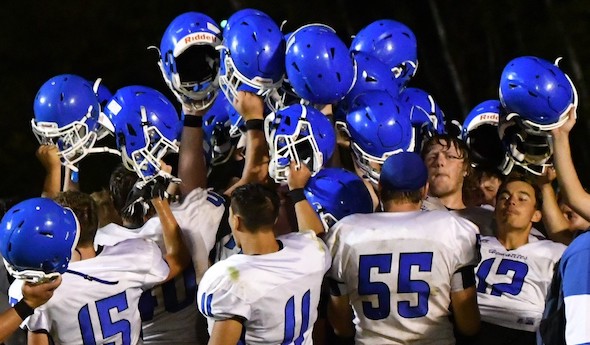
PHOTO: Ishpeming players raise their helmets during the postgame huddle after Friday's win over rival Westwood. (Photo by Cara Kamps.)