

Michigan's Football Past: A Must Read
By
Ron Pesch
MHSAA historian
September 27, 2016
By Ron Pesch
Special for Second Half
This week, the contents of my mailbox reminded me about one of my favorite items to collect – booklets and programs celebrating the history of Michigan high school football.
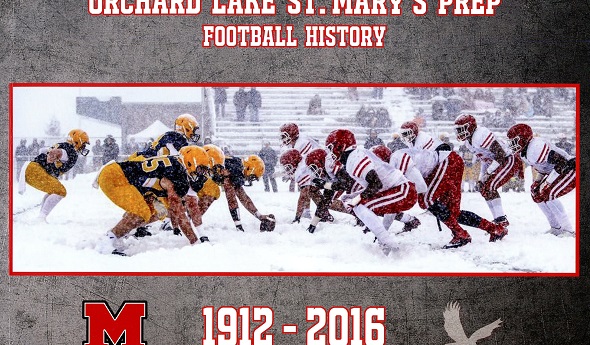
Contained within was the 2016 edition of the book, “Orchard Lake St. Mary’s Prep Football History.” Featuring a glorious image on the cover, it’s a delight to flip through. Rob Goddard and crew are to be commended on the fantastic job they’ve done with this 104-page chronicle.
The package recalled the first in my collection – a publication I helped create.
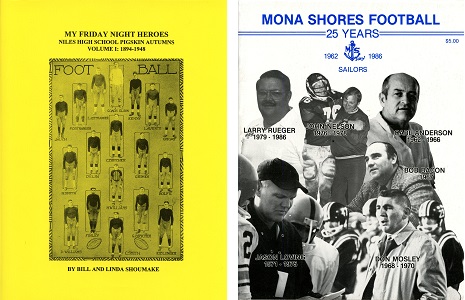
The 25-year celebration of Muskegon Mona Shores football was a modest piece, created before the days of desktop publishing. Because I had assembled the scores of the district’s games, I approached the school and found an individual willing to take a chance. Jerry Fitzpatrick, Sailors athletic director at the time, approved the idea of a booklet celebrating the school’s Silver Football Anniversary.
With gusto, we tapped into a host of resources and dove into digging out photos and details designed to capture everything we could on the years 1962 through 1985, with room for fans to collect details on the coming season. We even included a page on cheerleaders and Homecoming Kings and Queens in hopes of broadening our market.
My second acquisition was a document on Battle Creek Central football, created by MHSAA historian Dick Kishpaugh. It totaled 42 pages in length and included most everything there was to know about the Bearcats, Kishpaugh’s alma mater.
A souvenir football program celebrating Kalamazoo Central’s history followed, also heavily influenced by the work of Kishpaugh. A 60-year history of all sports at Gaylord St. Mary soon landed in my hands, passed on to me by sportswriter and historian Jay Soderberg, editor of the publication. A history of little Grant High School football, published, I believe, in 1979, was the next to arrive.
 In 1993, I partnered with baseball historian Marc Okkonen to produce “100 Years of Muskegon Big Red Football 1895-1994,” a 90-page history of our alma mater. That publication was marketed by the school’s Athletic Foundation as a fundraiser and sold well. To my delight, it seemed to spark the publication by a number of other districts of their football histories. Grand Haven and Escanaba followed a similar format and were both quick to market. Each book also celebrated a centennial of gridiron action. Other publications began to surface.
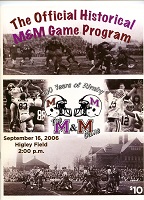
Riding a string of gridiron championships, Farmington Hills Harrison produced a 108-page program, highlighting the accomplishments from their 25-year football history, in 1994. Additional histories from Cadillac, Frankenmuth, Lowell, Negaunee, Boyne City, Niles, Sturgis and Traverse City appeared, some focused on football, others on all sports. So too did one highlighting the Centennial football game between Saginaw and Saginaw Arthur Hill, as did one a few years later celebrating the M & M game, among the nation’s oldest cross-border battles staged between Menominee and Marinette, Wisconsin.
But since then, things seem to have fallen silent. I believe a lengthy history on Grand Rapids Catholic Central made it to press, although I don’t possess a copy. I’ve seen, but have yet to acquire, a football booklet on Sparta High School football.
Do others exist? Enquiring minds want to know.
 During the gap, John Hulsebus has created, and continues to maintain and enhance a dream website, Michigan-football.com, containing an exhaustive collection of scores, season win-loss marks and records versus opponents for games played since 1950. The site lists schools, past and present for every high school in the state. Like many, I reference it often. Yet, for many schools in the state, that means as many as 55 years of gridiron action remains unrecorded.
Also missing are the stories that sit behind the scores: the players, the coaches, the drama, the locals and pageantry of a Friday night or a Saturday afternoon at the stadium. In the meantime, scrapbooks containing news clippings, game programs, and photographs, once prepared for our fathers, grandfathers and great-grandfathers, gather dust or disappear.
Tell me please, we haven’t forgotten to capture those details from our past?
 Ron Pesch has taken an active role in researching the history of MHSAA events since 1985 and began writing for MHSAA Finals programs in 1986, adding additional features and "flashbacks" in 1992. He inherited the title of MHSAA historian from the late Dick Kishpaugh following the 1993-94 school year, and resides in Muskegon. Contact him at [email protected] with ideas for historical articles.
PHOTOS: (Top) Orchard Lake St. Mary's annually produces an updated history of the school's football program. (Middle) Niles and Muskegon Mona Shores are among other programs that have documented their histories in book form. (Below) The program for the 100th game between Menominee and Marinette, Wis., was a keeper as well.
Performance: Cass Tech's Rodney Hall
December 1, 2016
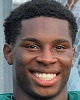 Rodney Hall
Detroit Cass Tech senior – Football
A year ago, Hall’s junior season ended on the Ford Field sideline, watching Cass Tech fall 41-27 to Romeo in the Division 1 Final after he suffered a lower leg injury two weeks before. But he came back this season fueled by championship motivation, and made it pay off. Hall threw for 220 yards and an MHSAA Finals record-tying five touchdown passes to lead the Technicians to a 49-20 win over Detroit Catholic Central in the Division 1 Final on Saturday and earn the Michigan National Guard “Performance of the Week.”
Hall started a pair of playoff games as a freshman before taking over the varsity fulltime in 2014 and leading Cass Tech to a 12-1 record. The Technicians were a combined 36-3 under him the last three seasons and scored a program-record 619 points (44.2 per game) this fall. The 6-foot-2, 210-pound signal-caller completed 10 of 18 passes in the Final and also ran for 58 yards on only seven carries. He finished this season 142 of 238 passing for 2,535 yards and 28 touchdowns, after a junior season when he threw for 2,232 yards and 20 touchdowns and ran for 1,053 yards and 14 scores.
 After admitting Saturday to being a little timid to run at the start of the fall, and with a steel plate still in his ankle, Hall ran for a combined 253 yards and three touchdowns over his final three playoff games. He has committed to sign to play football at Northern Illinois University but said he’s unsure which course of study he’ll pursue. MLive-Detroit reported Hall carries a 3.4 grade-point average in its feature on the Technicians standout as one of 10 finalists for MLive’s High School Football Player of the Year award.
Coach Thomas Wilcher said: Let's say it like this: He lost one game his first year, two games his second year, zero games his third year. That's enough said. ... I think the most important thing about Rodney Hall is you have to look at his stats. He has phenomenal stats. He has a phenomenal win-loss record. I haven't been around anything like that before. I just look at his game – (he's) the gamer. He's always bringing back a victory. We went down to the wire several times, and it was all about him. And I just told him this week, 'Look, I don't need you to run the ball. All I want you to do is throw the ball. You should throw the ball for over 300 yards.’ That’s it. And I told him, just stick with the game plan; no running. And I just kept telling the offensive coordinator, don't let him run. Let him throw it. That's it."
Performance Point: “Just to be able to make it back to this point and play in this game, I was just excited to come play, and glad we won,” Hall said. “The offense was clicking, and guys were open. They did the rest. I just put it to them. … (At last season’s Final) I was crying. I was hurt that I couldn't be out there to help my teammates. I wanted (this year) bad. We made history at Cass because I think we’re the first team to go 14-0 and win the state championship. We just wanted to win this game because we’ve been losing ever since we came into high school. We have a lot of wins, but we’ve been coming up short for the last three years – and it’s great to come out with the championship this year.”
Learning to run again: “I came in (to this season), I was a little timid to run, actually. I didn't want to get hurt again and miss this opportunity. Coach, he's been pressing me to run all year, and when I finally do, I get positive yards.”
 Star among the stars: “Quarterback is simple. You just have to keep everybody on the right track and make sure teammates don’t get down when we get behind. The last two weeks we’ve been losing, and I just remind my guys, ‘Come on, we can win this. We’re going to go back and score.’ Just remind them to keep scoring, remind the defense we’re going to keep getting stops, and just keep everybody’s heads up.”
Pass is present: “This year, I’ve been a way better passer. Because all offseason, I haven’t been able to run. I’ve just been working the pocket, making sure I’m looking at everything, making sure I’m reading the defense better. And I’ve had a better passing year this year, I believe.”
Leaving a legacy: “I just can’t believe it’s over with. I just want people to know I was a guy to go out there and give it all I’ve got. Just sell out for the team, and that’s what you should do – and you’ll end up a champion.”
- Geoff Kimmerly, Second Half editor
Every week during the 2016-17 school year, Second Half and the Michigan National Guard will recognize a “Performance of the Week" from among the MHSAA's 750 member high schools.
The Michigan Army National Guard provides trained and ready forces in support of the National Military Strategy, and responds as needed to state, local, and regional emergencies to ensure peace, order, and public safety. The Guard adds value to our communities through continuous interaction. National Guard soldiers are part of the local community. Guardsmen typically train one weekend per month and two weeks in the summer. This training maintains readiness when needed, be it either to defend our nation's freedom or protect lives and property of Michigan citizens during a local natural disaster.
Previous 2016-17 honorees:
Nov. 24: Ally Cummings, Novi volleyball – Read
Nov. 17: Chloe Idoni, Fenton volleyball – Read
Nov. 10: Adelyn Ackley, Hart cross country – Read
Nov. 3: Casey Kirkbride, Mattawan soccer – Read
Oct. 27: Colton Yesney, Negaunee cross country – Read
Oct. 20: Varun Shanker, Midland Dow tennis – Read
Oct. 13: Anne Forsyth, Ann Arbor Pioneer cross country – Read
Oct. 6: Shuaib Aljabaly, Coldwater cross country – Read
Sept. 29: Taylor Seaman, Brighton swimming & diving – Read
Sept. 22: Maggie Farrell, Battle Creek Lakeview cross country – Read
Sept. 15: Franki Strefling, Buchanan volleyball – Read
Sept. 8: Noah Jacobs, Corunna cross country – Read
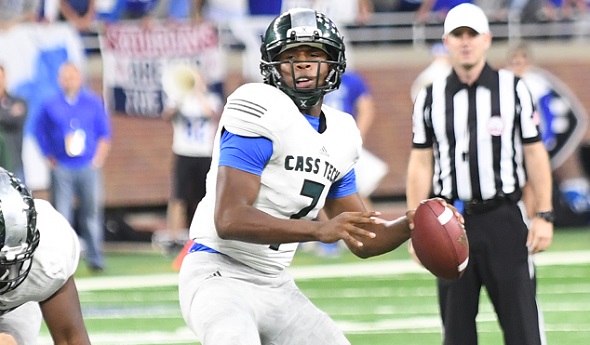
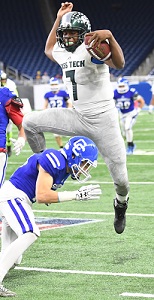
PHOTOS: (Top) Detroit Cass Tech's Rodney Hall prepares to unload a pass during Saturday's Division 1 Final at Ford Field. (Middle) Hall hurdles a would-be Detroit Catholic Central tackler.