

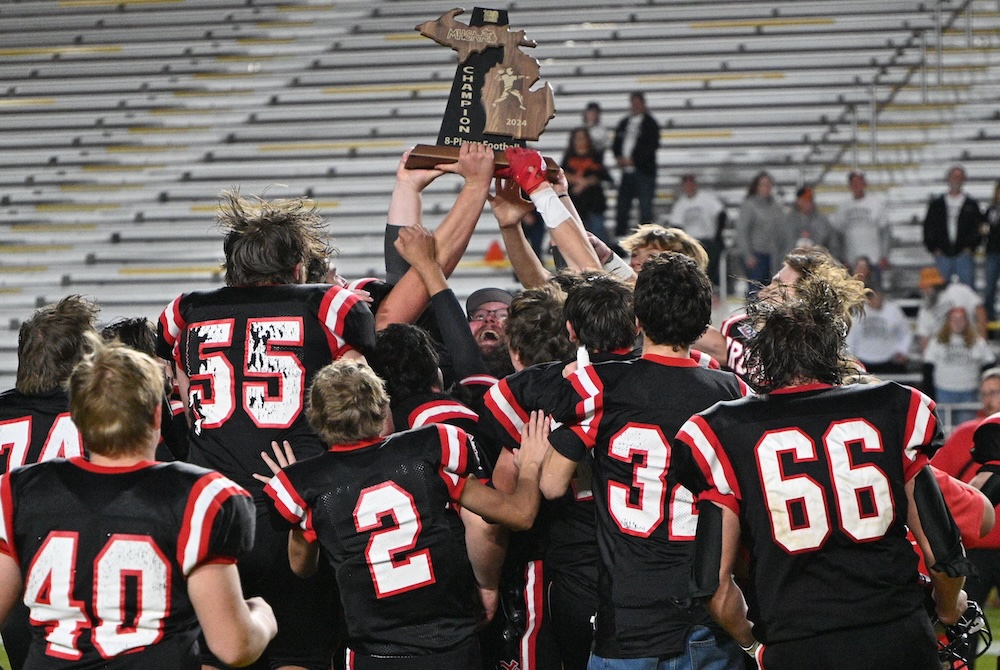
'Mighty' Forest Park Rides Overpowering Start to 5th Finals Championship
By
Jason Juno
Special for MHSAA.com
November 23, 2024
MARQUETTE — The Crystal Falls Forest Park tradition continues.
The Trojans won their fifth MHSAA Finals championship in their 15th title game appearance 42-20 over Morrice on Saturday in the 8-player Division 2 contest at the Superior Dome.
Forest Park (12-1) took advantage of two Morrice fumbles to take a 28-0 lead into halftime. The Orioles came alive in the second half, but they couldn’t overcome such a start.
It was the second 8-player title for Forest Park with the first coming in 2017, and the first for coach Brian Fabbri, who started as a lineman in two 11-player championship games (2004 and 2005) for the Trojans.
He was thrilled to help keep the tradition alive.
“I absolutely love it,” Fabbri said. “I’m blessed to be able to have my name up there with the Mettlachs, Santillis, Graffs. It’s unbelievable.”
Dick Mettlach led Forest Park to back-to-back titles in 1975 and 1976. Bill Santilli took Forest Park to seven title games and won the 2007 championship. Dave Graff was the head coach of the 2017 champion.
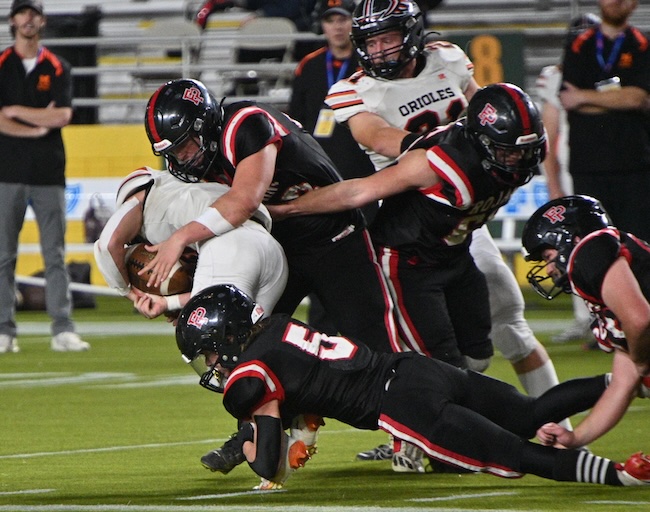
“We’re the fifth one to win it; it just feels awesome,” said Forest Park senior Kevin Giuliani, who at 6-foot-5 and 270 pounds was named the Upper Peninsula’s top lineman by media vote recently.
Forest Park’s first-half dominance proved to be the difference in this championship clincher.
 The Trojans got the ball first and capped an 11-play, 53-yard drive with a four-yard touchdown run by senior Grayson Sundell midway through the first quarter.
Forest Park’s Noah Starr recovered an onside kick on the ensuing kickoff, but Morrice came up with a big stop on fourth down in the red zone.
Any momentum from that evaporated quickly. The Orioles went three-and-out in their first offensive possession of the game, and Forest Park doubled its lead on the first play after getting the ball back. Sophomore running back Dax Huuki went 58 yards for a touchdown and Dietrich Rasner, who made all six extra points he tried in the game, made it 14-0 two minutes into the second quarter.
Morrice started its next possession with good field position at midfield but fumbled on the second play, and Nik Stephens recovered it at the Forest Park 45. It took the Trojans eight plays to score, and it was Stephens with the eight-yard run to paydirt for a 21-0 advantage.
The Orioles coughed it up again, this time on the third play of their next possession, with Vic Giuliani recovering it.
Huuki scored his second touchdown of the day, a four-yard rush with 10 seconds left in the half. It was another methodical drive of eight plays to go 50 yards. Forest Park led 28-0 at the half.
“Getting that quick score before half was huge for us,” Fabbri said.
The Trojans ended the half with 184 rushing yards on 33 carries. Morrice had only 11 offensive plays the whole half, thanks in part to their turnovers.
That changed during the second half – just not enough to put the game in any serious doubt.
Morrice (11-2) picked up its first first down during the first possession of the second half, and got its first big play, a 32-yard run by Joel Fisher that set the Orioles up at the Forest Park 5. Two plays later, he ran in a score and the lead was down to 28-6. Fisher led Morrice with 99 yards rushing on 12 carries.
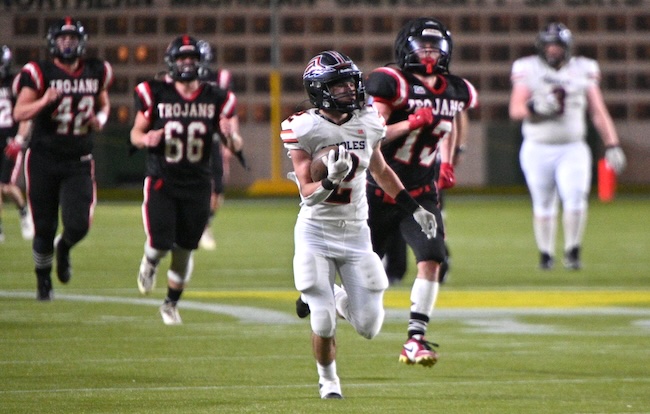
The Trojans added a third-quarter touchdown of their own as Stephens ran five yards for a score on the ensuing possession to make it 35-6. Morrice’s Wyatt Cartier ran one yard for a touchdown in the early stages of the fourth quarter, and Fisher returned a punt 85 yards for a TD with 5:30 left in the game, making it 35-20.
 “I knew they were a good team. We knew it was coming,” Fabbri said. “It was only a matter of time, and it happened. We had enough cushion there. We made enough big plays at the end.”
The last came a minute later, when Forest Park scored on a 49-yard rush by Stephens, his third touchdown of the day — half of his carries went for scores — and the Trojans were celebrating a championship soon after.
Morrice coach Kendall Crockett said he was proud of his team for fighting the entire game. The Orioles obviously competed much better during the second half as they accumulated 155 of their 194 total yards.
“We hung onto the ball, first of all. That was kind of a big deal for us,” he said. “... As physical as they were in that first half, I thought that we really fought back in the second half, didn’t quit and kept playing ball.”
That physical play has been a staple of Forest Park football since their first state title. Forest Park ran for 184 yards in the first half and finished with 291 on 47 carries — Huuki led with 136 yards on 19 carries. Fullback Trent Kannich ran for fewer yards, 68, but he was a factor as well as Crockett pointed out how hard he hit.
“(Huuki’s) a sophomore, but he runs like a senior,” Fabbri said. “He’s battle-tested. He stepped up when he had to and made some plays.”
Huuki said Morrice was a physical team as well, but Forest Park was determined to go home with a win.
“That was just put into our head going into this week — the most physical team with the most grit, and the mightiest team’s going to win,” he said. “So we just came in wanting it all.”
The Trojans did it in front of a huge sea of Forest Park fans, who chanted, “U.P. Power!” when it became certain the Trojans were going to win late in the fourth quarter.
“It doesn’t seem real,” Kevin Giuliani said. “I’m just so happy. Words can’t explain what I feel like right now. I feel like I’m on top of the world right now.”
PHOTOS (Top) Crystal Falls Forest Park players swarm coach Brian Fabbri (holding trophy) in celebration Saturday at the Superior Dome. (Middle) Forest Park’s Kevin Giuliani and Brody Starr (5) bring down an Orioles ball carrier. (Below) Morrice’s Joel Fisher (2) breaks away from the Forest Park defense for a long second-half touchdown run. (Photos by Cara Kamps. Click for more.)
Many-Sport Standout Gash Closing High School Career with Repeat Title Pursuit
By
Keith Dunlap
Special for MHSAA.com
September 3, 2026
Gideon Gash said this fall is marking the end of an era for him athletically.
 Throughout his life, it didn’t seem to matter what the sport was, because Gash was playing it.
Whether it was soccer, basketball, lacrosse, football, or track & field, Gash sampled them all, and it didn’t stop when his high school career began.
Last year as a junior at Detroit Catholic Central, Gash continued to play several sports after being named all-state for football in the fall.
During the winter, he played on Catholic Central’s basketball team. In the spring, he decided to go out for track and thrived, finishing second in the 100-meter dash and winning the long jump at the Catholic High School League meet, and then taking third in the long jump at the Lower Peninsula Division 1 Finals.
Following that championship meet, Gash returned to the lacrosse team and suited up for the Shamrocks during the final week of the season, which culminated in a DCC Division 1 title. Gash had played lacrosse the previous spring as a sophomore, but decided to focus more on track as a junior.
“I worked out different muscles and different skills and just having that versatility helped me a lot throughout life,” Gash said. “Being able to do different things and learn faster and having to keep up with everyone in terms of basketball, lacrosse, in terms of just raw skills. That helped me a lot in terms of just being able to add to my bag and be the best I can.”
But now, Gash said his multi-sport playing days are all but over.
One of the premier college football recruits in the nation, the 6-foot-4, 210-pound Gash has committed to play at Texas Tech for now, although he recently said his recruitment is “not closed down,” according to an article on Rivals.com.
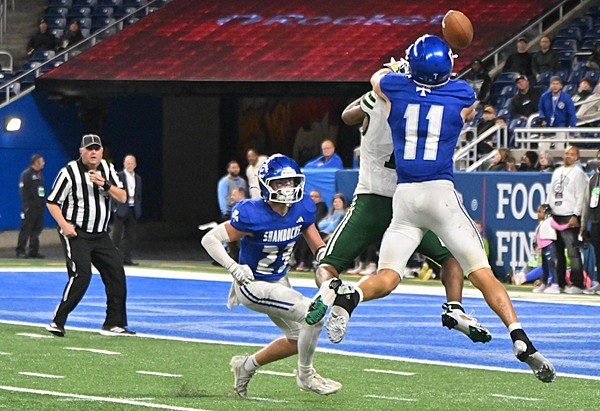 Regardless of where he ends up, Gash said he plans on enrolling early and starting college in January, adding he made sure to accumulate enough class credits to be able to do so.
That means it’s football from here on out, and odds are he’s going to have a monster senior year for reigning Division 1 champion Catholic Central.
Last year, Gash was all-state in Division 1-2 as a lockdown defensive back, collecting 74 tackles and nine pass breakups. He also was a big-play threat as a wideout, catching three long touchdown passes for Catholic Central in a championship game win over Detroit Cass Tech at Ford Field.
There are times this season where Gash may never leave the field, given he will see lots of time as a dangerous punt returner. In a season-opening win over Clinton Township Chippewa Valley, Gash returned a punt 48 yards for a touchdown.
Playing so many sports throughout his life has shaped him into an all-around force on the football field and helped turn him into a dominating physical specimen.
Gash gained 10 pounds of muscle since last fall and going into his senior year is more chiseled and faster than he has ever been.
“He just loves competing,” Catholic Central football head coach Justin Cessante said. “When we compete and he works the way he does when nobody is watching, and he’s got his agility, his strength and his size, he’s a 10 times better player and athlete than he was last year. I think that attributes to doing all those different things.”
This is the first year Gash is not playing alongside his older brother, Samson, the 2025 Finals champion in the 100-meter dash and all-state wide receiver last fall who is a freshman at Michigan State.
Gideon Gash will certainly be counted on for veteran leadership since Catholic Central entered this season with only two returning starters, although there are several talented underclassmen already with Division I college scholarship offers who are expected to soon make names for themselves on the high school level.
While the next wave of great players is already coming for Catholic Central, it certainly will be hard to replace Gash and how he was able to excel at more than just football.
“I’m going to miss it,” Gash said. “I’ve been playing three sports my whole life, so I’m going to miss it a lot.”
 Keith Dunlap has served in Detroit-area sports media for more than two decades, including as a sportswriter at the Oakland Press from 2001-16 primarily covering high school sports but also college and professional teams. His bylines also have appeared in USA Today, the Washington Post, the Detroit Free Press, the Houston Chronicle and the Boston Globe. He served as the administrator for the Oakland Activities Association’s website from 2017-2020. Contact him at [email protected] with story ideas for Oakland, Macomb and Wayne counties.
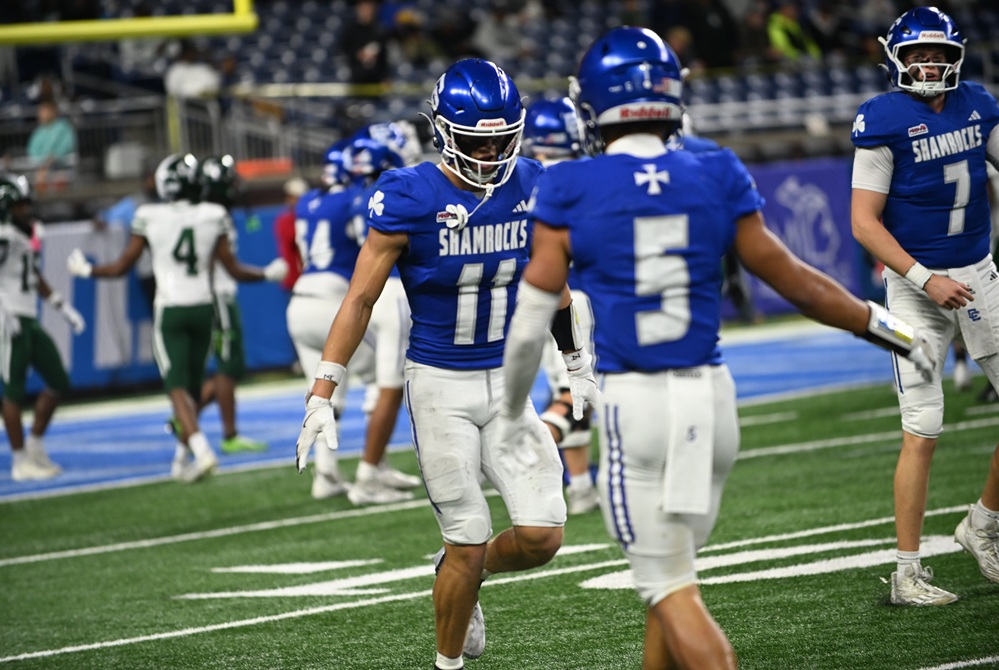
PHOTOS (Top) Detroit Catholic Central’s Gideon Gash (11) is congratulated by brother Samson Gash after scoring during last season’s Division 1 Final. (Middle) Gash breaks up a pass during the win over Detroit Cass Tech.