


Mixed Messages
November 27, 2013
One of the very few enjoyable aspects of waiting in an airport is the guiltless time it allows me to visit its bookstores and page slowly through some of the old classics I vaguely remember and the new releases I can’t wait to read.
Two months ago in one of the terminals of Sky Harbor Airport in Phoenix, my attention went quickly to a prominent display of books about football. Five titles were mostly critical of the game, focusing on the sport at the major college and professional levels. Down at the bottom of the display was one title that addressed the positive value of football to students, schools and communities.
One month ago, while I was eating breakfast, the television news reported on the results of new research about youth concussions. While the narration mentioned multiple sports, the video was mostly of football. I saw that story repeated on another television channel that evening. I wondered, how many times on how many channels did how many people get this gift of the latest youth concussion statistics for all sports presented in football-only wrapping paper?
The public is getting mixed messages about school-sponsored football. The problem of college and professional football is not the problem of school-sponsored football. And what problems of head trauma that do exist in school sports are not exclusively problems of football.
In fact, school-sponsored football has never been freer of serious injury than it is today – that’s true whether we are talking about heads, necks, knees or nicks. It’s the result of the most careful and cautious rules making, coaching and officiating ever. And it’s safer – not less so – as we ever more quickly assess and refer injuries to ever more educated and capable health care professionals.
March to Marquette: 8-Player Preview
November 17, 2017
By Geoff Kimmerly
Second Half editor
The MHSAA 8-Player Finals return to where they got their start Saturday, with two champions to be awarded for the first time.
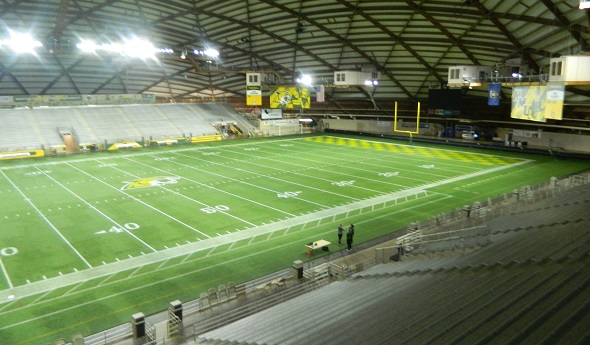
 Saturday’s games will be played at Northern Michigan University’s Superior Dome, which hosted the first MHSAA 8-Player Final in 2011. The 8-Player Playoffs also moved from one to two divisions this year, and Central Lake, Crystal Falls Forest Park and Portland St. Patrick all are seeking their first 8-player championships – while Central Lake will play 2012 champ Deckerville looking to win its first MHSAA title ever in the sport.
Both games will be broadcast live on the FOX Sports Detroit Facebook page and replayed on FOX Sports Detroit’s primary channel on Nov. 21 – Division 1 at 8 p.m. and Division 2 at 11 p.m. Audio of both games will be streamed live on MHSAANetwork.com.
Below is a look at all four finalists. Statistics are through Semifinals unless noted. The MHSAA Playoffs are sponsored by the Michigan Army National Guard.
 Division 1
CENTRAL LAKE
Record: 12-0, No. 1
Coach: Rob Heeke, seventh season (41-30)
League finish: First in Midwest Central Michigan Conference
Championship history: Has never played in an MHSAA Final.
Best wins: 54-20 over No. 7 Stephenson in the Semifinal, 58-26 (Regional Final) and 44-14 over No. 10 Suttons Bay, 36-14 (Pre-Regional) and 64-38 over No. 15 Mesick, 42-28 over Division 2 No. 2 Onekama.
Players to watch: QB/DB Gavin Mortensen, 5-11/160, sr. (1,062 yards/12 TDs rushing, 680 yards/18 TDs passing); TE/DB Jayce Hoogerhyde, 6-2/145, sr. (223 yards/8 TDs receiving, 49 tackles); RB/DB Skyler Spangler, 6-0/160, jr. (1,652 yards/26 TDs rushing, 272 yards/7 TDs receiving); RB/LB Grant Papineau, 6-3/210, jr. (1,886 yards/25 TDs rushing, 95 tackles).
Outlook: Central Lake has shined in its first season of 8-player football, improving from 2-7 in its final season of 11-player a year ago. Onekama came closest to catching the Trojans, losing by 14 in the game Week 8 that decided the league championship. It’s no secret how Central Lake succeeds; led by three 1,000-yard rushers, the Trojans have run for nearly 4,900 yards at 8.3 per carry. Defensively Papineau is a stopper, but Mortensen and Hoogerhyde are impressive pass defenders with 13 and 15 pass break-ups, respectively. Mortensen also has six interceptions.
DECKERVILLE
Record: 11-1, No. 3
Coach: Bill Brown, 25th season (201-71)
League finish: First in North Central Thumb League Stars
Championship history: 8-Player champion 2012, runner-up 2016.
Best wins: 52-18 over No. 5 Bellevue in the Semifinal, 38-0 over No. 4 Morrice in the Regional Final, 66-28 (Pre-Regional) and 42-8 over No. 12 Mayville, 20-14 over No. 6 Kingston, 52-0 over No. 16 Lawrence.
Players to watch: QB/DB Isaac Keinath, 5-10/155, soph. (660 yards/15 TDs passing); TB/DB Kenton Bowerman, 5-6/150, sr. (971 yards/14 TDs rushing, 8 interceptions); TE/LB/P Wyatt Janowiak, 6-4/255, sr. (288 yards/6 TDs receiving); TB/DB Cruz Ibarra, 5-10/150, jr. (1,430 yards/20 TDs rushing).
Outlook: A new cast of stars has emerged after most of last year’s graduated, and Bowerman stepped up even more last week scoring four touchdowns with leading rusher Ibarra reportedly out with an injury. Deckerville’s only loss this season was by a point to Morrice in Week 6, and was avenged with a 38-point shutout win in the Regional Final. Rival Kingston was the only other opponent to get closer than 20 points to catching the Eagles – despite a regular-season schedule that featured seven playoff teams. Senior Zachary Ostrowski has six catches as the team’s third-leading receiver – and five interceptions as its second-leading pass defender.
 Division 2
CRYSTAL FALLS FOREST PARK
Record: 9-2, No. 6
Coach: Dave Graff, fourth season (35-10)
League finish: Second in Western Eight Conference
Championship history: Three MHSAA titles (most recent 2007), 10 runner-up finishes.
Best wins: 36-34 over No. 1 Pickford in the Semifinal, 62-20 over No. 9 Engadine in the Regional Final, 20-6 (Pre-Regional) and 66-58 over No. 7 Powers North Central, 52-38 over Division 1 No. 13 Ontonagon.
Players to watch: RB/LB Connor Bortolini, 5-8/150, sr. (1,749 yards/20 TDs rushing); QB Tommy Peltoma, 6-1/180, soph. (666 yards/10 TDs passing); RB/DE Peter Ropiak, 6-0/185, sr. (863 yards/12 TDs rushing); RB/DB Calvin Post, 5-8/170, soph. (765 yards/9 TDs rushing, 4 interceptions).
Outlook: Forest Park is one of the most successful programs in MHSAA history, especially among smaller schools – it played in the Division 8 Final six straight seasons from 2004-09. The Trojans moved to 8-player last season and might have been the second or third-best team in Michigan, but shared a league and playoff path with eventual repeat champion Powers North Central and lost to the Jets in the Regional Final. Forest Park opened this season 1-2, but hasn’t been defeated since falling to Division 1 semifinalist Stephenson in Week 3. Bortolini took over this fall as the main ball carrier after the Trojans graduated a 2,400-yard rusher, and he’s carried on the program’s tradition of productive backs.
PORTLAND ST. PATRICK
Record: 11-1, No. 3
Coach: Patrick Russman, 11th season (69-42)
League finish: First in Central Michigan 8-Man Conference
Championship history: 11-Player Class D champion 1992, runner-up 1997 and 1991.
Best wins: 33-14 over No. 5 Kinde-North Huron in the Semifinal, 50-0 over No. 8 Flint International Academy in the Regional Final, 44-6 over No. 13 North Adams-Jerome in the Pre-Regional, 24-8 over No. 10 Marion, 38-22 over Division 1 No. 14 Webberville.
Players to watch: QB/DB Tanner Lawson, 6-3/165, jr. (1,093 yards/20 TDs passing); RB/LB Isaiah Smith, 5-10/190, sr. (359 yards/7 TDs rushing); RB/DL Ned Smith, 5-10/160, soph (779 yards/8 TDs rushing); WR/DB Will Simon, 6-2/170, sr. (395 yards/8TDs receiving). (Statistics through nine games plus one forfeit win.).
Outlook: St. Patrick also was one of the state’s top 11-player small-school programs through the 1990s and has been on the verge of playing for an 8-player championship since switching formats in 2012 – and making the Semifinals that first season. The only blemish on this season’s record was a Week 4 loss to eventual Division 1 semifinalist Bellevue, and no other opponent has gotten closer than 16 points. Junior linebacker Paul Cook is among those pacing a defense that has given up only 12.7 points per game.