


Mixed Messages
November 27, 2013
One of the very few enjoyable aspects of waiting in an airport is the guiltless time it allows me to visit its bookstores and page slowly through some of the old classics I vaguely remember and the new releases I can’t wait to read.
Two months ago in one of the terminals of Sky Harbor Airport in Phoenix, my attention went quickly to a prominent display of books about football. Five titles were mostly critical of the game, focusing on the sport at the major college and professional levels. Down at the bottom of the display was one title that addressed the positive value of football to students, schools and communities.
One month ago, while I was eating breakfast, the television news reported on the results of new research about youth concussions. While the narration mentioned multiple sports, the video was mostly of football. I saw that story repeated on another television channel that evening. I wondered, how many times on how many channels did how many people get this gift of the latest youth concussion statistics for all sports presented in football-only wrapping paper?
The public is getting mixed messages about school-sponsored football. The problem of college and professional football is not the problem of school-sponsored football. And what problems of head trauma that do exist in school sports are not exclusively problems of football.
In fact, school-sponsored football has never been freer of serious injury than it is today – that’s true whether we are talking about heads, necks, knees or nicks. It’s the result of the most careful and cautious rules making, coaching and officiating ever. And it’s safer – not less so – as we ever more quickly assess and refer injuries to ever more educated and capable health care professionals.
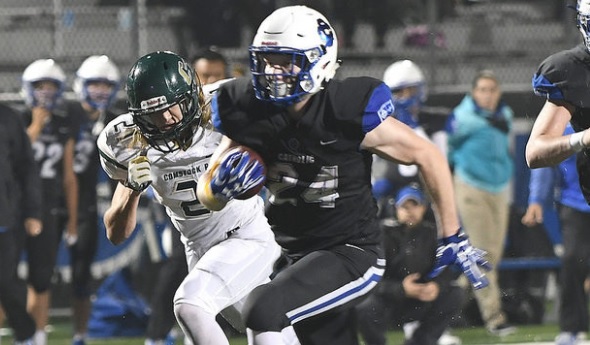
Performance: GR Catholic Central's Nolan Fugate
October 13, 2017
 Nolan Fugate
Grand Rapids Catholic Central senior – Football
Fugate, a 6-foot-1, 210-pound running back, ran 37 times for 477 yards and five touchdowns in GRCC’s 57-50 win over Comstock Park on Oct. 6. His rushing yardage ranked fourth-most in MHSAA history for one game and second-most in the state since 1990, earning Fugate the Michigan Army National Guard “Performance of the Week.”
Also the leading rusher on last season’s team that won the Division 4 championship, Fugate has carried the ball 111 times for 1,137 yards and 13 touchdowns this fall – averaging 10 yards per carry. He's amassed those numbers despite limited attempts in four running clock games this fall. After coming up for the playoffs but seeing little action as a sophomore, and then moving into a prominent role the last two seasons, Fugate is fourth in GRCC history with 335 career carries, second with 2,537 career yards, tied for second with 27 career rushing touchdowns and fifth with a career average of 7.6 yards per carry. And like any good back, he knows to credit those clearing the way – Fugate follows an outstanding line led by 6-5, 270-pound Jalen Mayfield, who has committed to sign with University of Michigan.
 Fugate also ran track last season for the first time in high school and plans to do so again this spring. He hopes to return to the basketball program as well – he played subvarsity his first two years before taking last season off. He’s aiming to continue his football career after high school and has interest from many of the state’s top Division II programs plus a few at the Division I mid-major and NAIA levels. Fugate is planning to study business and carries a 3.2 grade-point average. Wherever he goes, that program will get a proven winner – GRCC is 7-0 this fall heading into tonight’s Ottawa-Kent Conference Blue title-deciding matchup with reigning Division 5 champion Grand Rapids West Catholic, and the Cougars are 21-2 with Fugate on the roster.
Coach Todd Kolster said: "I think the world of Nolan. He is a very self-motivated young man. He is very mentally tough and has worked extremely hard to help lead our team. He is a great teammate and a high-character person. He's is a great competitor. ... He is one of the best tailbacks in the state of Michigan; he rushed for over 1,600 yards and 21 touchdowns a year ago. He could have very gaudy statistics and surpassed those totals already if I played him in those other (running clock) weeks."
Performance Point: “We had a good gameplan coming in, and I think we executed really well and our line blocked really well and it was just a good night offensively,” Fugate said of the Comstock Park win. “I knew I was having a pretty good night. I knew I had some big runs, and I was just following my blocks, but I didn’t know the exact yards I had. I was actually pretty surprised (at the yardage total). I had some big runs the first possession, and I could see our offensive line executing their blocks well so I was figuring I would have a pretty big night. The first play we had the ball in the second half, I broke a 72-yard run. That was my favorite run because I broke out into the open and I just ran past everyone and I could hear the crowd screaming.”
Following Jalen: “He’s my best friend too, and it’s pretty special. You don’t get a chance to run behind the best lineman in the state very often, so I’m pretty fortunate. We shared a moment when we talked about how good of a night it was, and it was just a really special night overall.”
 Great expectations: “We’ve just been listening to the coaching staff, and whatever they’ve asked we’ve been executing to the best of our ability. And we’ve been staying focused throughout the week trying to have the best practices we could have. We realize the expectations are high, so we just have to stay focused on each game and play united and just get better each day. You’ve just got to worry about one thing at a time and for that (opponent), and you can’t look ahead to the playoffs. … We knew the expectations were high, but I had faith. We definitely had more talent last year, but I feel like we’ve executed a lot better this year up to this point. I knew we could be special, and if we just keep working out each day and bringing it every day I think it will turn out really well.”
Running like “All Day” Adrian: “My favorite running back is probably (the Phoenix Cardinals’) Adrian Peterson, so growing up I always watched him. He’s a strong, explosive, physical runner. I like how he runs downhill and he’s always physical, and when he gets an opening he’s very explosive.”
Hooping like a football player: “A kid I grew up with (point guard Austin Braun) has been talking to me about (playing basketball). I was thinking about it, and I think I’m just going to do it. I think our team will do really well this year, so it would be fun to be a part of it. I’ll probably play really physical. I’ll probably be like the sixth man, bring intensity and defense and rebounding. That’ll probably be my job."
- Geoff Kimmerly, Second Half editor
Every week during the 2017-18 school year, Second Half and the Michigan Army National Guard will recognize a “Performance of the Week" from among the MHSAA's 750 member high schools.
The Michigan Army National Guard provides trained and ready forces in support of the National Military Strategy, and responds as needed to state, local, and regional emergencies to ensure peace, order, and public safety. The Guard adds value to our communities through continuous interaction. National Guard soldiers are part of the local community. Guardsmen typically train one weekend per month and two weeks in the summer. This training maintains readiness when needed, be it either to defend our nation's freedom or protect lives and property of Michigan citizens during a local natural disaster.
Previous 2017-18 honorees:
October 5: Marissa Ackerman, Munising tennis - Read
September 28: Minh Le, Portage Central soccer - Read
September 21: Olivia Theis, Lansing Catholic cross country - Read
September 14: Maddy Chinn, Pontiac Notre Dame Prep volleyball - Read
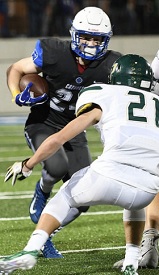
PHOTOS: (Top) Grand Rapids Catholic Central’s Nolan Fugate runs away from the Comstock Park defense during last week’s 57-50 win. (Middle) Fugate prepares to take on a Comstock Park defender. (Photos by Murray Sports Photography.)