

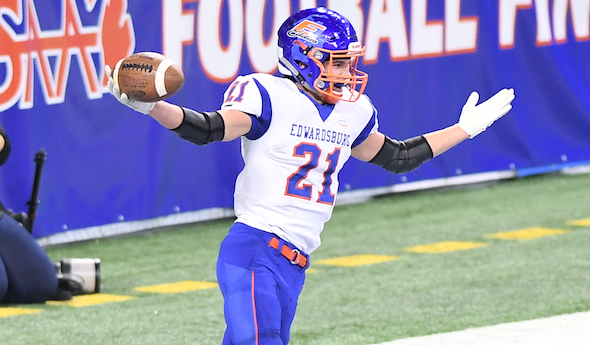
Moment: Nick & Nick Go 90, 27 Years Apart
October 30, 2020
By John Johnson
MHSAA Director of Broadcast Properties
The longest rushing play in the MHSAA Football Finals is one of two marks that has two players tied for the top spot.
Dominant Defense Sparks King Repeat
By
Tom Markowski
Special for Second Half
November 25, 2016
DETROIT – As much as it hurts Detroit Martin Luther King to lose to Detroit Cass Tech, falling twice to its rival this fall helped the Crusaders win the school’s third MHSAA football championship and second consecutive Friday.
King’s defense was outstanding, as the Crusaders held Walled Lake Western (12-2) to 124 yards in defeating the Warriors 18-0 in the Division 2 Final at Ford Field.
King (12-2) lost to Cass Tech, 31-18, during the regular season and then again in the Detroit Public School League title game at Ford Field, 41-20. King trailed 17-0 at halftime in the first game and 21-0 in the second meeting, and never seriously threatened Cass Tech in either.
First-year head coach Tyrone Spencer was the defensive coordinator before taking over for Dale Harvel, who died on July 22 of a heart attack. Harvel was the defensive coordinator in 2007 under coach Jim Reynolds when King won its first MHSAA title against Midland, 47-21.
“The (players) overcame a lot,” Spencer said. “They overcame adversity. But it’s also how you handle success. That’s why I thought those two losses helped. And I said then that I thought we would peak at the end.
“We think about (Harvel) all of the time. We thought about him yesterday, and we thought about him today. It meant a lot for us to win this. I know he’d be proud.”
King’s dominance on defense not only stuffed Western and an offense that averaged 42.5 points over the first four playoff games, but the unit had four interceptions, two of which went for touchdowns.
King led 6-0 at halftime, then gained just one yard in the third quarter and increased its lead to 12-0.
That’s what an opportunistic defense can provide.
Western began the second half well when quarterback Johnny Tracy completed a 21-yard pass to Justin Thomas to midfield. Jalen Bell then sacked Tracy for a 9-yard loss, and then Tracy attempted a sideline pass that was tipped just beyond the line of scrimmage and intercepted by Jesse Scarber at the King 44. Scarber, a first-year starter, raced down the left sideline to complete a 56-yard scoring play, and King led 12-0 with 10:37 left in the third quarter.
“King was very physical up front,” Tracy said. “They put on some pressure, and they were coming hard.”
For Scarber, it was his second interception of the game and fifth of the season – but this one was special.
“Once I saw it tipped, I just got it and ran for the end zone,” he said.
 The defensive line, led by sophomores Tyrece Woods and Bell, have been stubborn against the run all season. It’s the secondary that’s been prone to give up a big play here and there, and Spencer addressed that after the second Cass Tech loss and again this week.
“We put a lot of pressure on our defensive backs,” Spencer said. “We’ve been big on the run, and I told (the defensive backs) you’ve got to step up.”
Using two passers, Western completed 8 of 23 throws for 70 yards with three interceptions. The Warriors were sacked four times.
King was held to 156 yards, but the offense had its moments.
The game was scoreless late in the first half when King took over on the Western 26 after a short punt. It took the Crusaders five plays to score as quarterback Dequan Finn completed a 9-yard touchdown pass to Ambry Thomas with 12 seconds left before the break. Matt Alati blocked the kick conversion attempt, and King led 6-0 at halftime.
Jaylen Wilson led King with 57 yards rushing on nine carries and Finn, a sophomore in his first season as a starter, was 7 of 15 for 68 yards passing.
There was one play, with King nursing that 12-0 lead, when Finn made a play that sometimes can be overlooked. King faced a 2nd-and-6 from its 23 when Finn completed a 31-yard pass to Christian Chatman to get the Crusaders out of a hole. The play came with 6:33 left, and King was able to milk another two minutes off the clock.
“It was a double post,” Finn said. “I saw the corner playing out and we talked about it on the sideline before the play. We all noticed it.
“It’s all about the team. My line did a great job of blocking.”
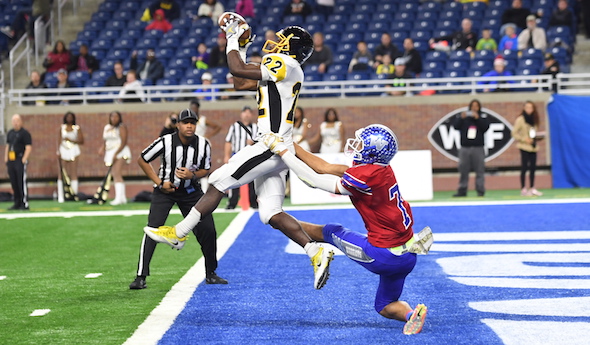
Jay-Veyon Morton completed the scoring when he returned an interception 66 yards for a touchdown with 2:53 left.
“King played great defense throughout the playoffs,” Western coach Mike Zdebski said. King’s defense allowed 35 points in the five playoff games. “They’re big up front. Cass must be a really good team.”
The MHSAA Football Finals are sponsored by the Michigan National Guard.
PHOTOS: (Top) Detroit King’s Jay-Veyon Morton (22) snags one of his two interceptions as Walled Lake Western’s Cody White works to bring him down. (Middle) King’s Ambry Thomas stretches toward the goal line while two Western defenders, including Jack Dodge (11), attempt to slow him.