

Moment: Streak-Ender Highlights 1st Finals
December 11, 2020
By John Johnson
MHSAA Director of Broadcast Properties
It’s been 45 years since the first MHSAA Football Playoffs took place, a two-week, 16-team tournament with the top teams of each of four regions in all four classes finally settling gridiron championships on the playing field.
In that first year, cries of “U.P. Power” thundered through the stands at Waldo Stadium in Kalamazoo and the new Perry Shorts Stadium in Mt. Pleasant as Crystal Falls Forest Park and Ishpeming claimed the 1975 titles in Classes D and C respectively. Bill Santilli ran wild for 179 yards on 37 carries and three touchdowns as the Trojans manhandled Flint Holy Rosary, 50-0, in the Class D game. But the Class C affair was one for the ages - perhaps the biggest upset in the history of the finals.
It was billed as David and Goliath. The mighty Hudson Tigers roared north to Mt. Pleasant riding a 72-game winning streak, which would stand as a national record until 1992; and is still a state record, only threatened once by a 69-game skein by Ithaca which ended in the 2014 Finals. Hudson had also laid claim to mythical state titles in Class C the three previous seasons. Ishpeming’s pedigree dated back to 1900, when it won the first of three straight - and of four in a five-year period - state titles in a championship conducted at and by the University of Michigan, primarily for the purpose of recruiting for Fritz Crisler’s Wolverines football program. The Hematites, having their best season in 15 years, had even lost a regular-season game along the way to a 9-0 Marquette squad that didn’t qualify for the playoffs.
On a cold, windy day at Central Michigan University, Ishpeming struck first and struck hard. Four minutes into the game, Tom Andriacchi blocked a Hudson punt and returned it to the Tigers' 10-yard line. Four plays later, quarterback Mark Marana kept the ball on the option and scored from two yards out. On its next possession just midway through the first period, the Hematites ripped off a 61-yard drive capped by a three-yard scoring run by Dave Farragh, and Ishpeming was up 16-0.
Hudson rallied following the ensuing kickoff with its first score, a 28-yard pass from Chris Luma to Dan Salamin, but the Hematites came right back with their third score of the opening frame, a 60-yard run by Mike Dellangelo to give Ishpeming all the points it would need.
The two teams traded scores in the second period, when Hudson then missed a golden opportunity to tighten things up just before halftime, fumbling at the Hematites' 2-yard line and with Ishpeming recovering for a touchback.
Dellangelo picked up a second TD in the third quarter, and finished the game with 156 of Ishpeming’s 336 rushing yards in the 38-22 victory.
“It wasn’t hard getting our guys up for the game,” Hematites coach Mike Mileski told Central Michigan Life after the game. “The emotion factor was a ready-made thing considering Hudson’s streak …”
Our action footage this week comes courtesy of Brian Sarvello, a member of that 1975 Ishpeming team. About 17 minutes film from that game was assembled with some of the local radio station call into a DVD that was shared with the team several years ago. We found it in a random internet search for this most recent series of MHSAA Moments, and appreciate Mr. Sarvello’s help in bringing it to you.
If you know of championship game footage from those pre-television years (1975-88) of the MHSAA Football Finals, we’d love to hear about it. Drop us a line at [email protected].
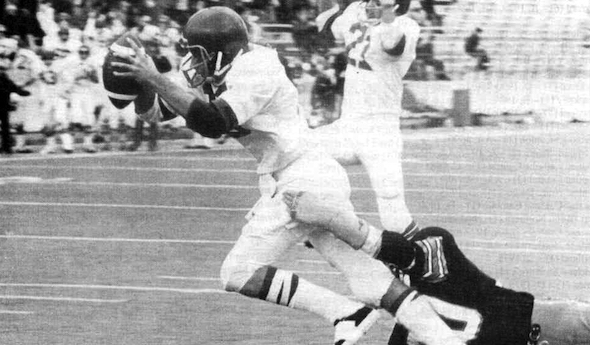
PHOTO: Ishpeming's Mark Marana works to break away from a tackler during the 1975 Class C Final. (MHSAA file photo).

Going on Offense
March 3, 2015
I was a defensive back on my college football team, but I refuse to be put on the defensive about the game of football.
The game is good for students, their schools and our communities. High school football is character-building for students, spirit-building for schools and community-building for cities and towns. Local school football programs ought to be part of the development plans and place-making strategies of all communities of Michigan.
The school-sponsored game has never been safer to play. The equipment has never been more protective, coaches have never had more safety training, the rules have never been more safety-oriented, and game officials have never had more encouragement to enforce those rules. The result is fewer injuries of all kinds – from nicks and bruises to ankles, knees and necks.
When the game of football has faults, we find and fix them. To continue doing so requires that we be honest with ourselves about where the game has weaknesses and be constantly alert to effective ways to improve the game.
Defensiveness gets in the way of discovering ways to go on offense. It blocks innovation and sacks aspirations before they can be launched.
I want our public to know that school-sponsored football is a great game. I also want the public to know that we aspire to keep improving the game and to exceed legal mandates. We will continue to do more than what is required and, in fact, we intend to do what’s unexpected to assure football remains a positive influence on students, schools and communities.