

Montague Follows QB's Unstoppable Lead
By
Paul Costanzo
Special for MHSAA.com
January 22, 2021
DETROIT – Montague football coach Patrick Collins was well prepared Friday night.
After a week of getting emotional when asked what it would be like coaching his son, Drew, for the final time in the MHSAA Division 6 Final, he told himself that he wouldn’t cry again if asked the question after the game.
He accomplished that feat, making him perfect on the night.
The Collins family will be celebrating their final game together forever, as they claimed Montague’s third Finals title with a 40-14 victory over Clinton at Ford Field.
“You can’t finish any better than that,” said Patrick Collins, who has been at the helm for all three Montague titles. “How does it get any better? It’s been a phenomenal run. Just pinch me, man. I just can’t believe it. I think all the coaches feel like (the players are) all our sons. We treat them all the same. … It’s special, because we’re tight. There’s a lot of love and a lot of guys playing for each other.”
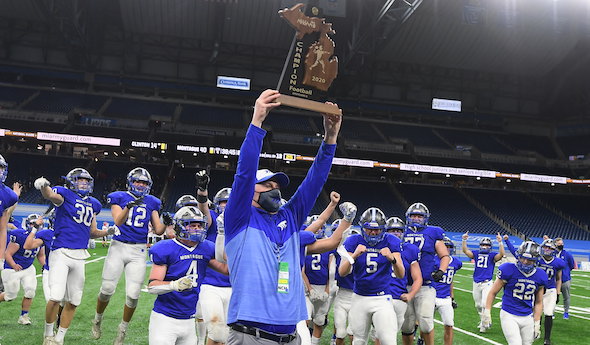
While the postgame press conference was tear free, the Montague sideline was not as the clock ticked down in the final quarter. A program that had come agonizingly close in each of the past two years – losing in the Final in 2018 and losing a thriller of a Semifinal in 2019 – had broken through for the first time since winning back-to-back titles in 2008 and 2009.
“Everybody on this football team, coaches, players, trainers – everybody on this football team loves high school football,” said Drew Collins, the Montague senior quarterback who accounted for five touchdowns on the night. “I love high school football. I love these coaches. I love my friends on the team. I love everybody on the team. I love the community. It’s bittersweet when you win a state championship when you’re a senior because it’s all over.”
Drew Collins, who was The Associated Press Division 5-6 Player of the Year, made the most of his final game in a Montague uniform, throwing for 244 yards and three touchdowns on 15-of-19 passing. He also rushed for 51 yards and two scores.
That led an offensive attack which put up 390 total yards and scored on all but two of its possessions – one of which ended on downs late in the fourth quarter as the Wildcats were attempting to run out the clock.
 “I just think they can do it all,” Clinton coach Jeremy Fielder said. “When you look at their team, look at what they have up front, look at the athletes they have in space, then you put a quarterback on that team, and you put a very experienced team out there, as well. That’s a lot to deal with. They’re a great football team, and I give them a lot of credit; they’re a great program.”
All three of Collins’ touchdown passes went to Sam Smith (nine, 44 and 26 yards), who had five receptions for 96 yards total. Tugg Nichols added five catches of his own for 89 yards, while Dylan Everett had 52 yards and a touchdown on nine carries.
While Montague’s dynamic offense put on a show, it was the defense’s second-half performance that allowed the Wildcats to pull away. Clinton (10-2) trailed 19-14 at the half but had put together a pair of 80-yard drives. The first finished with an eight-yard George Ames run, and was fueled by a long Brayden Randolph run. The other was a clock-killing masterpiece fullhouse backfields are known for and was closed out with a two-yard Bradyn Lehman run.
Each of those drives followed a Montague drive that ended with a touchdown pass from Collins to Smith. The Wildcats took the halftime lead with Everett’s two-yard touchdown run.
Clinton’s first two drives of the second half, however, ended with turnovers – the first on downs, and the second an interception by Montague’s Trey Mikkelsen. The Wildcats turned both turnovers into touchdowns – Collins’ third TD pass to Smith, and a nine-yard Collins TD rush – and started to put the game away. Collins’ final touchdown run of the game, a 23-yarder in the fourth quarter, erased any doubt.
“I thought the coaches did a great job – our staff is phenomenal,” Patrick Collins said. “We did some adjustments. But really, this team is run by the players, and it starts with the seniors. Their determination is what makes a difference. It was about their heart coming out in the second half and finding the energy to stack up to a great Clinton team, honestly. That Clinton team can bring it, and they brought it today.”
Randolph led the way for Clinton in his final game, rushing for 194 yards on 23 carries. He also had eight tackles, while Lehman led the Clinton defense with nine tackles, and Nik Shadley had six.
“We’re fortunate, we have about 15 or 16 seniors, and at our level, you win with seniors,” Fielder said. “We were able to make some key plays at some key times, and I think it was really big for us, too, when we got shut down (for the statewide pause), we had that senior leadership. We had a group of seniors who had won a wrestling state championship together last year, so they’ve been here before. As a coach, you’re looking at these guys in the huddle, and you’re looking at these guys on the sidelines, you know you’re in pretty good shape. We just ran into a team that was outstanding.”
Izac Jarka and Colton Blankstrom each had eight tackles to lead the Montague defense, while Mikkelsen and Alex Waruszewski each had seven.
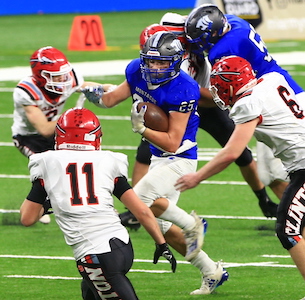
PHOTOS: (Top) Montague celebrates its first Football Finals championship Saturday since 2009. (Middle) The Wildcats’ Samuel Smith breaks through an opening as Clinton’s Bradyn Lehman (6) and others close in. (Click for more from Hockey Weekly Action Photos.)
Divine Child Delivers in Defining Moments to End 40-Year Championship Wait
By
Paul Costanzo
Special for MHSAA.com
November 28, 2025
DETROIT – Marcello Vitti knew his teammates had his back.
After fumbling near midfield with five minutes to play and his Dearborn Divine Child team clinging to a one-point lead, Vitti’s faith was rewarded as the Falcons forced a four-and-out from the Hudsonville Unity Christian offense.
Then he paid them back.
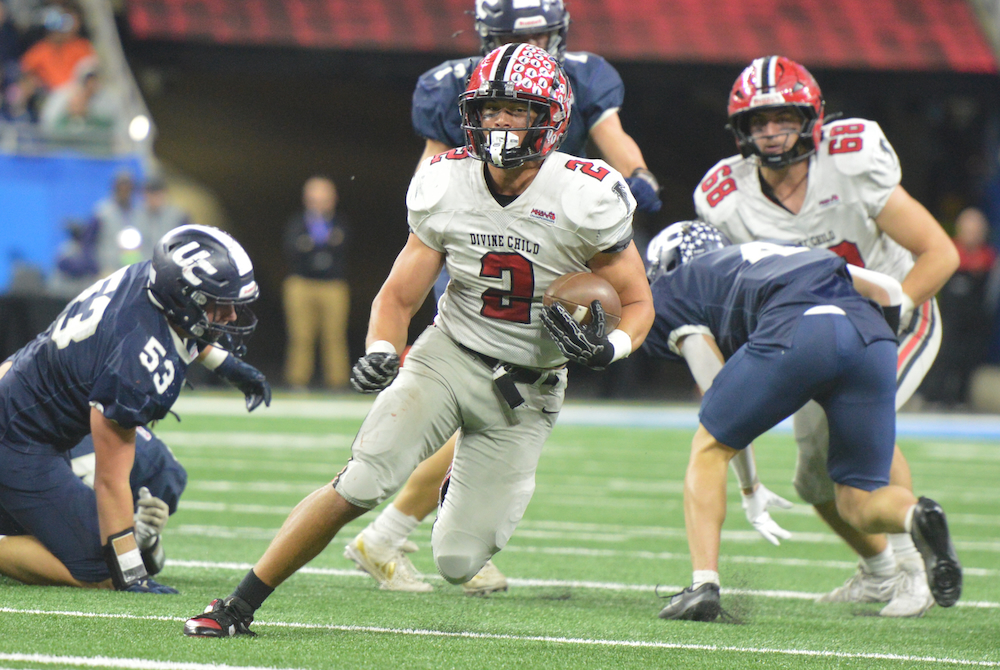
The senior running back rushed for 20 yards and a pair of first downs on the final drive, including the game clincher, as Divine Child picked up a 23-22 victory Friday in the Division 4 Football Final at Ford Field.
“I knew that I was going to have to make plays to win this game,” said Vitti, who rushed for 120 yards and a touchdown. “I fumbled at the end, and I knew that my team’s got my back. This team isn’t good because of me. We have a lot of guys that do their jobs and maybe a little bit extra. There’s so many good guys and good players, Division I, Division II players on our team that they make me that much better.”
The title is the third in program history for the Falcons, and first since 1985.
To win it, Divine Child (13-1) had to survive a back-and-forth battle with several plays that felt as if they could be game-defining in the moment.
Vitti’s fumble felt like it could have been that, as Unity Christian took over near midfield with an offense that had been rolling through the second half.
 The Crusaders (12-2) had gained 205 yards on 35 plays on their first three second-half drives, scoring a pair of touchdowns and getting inside the 5 on the other.
But after the turnover, Divine Child’s defense stiffened up, holding Unity Christian to two yards and forcing a turnover on downs.
“I do want to say, congratulations to Unity Christian,” Divine Child coach Chris Laney said. “I think they replaced 18 starters going into this year, and (coach Craig Tibbe) does a tremendous job; that scheme gives you nightmares. But, I wasn’t the one that coined it, but defense wins championships, and we had a great defense this year. Great defensive staff. The kids bought in, they really checked their egos this year at the door and played within our scheme defensively.”
Divine Child had its lead thanks to a five-yard touchdown rush by Vitti and a 2-point conversion run on which he broke multiple tackles and pushed through several defenders at the goal line with the help of his teammates.
All of that was set up by a toe-tapping catch from sophomore Rayshawn Thomas on the sideline on a pass from fellow sophomore Drew Sheridan. Initially, it was called incomplete, but was overturned on replay.
“To be honest, I thought I had my foot down,” Thomas said. “Then I saw that I had my foot down (on the big screen) and I was like, ‘Oh my God, I caught it.’”
Unity Christian answered with a 10-play, 69-yard drive capped off with a two-yard touchdown run from Jared DeVries.
The Crusaders lined up to kick an extra point to tie the game, but faked it. The pass was intercepted by Divine Child’s Adam Garcia, preserving the one-point lead.
“Silly stuff, isn’t it?” Tibbe said. “I’d like a do-over, for sure. They defended it well. I look at myself, I’m kicking myself, asking, ‘Why did you get so cute?’ Just pound the ball. They hadn’t stopped these guys. These guys had just been tearing it up, then I go and do something like that. So, yeah, I would like a do-over there.”
Tibbe’s offense was strong throughout the game, gaining 332 yards on the ground and averaging five yards per carry. That was led by Lucas Elliott, who had 115 yards, and DeVries, who had 90 yards and a pair of touchdowns, including the game’s first score. Joshua Bremer added 60 yards, and had the fumble recovery in the fourth quarter.
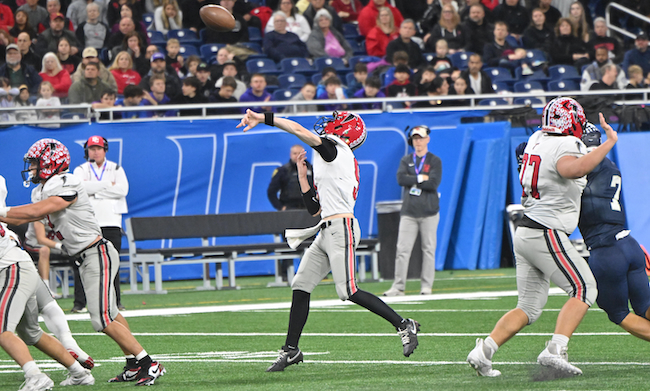 Quarterback Justin Febus rushed for 48 yards and a touchdown, which, following a DeVries conversion run, gave his team a 16-15 lead early in the third quarter.
“I’m super proud of how we hung,” Tibbe said. “The fact that we were right there with this team says a lot about these guys. There’s probably a couple times in this game where it didn’t look great, but they didn’t quit. They kept chugging along.”
The offensive output was needed to keep up with Divine Child’s balanced attack, led by Vitti and Sheridan. The left-handed quarterback completed 13 of his first 15 passes in the game, and finished 19-of-25 for 241 yards and a pair of first-half touchdown throws to Antonio Solares-Vitti. He did it all with his non-throwing shoulder in a brace thanks to an injury suffered in the Regional Final against Harper Woods.
“My mindset, honestly, the past two weeks was do whatever it takes to win,” Sheridan said. “Harper Woods, we didn’t really throw the ball, I got injured. Last week, I made plays when they had to be made. Marcello made plays, Ray made plays, Giancarlo (Vitti), Antonio, they’ve all been making plays for me. So, for me, it’s been about rehabbing and getting better. Today, the mindset was, it was just a next-play mentality. If we don’t have a good play, we had to make up for it the next play. And the guys made plays for me today.”
Solares-Vitti had seven catches for 88 yards, including a big 13-yarder on the final drive. Thomas had four for 64.
Marcello Vitti led the defense with 14 tackles, while Andre Davis Jr. had 12 and Giancarlo Vitti had an interception.
Unity Christian’s defense was led by DeVries’ 10 tackles, while Febus and Jack Portenga each had eight.
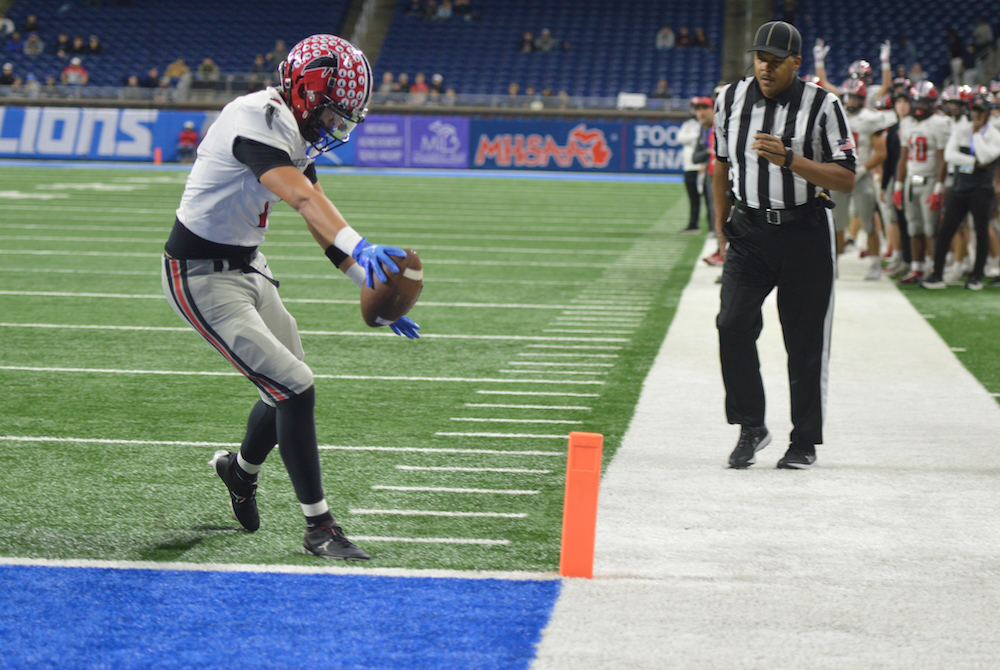
PHOTOS (Top) Dearborn Divine Child’s Marcello Vitti (2) breaks through the line during Friday’s Division 4 Final. (Middle) Antonio Solares-Vitti stretches across the goal line for a score. (Below) Divine Child quarterback Drew Sheridan tosses a pass.