

Multi-Skilled Hines Sparks Milan Charge
September 14, 2018
By Doug Donnelly
Special for Second Half
MILAN – It’s a good thing Tristen Hines doesn’t get tired.
 “Tristen doesn’t want to come off the field, and we don’t want him to come off the field,” said Milan football coach Jesse Hoskins. “He’s that type of player.”
Hines is a 5-foot-11, 170-pound junior already in his third season on the varsity football team for Milan, which is off to a 3-0 start and tied atop the Huron League standings. During the past couple of seasons, he’s played running back, wide receiver and quarterback on offense as well as cornerback and strong safety on defense. He also returns kickoffs and punts.
No matter where he plays, he’s electric.
“The cool thing about Tristen is he doesn’t know how to be lazy,” Hoskins said. “He plays hard and enjoys it. He could play just about any offensive position. He’s a legitimate Division I recruit.”
Early in his career, Hines played mainly just defense for Milan. As a freshman, he made an impact on the Big Reds defense, intercepting seven passes and joining in on 76 tackles. As a sophomore, he moved into more of an offensive role. When the season began he was a wide receiver, but an injury to starting Milan quarterback Dyllan Jones forced Hoskins to put the athletic Hines into the QB spot.
“Our system fits a mobile type of quarterback and Tristen is just that, plus he passes the ball well,” Hoskins said. “This year, with D.J. (Dyllan Jones) returning and Hunter Aeschbacker at running back, we decided to keep Tristen at wide receiver.”
Hines was happy with the move back to wide receiver.
“I think for the team, that is the best position for me,” he said. “I like it better there. I like to go one-on-one with the defender and get out into space. If the defense must pay attention to me, that opens things up for the other guys.”
Hoskins said there are various plays in the Big Reds’ playbook to get the ball into Hines’ hands.
“We have a few wrinkles,” the seventh-year Milan coach said with a smile.
The performance Hines had last week in Milan’s 46-24 win over Flat Rock made Hoskins and the Milan coaches look like geniuses. Hines caught six passes for 201 yards and three touchdowns from his wideout spot, ran for a touchdown and returned a blocked field goal 80 yards for a fifth score.
In three games this season, Hines has 102 yards rushing, 323 receiving, 448 all-purpose yards and eight touchdowns. In Week 2, Hines rushed for one touchdown and had more than 100 receiving yards against Monroe St. Mary Catholic Central. It was a thrilling Milan victory, with the final touchdown coming with less than a minute left in the game.
Milan’s Evan Furtney caught the game-winner from Jones. Hines couldn’t believe the finish.
 “We got the ball with four or five minutes left, which seemed like plenty of time,” he said. “In the huddle, I was like ‘All right, let’s get this down the field.’ But, we kept getting penalties and moving back. Finally, it was fourth down and it was like, ‘somebody has got to make a play.’ … I knew the ball wasn’t coming to me. When D.J. threw it up and Evan came down with it, I just started jumping up and down. That was crazy. I’ve never been in a game like that, where it came down to the final seconds.”
Hines and Furtney are best friends.
“I knew one of us was going to have to make a catch or make a play,” he said. “I was happy for him.”
The Big Reds host Riverview (2-1) tonight in Milan’s first home game of the season.
“It should be pretty exciting,” Hines said. “This year feels a lot like 2016 when we won the league. Last year, we were sort of expecting to be the best team in the league, but with injuries and everything, it didn’t work out.”
Milan did finish 5-5 last year and made the playoffs for the third consecutive season. The Big Reds have a long and prosperous football tradition. They have made the playoffs 17 times over the years and have had some outstanding football players, dating back to University of Michigan and American Football League standout Joe O’Donnell, for whom the Milan football stadium is named.
Hines looks like the next Big Red to play Division I college football. He’s received interest from several Mid-American Conference schools, from the University of Toledo to Eastern Michigan University. The University of Cincinnati has stayed in contact, and recently Indiana and Michigan State University assistant coaches have reached out to him. There are no offers yet, but Hines isn’t worried about that for now.
“I know that will happen eventually,” he said. “I don’t dwell on it. I am focused on my team right now.”
Hines said he’ll probably end up playing cornerback in college.
“That’s where I want to play,” he said. “When I first started football, back in the third grade, I was always on defense. I loved to hit. I think defense is where I’ll be in college.”
Hoskins thinks once one school puts an offer on the table for Hines, there will be a domino effect and other teams will follow. Hines just wants to keep his Big Reds in contention for a Huron League title and a playoff berth.
“I’m just focused on playing football for Milan and winning,” Hines said. “That’s what it is all about. That is what makes football fun, to win.”
 Doug Donnelly has served as a sports and news reporter and city editor over 25 years, writing for the Daily Chief-Union in Upper Sandusky, Ohio from 1992-1995, the Monroe Evening News from 1995-2012 and the Adrian Daily Telegram since 2013. He's also written a book on high school basketball in Monroe County and compiles record books for various schools in southeast Michigan. E-mail him at [email protected] with story ideas for Lenawee and Monroe counties.
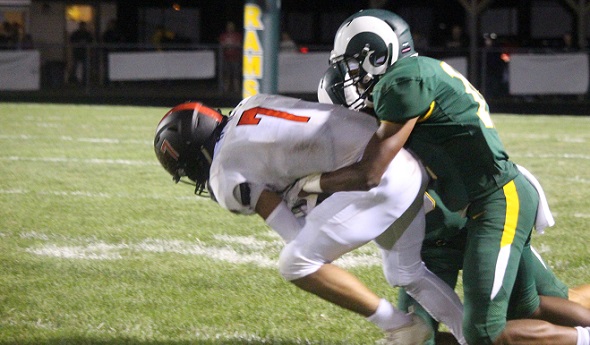
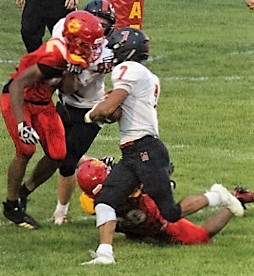
PHOTOS: (Top) Milan’s Tristen Hines pushes forward for another yard during last week’s win over Flat Rock. (Middle) Hines breaks for the end zone during a Week 1 victory at Bridgeport. (Photos courtesy of the Milan football program.)
Drive for Detroit: District Semis in Review
November 5, 2013
By Geoff Kimmerly
Second Half editor
Upsets seemed to fall with the raindrops that unexpectedly cropped up in spurts during the first weekend of the 2013 MHSAA football playoffs.
From Romeo to Dowagiac, Britton-Deerfield to Wayland with Parchment and Bath in between, teams celebrated wins that probably weren't expected by most when the brackets were revealed during the Sunday Selection Show.
A telling stat: While teams with higher playoff points averages host during the first three rounds, nearly 23 percent (31 of 136) of road teams won last weekend.
Here’s a look at the results from each division that stuck out most from the 11-player District openers and 8-player Regional Semifinals:
Division 1
Detroit Catholic Central 35, Northville 14
Detroit Catholic Central (8-2) opened the playoffs against Northville (8-2) for the second time in three seasons and with hopes of again starting off smoothly on a third straight trip to the MHSAA Finals. This opener certainly was closer than the 2011 56-6 DCC win, but the result was the same as the Shamrocks ended an outstanding run by the Kensington Lakes Activities Association overall champion. Click to read more from the Detroit Free Press.
Also noted:
Macomb Dakota 19, Warren DeLaSalle 14: DeLaSalle (6-4) gave Dakota (10-0) its closest game this season and was the first to come within single digits of the Cougars since opening night.
Walled Lake Western 44, Canton 41: Western (9-1) advanced to the District Final for the third straight season but only after holding off a late comeback by Canton (8-2).
Romeo 24, Lake Orion 21: Likely considered an upset because of Lake Orion’s playoff history, there is some back story. In three playoff games during 2005-08, Lake Orion (7-3) beat Romeo all three times by a combined six points – but this time the Bulldogs (6-4) captured a close one.
Brighton 14, Grand Blanc 7: Grand Blanc (7-3) won the KLAA West thanks to a 44-21 win over Brighton in Week 4, but the Bulldogs remain alive after entering the postseason 5-4.
Division 2
Birmingham Seaholm 17, Southfield 16
Seaholm (9-1), the Oakland Activities Association Blue champion, scored twice during the final seven minutes to eliminate OAA White winner Southfield (7-3). The Maples will play in their first District Final since 2001, the last time the team also won nine or more games. Click to read more from The Oakland Press.
Also noted:
Wyandotte Roosevelt 45, Ypsilanti Lincoln 40: Downriver League champion Roosevelt (10-0) outlasted another league title winner, Southeastern Conference White winner Lincoln (7-3).
Midland Dow 30, Fenton 21: The Chargers (8-2) returned to the playoffs for the first time since 2010 and opened by beating Flint Metro League co-champ Fenton (8-2).
Pinckney 14, South Lyon 10: In its first playoff appearance since 2001, Pinckney (7-3) won its first playoff game ever and finished a season sweep of South Lyon (6-4), also its opening-night opponent.
Detroit U-D Jesuit 37, Warren Woods Tower 14: Jesuit’s first winning season since 2002 will continue; the Cubs (6-4) ended quickly the first playoff appearance for Warren Woods Tower (6-4) since 2007.
Division 3
Grand Rapids Christian 14, Grand Rapids Forest Hills Northern 13
The reigning Division 3 champion got a scare from Forest Hills Northern (7-3), which led 13-0 in the third quarter of its first playoff game since 2002. The Eagles (8-2) made an impressive comeback to move on to their fourth straight District Final. Click to read more from the Grand Rapids Press.
Also noted:
Zeeland West 44, Zeeland East 13: The Dux (9-1) received their lone loss from East (5-5) in Week 2, but this one wasn't as close as that six-point defeat.
Byron Center 28, Battle Creek Harper Creek 3: Harper Creek (7-3) made the Semifinals the last two seasons, but were stopped quickly this time by the Bulldogs (7-3).
Wayland 38, Plainwell 28: A year after finishing 0-9 (after three straight ending 1-8), Wayland is 6-4 and knocked out a solid contender in Plainwell (8-2).
Eaton Rapids 49, Charlotte 21: Although Eaton Rapids (6-4) beat Charlotte in Week 3, it was expected by at least a few that the Greyhounds’ first playoff appearance would be a short one since Charlotte (7-3) had won five straight.
Division 4
Dowagiac 21, Edwardsburg 17
Dowagiac has been exceptional over the last three seasons – the Chieftains (7-3) are playing to reach 10 wins for the third straight. But it was hard to see this one coming with Edwardsburg (9-1) undefeated and having beaten Dowagiac 36-0 only two weeks ago to decide the Wolverine B West championship. Click for to read more from the Kalamazoo Gazette.
Also noted:
Belding 21, Spring Lake 20: This spoke to the strength of the O-K Blue, as third-place Belding (7-3) beat Lakes 8 Conference champion Spring Lake (8-2).
Allendale 24, Grand Rapids Catholic Central 21 (OT): Also from the O-K Blue, league runner-up Allendale (8-1) survived a scare from frequent playoff power GRCC (6-4).
Battle Creek Pennfield 21, Paw Paw 17: The Kalamazoo Valley Association was pretty strong too, with Pennfield (9-1) one of three co-champs and the winner in this one over Wolverine B East champ Paw Paw (8-2).
Saginaw Swan Valley 14, Yale 13: Swan Valley’s hope of returning to the Semifinals – and going to Ford Field – nearly ended until the Vikings (10-0) scored the go-ahead points with two minutes to play to escape Yale (6-4).
Division 5
Parchment 40, Jackson Lumen Christi 35
In a weekend full of upsets, this was the one that rang the statewide bell loudest. Parchment has had a nice run in a tough KVA and is 7-3 overall after finishing 3-6 only a year ago. But Lumen Christi had the highest playoff point average in Division 5 by a substantial chunk and was considered a definite contender as it pursued its first MHSAA championship since 1999. Click to read more from the Kalamazoo Gazette.
Also noted:
Reed City 49, Clare 7: The Central State Activities Association champion Coyotes (10-0) continued their dominating play in eliminating Jack Pine Conference champ Clare (7-3).
Millington 28, Almont 21: The Cardinals’ two regular season losses were their most since 2006, but Millington (8-2) is looking strong again after opening with a win over Blue Water Area Conference runner-up Almont (8-2).
Grand Rapids West Catholic 27, Portland 14: This rematch of last season’s Division 5 Final ended the opposite way, with West Catholic (6-4) continuing a five-game winning streak while Portland (7-2) closed with two straight defeats.
Detroit University Prep 42, Clinton Township Clintondale 34: University Prep (8-2) equaled its 2012 record in only its eighth season as a program and handed a first loss to Macomb Area Conference Bronze champion Clintondale (9-1) in one of its best wins during that brief history.
Division 6
Grandville Calvin Christian 14, Grand Rapids NorthPointe Christian 12
These two and Hopkins played to a three-way tie for the O-K White championship during the regular season, which resulted in part because of NorthPointe’s 13-8 win over Calvin Christian (7-3) in Week 3. This time the Squires came out on top in a matchup of teams both looking for their first playoff wins. NorthPointe finished 8-2. Click to read more from the Grand Rapids Press.
Also noted:
Montrose 42, Reese 13: The Rams (10-0) won their 10th game for the third straight season and made it two this fall over solid Reese (8-2).
Shelby 35, Montague 23: Montague (6-4) played West Michigan Conference champion Shelby (9-1) closer than in Week 4, but the Tigers (9-1) bounced back from its lone loss, in Week 9, against Division 4 Spring Lake.
Schoolcraft 28, Niles Brandywine 21: Co-KVA champ Schoolcraft (9-1) hasn't lost in two months, although Brandywine (8-2) gave the Eagles one of their closest games in a while.
Constantine 41, Michigan Center 26: This win over Michigan Center (8-2) gave Constantine (6-4) at least one postseason victory in each of the last 12 seasons.
Division 7
Britton-Deerfield 42, Hudson 28
Britton-Deerfield has made the playoffs all three seasons since its creation from the merging of the Britton-Macon and Deerfield districts. In fact, the Patriots reached the Regional Final in just their second season last fall. But Lenawee County Activities Association co-champion Hudson has reached the MHSAA Semifinals three of the last five seasons and had to be considered a possibility to get back again this month. Click to read more from the Adrian Daily Telegram.
Also noted:
Iron River West Iron County 21, Traverse City St. Francis 7: Given St. Francis’ history of postseason success, this seemed ripe for an upset – but West Iron (10-0) broke away from the Gladiators (5-5) in the second half.
Pewamo-Westphalia 57, Saugatuck 21: The Central Michigan Athletic Conference champion Pirates (9-1) bounced back from their lone loss the week before to finish the season for Southwestern Athletic Conference North winner Saugatuck (8-2).
Bath 27, Elkton-Pigeon-Bay Port 14: This is not only Bath’s first playoff run since 2000, but first winning season since that fall – and the Bees (6-4) continued with a stunner against Greater Thumb Conference West runner-up Laker (7-3).
Madison Heights Bishop Foley 42, Royal Oak Shrine 10: A Week 3 loss to Shrine (6-4) got Bishop Foley off to a rough start in the Catholic League Intersectional, but the Ventures (7-3) scored their second-most points of the season in this rematch.
Division 8
Detroit Allen 54, Adrian Lenawee Christian 32
Detroit Allen (7-2) built on its first playoff berth with its first playoff win, ending a similarly historic season for Lenawee Christian – the Cougars set a team record for wins in finishing 7-3. Both programs have been in existence for only six seasons, and this fall Allen finished second to much larger River Rouge in the Michigan Metro Athletic Conference. Click to read more from the Adrian Daily Telegram.
Also noted:
Waterford Our Lady, 34, Clarkston Everest Collegiate 7: These two previously were one as a co-op team before splitting this season; Our Lady (8-2) will move on while Everest (7-3) finished an impressive first season on its own.
Powers North Central 35, Munising 21: Although Munising (6-4) made the playoffs for the second time in three seasons, neither of these teams has much recent postseason history – but Powers (8-2) made its own with this first playoff win.
Crystal Falls Forest Park 30, Bessemer 16: The Trojans (10-0) beat the Miners (6-4) for the second time in three weeks and have 10 wins again for the first time since 2010.
L’Anse 52, Lake Linden-Hubbell 34: The Purple Hornets (8-2) bounced back from a Week 9 loss with their most points of the season to outlast one of the best offensive performances as well by Lake Linden-Hubbell (5-5).
8-Player
Engadine 28, Cedarville 26
Perhaps a little under the radar, Engadine has been arguably the hottest team in 8-player football with five straight wins after beginning this season 1-4. The Eagles’ third loss this fall was 42-16 to Cedarville (8-2) – but in six weeks, Engadine (6-4) found a way to reverse the tide just enough. Click for more from WWTV 9&10.
Also noted:
Peck 32, Deckerville 14: The 8-player champion could come from the Thumb area for the third straight season; in 2012 it was Deckerville (5-5), and Peck (10-0) is looking like a favorite this time.
Carsonville-Port Sanilac 54, Portland St. Patrick 18: The Tigers (7-3) made it two straight wins and two straight over the Shamrocks (7-3) after also beating St. Patrick 45-12 in Week 9.
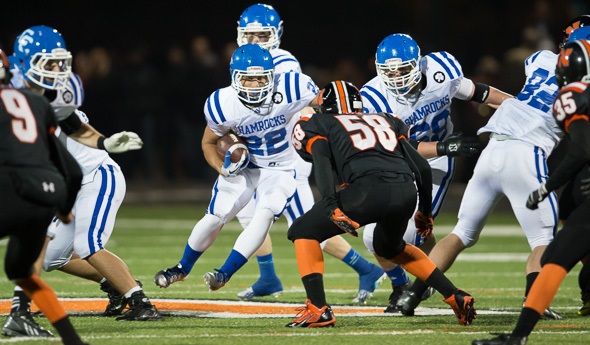
PHOTO: Detroit Catholic Central running back Connor Holton (22) prepares to sprint through a hole in the line while Northville linebacker Jack Ernst works to stop him. (See more at Terry McNamara Photography.)