

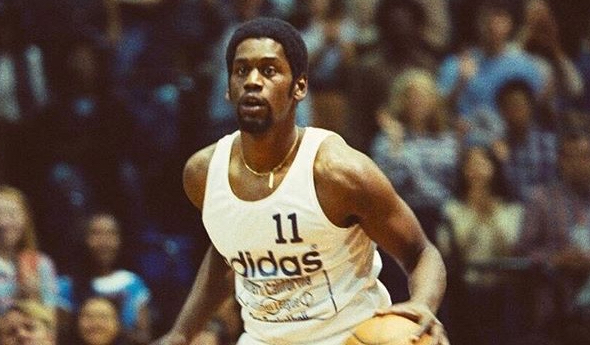
Muskegon Grad Casts 'Magic' in HBO Series
June 15, 2020
By Tom Kendra
Special for Second Half
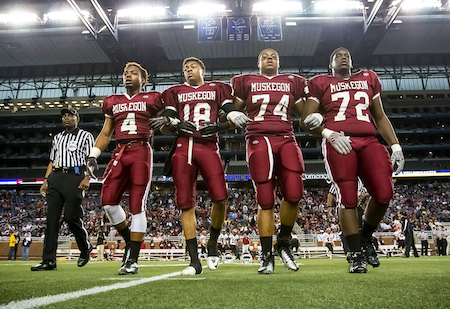
The last time many people saw Quincy Crosby was during his final high school football game at Ford Field back in 2012, when the 6-foot-3, 280-pounder was a senior captain for Muskegon High School.
 Chances are most didn’t notice him, since he was doing the unheralded dirty work as the starting center for the Big Reds, who lost a 35-28 heartbreaker to Bloomfield Hills Brother Rice that day in the MHSAA Division 2 Final.
The next time many see Crosby, he will be front and center, and impossible to miss, showing off an entirely different skill set.
Crosby, 24, has transformed from bruising lineman to up-and-coming Hollywood star, who last year landed a dream role as Michigan’s own Earvin “Magic” Johnson in the upcoming HBO series focusing on the Los Angeles Lakers’ “Showtime” era of the 1980s.
“I’m just a kid from Muskegon; now I’m playing Magic on a TV show. How cool is that?” said Crosby, who played football and was a theater major at Kalamazoo College after his prep days. “I guess this is the big break I’ve been waiting for my whole life. Every part I didn’t get was worth it to get this one.”
The show, which is being produced by former Lakers standout Rick Fox, was originally titled “Showtime.” But that name was scrubbed when it was picked up by HBO, a competing network with Showtime. Right now, the series is referred to by the generic, “Untitled Lakers Project.”
The one-hour limited series drama is based on Jeff Pearlman’s book “Showtime: Magic, Kareem, Riley, and the Los Angeles Lakers Dynasty of the 1980s.” The Untitled Lakers Project is described by HBO as a fast-break series chronicling the professional and personal lives of the 1980s Los Angeles Lakers, one of sports’ most revered and dominant dynasties—a team that defined its era, both on and off the court.
The series features some big names, including John C. Reilly as Jerry Buss, Solomon Hughes as Kareem Abdul-Jabbar and Jason Clarke as Jerry West. In the cast list, Crosby goes by his stage name of Quincy Isaiah – which are his first and middle names, respectively.
The series was expected to debut this month to coincide with the NBA Finals, but production delays due to Covid-19 and the suspension and uncertainty of the NBA season have pushed that tentative starting date back to June, 2021.
The delay hasn’t kept Crosby off Cloud 9.
Crosby landed the part in early June of last year, and in the days following that announcement, he went to Game 5 of the NBA Finals, where Fox introduced him to celebrities like Jalen Rose, Jerry West and Common. Then he hung out in Las Vegas for some NBA summer-league games, where the stargazing continued. He has yet to meet Magic, but expects that to happen soon.
“Everyone is telling me this is a game-changer, that this is going to be huge,” Crosby said. “I’m just so thankful for the opportunity.”
Catching the bug
Muskegon High School football coach Shane Fairfield wasn’t surprised to learn that his former team captain and three-year varsity player had earned a leading role in a television show – but as a basketball star?
“I said: ‘Basketball? You ain’t got no game!” Fairfield said with a laugh. “But the reality is, that role was kind of made for him. Quincy has that charisma and that big, amazing smile, just like Magic.”
Crosby’s transition from one of the “Brothers of Destruction” on the Big Reds’ offensive line to thespian actually began a few months after that crushing loss to Brother Rice.
 That game started Muskegon’s incredible run of seven football Finals appearances in eight years, and the Big Reds have the winningest program in state football history and rank No. 7 in the nation with 859 wins (dating back to 1895). But the school had not been able to put on a spring musical in more than 20 years due to budget cuts.
But that spring, in a stroke of fortune, the school was selected in NBC’s 2013 “Smash” Make A Musical contest and awarded funding to put on the classic musical, “Thoroughly Modern Millie.”
Crosby said theater director Karli Baldus talked him into trying out for the show, and he landed the comical part of Ching Ho.
“I caught the bug, big time,” Crosby recalled with a laugh. “I thought it was the best thing.”
He also noticed parallels right away with football, with both requiring hours and hours of practice and repetition in preparation for game time – or show time.
“When I was playing football, I wouldn’t be able to think about anything else and I would just get zoned out on what I had to do on the line,” said Crosby. “It’s the same thing in acting. You practice until you know it by heart, and then you get out there and just let it go. Acting is all instincts.”
Crosby took acting classes at Kalamazoo, but due to football, never had enough time to be part of the big productions.
That all changed after performing a sketch in his television production class his junior year. He got pulled aside by his professor, who told Crosby he saw major acting potential in him and encouraged him to get more involved his senior year.
That heartfelt plea led Crosby to not only quit the football team after three years as a starter on the offensive line, but also to change his major from business to theater. He then blossomed on the stage his senior year, working behind the scenes in the fall production of “The Rocky Horror Picture Show” before earning major roles of Walter Lee Younger in “Raisin In The Sun” and Benny in “In The Heights.”
Finding the Magic
Shortly after graduating from K-College in 2017 with a theater degree, Crosby made his way to Hollywood to pursue his acting dream, only to find it was a bumpy road – to say the least.
Crosby was able to land small roles in short productions like “Corporate Coffee” and “Anomaly,” but his bid for major roles was met by rejection after rejection.
In those moments, he said, his background as an offensive lineman at Muskegon got him through.
“I learned to embrace the grind playing football at Muskegon,” said Crosby, the son of Delores Crosby and the late Gregory Crosby, who died when Quincy was just 3 years old. “You know, being an offensive lineman helped too. You get blamed when things go wrong and none of the praise when things go right, so you learn to just stay in your bubble and grind.”
 His Hollywood experience nearly ground to a halt in early 2019, and he was about to enlist in the Navy when his agent and fellow Muskegon native Terrance Williams helped him land the audition that would change his life.
Ironically, he didn’t even get a script until the day of the audition and while others had memorized their lines, Crosby read directly from the script. He still landed a callback for the lead role of Magic and, six days later, he was ready and brought his “A game.”
“Walking out of the callback, the casting director told me to keep my phone close because that was a really good audition,” said Crosby.
The only thing left was a basketball audition with Fox in a high school gym, which clinched the role, Crosby said.
Fox and Crosby then started making the Hollywood rounds before shooting the pilot in October, after which the series was picked up by HBO in November. After a lengthy delay due to Covid-19, the plan is to shoot the first year of the series this fall, starting when Magic was drafted by the Lakers out of Michigan State in 1979.
One benefit of the delay is that it has given Crosby time to watch reams of old Magic footage and try to capture his nuances – on and off the court.
“The good thing about playing Magic is that there is so much video and footage of him out there,” said Crosby. “There’s so many things I’ve picked up – the way he walks and the way he always says ‘right’ after sentences. I’m getting better and better at it.”
Meanwhile, back in Muskegon, the Big Reds’ coaching staff is continuing its year-round quest to get more players into college and prepared for life after high school. Fairfield said he can’t wait to have his team watch the Lakers series and see one of their own in a starring role.
“Quincy is an example to our kids that there are so many avenues to success,” Fairfield said. “Making the NFL is one-in-a-million. What we emphasize is that you take what you learn here – hard work, discipline, perseverance, humility – and you apply it to anything you want to do in life.”
This is the first installment in a weekly summer “Made in Michigan” series catching up with this state's past high school athletes as they continue their stories.
 Tom Kendra worked 23 years at The Muskegon Chronicle, including five as assistant sports editor and the final six as sports editor through 2011. E-mail him at [email protected] with story ideas for Muskegon, Oceana, Mason, Lake, Oceola, Mecosta and Newaygo counties.
PHOTOS: (Top) Quincy Crosby plays Magic Johnson in an upcoming HBO series. (Middle) Crosby, now seven years after graduating from Muskegon High. (Below) Crosby, far right, heads to midfield with his teammates for the coin flip before the 2012 Division 2 Final at Ford Field. (Top and middle photos courtesy of Quincy Crosby. Below photo by Tim Reilly.)
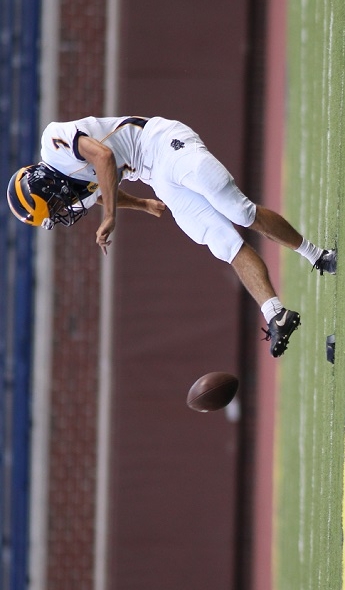
Clarkston Surges by Kicking it Forward
By
Tom Markowski
Special for Second Half
October 27, 2016
CLARKSTON – Coach Kurt Richardson held a disdain for kickers. He didn’t trust them. He contends that a poor kicking game cost his Clarkston football team the 2000 Division 1 Semifinal, a 17-15 loss to eventual champion Grand Ledge.
 Three years before, Clarkston had lost one-point games to Rochester (20-19) and Troy (21-20) that cost the Wolves an opportunity to play in the playoffs. Again, the kicking game had let him down.
“We didn’t have kickers,” Richardson said. “We made kickers. We tried a soccer player once back then, and it didn’t work.”
Enter the Breen brothers, Andrew and Ryan. Andrew Breen was Clarkston’s kicker in 2003. Ryan Breen followed and was the kicker in 2005 and 2006. Maybe it’s a coincidence, but Clarkston hasn’t missed the playoffs since 2002. You won’t get Richardson to say that.
Andrew Breen went on to kick for Tiffin University (Ohio), and every place-kicker since has gone on to college as a kicker – including his brother, Ryan, who went to Penn State.
The others include Alex Barta, who went on to kick for the U.S. Naval Academy. Then there’s Shane Hynes, the place-kicker on the 2013 Division 1 championship team, who is currently Kent State’s place-kicker. Alex Kessman was the place-kicker on the 2014 Division 1 title team, and he’s at Pittsburgh after graduating from high school this past June.
Zach Mansour is Clarkston’s place-kicker this season. And although he hasn’t decided what college he will attend next year, rest assured Mansour will be on a roster somewhere, whether it’s at the Division I level or below.
“Andrew kind of broke up the ice,” Richardson said. “It’s made a big difference. What also comes out of making field goals and having good kickers is now we’re kicking the ball in the end zone and teams are starting from their 20.”
Ryan Breen doesn’t remember exactly when it happened, but his life changed when he was a freshman at Clarkston High.
Breen and his brother were soccer players throughout their childhood. Then his freshman year his brother was a senior and Clarkston’s kicker, and something clicked. Ryan was just having fun working with his brother, shagging footballs, when he got the urge to try it.
Something clicked for the Clarkston football program as well.
“Coach Kurt realized, after a while, that kicking is so much part of the game,” Ryan Breen said. “He started to trust me my junior and senior years. He’d been let down so much (by kickers). It’s frustrating.
“It opened his eyes that (Clarkston’s) kicking game could be so good.”
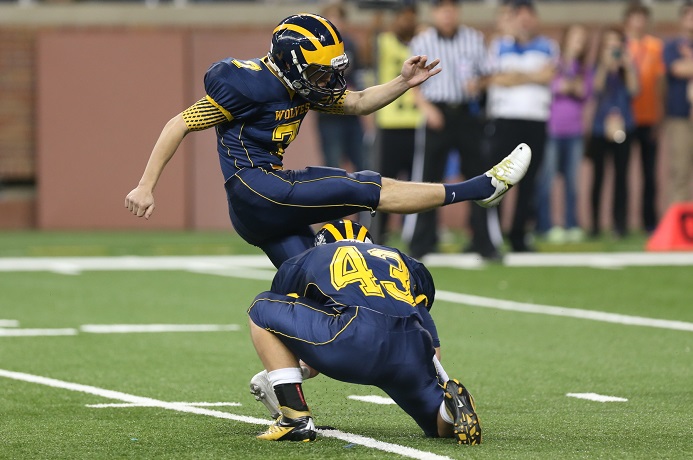 Ryan gives credit to his brother for starting what has become a fraternity of kickers at Clarkston. And it continues today with Ryan Breen giving back – or paying it forward, if you will.
Clarkston is a sports-crazed community with football and basketball taking the lead. The fan support these teams receive is as fervent as any in the Detroit area. When an athlete experiences success at a school like this, often that person is motivated to give back. That’s what Breen has done.
“My brother kind of got me into it,” Ryan said. “We were athletes first. My freshman year I’d help him, chasing the footballs after he kicked them. I figured I’d do it for him. I never thought I’d kick. We never thought we’d kick.”
At first, his experience in college led Ryan to go back to Clarkston and share his expertise with the next kicker in line, Barta.
“I got with Alex and his dad,” Ryan said. “I tried to lend the knowledge I had.”
After coaching as a volunteer, Ryan came on staff at the junior varsity level for three seasons. He was there to start this season, but was forced to leave due to the time commitment he had with his business in Oakland County. He’s hoping that soon, perhaps in a year or so, his business will become less demanding and he’ll return to Richardson’s staff.
But he’s left his mark, and others have picked up his lead. Those who have followed, like Mansour, are reaping the benefits.
Mansour handles the place kicking and kickoff duties for Richardson, and he’s 5 of 7 on field goal tries with a long make of 45 yards. A junior, Jermaine Roemer, is the punter and, at this point, it appears he will replace Mansour as the team’s place-kicker next season.
“I was close with Shane (Hynes) and Alex (Kessman),” Mansour said. “I got a ton of knowledge from them. And Shane learned from Barta. I’m close with Jermaine. And Tristan Mattson is on (junior varsity). I’ll be working with him after the season.
“We’ve gotten so good with our kicking. It puts us ahead of other teams. When I worked with Shane and Alex, they were brutally honest. They’ll break you down. They yelled at me. It’s not to hurt your feelings. It’s all for the game.
“Paying it forward? It’s kind of my job. Jermaine and I developed a good relationship. We’ve had that reputation of having good kickers, and we want to keep it that way.”
 Tom Markowski is a columnist and directs website coverage for the State Champs! Sports Network. He previously covered primarily high school sports for the The Detroit News from 1984-2014, focusing on the Detroit area and contributing to statewide coverage of football and basketball. Contact him at [email protected] with story ideas for Oakland, Macomb and Wayne counties.
PHOTOS: (Top) Zach Mansour kicks off Clarkston's season against Lapeer on Aug. 26 at Michigan Stadium. (Middle) Shane Hynes follows through on a kick during the 2013 Division 1 Final at Ford Field. (Click to see more of top photo from HighSchoolSportsScene.com.)