

Neighbors Rally, Revive 'Community' Stadium
August 31, 2015
By Geoff Kimmerly
Second Half editor
MOUNT PLEASANT – Josh Wheaton stood admiring the Community Memorial Stadium grass a little less than a year ago, and he knew what was coming next.
The weeks of trampling to come would produce the same result as every year beginning in mid-September.
 “I’m looking at it and thinking, I can’t believe a week ago it was exactly the way you’d want your yard to look,” said Wheaton, a varsity assistant coach for Mount Pleasant’s football team. “And now, it’s this. It’s the same every year. I knew it was coming – and by weeks 7, 8, 9, we were going to be playing in a mud pit.”
But less than a year later, as the team prepared for its first game last week, Wheaton and his Oilers – and co-tenant Mount Pleasant Sacred Heart as well – all were enjoying something that defied any expectation: a project pulled off so quickly, it spoke well to the name of the stadium the schools share.
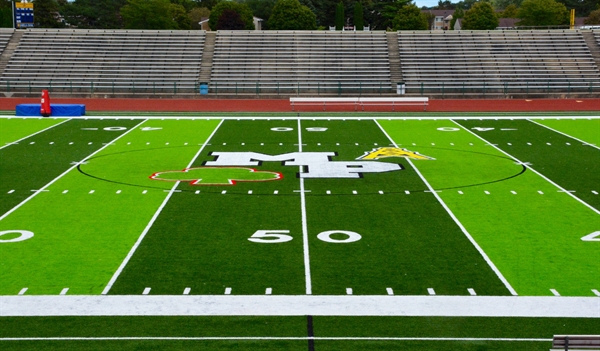
In less than a year, supporters of Mount Pleasant High and Sacred Heart Academy raised $600,000, secured another $300,000 in donated work, and assisted in the transformation of the stadium from an aging landmark built 50 years ago to what should again be one of mid-Michigan’s athletic jewels for years to come.
The schools reopened the stadium Friday for a doubleheader. Sacred Heart fell to rival Beal City in the opener, and Mount Pleasant then defeated Midland Dow to finish a night that saw more than 5,000 fans pass through the new gates and witness the official debut of stunning two-tone green turf that served as the main focus of a renovation that has only just begun.
“It is a community that believes in young people and certainly believes in athletics,” Mount Pleasant athletic director Jim Conway said. “I think being in a college town (with Central Michigan University), there’s that collegiate portion to it where the kids start (here), and many end up matriculating over there. And we sit right here in the middle of the city, and being the shared facility, that is kind of the focal point. We were able to use that and people latched on and wanted to be a part of it, and we’re still going.”
If you rebuild it …
Community Memorial Stadium opened in 1965 as the shared home of the Mount Pleasant High and Sacred Heart football and track and field programs. Prior to its construction, the programs had a variety of homes – CMU’s Alumni Field for the Oilers and at times the Irish, who also played at Fancher Field and at Island Park going back to at least the mid 1930s.
The new stadium construction was funded solely by the community and opened Sept. 25, 1965, for what ended as a 26-26 tie between Mount Pleasant and East Lansing. The field has remained a point of local pride since, with junior high games and the town’s rocket football teams also taking regular turns on the grass.
 Most weeks during the fall see the stadium host three or four games. But Wheaton said last fall there were three weeks during which 11 games were played.
It’s not that all the activity tore up the field. But it didn’t allow the grass time to regrow after the older kids did their damage on Fridays and Saturdays.
All of that caused Wheaton to casually suggest last fall to Oilers coach Jason McIntyre that the grass should be replaced with synthetic turf. Never will happen, McIntyre responded. That conversation had been had before – including briefly when a bond was passed eight years ago that led to the repair of the locker rooms, concession stand, press box and track at the stadium – and talks about going to turf had never progressed past the idea stage.
Wheaton told his boss he’d take care of it, but nothing more was said on the topic for a couple weeks … until someone else brought it up, and McIntyre joked that Wheaton was all over it.
This time, he ran with it.
In October, Wheaton formed a committee made up of supporters of both schools. They decided they would need to raise all of the money for turf over six months – by April 1 – and split into sub committees to handle fundraising and construction.
“When I first heard about it, I was a little skeptical,” said Sacred Heart athletic director and football coach Rick Roberts, who like McIntyre is a second-generation football coach in the 26,000-resident town and has led his program for 23 years.
“I wasn’t sure we could raise that much money in that short of a time; the economy isn’t the greatest at the moment. But when I went to a meeting, and saw the energy that was around the table, I knew it was going to happen.”
Pillars of the Community
Mount Pleasant High is a Class A public school with about 1,070 students. Sacred Heart is a Class D Catholic school with about 140 enrolled. In those ways, they couldn’t be more different.
But kids at the schools grow up playing Little League baseball or youth basketball together, and a number of Mount Pleasant High families attend Sacred Heart Parish.
 And there was plenty of work for all to do, and do quickly.
With money rolling in, the old grass field would need to be dug out to eight inches below the surface. Materials would need to be brought in to refill the base where the synthetic surface would be laid.
Pennsylvania-based ProGrass did the turf work, but the rest was done with local hands and equipment.
Wheaton made contact with the Isabella County-based Morey Foundation, which pledged to match $200,000 in donations from the community. Committee member Doug Moore is a president with Fisher Companies, which does concrete and asphalt work as well as construction transportation in mid-Michigan, and his company contributed much of the $300,000 in in-kind work.
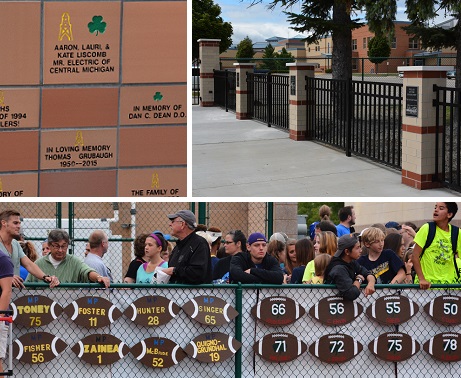
McGuirk Sand-Gravel, which had also contributed when the stadium originally was built, hauled out the old field, while Malley Construction built the concrete curbs and long jump pits. Contractor Eric Borodychuk constructed the new entrance. Straus Masonry continues to build the wall of bricks and pillars purchased by donors, and other volunteers landscaped the hill near the front gate.
“If you don’t have those kind of people in your community, this doesn’t even get off the ground,” Wheaton said.
“We thought that was there,” Conway said of the support. “This is proof.”
Still work to do
Oilers senior Zach Heeke remembers teammates turning ankles on the old practice fields in holes left over from shot put tosses the previous spring.
Those are more or less a memory now – the varsities for both schools practice daily at the stadium, sometimes splitting the field down the middle. The subvarsity teams still practice on other fields, but the track and field throwing areas are inside the stadium as part of the new construction.
 Heeke is more connected to athletics than a typical high schooler – his dad Dave Heeke is CMU’s athletic director – and Zach appreciates greatly what’s gone into his team’s new home field.
“It’s an honor, for sure. It gives us a lot of motivation,” Heeke said. “All the people who donated money to have this happen, we have to show them that we’re good enough and we want to play here, and we’ve got to play for them. It’s awesome to think of all the people who come to our Friday night games, and maybe they’re not showing up in the stands, but they’re on the wall and they’re thinking about us.”
Two members of the original 1965 stadium committee attended a celebration of the new field Thursday. Roberts, who remembers the stadium’s initial construction, believes the original contributors who have since died would be “thrilled” with how the current community has taken up their work and improved upon it.
Bricks and pillars continue to be sold, for as little as $250 and as much as $25,000, as part of the Pillars for the Community fundraising group the renovation committee set up. That money will fund a phase two that likely will include replacing original concrete and possibly adding new bleachers. Both schools are contributing together annually to a fund that will allow for the necessary regular maintenance and then replacement of the turf in 10-12 years.
“(The committee) all wanted the same thing. And when you get a bunch of ex-athletes in a room who all want the same thing for kids in the community, it goes pretty well,” Conway said.
“It’s just been a Mount Pleasant family, if you will."
 Geoff Kimmerly joined the MHSAA as its Media & Content Coordinator in Sept. 2011 after 12 years as Prep Sports Editor of the Lansing State Journal. He has served as Editor of Second Half since its creation in Jan. 2012. Contact him at [email protected] with story ideas for the Barry, Eaton, Ingham, Livingston, Ionia, Clinton, Shiawassee, Gratiot, Isabella, Clare and Montcalm counties.
PHOTOS: (Top) The Community Memorial Stadium turf includes the logos of both its home teams, the shamrock for Sacred Heart and the oil derrick for Mount Pleasant High. (Middle top) Supporters have given to the stadium and the schools' players in multiple ways, from buys bricks and pillars to hanging signs. (Middle below) Sacred Heart runs a play against Beal City during Friday's game. (Bottom) Mount Pleasant High and Midland Dow players warm up before their game Friday night.
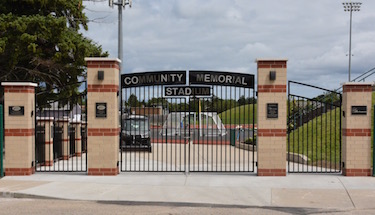 A new gate at the north entrance welcomes fans to Mount Pleasant's Community Memorial Stadium. The gate is anchored by pillars highlighting some of the project's largest donors.
 The parking lot-side of the stadium pressbox, like field below, includes banners of both teams that share the field.
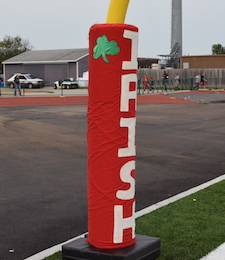 The uprights are padded specific to the team on the field; red for Sacred Heart's Irish and dark blue for Mount Pleasant High's Oilers.
 More than 5,000 fans filled the stadium for Friday's doubleheader, these mostly supporters of Mount Pleasant High after the Sacred Heart game against Beal City had ended.
A Game for Every Fan: Week 7
October 7, 2015
By Geoff Kimmerly
Second Half editor
We're at the point every football season when conference champions begin to be crowned. But for the Week 7's schedule to fall together like this is nearly inconceivable.
Fifteen leagues statewide will feature matchups of teams tied for first place, with five more conferences bracing for tilts between first and second-place teams that could have immediate title implications.
Many of those games are discussed in detail below; all are tonight unless noted. Check MHSAA Score Center for results as they come in, updated standings and playoff-point averages.
Bay & Thumb
Almont (6-0) at Algonac (6-0)
What gives this matchup the slight edge in intrigue over undefeated teams facing off in the Saginaw Valley League (see below)? This is shaping up as arguably the most meaningful game in Algonac football history. The Muskrats’ perfect start is earning attention statewide and is a great story after the team went 1-8 a year ago and last had a winning record in 2005. But a league title, clinched tonight, would be the team’s first since 1972 – and standing in the way is reigning champion Almont, which hasn’t lost in the Blue Water Area Conference since Week 4 of 2013.
Others that caught my eye: Lapeer (6-0) at Midland (6-0), Vassar (5-1) at Unionville-Sebewaing (5-1), Detroit Cesar Chavez (4-2) at Mayville (4-2), Sterling Heights (5-1) at Marysville (4-2).
Greater Detroit
Canton (5-1) at Plymouth (5-1)
Plymouth’s championship-contending golfers this fall could land a ball at Canton in two strokes, these schools are so near to each other. And their last seven football meetings have been about that close too, all decided by 12 points or fewer. The Wildcats own a share of the Kensington Lakes Activities Association South title by way of Canton’s loss last week to Livonia Churchill – but the reigning champion Chiefs can grab a share as well by extending a current winning streak against Plymouth to three.
Others that caught my eye: Berkley (5-1) at Birmingham Groves (6-0), Farmington Hills Harrison (5-1) at Farmington (4-2), River Rouge (6-0) at Pontiac Notre Dame Prep (5-1), Warren Mott (5-1) at Sterling Heights Stevenson (5-1).
Mid-Michigan
St. Johns (5-1) at DeWitt (6-0)
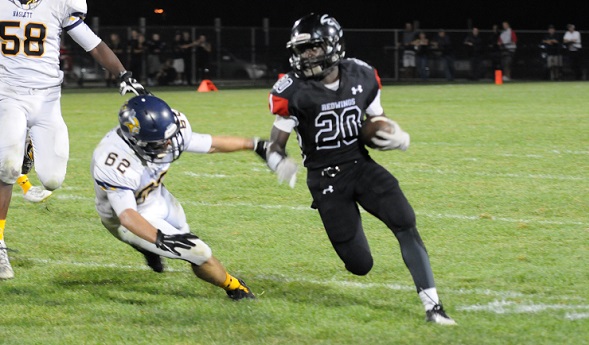
These neighbors are meeting to decide the Capital Area Activities Conference Red title for the second straight season, with DeWitt the reigning champion thanks to last year’s 16-10 victory. The Panthers have won five straight against the Redwings and won’t have trouble drumming up enthusiasm despite coming off facing its other rival, Haslett, last week. The Redwings have lost only to one-loss Grand Rapids Catholic Central, in Week 2, and feature speedy MHSAA track champion Steven Linton in the backfield and a defense that could slow this game down substantially.
Others that caught my eye: Sanford Meridian (6-0) at Harrison (5-1), Howell (5-1) at Brighton (5-1), Vestaburg (5-1) at Mount Pleasant Sacred Heart (3-3), Pewamo-Westphalia (6-0) at Laingsburg (5-1).
Nothern Lower Peninsula
Harbor Springs (4-2) at Frankfort (5-1)
Most of the best up north this weekend are nonleague matchups, but Harbor Springs could make some noise in the Northern Michigan Football League Legends division as it seeks to guarantee its best finish since 2000. The Rams earned an impressive victory last week over 4-2 Indian River Inland Lakes and have won two of the last three against Frankfort – which is first in the Legends and undefeated since opening night. The Panthers have given up 35 points total.
Others that caught my eye: Lincoln Alcona (5-1) at Johannesburg-Lewiston (5-1), Oscoda (4-2) at Hillman (5-1), Gaylord (5-1) at Petoskey (4-2), Maple City Glen Lake (4-2) at Traverse City St. Francis (6-0).
Southeast & Border
Monroe St. Mary Catholic Central (6-0) at Milan (5-1)
St. Mary hasn’t given up more than seven points in a game since Week 3 as it’s cruised during the first two-thirds of its Huron League repeat pursuit. But Milan arguably has been more impressive; the Big Reds, who won the league in 2012 and 2013, are a one-point loss to 5-1 Marshall on opening night from a perfect record this fall – and after losing to the Falcons 43-0 last year, would love to break St. Mary's 11-game winning streak.
Others that caught my eye: Ottawa Lake-Whiteford (5-1) at Morenci (5-1), Ann Arbor Skyline (3-3) at Ann Arbor Pioneer (5-1), Hudson (3-3) at Ida (6-0), Chelsea (6-0) at Ypsilanti Community (3-3).
Southwest Corridor
Watervliet (5-1) at Delton Kellogg (5-1)
This is the product of the reconfigured Southwestern Athletic Conference, which added teams – including Delton Kellogg – from the former Kalamazoo Valley Association this fall and split into three divisions. The SAC Lakeshore division has provided an extra boost to a Delton program that hasn’t made the playoffs since 2001 but has upped its win total three seasons running. Watervliet is a little more used to this with three 10-win seasons over the last four, but this fall both teams are in similar position – both one-point losses from perfection.
Others that caught my eye: Mattawan (3-3) at Battle Creek Central (3-3), Parchment (4-2) at Berrien Springs (6-0), Plainwell (4-2) at Edwardsburg (6-0), Portage Northern (3-3) at Portage Central (6-0).
Upper Peninsula
Negaunee (6-0) at Ishpeming (5-0)
Ishpeming has won 37 of its last 38 regular-season games. The only team to beat the Hematites? Negaunee, back in 2012, but the Miners came close in 2013 and remain Ishpeming’s toughest annual obstacle despite being shut out 28-0 a year ago. Ishpeming is coming off an open week and has had a little extra time to prepare, although a defense that has given up 33 points in five games has looked plenty ready to match a Negaunee offense scoring 41 points per contest.
Others that caught my eye: Calumet (4-2) at L'Anse (4-2), Bark River-Harris (5-1) at Munising (5-1), Iron Mountain (4-2) at Kingsford (4-2), Houghton (3-3) at Lake Linden-Hubbell (6-0) (Sat.).
West Michigan
Grand Rapids West Catholic (4-2) at Comstock Park (5-1)
Most teams would be fine with a 6-5 blip like Comstock Park experienced in 2014 after three seasons with a combined record of 33-6. But the Panthers look like themselves again, with a win over Ottawa-Kent Bronze co-leader Cedar Springs and the only loss to O-K Green co-leader Zeeland West by 10. West Catholic, which won the O-K Green last season thanks to a 47-33 win over Comstock Park, looked like it might be in for an off season after a 1-2 start. But the two-time reigning Division 5 champion has found a source of offense the last three weeks and looks good to make the playoffs for the 13th straight season regardless of what happens tonight. (This game can be viewed live with subscription on MHSAA.tv.)
Others that caught my eye: Byron Center (5-1) at Zeeland West (6-0), Wyoming Godwin Heights (4-2) at Grand Rapids NorthPointe Christian (6-0), Big Rapids (4-2) at Remus Chippewa Hills (5-1), East Kentwood (4-2) at Rockford (4-2).
8-Player
Waldron (6-0) at Battle Creek St. Philip (6-0), Saturday
This has been a history-making season for Waldron, off to its first 6-0 start since 1978 and approaching at least eight wins for the first time since 1984 (its final two opponents, Litchfield and Carsonville-Port Sanilac, are winless). Beating St. Philip would put the Spartans’ run into another echelon. The Tigers’ only losses the last two seasons were three times to reigning 8-player champion Lawrence – and they have a 49-0 win over 4-2 Webberville and a 65-32 win over 5-1 Morrice this fall.
Others that caught my eye: Portland St. Patrick (5-1) at Webberville (4-2), Lawrence (6-0) vs. Prairie Farm, Wis. (7-0) at Madison Middleton, Wis. (Sat.).
PHOTO: St. Johns' Steven Linton (20) turns the corner during a two-point win over Haslett in Week 4. (Click for more from HighSchoolSportsScene.com.)