


New Football Coaches Rise for PCCP Schools
By
Tom Markowski
Special for Second Half
August 30, 2018
CANTON – Athletically, the Plymouth-Canton Community School system is like no other.
 Canton, Plymouth and Salem are the three high schools and all equally share student-athletes, who are randomly assigned to one of the three high schools in seventh grade.
This football season there is an added twist for the football players. All three schools have new varsity head coaches.
Former assistant Andy Lafata has taken over at Canton, while Brian Lewis has taken over Plymouth after leading Ann Arbor Gabriel Richard last season and Justin Reed brings championship experience to Salem after most recently assisting at Warren DeLaSalle and then Livonia Clarenceville.
“We’re finding out as coaches that the seniors don’t care that there is a new coach,” Lafata said. “There are goals that are attainable. They have high expectations. They don’t care who’s coaching. They want results.
“Plymouth (as a school district) has high expectations. It doesn’t matter (who the head coach is). What you learn is the kids are still the same. And we owe it to them to be the best coaches we can be.”
Two started 1-0 last week, Plymouth downing Livonia Stevenson 35-11 and Salem defeating Wayne Memorial 23-14. Canton opened with a 35-21 loss to Livonia Churchill.
Athletes’ expectations may be the same at all three schools, but as noted, the district is unique. Without being specific to the point of confusing, here’s the nutshell on how PCCS students are assigned to a high school:
As noted above, students entering seventh grade in the district are assigned at random, by computer, to one of the three high schools. It doesn’t matter where they want to study or whether they want to play football at Canton or softball at Plymouth or soccer at Salem. A student’s name is in the computer, and the selection process plays no favorites. If a student transfers into the school system, that student also has a 33 percent chance of attending any of the three schools.
Individual classes, however, can be a mix of students from all of them. It’s common for a student at Plymouth to have algebra classmates from Canton or Salem. You could have a student sitting next to you, and on Friday that same student could be doing his or her best to tackle you in the open field. All three high schools are located on the same campus, so classrooms are equally accessible to students from all three.
 Still with me? In addition there is just one marching band that represents all three schools – and the only time it plays during a football game is during homecoming for each.
Back to football. Of the three programs, the players at Canton might appear to have the easier time adjusting to the new coach. Lafata is a 2005 graduate of Canton and spent the last 10 seasons as an assistant coach under Tim Baechler, who retired as head coach following last season's 10-2 finish. Lafata was the starting center on the 2005 team that, with Baechler at the helm, reached the school’s only MHSAA Final – losing to Rockford, 31-21, in Division 1.
Reed, Salem’s new coach, is leading a program for the first time. His previous coaching experience, seven years in all, was split as an assistant between four schools – Royal Oak, Sterling Heights Stevenson and Warren DeLaSalle and, most recently, at Livonia Clarenceville in 2017. The Rocks finished 5-5 last season.
At 29, Plymouth’s Lewis is the youngest of the trio, but he does have experience as a head coach after leading Ann Arbor Gabriel Richard in 2017. Plymouth is coming off a 4-5 season, and his Gabriel Richard team was 7-3.
Lafata, 30, also benefitted by being hired in February. Reed was hired in early June, Lewis a few weeks later.
“To tell you the truth, having three schools on campus is unusual,” Lewis said. “We just focus on ourselves. The other things that happened (in the district) doesn’t affect us. The challenge for me, (Plymouth) is bigger than Richard. The bigger challenge is, I’m an east-sider. I have to learn the different nuances of how they run things here. It’s a work in progress. I have great administrative support. I’m hitting the ground running.”
Lewis was wise to surround himself with coaches who have experience at the high school and college levels. One important hire was his father Mike Lewis, a longtime defensive coordinator at DeLaSalle and Detroit Catholic Central, Mike’s alma mater. Lewis also lured Mike Mach away from Catholic Central where his father, the legendary Tom Mach, coached for 41 seasons. Cory Zirbel, a former University of Michigan offensive lineman, is also on the staff. Zirbel coached with Rich Rodriguez at Arizona.
Lewis played football at DeLaSalle and then cut his coaching teeth at his alma mater, Michigan, as an offensive analysist – or what Lewis termed as a sort of graduate assistant, from 2012-14. When Brady Hoke was fired as U-M’s head coach, Lewis decided to place his family (he has a wife, Teddi, and a 1-year-old child, Evelyn) above a potential college coaching career as he pursued teaching and coaching at the high school level instead.
Reed, 34, spent his first three seasons as an assistant at Royal Oak before going to DeLaSalle under Paul Verska, and he helped the veteran coach win the Division 2 title in 2015. He’s been working toward this kind of opportunity.
 “To have your own program, for the first time, the hardest thing is to convince the community that it’ll work,” he said. “For Andy it’s different. It’s a carryover.
“It’s a positive atmosphere here. They’re craving for success. We’re adding kids all the time. I got my 35th player (on varsity) the day after our first scrimmage. We have a freshmen team, too. They didn’t have one last year. It’s invaluable. It was a lot of work. I was kind of like a salesman.
“It’s an exciting time. For all three of us.”
Lafata, by all accounts, was the right person at the right time to replace Baechler. The retired coach had built the program into not only one of the best in the Detroit area, but one that competed well throughout the state. Since 1999, Canton has made the playoffs every season but one. The Chiefs came within one play of reaching the Finals a second time but lost to Detroit Cass Tech in a 2015 Semifinal, 48-41.
“Last year we knew every week was a special week,” Lafata said. “We all knew Tim would leave once his son (Lou, a linebacker) graduated. It was like being a senior when you knew this would be the last year that this group would be together.”
Lafata also is the offensive coordinator, a position he held under Baechler. Don’t look for Lafata to change the way Canton plays, especially on that side of the ball. The Chiefs will continue to run the full-house, T-formation with double tight ends and on occasion slip a receiver out wide with one of the three backs on a wing.
“Canton stays Canton,” he said. “We coach what we know.
 Tom Markowski is a columnist and directs website coverage for the State Champs! Sports Network. He previously covered primarily high school sports for the The Detroit News from 1984-2014, focusing on the Detroit area and contributing to statewide coverage of football and basketball. Contact him at [email protected] with story ideas for Oakland, Macomb and Wayne counties.
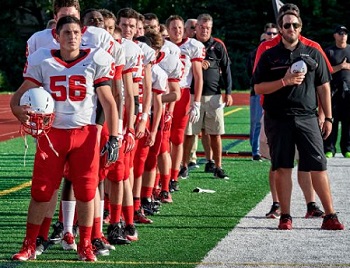
PHOTOS: (Top) Clockwise from left: Salem coach Justin Reed, Canton coach Andy Lafata and Plymouth coach Brian Lewis. (Middle) Lafata stands for the national anthem with his players. (Below) Salem players celebrate last week during a win over Wayne Memorial. (Photos submitted by respective athletic departments.)
1st & Goal: Playoff Week 1 in Review
November 2, 2020
By Geoff Kimmerly
Second Half editor
This already-unusual 2020 football season introduced the first nearly all-in football playoffs this weekend with plenty of new in terms of format – but also a lot of the unpredictability we expect from this time of year.
For the first time, with fields doubled, 11-player teams were placed in eight-team Districts and 8-player teams in eight-team Regionals. And going by seeds, 35 games were upsets, including two by No. 8 seeds over No. 1s, four by seven seeds over No. 2s and 13 by six seeds over No. 3s.
There also were 66 rematches of regular-season games – with 13 different winners the second time around.
Below is a glance at results that intrigued the most from this first playoff week. Historical context is based in part on data at Michigan-football.com.
8-Player
Division 1
HEADLINER Rochester Adams 39, Rochester 7 Their Week 1 game didn’t happen, of course, and Rochester (6-1) went on to its first perfect regular season since 1993. But Adams (3-4) ran its winning streak over its rival to 23 with its best scoring output of the season. Click for more from the Oakland Press.
District Digest Novi 41, Brighton 27 Their opening night meeting was canceled, with the Bulldogs (4-3) getting the forfeit win. Before that, Brighton had won seven of their last eight matchups with the Wildcats (3-4) – with Novi’s win during that string coming in the 2016 playoffs. Grand Blanc 28, Lake Orion 14 The Bobcats (6-1) claimed their first playoff win since 2012, guaranteeing their best record since 2017 and in three fewer games than both of the last two seasons. Dearborn 20, Monroe 15 The Pioneers (3-4) joined Novi among No. 6 seeds that upset No. 3s, giving up their fewest points since the season opener. Monroe did finish 4-3, a win better than 2019. Romeo 20, New Baltimore Anchor Bay 6 Romeo was another No. 6 seed to prevail, but Anchor Bay (4-3) still had plenty to celebrate this fall with a three-win improvement and league title.
Division 2
HEADLINER Oak Park 35, Grosse Pointe South 27 The Knights (1-6) couldn’t have picked a better moment to have their best of the season, winning their first game and scoring nearly half of their points for this fall in front of a FOX Sports Detroit audience. Oak Park was the eighth seed in the District and had put up only 45 points heading into the game. Grosse Pointe South (4-3) finished its season with two of its losses by eight points or fewer. Click for more from the Detroit Free Press and see highlights below from FSD.
Tonight's Game of the Week was STELLAR. Oak Park & Grosse Pointe South traded blows with the Knights defeating the Blue Devils 35-27. We hear from Knights QB James Burnley, WR Kyshaun Jackson, & Head Coach Greg Carter PLUS more reaction from Shep & Devin! #FWIM2020 pic.twitter.com/lu0XZJhoDo
— FOX Sports Detroit (@FOXSportsDet) October 31, 2020
District Digest Lowell 35, Byron Center 28 The Red Arrows (4-3) avenged a 14-point Week 7 loss to the Bulldogs (5-2), who went on to share the Ottawa-Kent Conference White title. Lowell also broke its three-game losing streak to close the regular season. Swartz Creek 28, Flint Carman-Ainsworth 6 The Dragons (5-2) added to a big turnaround season with their first playoff win. Dexter 56, Ypsilanti Lincoln 28 The Dreadnaughts (5-2) also earned their first playoff victory after near-misses the last two seasons. Ypsilanti Community 21, Dearborn Heights Crestwood 7 The Grizzlies (4-3) earned their first playoff victory as well and guaranteed at least their second-best season in eight as a program.
Division 3
HEADLINER Battle Creek Harper Creek 30, Parma Western 13 Their annual regular-season meeting was scheduled for Week 3, but Harper Creek (5-2) had to wait until the playoffs to break a recent two-game losing streak to the Panthers (4-3). The Beavers are now two wins better than both of the last two seasons. Click for more from the Battle Creek Enquirer.
District Digest Lansing Waverly 39, St. Johns 7 With their first playoff win, the Warriors (4-3) also guaranteed their best finish since at least 2012. Orchard Lake St. Mary’s 38, Pinckney 14 It’s not rare for a Catholic League Central team to have a so-so record after a highly-competitive regular season and come out strong in the playoffs, and St. Mary’s (2-3) is the latest example with this win over the Pirates (4-3). River Rouge 21, Gibraltar Carlson 0 The reigning Division 3 champion Panthers (5-1) picked up their fifth shutout of the season, halting a Marauders offense that had averaged nearly 34 points per game as the team went 4-2 during the regular season. Allen Park 18, Trenton 7 The Jaguars (5-2) made it three straight seasons with playoff wins over the league rival Trojans (3-4).
Division 4
HEADLINER Ada Forest Hills Eastern 42, Allendale 0 The Hawks (4-3) missed the playoffs the last four seasons and hadn’t finished with a winning record since 2015. But they’ll finish at least .500 this fall thanks to their second shutout over the last four weeks, against an Allendale team that did open this season 3-0 before a tough final month. See highlights below from FOX 17.
Five-seed Forest Hills Eastern shuts out four-seed Allendale to advance in the Division 4 playoffs. https://t.co/ysUjsQZsMG
— FOX 17 Blitz (@FOX17Blitz) October 31, 2020
District Digest Coopersville 26, Sparta 14 The Broncos (3-4) earned their first playoff win since 2007 as another No. 6 seed winner. Vicksburg 17, Plainwell 12 These teams didn’t get to play their Wolverine Conference game this fall, but Vicksburg (5-2) handed Plainwell (3-3) its only loss this season on the field. Madison Heights Lamphere 43, Bloomfield Hills Cranbrook Kingswood 0 The Rams (7-0) earned their first playoff win since 2009, continuing their best run since at least that fall. Croswell-Lexington 40, Imlay City 26 The Pioneers (6-1) tied their winningest season since 2012 with their second victory this fall over Imlay City (4-3).
Division 5
HEADLINER Belding 32, Hopkins 18 The Black Knights’ surge continued as they’ve gone on to outscore three opponents by a combined 140-21 since losing to Hopkins by six in Week 7. That first-meeting win earned the Vikings (5-2) the O-K Silver championship, but this rematch allowed Belding (6-1) to move on in one of the strongest Districts in the state, regardless of division. Click for more from the Greenville Daily News.
VIDEO: Check out the highlights of the Hopkins at Belding football game from this afternoon. Courtesy: WXMI-TV#StateChamps X @MHSAA pic.twitter.com/6h92cUrPrT
— STATE CHAMPS! Michigan (@statechampsmich) November 1, 2020
District Digest Kingsford 13, Ogemaw Heights 6 The Flivvers (4-2) improved to 4-1 on the field, reducing their points-allowed average this fall to 12.4 per game. Howard City Tri County 33, Central Montcalm 7 All four Vikings losses this season have come by seven points or fewer, and this avenged a 7-0 defeat to the Hornets (4-3) in Week 7. Olivet 20, Hillsdale 17 The Eagles (6-1) emerged with a solid win in another strong top-to-bottom District, as the No. 6-seeded Hornets finished 4-3. Richmond 38, Macomb Lutheran North 7 Add the Blue Devils (3-4) as well to the No. 6 seeds that won over the weekend as they upset Lutheran North (4-3).
Division 6
HEADLINER Clare 41, Kent City 6 The Pioneers moved to 7-0 by winning this matchup of league champions and added to a defensive effort that’s allowed just 8.6 points per game. Kent City (5-2) had averaged nearly 31 points per game entering the weekend. Click for more from the Mount Pleasant Morning Sun and see below for highlights from MI Sports Now.
Clare opened its stay in the Division 6 postseason with a 41-6 win over Kent City on Friday.https://t.co/paJ0NqYtYk pic.twitter.com/utMYr00j3Z
— MISportsNow (@MISportsNow) October 31, 2020
District Digest Negaunee 28, Gladstone 14 The Miners’ two losses on the field this season were by a combined four points, and with this win they avenged the first. Harrison 22, Sanford Meridian 14 Harrison (5-2) also avenged a loss after falling to Meridian (4-3) by 20 points in Week 6. Parchment 42, Coloma 40 The Panthers (3-4) started 0-4, with that fourth defeat by 11 to Coloma (4-3) in Week 7. Adrian Madison 34, Quincy 30 The Trojans (6-1) tied their most wins in a season since 2009 with their first ever in the playoffs.
Division 7
HEADLINER Evart 23, Houghton Lake 18 The Wildcats’ first playoff win since 2012 guaranteed its winningest season since 2016 and earned Evart (5-2) a rematch with Highland Conference champion McBain. Evart has won five straight since losing the first McBain game in Week 5. Houghton Lake finished 4-3, with two of those losses to the Wildcats. Click for more from the Cadillac News.
District Digest Madison Heights Bishop Foley 27, Madison Heights Madison 24 After beating Madison 34-2 in Week 9, Bishop Foley (6-1) had to rally to move on in the rematch a week later. Detroit Central 26, Detroit Community 22 The Trail Blazers (5-2) bounced back from two straight losses, while Community ended a season that saw three of its last four losses come by eight points or fewer. Bad Axe 19, Elkton-Pigeon-Bay Port Laker 12 Laker (4-3) made this rematch closer than Bad Axe’s 21-point win two weeks ago, but the Hatchets (5-2) were able to get to five wins for the first time since 2014. Cass City 36, Reese 26 The Rockets had come a long way since Cass City’s 42-3 win in Week 5, but the Red Hawks (7-0) held on despite giving up a point shy of half their season total.
Division 8
HEADLINER Gwinn 24, East Jordan 20 The Modeltowners earned their first playoff victory since 1999, improving to 4-3 after winning just a game a year ago – another wonderful tribute to late coach Dion Brown, who died unexpectedly in January. Click for more from the Traverse City Record-Eagle.
District Digest Unionville-Sebewaing 57, Marlette 14 The Patriots (5-2) are 12 points over two games from being undefeated and went over 50 points for the second time this fall. Detroit Leadership 8, Melvindale Academy of Business & Tech 6 The Cougars (4-3) earned the first playoff win in their five years as a program. Bark River-Harris 54, St. Ignace 20 The Broncos (4-2) opened this fall with two losses but haven’t lost since, in this win putting up one-third of their points for the entire season. Saranac 14, Potterville 0 After not winning since opening night, Saranac picked up its first playoff victory since 2011.
8-Player
Division 1
HEADLINER Indian River Inland Lakes 34, Munising 22 After two straight winless seasons in 11-player, and three over its final four, Inland Lakes improved to 6-1 this fall by ending Munising’s first 8-player season at 4-3. This also was Inland Lakes’ first win in the playoffs since 1995. Click for more from the Cheboygan News.
Regional Roundup Merrill 66, Deckerville 22 The Vandals (6-1) opened their first 8-player playoffs with their highest-scoring game of the season, ending Deckerville’s season at 4-3. Gaylord St. Mary 86, Central Lake 54 By combining for 140 points, these teams earned a record book entry for fourth-highest scoring game in MHSAA 8-player history. Mesick 34, Vestaburg 0 The Bulldogs (5-2) won their first playoff game ever with their first shutout since last season. Mayville 48, Genesee 20 The Wildcats’ best season since at least the 1980s will continue as they earned a matchup with also-undefeated Adrian Lenawee Christian this week.
Division 2
HEADLINER Wyoming Tri-unity Christian 59, Burr Oak 18 The Bobcats (5-2) have to celebrate a season during which they tied their most wins since 1974. But the Defenders’ offense remains potent scoring nearly 43 points per game despite the team being only 3-4. And note, all four of those defeats came to teams in Division 1 or too large for the 8-player playoffs. Click for more from JoeInsider.com.
Regional Roundup Lake Linden-Hubbell 48, Crystal Falls Forest Park 8 The Lakes (4-3) have gotten on the field for only five games, but they’ve made them count including with this big win over old rival Forest Park (4-2). Peck 30, Ashley 0 After losing 30-22 to the Bears (3-4) in Week 9, Peck (4-3) came back big a week later in the rematch. Colon 52, Climax-Scotts 14 The Magi (6-1) may have suffered a loss this season after a perfect 2019, but that hasn’t meant they’re done – especially considering that defeat came to Division 1 Lenawee Christian. Waldron 30, Tekonsha 6 The Spartans (5-2) nearly reversed a 28-point loss to Tekonsha (4-3) only three weeks ago.
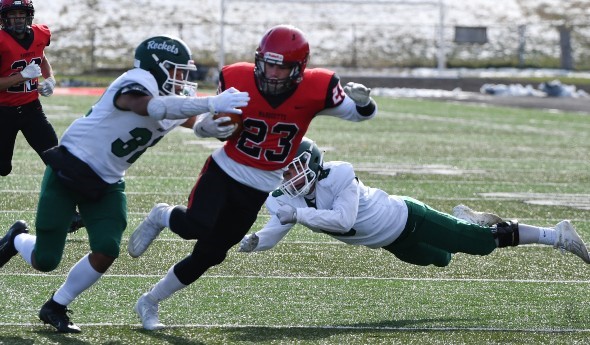
PHOTO: Marquette's Kameron Karp (23) is able to get by Muskegon Reeths-Puffer's Caden Brainard (8) but is taken down by Landon Mechem (32) at the 4-yard line during their Saturday matchup. (Photo by Cara Kamps.)