


New Football Practice Policies
March 25, 2014
Drive for Detroit: Week 2 in Review
September 8, 2014
By Geoff Kimmerly
Second Half editor
The storms came on hard on the state's west side about an hour before kickoff Friday. A handful mid-Michigan games started an hour or two late and got over just before midnight, and most in the the Detroit area were postponed for the night somewhere around the end of the first quarter.
Roughly 35 percent of MHSAA Week 2 games either were finished or played in full Saturday because of the string of lightening, thunder, rain and hail that made its way across most of the Lower Peninsula. At points before and after, teams continued finding their footing to start September, as the elite continued to show and local history was made in your backyards.
Below are the results that jumped out most from the wild weekend that was:
West Michigan
Zeeland West 38, Zeeland East 27
A little different start to this season’s chapter for these rivals; lately East has won the regular-season meeting with West then winning big in the playoffs. But West took control during the third quarter and rode its crushing running game to a win in what could again be a two-game series between the neighbors. Click to read more from the Holland Sentinel.
Also noted:
Muskegon 29, Grand Rapids Christian 21 – The Big Reds (2-0) just keep piling up impressive wins, including this second in a recent two-game series over the Eagles (1-1).
Caledonia 47, Grand Rapids South Christian 21 – Few in the state have been as impressive early as the Fighting Scots (2-0), who doubled up reigning Division 4 runner-up South Christian (0-2) after beating Battle Creek Harper Creek by 41 on opening night.
Rockford 40, Holt 28 – Holt (0-2) never makes this easy on Rockford (2-0), which had to come back from a halftime deficit.
Holland 28, Spring Lake 20 -- The Dutch (1-1) equaled its win total of the last two seasons combined by beating the Lakers (1-1), who finished 8-2 a year ago.
Greater Detroit
Macomb Dakota 42, Clinton Township Chippewa Valley 21
Dakota (1-1) showed it’s a Division 1 contender on opening night in a three-point loss to reigning champion Clarkston, and remains the favorite in the Macomb Area Conference Red after keeping this rivalry one-sided with a 16th-straight win over Chippewa Valley (1-1). Up next is league newcomer Warren Mott, another Red contender, but Dakota’s confidence should be running on high. Click to read more from the Macomb Daily.
Also noted:
East Detroit 28, Clinton Township Clintondale 22 – The Shamrocks (1-1) haven’t won more than five games in a season since 1986, but this has to be one of the biggest during that time; Clintondale had won 20 straight regular-season games dating to 2011.
Detroit Country Day 18, Detroit U-D Jesuit 16 – Beating Country Day in Week 2 last season set the tone for Jesuit’s best finish in more than a decade; this time the Yellowjackets get a nice bounce-back after a tough loss to Zeeland West on opening night.
Oxford 7, Rochester Hills Stoney Creek 0 – Oxford’s addition to the Oakland Activities Association Red made a strong league even tougher, but wins like this one over reigning Red runner-up Stoney Creek (1-1) are a must if the Wildcats (2-0) are to contend.
Utica Ford 23, Utica 20 – Ford (2-0) went a combined 1-17 over 2012-13 and hadn’t scored a point on rival Utica (0-2) since 2011.
Bay and Thumb
Marine City 28, St. Clair 14
Running back Jarrett Mathison, a hero of last season’s Division 4 championship run for Marine City, was a hero again with more than 200 yards rushing as the Mariners won the game that could eventually decide the Macomb Area Conference Gold title. These teams met in Week 8 to decide last season’s league championship, and Marine City definitely has an upper hand moving forward after also winning last year's tilt. Click to read more from the Port Huron Times-Herald.
Also noted:
Birch Run 33, Essexville Garber 7 – The Panthers (2-0) have had three up-and-down seasons, but this one looks more up after they avenged last season’s 43-12 loss to the Dukes (0-2).
Gladwin 35, Standish-Sterling 21 – The Flying G’s are 2-0 for the first time since 2003, this week beating a Standish-Sterling (1-1) team coming off 9-2 in 2013.
Clio 30, Central Montcalm 29 – Last week, Clio broke a 37-game losing streak; this week it edged the Hornets (1-1) to guarantee at least two wins for the first time since 2001.
Fenton 17, Temperance Bedford 8 – Not quite a streak, but Fenton (2-0) has won 18 of its last 19 regular-season games and handed Temperance Bedford its second loss this fall after the Mules were perfect for the regular season in 2013.
Mid-Michigan
Mount Pleasant 28, Flint Carman-Ainsworth 27 (OT)
A four-quarter comeback and two-point conversion stand could count significantly toward deciding the Saginaw Valley Association Red championship, even as this game was only the league opener for both contenders. Mount Pleasant (1-1) bounced back big after an opening nonleague loss to Midland Dow and stopped Carman-Ainsworth (1-1) as it went for the win at the end of first overtime. Click for more from the Mount Pleasant Morning Sun.
Also noted:
Beal City 15, Clare 14 – Beal City came back from a two-score deficit to move to 2-0; Clare, meanwhile, is 0-2 having faced the reigning Division 6 champion (Ithaca last week) and Division 8 runner-up.
Hartland 24, Canton 21 – The Eagles (2-0) are bouncing back well after going 3-6 a year ago, with Canton annually among Division 1’s most respected contenders.
Mason 10, Eaton Rapids 7 – The Bulldogs (1-1) came back from a disappointing opening-night loss to rival Okemos, hanging on against the improved Greyhounds (1-1) thanks to a touchdown with fewer than two minutes to play.
Parma Western 50, Battle Creek Pennfield 37 – Western (2-0) is making big strides in the second season under former Dearborn coach Dave Mifsud, with 50 points its most since 1962 and its pair of wins already equaling last season’s total – and with this one coming over a Pennfield team (0-2) coming off 10 wins and 15 straight playoff berths.
Lower Up North
Gaylord 35, Grayling 0
The first meeting between these two since 1996 didn’t end up as nail-biting as anticipated, but the credit needs to go to the Blue Devils – they are 2-0 and with another win will guarantee their best finish since 2008 after winning a combined three games over the last four seasons. What’s more, Gaylord has outscored its first two opponents by a combined 75-0 after not shutting out any since Week 5 of 2011. Grayling, a playoff team the last five years, fell to 1-1. Click for more from the Gaylord Herald Times.
Also noted:
Alpena 29, Sault Ste. Marie 18 – The Wildcats (1-1) not only equaled their win totals of the last three seasons, but did so against a Sault Ste. Marie team (0-2) coming off consecutive playoff appearances.
Traverse City Central 50, Escanaba 14 – The Trojans are 2-0 for the first time since 2004 and heading into this week’s Big North Conference opener against rival Traverse City West.
Traverse City St. Francis 42, McBain 12 – The Gladiators snapped back from an overtime loss to New Lothrop by moving to 1-1 with a win over a 2013 playoff team in McBain (0-2).
Indian River Inland Lakes 54, Pickford 14 – The Bulldogs (2-0) added 54 to their 62 points on opening night for a two-game total eclipsing 100 for the first time since 2004.
Southwest and Border
Martin 34, Bellevue 14
The Clippers (1-1) needed to put off the celebration one more day because of storms Friday but enjoyed their first win since 2007, a stretch of 56 games that actually began with a loss in the playoffs. The 34 points were Martin’s most since it scored 44 in its previous most recent win, a 2007 District opener, and came against a Bellevue team (0-2) that made the playoffs in 2013.
Also noted:
Constantine 31, Schoolcraft 17 – The Kalamazoo Valley Association rivals played another close one, with the Falcons (2-0) avenging last season’s nine-point loss to earn an upper hand this fall on the Eagles (1-1).
Whitehall 33, Shelby 0 – The Vikings (2-0) have doubled last season’s one-win total and done so by a combined 84-24 score and with their first shutout since 2011.
Paw Paw 29, Three Rivers 0 – The Redskins (2-0) are off to another solid start, with the shutout more impressive because Three Rivers (0-2) fell to powerful Edwardsburg by only two on opening night.
Ida 41, Petersburg-Summerfield 20 – Ida (2-0) lost only twice during the 2013 regular season, the worst by 21 points to Summerfield, now 1-1 this fall.
Upper Peninsula
Ishpeming Westwood 52, Houghton 14
The Patriots are faced with the large shadow of neighboring Ishpeming High, which has won the last two MHSAA Division 7 championships. But Westwood has built a nice start as well this fall, opening 2-0 against Stephenson and now Houghton after starting 0-2 against those opponents a year ago. By doing so, Westwood (2-0) equaled last season’s win total – and beat a 2013 playoff team in the Gremlins (0-2). Click for more from the Marquette Mining Journal.
Also noted:
Gladstone 41, Roscommon 12 – The Braves (2-0) ended a 16-game losing streak with a victory on opening night and tied their highest win total since 2010 with this one over the Bucks (0-2).
Iron River West Iron County 54, L'Anse 8 – The Wykons (2-0) got a huge start on another Western Peninsula Athletic Conference title by beating last season’s league runner-up, L’Anse (1-1).
Munising 41, Powers North Central 6 – The Mustangs bounced back from a 22-point loss on opening night to get a step up in the Mid-Eastern Conference against last season's runner-up, North Central, which didn’t play last week.
Negaunee 31, Calumet 22 – The always-steady Miners started 2-0 for the seventh straight season, while Calumet fell to 1-1.
8-player
Lawrence 57, Carsonville-Port Sanilac 6
Lawrence (2-0) continued its surge coming off last season’s MHSAA Semifinal berth, pushing its overall scoring margin this fall to 107-6 after two games. Derek Gribler, last season’s standout running back, ran for four scores and threw for two more from his new quarterback spot. Carsonville-Port Sanilac fell to 0-2. Click for more from Mlive.
Also noted:
Deckerville 14, Kingston 8 – The 2012 MHSAA champion is 2-0 for the first time in its three seasons as an 8-player team, although Kingston (0-2) played the Eagles the closest of their three recent meetings.
Webberville 44, Tekonsha 36 – The Spartans (1-1) bounced back from an 86-48 loss to Dryden on opening night, while Tekonsha fell to 0-2.
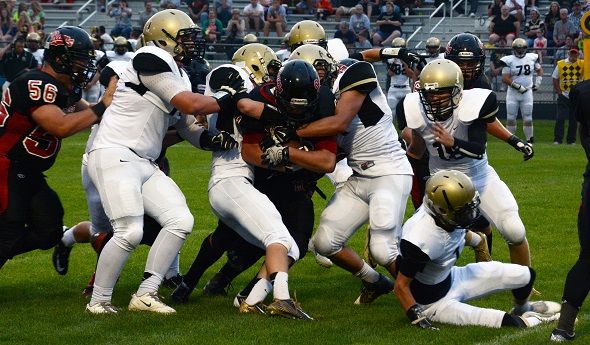
PHOTO: Corunna defenders (gold helmets) surround a Montrose ball-carrier Friday, but couldn't pull off an upset as the Rams prevailed 28-21 when the game was finished Saturday.