


New Football Practice Policies
March 25, 2014
A Game for Every Fan: Week 1
August 28, 2014
By Geoff Kimmerly
Second Half editor
It’s a lot like birds knowing to fly north in the spring.
If you’ve played, coached, parented or followed high school football, you’re likely having a hard time not jumping out of your shoes in anticipation of opening night.
So let’s get right to it; below are some of the most intriguing matchups from this first weekend of the MHSAA football season. More than 250 of the total 310-plus games will be played tonight, with 50 more Friday and a handful Saturday.
Tune in to MHSAA.com’s Score Center all weekend for game times, scores as we get them, standings for those starting league play immediately and all the playoff-point equating that will start to matter to most as we get rolling into the season’s second half. (Records below are from 2013. Games are organized based on the region of Michigan where they'll be played.)
West Michigan
Detroit Catholic Central (11-3) at Muskegon (12-2), Friday
This is set up to be arguably the most high-octane opener in Michigan in some time. DCC is back-to-back-to-back Division 1 runner-up, while Muskegon has finished runner-up in Division 2 the last two seasons. Granted, rosters turn over – but Joeviar Kennedy was Muskegon’s leading receiver in last season’s championship game and Alezay Coleman its leading tackler, and both are back. So are Alex Bock and Jordan Jenkins, two of the most noticeable Shamrocks during their run to Ford Field.
Others that caught my eye: Detroit Country Day (8-4) at Zeeland West (13-1), Grand Rapids South Christian (12-2) at Grand Rapids Christian (8-3) on Friday, Grand Rapids West Catholic (10-4) at Muskegon Oakridge (11-2) on Friday, Grand Rapids Catholic Central (6-4) at East Grand Rapids (5-4).
Greater Detroit
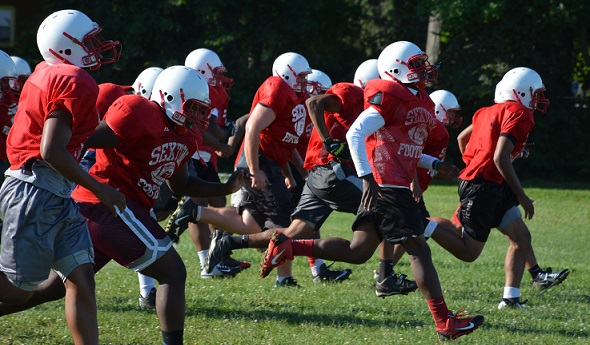
Lansing Sexton (12-1) vs. Detroit East English (9-3), Saturday at Wayne State
Many of the best from Detroit will be playing at Wayne State University over the next three days (see a few more big-time contests listed below), but this one carries the most intrigue because it features one of the best from the city against a Sexton team that missed making last season’s Division 4 Final by a touchdown. The Big Reds have all of their playmakers and much of their outstanding defense back; East English is keyed by run/pass dynamo Anton Curtis, one of the state’s most exciting quarterbacks.
Others that caught my eye: Macomb Dakota (11-1) at Clarkston (13-1), Pewamo-Westphalia (10-2) at Madison Heights Madison (11-1), Detroit Cass Tech (12-1) vs. Oak Park (6-5) on Friday at Wayne State, Southfield (7-3) vs. Orchard Lake St. Mary's (5-4) on Friday at Wayne State.
Bay and Thumb
Saginaw Swan Valley (11-1) at Saginaw Nouvel (9-2)
A nail-biting 27-20 win for Swan Valley in this opener last season kicked off a run to the Regional Finals and the team’s best season in the last eight. Senior running back Alex Grace returns from the most potent offense in school history and arguably is the most potent runner in MHSAA history with more than 5,000 yards in his career and nearly 3,000 last season alone. Nouvel’s lineup will include more new names – but the Panthers rattled off nine straight wins after the 2013 opening loss and will be prepared to get the streak started a week earlier this time.
Others that caught my eye: Flint Carman-Ainsworth (11-2) at Grand Blanc (7-3), Freeland (6-4) at Lake Fenton (8-3), Montrose (12-1) at Reese (8-2), Mount Pleasant (10-2) at Midland Dow (8-3).
Mid-Michigan
Ithaca (14-0) at Clare (7-3), Friday
The Yellowjackets’ 56-game winning streak stretches over four seasons and is the longest of any in MHSAA history achieved entirely during the playoff era. But Clare – the Jack Pine Conference champion for seven years running – should be Ithaca’s toughest regular-season test of at least the last two or three. Ithaca star quarterback Travis Smith is graduated and gone to Wake Forest University, but younger brother Jake Smith has been similarly anticipated and takes over the offense to start his junior year.
Others that caught my eye: Manchester (7-3) at Clinton (13-1), St. Johns (5-4) at East Lansing (4-5), Jackson Northwest (5-4) at Eaton Rapids (7-5), South Lyon (6-4) at Pinckney (7-4).
Lower Up North
New Lothrop (11-1) at Traverse City St. Francis (5-5), Friday
This is the second chapter of a series started a year ago that allows both to start out against a tough opponent before jumping into league play against more familiar foes. New Lothrop won last season’s matchup and went on to make the Division 8 Semifinals for the second time in three seasons. St. Francis hasn’t had two straight middling seasons like this since 2000-01 (it also finished 4-5 in 2012). But the Gladiators are back in a league for the first time since 2011 and should be able to add on last season’s return to the playoffs.
Others that caught my eye: Midland (10-2) at Traverse City West (5-5), Cadillac (11-1) at Big Rapids (3-6), Kingsley (6-4) at McBain (5-5), Marquette (5-4) at Traverse City Central (5-4).
Upper Peninsula
Munising (6-4) at Iron River West Iron County (10-1), Friday
These two did some celebrating in 2013. West Iron tied its school record for wins, while Munising bounced back from 2-7 in 2012 to make the playoffs for the second time in three seasons – and also for only the second time since 1990. Both should be looking for more this fall; West Iron’s lone loss came in the playoffs to eventual Division 7 champion Ishpeming, while Munising – after falling to West Iron 7-0 in last season’s opener – then lost its next two games by a combined six points before rattling off six straight wins.
Others that caught my eye: Houghton (6-4) at L'Anse (8-3), Ishpeming (14-0) at Iron Mountain (4-5), Petoskey (5-4) at Sault Ste. Marie (7-4) on Friday, Posen (4-6) at Cedarville (8-2).
Southwest and Border
Dowagiac (7-4) at Plainwell (8-2)
Dowagiac was cruising along on a 17-game regular-season winning streak when Plainwell broke it last fall with a 10-0 win on the way to a third straight playoff berth. These two haven’t played in the same division of the Wolverine B since 2011, but the rivalry continues to run hot now that both are division favorites on an annual basis.
Others that caught my eye: Watervliet (10-1) at Gobles (5-4), Parchment (7-4) at Schoolcraft (10-2), Edwardsburg (9-1) at Three Rivers (5-4), Portage Central (12-1) at Mattawan (4-5).
PHOTO: Lansing Sexton, practicing earlier this month, fell just a touchdown shy last season of reaching its first MHSAA Final.