

'Next Person Up' Mentality, Super Subs' Success Has Almont Returning to Ford Field
By
Paul Costanzo
Special for MHSAA.com
November 24, 2023
Gavin Szymansksi was nervous for about two plays.
 The junior was making his first start for the Almont football team in Week 3 against Imlay City, replacing injured Cole Willard at left tackle.
Willard had been hurt in the first half of the Raiders’ Week 2 game against Algonac, and while Szymanski had filled in then, there was less pressure, as his team already had a hefty cushion.
But this was different. A first varsity start, on the opposite side of the line from his more familiar right tackle position.
“It wasn’t too scary in that moment (against Algonac), plus I thought he was going to be back,” Szymanski said. “(Week 3) was kind of scary. But the team was pretty supportive, and they didn’t have any doubt I’d be able to fill in. Then we had a TD on like the first or second play in the Imlay game, and I was fine.”
Szymanski filled in seamlessly for the Raiders, which became a theme throughout the season. As players went down with injuries, both short and longterm, their backups filled in without a hitch.
While every team is banged up throughout a season, for a Division 6 school with just more than 30 players on the varsity roster, it’s a remarkable feat to remain competitive, let alone go 8-1 during the regular season, win the Blue Water Area Conference title, and, for the second time in school history, advance to the MHSAA Finals at Ford Field.
“Our motto is ‘next person up,’” Almont coach James Leusby said. “They literally live by that. You never know when your number is going to get called, but they seem to always be ready.”
Szymanski – who is back in the starting lineup for the Raiders, now as a right tackle filling in for the injured Yousif Abu-Joudeh – and his Almont teammates will play Kingsley at 4:30 p.m. Saturday in the Division 6 Final, looking for the program’s first Finals title.
While the Raiders certainly have star power – junior back Chase Battani had rushed for 1,169 yards and 18 touchdowns – it’s been the efforts of a team that has stretched well beyond it’s starting 22 that put them in this position.
The list of injuries, big and small, is extensive.
 It started with Willard and ended with Abu-Joudeh, who was injured in Week 9. Fullback Jacob Stewart, who was averaging 15 yards per carry, was injured in Week 6 and missed a stretch. Matthew Bacholzky stepped up in his place, along with Ayden Ferqueron.
Outside linebacker Eric Haddon suffered a high ankle sprain, and was replaced by Jacob Fuller, who had spent most of the season on the offensive side of the ball. Defensive end and tight end Brent Corneau missed a stretch as well, and Nolan Maxlow, who was a split end and defensive back, had to step up in his place.
And that’s just what Leusby could remember off the top of his head late Tuesday night.
“In Division 6, you don’t have much depth, so the backups have to know multiple positions,” Leusby said. “I think it talks highly of our program and our system and the coaches we have in it. In the playoffs, we’ve started two JV kids at defensive tackle. Our motto is, when we bring our sophomores up, the best kids are going to play.”
Because of that program-wide preparation, players are not only ready, but have confidence in one another when it’s someone else’s time to step up.
“I felt confident in him,” Willard said of Szymanski. “A lot of kids get a lot of reps at practice. And we’ve run the same plays for like five years, so everyone knows them.”
Leusby, who took over at Almont in 2015, credited not just his high school staff, but a youth program that’s bursting at the seams with participants.
Almont is a football community, and while there are no Finals titles listed on the city limits sign, it has a very proud history of success, especially lately.
The Raiders have made the postseason each of the past 14 seasons, and 17 of the past 18. The lone miss was 2009, when they were 5-4. Only the pandemic-shortened 2020 season resulted in a record that wasn’t over .500, and even that one ended at 3-3 with a playoff win.
“I think, all in all, the community, they invest a lot of time into the program, and they expect results,” Leusby said. “You ask anybody, Almont is a football town.”
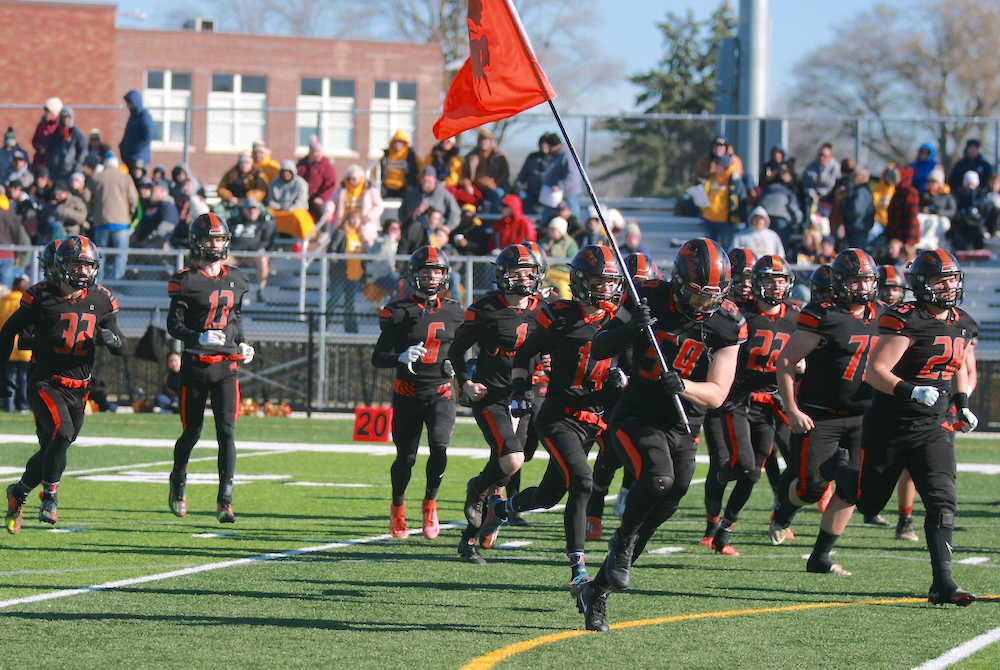
Leusby and his players are expecting that support to result in a lot of orange and black in the lower bowl of Ford Field on Saturday.
“Everybody has our back and wants us to win,” Willard said. “The whole town is travelling down there.”
They did the same in 2019 when the Raiders made their previous run to Ford Field. That ended with a 31-17 loss to Grand Rapids Catholic Central in the Division 5 Final.
“Honestly, when I was there in 2019, I was just thrilled to get to Ford Field,” Leusby said. “Yeah, it was a game and we wanted to win, but it was just cool to get to the Finals. After it was over, I thought, maybe I had sent the wrong messages. This year, we’ve reiterated that we’re going there to come home with the big daddy. Not second place – we want the big trophy.”
 Paul Costanzo served as a sportswriter at The Port Huron Times Herald from 2006-15, including three years as lead sportswriter, and prior to that as sports editor at the Hillsdale Daily News from 2005-06. He can be reached at [email protected] with story ideas for Genesee, Lapeer, St. Clair, Sanilac, Huron, Tuscola, Saginaw, Bay, Arenac, Midland and Gladwin counties.
PHOTOS (Top) Senior Isaiah Bankston (59) leads Almont onto the field before last Saturday’s Semifinal win over Ovid-Elsie. (Middle) Chase Battani (32) followers his Raiders blockers during the Regional Final win over Detroit Edison. (Photos by Maureen Flannery Walton.)
St. Patrick Immediately Sets Tone On Way to Claiming 1st Title Since 1992
By
Jason Juno
Special for MHSAA.com
November 22, 2025
MARQUETTE — Portland St. Patrick has been no stranger to the MHSAA Finals since moving to 8-player football, but the Shamrocks had come up short of a title in three appearances since 2017.
They were back in the Division 2 championship game Saturday, and again facing a team from the Upper Peninsula, just like the other three times. But this time, St. Patrick made it clear from the opening kick it had no intention of going back below the Mackinac Bridge without the championship trophy.
The Shamrocks rode the momentum from a fast start and blanked Felch North Dickinson 53-0 at the Superior Dome.
“It means a lot,” St. Patrick senior back Brady Leonard said with the trophy in his hand. “Having a couple classes before us come here and not be able to finish the job, it was not just for our team, but it was for everyone that came and wasn’t able to finish it.”
Aiden Fandel set the tone when he took the opening kick to the Nordics’ 3-yard line. Jerryd Scheurer ran three yards on the first play from scrimmage, and Leonard ran in the conversion for an 8-0 lead just 20 seconds into the game.
 “It was huge, just to flip the field position right away was a big deal,” St. Patrick coach Patrick Russman said.
The Shamrocks scored two more times during the first quarter, taking advantage of excellent field position.
St. Patrick’s Tyler Thelen blocked a punt to set up its next score. The Shamrocks took over at the North Dickinson 9, and Charlie Thelen caught a four-yard pass from Scheurer on the second play of the drive for a 14-0 lead.
The Nordics went for it on fourth-and-1 at their own 29 on the ensuing possession, but they were stuffed for no gain, giving St. Patrick the ball not far from the red zone.
Leonard ran eight yards for the touchdown and a 20-0 lead with 5:34 still left in the first quarter.
What a start.
"It was very important," Leonard said. "We knew if we came off hot, we knew that we'd be able to punch them in the mouth and we'd get off to the start that we normally have.”
The Shamrocks scored two more times in the first half, both on runs by Hudson King, who led with 120 yards on 10 carries. His 30-yarder came just seven seconds into the second quarter, and his 21-yard rush gave them a 33-0 lead that held until halftime.
The Nordics drove into St. Patrick territory twice in the period. The first stalled at the 44 when the game was still within reach at 26-0. The second got all the way to the 24, but incomplete passes on third and fourth downs gave St. Patrick the ball back with four seconds on the first-half clock.
North Dickinson just couldn’t overcome that start, or the talent level of the Shamrocks.
“We’ve been punched in the mouth before, but they’re way better,” Nordics coach Mike Christian said. “They were just so much better than us today. They’re bigger, faster, stronger. We just couldn’t get anything going.”
 The second half proved to be more of the same. St. Patrick reached the end zone three more times, on short runs by Caleb Pline and two players listed as linemen, Logan Krieger and Nick Pung.
St. Patrick finished a perfect 13-0, and went unbeaten even with a tough schedule. Russman said the Shamrocks started off with tough Mid-State Activities Conference foes Merrill and Morrice. They ended the regular season with a win over eventual Division 1 runner-up Blanchard Montabella. Their playoff run included wins over Mendon, ranked No. 1 in the final media poll of the season, and last year’s Division 1 champion, Deckerville.
“We didn’t have any time to not be ready this year,” Russman said. “We’ve had a pretty good run of some very quality football teams throughout the stretch of the year. They didn’t give us any rest, so the kids did a good job of getting ready each week. Sometimes you slip, and these guys didn’t slip.”
He credited the team’s chemistry for the special season. The practices were superb all year. And they of course had some really good players.
“Our line has been working hard and they just continued to grind it out today, and our backs finished plays on the offensive end,” Russman said. “We’ve been trying to get a faster and faster defense each week, and I think they’ve really done that and accepted that challenge.”
St. Patrick’s last Finals win came when it was playing 11-player football in 1992, in Class D. North Dickinson was seeking its first championship but had to settle for its second runner-up finish (11-player, Class D, 1998).
The Nordics’ 17-game winning streak came to an end. They finished at 12-1 this year after winning their final five games last season.
North Dickinson canceled its varsity season in 2023, announcing at the time that it would play a JV schedule with only four upperclassmen on the roster. Two years later, the Nordics made it to the final game.
“My seniors would have been sophomores then,” Christian said. “I didn’t want to throw them into that right away. This is kind of what we were aiming for when we did that.”
It all worked out. Missing the playoffs last year proved to be a good motivator as well.
“They really put the extra work in,” he said. “They’re such great kids, and they worked their tails off all summer and I’m just so proud of them.”
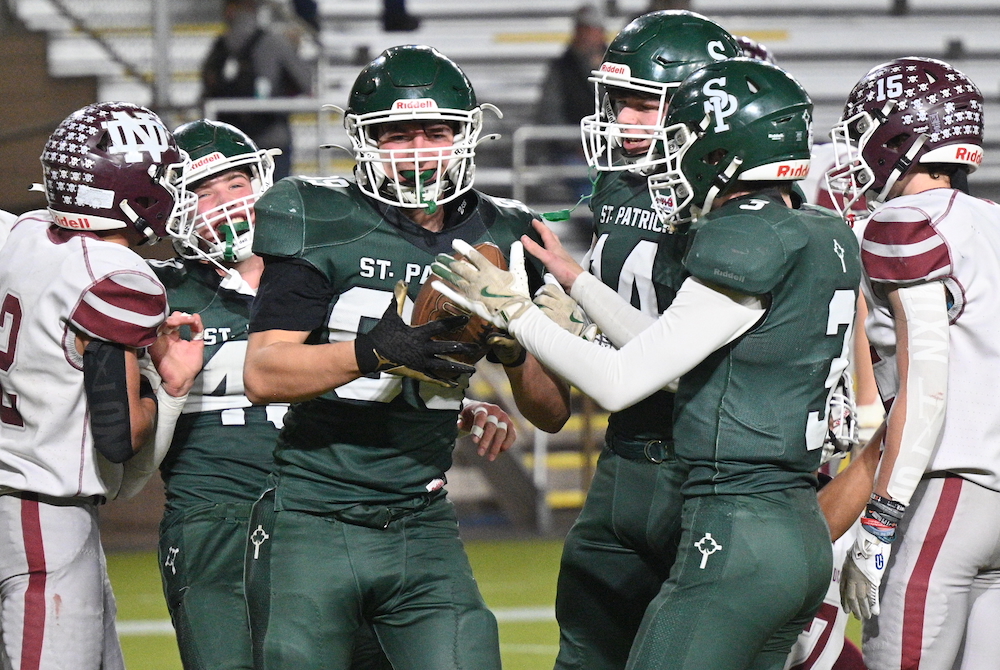
PHOTOS (Top) Portland St. Patrick players celebrate a touchdown Saturday at Superior Dome. (Middle) North Dickinson quarterback Brady Jungwirth (15) works to pull away from a tackler. (Below) The Shamrocks’ Charlie Thelen (12) goes high to pull in a pass. (Click for more from Cara Kamps.)