

Next Players Up Keep Whiteford Surging
October 5, 2017
By Doug Donnelly
Special for Second Half
OTTAWA LAKE – For many smaller Class C football teams, losing four starters to injuries during the first six weeks of the season would be devastating.
 In Ottawa Lake, however, probably only those close to the Whiteford football program have noticed.
Despite the injury bug, the Bobcats are rolling like never before in school history. They are 6-0, averaging 53 points per game and sit alone atop the Tri-County Conference. The key is an unusual amount of depth – and a 28-player roster with 14 seniors and 14 juniors.
“Some of it has to do with a couple of innate classes, with more than the usual amount of kids,” sixth-year Bobcats coach Jason Mensing said. “There’s always an ebb and flow from one grade to the next. But, what we are experiencing is different. In Hunter Lake, not only did we lose a running back, but he was also a cornerback, kick returner and punt returner. And, Alex (Kohler) is a second-year starting guard, but is also our punter and he kicked off.”
Typically, only two or three players start on both sides of the ball for the Bobcats – a rare occurrence for a team has played in the Division 8 playoffs each of the past four seasons (they were in Division 7 in 2012).
“We try and coach every kid the same,” Mensing said. “That’s a very important piece. We really try and develop every player into a starting player. The ultimate goal is to make sure every kid gets on the field.”
Part of the reason the Bobcats have developed such depth is their deep playoff runs the past couple of seasons. The 2015 team advanced to the Division 8 Semifinals, and last year the Bobcats played in the championship game at Ford Field against Muskegon Catholic Central. Since Mensing arrived at Whiteford, he has invited every junior varsity player to practice with the varsity for all of the playoff weeks.
 “Those playoff runs have allowed our JV players a ton of extra practice over the past couple of seasons,” Mensing said. “If you think about that, it’s another season and then some. That makes a really big difference, especially the first two weeks or so of the next season. The players come in and already know what to expect, and they know the routine and the pace. They are playing at a higher level at an earlier time.”
Mensing and his staff of 10 varsity coaches work with grades 9-12 in practice on a daily basis.
“That’s a critical piece of coaching – every kid is receiving the same instruction,” he said.
A Tecumseh graduate and former Adrian College football player, Mensing is 53-13 since becoming head coach of the Bobcats, giving him the highest winning percentage of any coach in school history. The program has never been stronger – six straight playoff appearances, a 9-0 regular season last year and two consecutive 9-0 seasons by the JV team. He said he developed his coaching style from playing small college football.
“My background is small college football,” he said. “It always seemed to me to be the best way to operate that I know.”
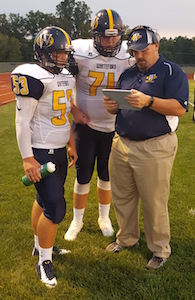
Whiteford’s offense has rushed for more than 2,200 yards heading into Friday’s game against Sand Creek – an average of about 10 yards a carry. Many of those yards are gained behind 6-foot-5, 280-pound all-state tackle Lucas Tesznar. Jacob Lewis, Jordan Book and Jaret Atherton all are starting for a second year on the offensive line. There are five solid backups in the mix, too, who have received plenty of playing time even though Whiteford has had a running clock at some point in each of its six games.
“At the line of scrimmage we have guys who can come in and play that would start in just about any other year,” Mensing said.
Whiteford lost two 1,000-yard running backs to graduation after last season, but have found several capable replacements in six juniors: Logan Murphy (823 yards on just 61 carries), Zach Bertz (266 yards and 10 touchdowns), Nathan Bauman (258 yards), Ty Eitniear (188 yards) and Lake (148 yards in three games). Bradyn Clark-Gilmore started the season at running back and had a 100-yard game but shifted to tight end and is now the leading receiver on the team (280 yards on 11 receptions).
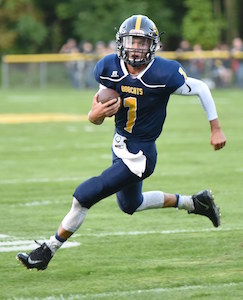
 Thomas Eitniear is the Bobcats’ quarterback. As the starting signal-caller, Eitniear is 29-4, already setting a record for most starts and wins by a Whiteford QB. He holds the school record for career passing touchdowns and is nearing the school record for career passing yards. This season he has 567 yards passing and 409 yards rushing. He’s committed to play baseball at the University of Toledo next year.
“We’ve got a Division I athlete playing quarterback,” Mensing said. “He is a difference-maker. I can’t tell you how many drives or even games have changed over the last three years because of him making a big play.”
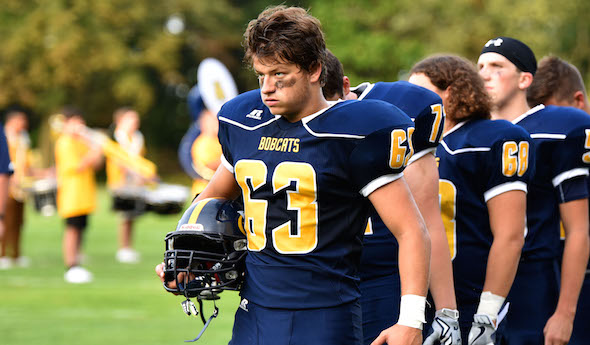
Inside linebacker Eli Shelton, safety Abba Risley, cornerback Ty Eitniear (three interceptions) and end Ethan Inman have been standouts on defense. Jack Garrison stepped up when Lake was injured and had several big games. One of the few two-way starters, Matthew Taylor, has been solid all season.
Mensing said players like Thomas Eitniear and Murphy won’t put up gaudy numbers because of the system they are in, but that doesn’t make them any less effective.
“It’s not about any one individual effort,” he said. “It’s about a collective group. That’s what we’ve always been about.”
Whiteford is seeking to win back-to-back league championships for the first time in more than 50 years, the last time when it was a member of the River Raisin Conference. They have games remaining against Sand Creek (3-3), Clinton (4-2) and Britton Deerfield (1-5) on the regular-season schedule. Then the playoffs begin. Lake and Kohler are expected back before the end of the season to help solidify the depth.
“We still have room to show improvement from week to week,” Mensing said. “As long as we continue to improve, and if we can continue to get better over the next three weeks, it will determine where we will end up on the season.”
 Doug Donnelly has served as a sports and news reporter and city editor over 25 years, writing for the Daily Chief-Union in Upper Sandusky, Ohio from 1992-1995, the Monroe Evening News from 1995-2012 and the Adrian Daily Telegram since 2013. He's also written a book on high school basketball in Monroe County and compiles record books for various schools in southeast Michigan. E-mail him at [email protected] with story ideas for Lenawee and Monroe counties.
PHOTOS: (Top) Ottawa Lake Whiteford’s Eli Shelton, standing for the national anthem, is one of the defense’s standouts this fall. (Middle) Quarterback Thomas Eitniear takes off around a corner during his third season as a starter. (Below) From left: Jacob Lewis, Lucas Tesznar and coach Jason Mensing confer on the sideline. (Top and middle photos by Carl Hayes, below photo by Doug Donnelly.)
Drive for Detroit: Week 2 Preview
August 31, 2016
By Geoff Kimmerly
Second Half editor
After an opening weekend highlighted by showcases in the Detroit and Ann Arbor areas, Michigan high school football fans should look west, north and really far north for the most colossal matchups of Week 2.
 Arguably the top teams in the Lansing and Grand Rapids areas and all of 8-player football will face off as the most intriguing games of this week’s Drive for Detroit, powered by MI Student Aid. A number of leagues also begin play, with matchups in at least three conferences likely playing a part in which favorite eventually is crowned champion.
Check out our previews below – and visit the MHSAA.com Score Center tonight and all weekend for scores as they are reported and links to updated schedules and standings.
Bay & Thumb
Almont (1-0) at Algonac (1-0)
The water should be boiling for this Blue Water Area Conference opener. Rewind to Week 6 of last season, when upstart Algonac broke reigning league champ Almont’s 16-game BWAC winning streak with a 21-7 victory. Algonac went on share the league title with Richmond (with Almont a win short of also sharing), then beat Almont again, 13-0, in their Division 5 District Final. Both earned impressive victories last week, Algonac over Marine City and Almont over Saginaw Michigan Lutheran Seminary.
Others that caught my eye: Chesaning (1-0) at Freeland (1-0), Midland Dow (1-0) at Bay City Central (1-0), Harbor Beach (1-0) at Beaverton (1-0), Flint Powers Catholic (0-1) at Saginaw Heritage (1-0).
Greater Detroit
Allen Park (1-0) at Wyandotte Roosevelt (1-0)
Allen Park shared the Downriver League championship last season by winning its final seven regular-season games after falling to Roosevelt 23-14 in Week 2. The Bears, meanwhile, ended up missing out on any share of the league title by going on to lose two games by a combined four points. Roosevelt has won seven of eight meetings against Allen Park – including once in the playoffs – since the two became league foes in 2009.
Others that caught my eye: Walled Lake Western (1-0) at Canton (0-1), Utica Eisenhower (1-0) at Macomb Dakota (1-0), Clinton Township Chippewa Valley (1-0) at Romeo (0-1), Orchard Lake St. Mary’s (0-1) at Detroit Loyola (1-0) on Friday.
Mid-Michigan
DeWitt (1-0) at Grand Ledge (0-1)
Lansing-area fans have been anticipating this matchup not just since schedules were announced for this season, but for many years. These two have been the most successful programs in the Capital Area Activities Conference for most over the last two decades and nearly are neighbors, although Grand Ledge has about 700 more students. The Comets made the Division 1 Semifinals a year ago; DeWitt’s most recent of five MHSAA Finals appearances came in 2013. Both are led by standout quarterbacks – DeWitt by Will Nagel and the Comets by Nolan Bird – although playmakers JD Ross and Antonio Rush, respectively, could be the difference-makers for those teams on offense. DeWitt dominated at Linden last week, while Grand Ledge fell a score short at Hudsonville.
Others that caught my eye: Lansing Catholic (1-0) at Lansing Everett (0-1), Dansville (1-0) at Pewamo-Westphalia (1-0), Hillsdale (1-0) at Portland (1-0), Davison (1-0) at Mount Pleasant (0-1) on Friday.
Northern Lower Peninsula
Maple City Glen Lake (1-0) at Traverse City St. Francis (1-0) on Friday
St. Francis is fresh off a trip to the Upper Peninsula and a 40-14 win over frequent playoff team Marquette. Glen Lake certainly is a more familiar opponent – the teams were in the same division of the Northern Michigan Football Conference during the league’s first two seasons, although they are in different divisions this fall. Glen Lake made headway in its two matchups with St. Francis last season, coming off a 41-7 Week 7 loss to fall only 21-3 in a Division 6 playoff opener. A four-touchdown win over Kingsley last week should be a good sign of things to come for the Lakers.
Others that caught my eye: Charlevoix (1-0) at Boyne City (0-1), Lincoln Alcona (0-1) at Hillman (0-1), Whittemore-Prescott (1-0) at Tawas (1-0), Central Lake (1-0) at Frankfort (1-0).
Southwest Corridor
Edwardsburg (1-0) at Vicksburg (1-0)
Although Edwardsburg won this matchup 58-25 a year ago, the fact remains that Vicksburg is still the only team to hand the Eddies a regular-season loss over the last three seasons – winning 16-14 in 2014. That’s enough to make this intriguing. But add in a solid 17-7 win for the Bulldogs over Dowagiac last week, and it appears they’re up to the task of challenging the Wolverine Conference frontrunners again.
Others that caught my eye: Marshall (0-1) at Coldwater (1-0), Schoolcraft (1-0) at Watervliet (1-0), Niles (1-0) at Mattawan (0-1), Kalamazoo Central (0-1) at Stevensville Lakeshore (1-0).
Southeast & Border
Morenci (1-0) at Hudson (1-0)
An early key moment in Morenci’s turnaround over the last three seasons was a 2014 win over the rival Tigers, who had mostly dominated their annual game over the previous decade and a half. Morenci made it two straight on Hudson by winning 26-20 last year and is coming off a solid 34-7 win over 2015 playoff qualifier Pittsford. The Tigers are coming off their first sub-.500 finish last year since 2006 and have plenty to prove – and also to benefit from by winning this one with an increasingly tough Lenawee County Athletic Association schedule ahead.
Others that caught my eye: New Haven (1-0) at Ida (1-0), Milan (1-0) at Flat Rock (1-0) on Friday, New Boston Huron (1-0) at Carleton Airport (1-0) on Friday, Ypsilanti Community (0-0) at Monroe (0-1) on Friday.
West Michigan
Lowell (1-0) at Rockford (0-1) on Friday
After three seasons off, these Grand Rapids-area powers will face off again; Lowell won both the 2011 and 2012 meetings when the teams first brought this matchup back after nearly four decades. Aside from these being two of the best-known programs in the state, last week’s events should draw a few more statewide eyes west. Lowell, the reigning Division 2 runner-up thanks to a last-play touchdown in the 2015 Final by Detroit Martin Luther King, blazed out of the gates with a 36-19 win over Warren DeLaSalle. Rockford, meanwhile, was forced to forfeit to Saline last week because an illness sidelined a good portion of the team. The Rams made the Division 1 Regional Finals last fall.
Others that caught my eye: Benton Harbor (1-0) at Grand Rapids South Christian (1-0), at Hudsonville; St. Ignace (1-0) at Muskegon Catholic Central (1-0), Zeeland West (1-0) at Muskegon Mona Shores (1-0), Caledonia (1-0) at Grand Rapids Christian (1-0) on Friday
Upper Peninsula
Negaunee (1-0) at Calumet (1-0)
Calumet is one of the most consistently solid teams on either peninsula, with seven or more wins nine of the last 11 seasons. And the Copper Kings broke through one of their toughest annual obstacles at the end of last fall, downing Negaunee 24-14 in a Division 6 playoff opener after losing all five of the teams’ recent meetings. Still, the Miners’ 7-3 finish last fall was similarly solid but a little deceptive – those three losses came over the final four weeks and by a combined 17 points. This could be a statement win for a team looking to take those next small steps back to elite.
Others that caught my eye: Petoskey (0-1) at Escanaba (1-0), Gwinn (1-0) at Iron Mountain (1-0), Bessemer Gogebic (1-0) at Bark River-Harris (1-0) on Friday, Newberry (1-0) at Munising (0-1) on Friday.
8-Player
Powers North Central (1-0) at Crystal Falls Forest Park (1-0) on Friday
Forest Park, 11-player until this fall, has taken a deep dive immediately into 8-player football, opening up last week against annual power Rapid River (and winning 64-22) and now hosting reigning champion Powers North Central. The Jets opened last week just as explosively as they played all of last season, putting up 60 on Luck, Wis. This one could be telling in how the Western Eight Conference standings eventually shake out – and also indicate where Forest Park sits in relation to the 8-player elite.
Others that caught my eye: Posen (1-0) at Cedarville (1-0), Lawrence (1-0) at Morrice (1-0).
Second Half’s weekly “Drive for Detroit” previews are powered by MI Student Aid, a part of the Student Financial Services Bureau located within the Michigan Department of Treasury. MI Student Aid encourages students to pursue postsecondary education by providing access to student financial resources and information, including various student financial assistance programs to help make college more affordable for Michigan students. MI Student Aid administers the state’s 529 savings programs (MET/MESP) and eight additional aid programs within its Student Scholarships and Grants division. Click for more information and connect with MI Student Aid on Facebook and Twitter @mistudentaid.
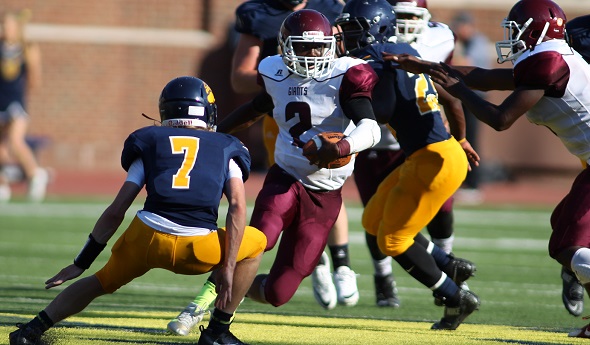
PHOTO: Kalamazoo Central, here on offense against St. Joseph last week at Michigan Stadium, will face Stevensville Lakeshore seeking its first win this season. (Click to see more from HighSchoolSportsScene.com.)