


NFHS Voice: Campaign Touts Benefits of High School Football
By
Karissa Niehoff
NFHS Executive Director
May 21, 2021
A full return to high school sports and performing arts programs – that’s the hope for this fall in schools across the country.
After a year of unprecedented challenges in keeping these programs going due to the pandemic, which included 11 states that conducted their primary football season this spring, there is great optimism as we look to a new school year.
Even in those states that were able to conduct activities last fall, attendance restrictions kept many fans out of stadiums and watching games online. However, with vaccine eligibility now at 12 years of age and older and with vaccinations continuing during the next three months, the likelihood of routines and traditions returning this fall grows stronger each day.
And there is no tradition more anticipated than the full-scale return of high school football. While there were 34 states there were fortunate enough to conduct football at some level last fall, the routines were anything but normal.
This fall, however, we anticipate a return to the energy and excitement of the 2019 season when 1,003,524 boys participated in 11-player football. That total marked a decline of only 2,489 from the previous year and was a good sign of a renewed confidence on the part of parents and student-athletes that concerns about the risk of injury were being addressed.
While boys participation in 11-player football has exceeded one million participants every year since 1999 and is overwhelmingly the most popular boys sport, there have been concerns about declines in past years.
Last fall, the NFHS and the National Football League announced a partnership to promote the growth, understanding and support for football at the high school level. The NFHS and NFL have been studying participation trends, developing educational tools and striving to restore confidence in students and parents that the sport is, in fact, more focused on risk minimization than ever before.
As a result, the springboard to the return of high school football next fall begins this week with the launch of the #ThisIsHSFootball campaign. Through this effort over the next few months, the NFHS will be reaching out to coaches, students, parents, officials, athletic directors and others with research information, participation trends and data on various risk mitigation efforts that, we believe, continues to make high school football safer than it has ever been.
As a part of this effort, the NFHS produced a video entitled “This is High School Football” designed to detail the benefits of participation in high school football.
As the video states, more so than at any other level of play, parents should feel good about their kids playing high school football.
>Here are some of the many educational and medical safeguards put in place the past 12 years to offer parents a comfort level about the safety standards that are a part of high school football.
► Concussion research and education. All NFHS high school playing rules require a student who is exhibiting signs of a concussion to be removed from the game and not allowed to return until the student has been cleared by a medical professional. Thanks to education and training on the part of students, coaches, trainers, parents and others, research data has shown positive trends in concussion rates. In a recent five-year period, concussion rates during practices dropped from 5.47 to 4.44 concussions per 10,000 athletic exposures.
► Concussion in Sport Course. This free online education course has been available through the NFHS Learning Center since 2010, and millions of individuals have taken the course for a deeper understanding about concussions.
► Concussion Laws. By 2014, every state had adopted state concussion laws that established mandatory protocols, and every state high school association has adopted policies that limit contact during preseason drills and in practices during the season.
► Football equipment. Manufacturers continue to produce higher quality equipment every year, and high school coaches are doing a much better job at teaching and coaching the rules of the game and making attempts to minimize risk of injury for players.
► Emergency Action Plans. Thanks to the NFHS Foundation, a copy of the “Anyone Can Save a Life” emergency action plan originally developed by the Minnesota State High School League was sent to all state high school associations and their high schools, and all schools have access to an AED to help save lives.
► Playing Rules. Risk minimization is a major focus of every NFHS sports rules committee. In football, helmet-to-helmet hits are not allowed.
High school football has been a significant part of schools, towns and communities across America for almost 100 years. The NFHS is committed to making the sport as safe as possible for the millions of kids who will play the sport in the years to come.
Dr. Karissa L. Niehoff is in her third year as executive director of the National Federation of State High School Associations (NFHS) in Indianapolis, Indiana. She is the first female to head the national leadership organization for high school athletics and performing arts activities and the sixth full-time executive director of the NFHS, which celebrated its 100th year of service during the 2018-19 school year. She previously was executive director of the Connecticut Association of Schools-Connecticut Interscholastic Athletic Conference for seven years.
1st & Goal: 2025 Week 5 Review
By
Geoff Kimmerly
MHSAA.com senior editor
September 29, 2025
Some weekends, it's easy to identify the game or few across the state that everyone will be talking about Monday morning.
 Some weekends, we get to Friday night and still don't have one that necessarily sticks out – and then several emerge with an argument for being considered the most notable matchup.
Week 5 this season definitely resembled the latter. And often, those weekends are the most fun from a spectator's point of view. Of our "headliner" games below, six were decided by seven points or fewer and could end up deciding league championships.
And as always, there was much more to tell.
Bay & Thumb
HEADLINER Port Huron Northern 21, Port Huron 7 Northern (4-1) took a 7-0 lead into halftime but pulled away during the second and secured not only this win but first place alone in the Macomb Area Conference Blue with a chance to clinch a share of the league title this week at Fraser. Port Huron (3-2) is one of three teams a game back and hoping for help to get back into the championship mix. Click for more from the Port Huron Times Herald.
Watch list Elkton-Pigeon-Bay Port Laker 13, Central Montcalm 0 There were a handful of matchups across the state featuring undefeated teams facing off, and Laker won this one with its third shutout of the season, and against a Hornets team (4-1) that entered the weekend averaging 42 points per game.
On the move Grand Blanc 41, Lansing Everett 6 This also was a matchup of undefeated teams, with the Bobcats moving to 5-0 for the first time since 2021. Goodrich 65, Clio 14 The Martians moved to 5-0 and a win away from potentially clinching the Flint Metro League Stars title while sending Clio (4-1) into a tie for second with two others. Montrose 14, Ovid-Elsie 10 The Rams (5-0) avenged last season’s 42-7 loss to the Marauders (3-2) to move into first place alone in the Mid-Michigan Activities Conference.
Greater Detroit
HEADLINER Dearborn Divine Child 17, Jackson Lumen Christi 13 Divine Child (5-0) gave up its first points this season, but again scored more to continue its best start since 2017. The Falcons opened Catholic High School League AA play by avenging last season’s 35-0 loss to the reigning champion Titans (2-3). Click for more from the Detroit News.
Watch list South Lyon 24, Walled Lake Western 21 The Lions (5-0) took their resurgence this season up a level with their first win over reigning Lakes Valley Conference champion Western (3-2) since 2021.
On the move Clarkston 21, Rochester Adams 7 The Wolves (4-1) are tied for first with West Bloomfield halfway through the Oakland Activities Association Red slate after avenging regular-season and playoff losses last season to Adams (3-2). Farmington 42, Birmingham Seaholm 19 The Falcons (4-1) can clinch a share of the OAA Blue title this week after avenging last season’s loss to the Maples (4-1). Redford Thurston 12, Redford Union 6 Thurston put an end to Union’s 35-game winning streak in the Western Wayne Athletic Conference and after having been shut out by the rival Panthers the last three seasons by a combined score of 63-0. Both are 3-2 overall but among four teams now tied for first in the league. Melvindale Academy for Business & Tech 32, Detroit Community 6 ABT (5-0) won a matchup of undefeated teams to move into first alone in the Charter School Conference Silver.
Mid-Michigan
HEADLINER Brighton 21, Northville 14 Brighton (4-1) sits in the top spot alone in the Kensington Lakes Activities Association West thanks to turning away another tough challenge from Northville (4-1) after also emerging with a one-point win in the teams’ 2024 meeting. Brighton also has handed a first league loss to Hartland, with Week 8 opponent Howell the third team tied for second place. Click for more from the Livingston Daily Press & Argus.
Watch list Pewamo-Westphalia 49, Bark River-Harris 0 A potential open date for both was salvaged with a meeting in Gaylord instead, and the Pirates (5-0) added one of their most impressive victories with a third shutout this fall to go with 12 points surrendered overall. The loss was Bark-River Harris’ first.
On the move Williamston 43, St. Johns 0 The Hornets (5-0) posted their third-straight shutout as they set up this week’s matchup at Haslett with a share of the Capital Area Activities Conference Red title on the line. St. Johns (4-1) remains just a game back. Lansing Sexton 34, Charlotte 18 Four of Sexton’s first five opponents have winning records, and this victory by the J-Dubbs (2-3) was Charlotte’s first in CAAC White play. Stockbridge 32, Reading 20 With a second-straight Big 8 Conference victory, the Panthers (2-3) suddenly have created some league title possibilities with leader Springport next up.
Northern Lower Peninsula
HEADLINER Traverse City St. Francis 21, Kingsley 20 This literally came down to inches as St. Francis stopped Kingsley (3-2) short on what would have been a go-ahead two-point conversion during the closing minutes. St. Francis (5-0) can finish its Northern Michigan Football Conference Leaders schedule undefeated this week against Boyne City, which joins Kingsley a game back in the standings. Click for more from the Traverse City Record-Eagle.
Watch list Traverse City West 27, Midland 21 (OT) The Titans (3-2) have navigated a pair of losses to top teams, and perhaps that paid off as they handed Midland (4-1) its only loss.
On the move Elk Rapids 15, Mancelona 14 Elk Rapids (2-3) has played a tough schedule and with undefeated Charlevoix up next. This win over Mancelona (3-2) was significant enough to jump the Elks six spots on the Division 6 playoff-points list. Ogemaw Heights 41, Clare 7 With a third-straight win over a possible contender, Ogemaw Heights (4-1) held on to the top spot alone in the Jack Pine Conference Division 1. East Jordan 34, Mount Pleasant Sacred Heart 12 The Red Devils (3-2) ended a two-game skid as they readied to jump back into NMFL Legacy play this week.
Southeast & Border
HEADLINER Michigan Center 36, Leslie 32 The Cardinals (5-0) remain undefeated overall and midway through the Cascades Conference East schedule thanks to winning their first close game this fall with a notable comeback. Leslie (4-1) led 20-8 at halftime before Michigan Center surged ahead and then held off a late Leslie charge. Click for more from the Jackson Citizen Patriot.
Watch list Adrian 3, Ypsilanti Lincoln 0 The Maples (4-1) equaled last season’s win total by handing Lincoln (4-1) its lone defeat thanks to Zach Hassan’s field goal during the closing seconds.
On the move Dexter 42, Chelsea 28 In one of the most power-packed matchups in the state, Dexter (4-1) bounced back from its Week 4 loss to hand Chelsea (4-1) its first this fall. Monroe Jefferson 44, Flat Rock 22 Jefferson (5-0) remains tied with Monroe St. Mary Catholic Central atop the Huron League standings after breaking a seven-game losing streak against the Rams (3-2). Hudson 56, Adrian Madison 7 Midway through the Lenawee County Athletic Association schedule, Hudson (5-0) is tied with Clinton for first, as Madison (3-2) has fallen to both but remains a solid 26th on the Division 6 playoff-points list thanks to bonus points earned during both defeats.
Southwest Corridor
HEADLINER Buchanan 16, Berrien Springs 13 The Bucks (4-1) took a serious step toward claiming a first Lakeland Conference title since 2022, edging two-time reigning champion Berrien Springs (3-1). Next up for Buchanan is reigning Division 7 champion Millington before a Week 7 matchup with Dowagiac that will decide the Lakeland title outright for one or both teams, depending on how Dowagiac does this week against the Shamrocks. Click for more from the Niles Daily Star.
Watch list Coldwater 28, Parma Western 21 The Cardinals (4-1) are seeking their first playoff berth this decade and picked up what could end up a significant win toward earning that postseason invite – Coldwater’s first victory over Western (1-4) since 2019.
On the move Battle Creek Harper Creek 37, Grand Rapids Kenowa Hills 15 The Beavers’ quick break in the Interstate 8 Athletic Conference schedule put them up against undefeated Kenowa Hills (4-1), and Harper Creek (4-1) avenged a 34-30 loss from a year ago. Vicksburg 28, Three Rivers 24 The Bulldogs (4-1) came up big in their toughest Wolverine Conference game yet, avenging last year’s 14-11 loss by handing Three Rivers (4-1) its first defeat. Union City 38, Quincy 14 The Chargers (4-1) bounced back quickly from a Week 4 loss to hand Quincy (4-1) its first this fall.
Upper Peninsula
HEADLINIER Kingsford 17, Calumet 15 The Western Peninsula Athletic Conference Copper race continued to sort itself out as Kingsford moved into a first-place tie with Menominee and Calumet joined three other teams tied for third. The Flivvers capped this win with a go-ahead field goal during the final minute. Click for more from the Iron Mountain Daily News.
Watch list Iron Mountain 30, L’Anse 26 This was easily the closest game these two have played against each other since becoming annual foes in 2018, and the win was especially significant for the Mountaineers (4-1) as they prepare for a rematch with Bark River-Harris in two weeks – while L’Anse (4-1) sees BR-H on Friday.
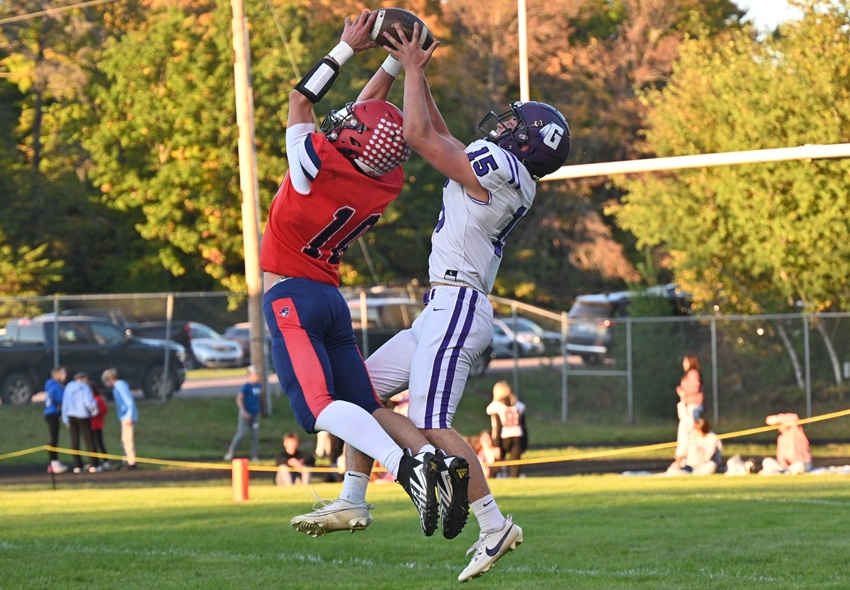
On the move Gladstone 59, Ishpeming Westwood 22 Gladstone (2-3) has found its stride offensively with two straight games reaching 50 points as the team surpassed last year’s win total before the end of September. Escanaba 42, Cheboygan 13 Escanaba (5-0) equaled last season’s win total in advance of this week’s matchup with rival Marquette. Marquette 48, Sault Ste. Marie 6 The Sentinels also set up for this week’s showdown with a big win including their most points scored in a game this season.
West Michigan
HEADLINER Big Rapids 40, Reed City 13 Big Rapids is 5-0 for the first time since 2009 and ran its Central State Activities Association winning streak to 17 with a third-straight victory over Reed City, having started this league run after falling to the Coyotes in 2022. The Cardinals can clinch a share of the CSAA Red title this week against Remus Chippewa Hills. Click for more from the Big Rapids Pioneer.
Watch list Rockford 28, Grandville 0 The Rams’ Week 1 loss to still-undefeated Saline is looks better every Friday, and Rockford has responded to that defeat by reducing the number of points it has given up for four weeks straight. The Rams have handed lone Ottawa-Kent Conference Red losses to East Kentwood and now Grandville (3-2), all great news heading into Friday’s showdown with undefeated Hudsonville.
On the move East Grand Rapids 10, Grand Rapids Northview 3 The O-K Black is going to be an interesting follow over the next three weeks as East Grand Rapids (3-2) handed Northview (4-1) its first loss to create a four-team tie for second behind Grand Rapids Catholic Central. Grand Rapids Catholic Central 10, Middleville Thornapple Kellogg 0 The Cougars (5-0) remain atop their league after a close win over a Trojans team (3-2) that already has equaled its win total from last year. Byron Center 42, Muskegon Mona Shores 35 (OT) After a tough start facing a loaded first-half schedule, Byron Center (2-3) might be on the verge of a nice run back to the playoffs and potentially shook up the O-K Green with this victory over the Sailors (3-2).
8-Player
HEADLINER Norway 44, Pickford 6 Pickford’s wins over the Knights had come by 45, 18 and 22 over the last two seasons (including once in the playoffs), but Norway (5-0) avenged in a big way with arguably its most impressive win this fall and over the last three playoff seasons. Pickford (4-1) had given up only 14 points total over its first four games.
Watch list Grand Rapids Sacred Heart 33, Gobles 14 Sacred Heart is a combined 14-1 over the last two seasons, but defeating a program of Gobles’ caliber adds more serious punch to an already impressive run.
On the move Onekama 30, Bay City All Saints 24 The Portagers (5-0) have defeated four teams with winning records, including All Saints (3-2), on the way to being tied for first on the Division 2 playoff-points list. Indian River Inland Lakes 49, Hillman 14 In handing Hillman (4-1) its first loss, Inland Lakes (5-0) kicked off a run that will send it against three more teams with winning records (at this point) to finish the regular season. Kingston 48, Brown City 20 The Cardinals (5-0) moved closer to a potential Week 7 showdown with rival Deckerville to decide the Big Thumb Conference Blue title.
MHSAA.com's weekly “1st & Goal” previews and reviews are powered by MI Student Aid, a division within the Department of Lifelong Education, Advancement, and Potential (MiLEAP). MI Student Aid encourages students to pursue postsecondary education by providing access to student financial resources and information. MI Student Aid administers the state’s scholarship and grant programs that help make college Accessible, Affordable and Attainable for you. Click to connect with MI Student Aid and find more information on Facebook and Twitter @mistudentaid.
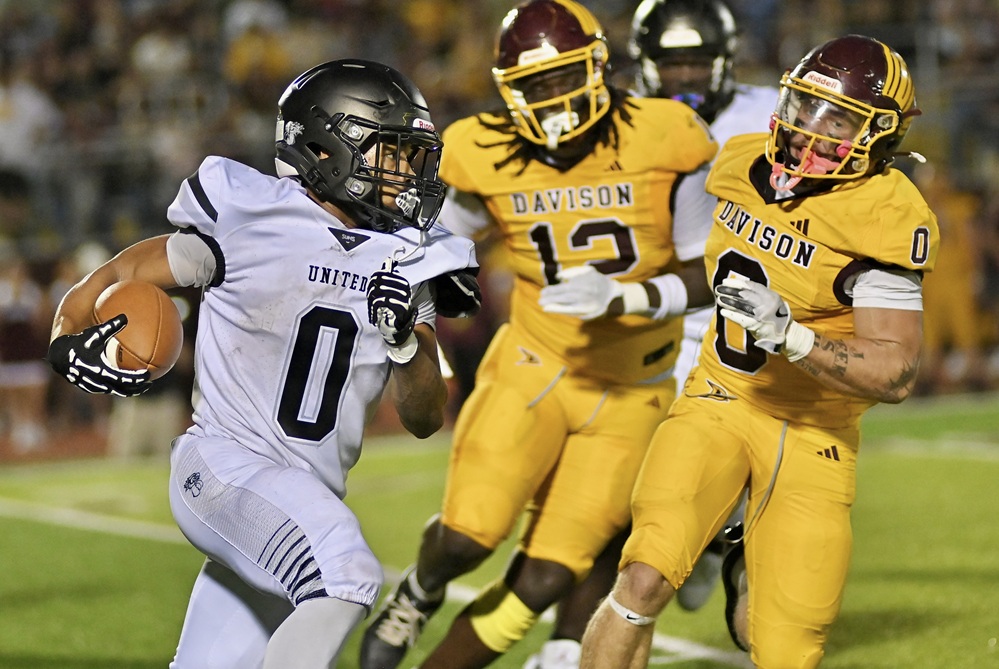
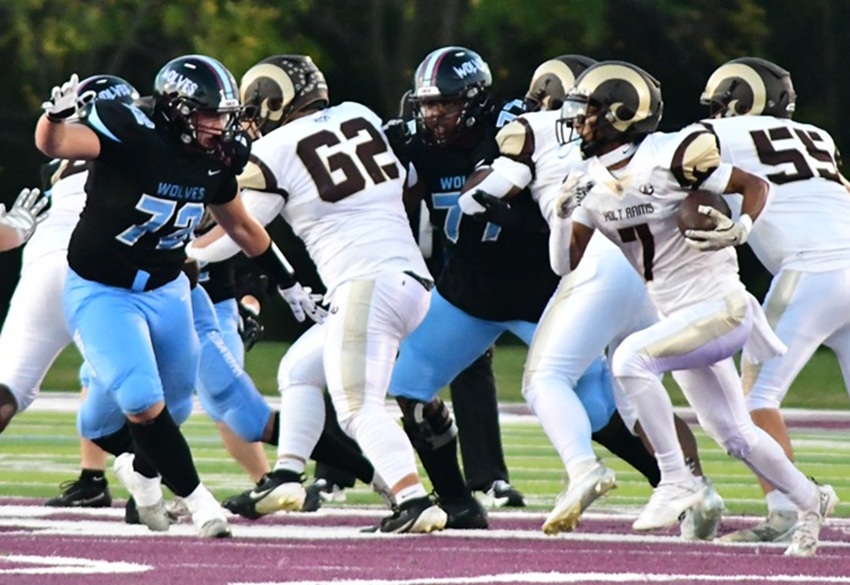
PHOTOS Davison defenders pursue a Saginaw United ball carrier during the Cardinals' 49-8 win Friday. (Middle) A Holt ball carrier works to get outside during the Rams' 42-14 win over Okemos. (Below) Ishpeming Westwood's Ethan Marta and Gladstone's Trevor Thorbahn jump up for a ball intended for Thorbahn, but Marta is able to hit it away. (Davison/Saginaw United photo by Terry Lyons. Holt/Okemos photo by John Johnson. Westwood/Gladstone photo by Cara Kamps.)