


NFHS Voice: Campaign Touts Benefits of High School Football
By
Karissa Niehoff
NFHS Executive Director
May 21, 2021
A full return to high school sports and performing arts programs – that’s the hope for this fall in schools across the country.
After a year of unprecedented challenges in keeping these programs going due to the pandemic, which included 11 states that conducted their primary football season this spring, there is great optimism as we look to a new school year.
Even in those states that were able to conduct activities last fall, attendance restrictions kept many fans out of stadiums and watching games online. However, with vaccine eligibility now at 12 years of age and older and with vaccinations continuing during the next three months, the likelihood of routines and traditions returning this fall grows stronger each day.
And there is no tradition more anticipated than the full-scale return of high school football. While there were 34 states there were fortunate enough to conduct football at some level last fall, the routines were anything but normal.
This fall, however, we anticipate a return to the energy and excitement of the 2019 season when 1,003,524 boys participated in 11-player football. That total marked a decline of only 2,489 from the previous year and was a good sign of a renewed confidence on the part of parents and student-athletes that concerns about the risk of injury were being addressed.
While boys participation in 11-player football has exceeded one million participants every year since 1999 and is overwhelmingly the most popular boys sport, there have been concerns about declines in past years.
Last fall, the NFHS and the National Football League announced a partnership to promote the growth, understanding and support for football at the high school level. The NFHS and NFL have been studying participation trends, developing educational tools and striving to restore confidence in students and parents that the sport is, in fact, more focused on risk minimization than ever before.
As a result, the springboard to the return of high school football next fall begins this week with the launch of the #ThisIsHSFootball campaign. Through this effort over the next few months, the NFHS will be reaching out to coaches, students, parents, officials, athletic directors and others with research information, participation trends and data on various risk mitigation efforts that, we believe, continues to make high school football safer than it has ever been.
As a part of this effort, the NFHS produced a video entitled “This is High School Football” designed to detail the benefits of participation in high school football.
As the video states, more so than at any other level of play, parents should feel good about their kids playing high school football.
>Here are some of the many educational and medical safeguards put in place the past 12 years to offer parents a comfort level about the safety standards that are a part of high school football.
► Concussion research and education. All NFHS high school playing rules require a student who is exhibiting signs of a concussion to be removed from the game and not allowed to return until the student has been cleared by a medical professional. Thanks to education and training on the part of students, coaches, trainers, parents and others, research data has shown positive trends in concussion rates. In a recent five-year period, concussion rates during practices dropped from 5.47 to 4.44 concussions per 10,000 athletic exposures.
► Concussion in Sport Course. This free online education course has been available through the NFHS Learning Center since 2010, and millions of individuals have taken the course for a deeper understanding about concussions.
► Concussion Laws. By 2014, every state had adopted state concussion laws that established mandatory protocols, and every state high school association has adopted policies that limit contact during preseason drills and in practices during the season.
► Football equipment. Manufacturers continue to produce higher quality equipment every year, and high school coaches are doing a much better job at teaching and coaching the rules of the game and making attempts to minimize risk of injury for players.
► Emergency Action Plans. Thanks to the NFHS Foundation, a copy of the “Anyone Can Save a Life” emergency action plan originally developed by the Minnesota State High School League was sent to all state high school associations and their high schools, and all schools have access to an AED to help save lives.
► Playing Rules. Risk minimization is a major focus of every NFHS sports rules committee. In football, helmet-to-helmet hits are not allowed.
High school football has been a significant part of schools, towns and communities across America for almost 100 years. The NFHS is committed to making the sport as safe as possible for the millions of kids who will play the sport in the years to come.
Dr. Karissa L. Niehoff is in her third year as executive director of the National Federation of State High School Associations (NFHS) in Indianapolis, Indiana. She is the first female to head the national leadership organization for high school athletics and performing arts activities and the sixth full-time executive director of the NFHS, which celebrated its 100th year of service during the 2018-19 school year. She previously was executive director of the Connecticut Association of Schools-Connecticut Interscholastic Athletic Conference for seven years.
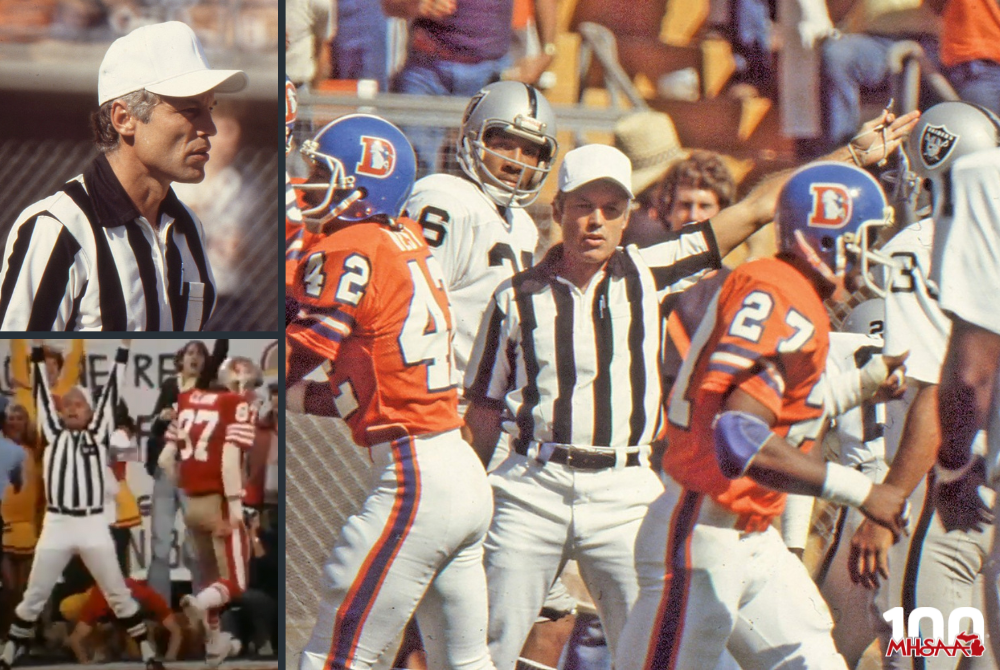
Flashback 100: Multi-Sport Star Look Becomes Super Bowl Officiating Legend
February 6, 2025
In 1960, Dean Look was drafted by both the Chicago White Sox of Major League Baseball and the Denver Broncos of the American Football League. For those familiar with Look’s athletic career at Lansing Everett and Michigan State University, his professional prospects in multiple sports came as no surprise.
A standout in football, baseball, and track, Look instead would make his most memorable pro sports mark as one of the NFL’s top officials.
At Everett during the mid-1950s, Look played a key role in leading his school to two state track & field championships (1954 and 1956) under legendary coach Archie Ross. Look also captured three individual state titles – two as part of 880-meter relay teams (1954 and 1956) and one in the pole vault (1956). In addition to his track achievements, Look was a star performer for Everett’s football and baseball teams.
After high school, Look continued his multi-sport career at Michigan State, excelling in both football and baseball. He finished sixth in the 1959 Heisman Trophy voting and was a key contributor to MSU’s shared football national championship in 1957.
Following college, Look signed with the White Sox, turning down an opportunity with the Broncos. After a brief stint in professional baseball, he returned to football, playing for the AFL’s New York Titans in 1962.
However, it was as an NFL official that Look truly left his legacy. Over a 29-year officiating career (1972–2001), he was assigned to three Super Bowls – Super Bowl XIII (1979), Super Bowl XV (1981) and Super Bowl XXVII (1993). One of his most iconic moments came during the 1981 NFC Championship Game, where he signaled "touchdown" after Joe Montana's legendary pass to Dwight Clark – forever known as “The Catch.”
Listen to Look discuss that historic play here: Watch on YouTube.
Athletic talent ran in the family, as Dean’s brother Bruce Look also played professional baseball, spending time with the Minnesota Twins.
Michigan has produced several notable Super Bowl officials, including brothers Carl, Dino, and Perry Paganelli from Wyoming Rogers High School. Carl officiated in Super Bowls XXXIX, XLI, XLVI, and XLVIII. In Super Bowl XLI, he and Perry made history as the first brothers to work on the same Super Bowl officiating crew. Perry also officiated Super Bowl LII, while Dino has been part of three Super Bowls – XLVII, LV, and LVII. Remarkably, at least one Paganelli has officiated in eight of the 59 Super Bowls.
This year’s Super Bowl referee is Ron Torbert, a fellow Michigan State graduate who has been an NFL official since 2010. Like Look and the Paganellis, Torbert also got his start officiating Michigan high school football.
For more information on becoming an MHSAA official, visit the MHSAA Officials page.
Previous "Flashback 100" Features
Jan. 31: Johnson Family Put Magical Stamp on Michigan High School Hoops - Read
Jan. 24: Future Hall of Famers Face Off First in MHSAA Class A Final - Read
Jan. 17: First-Ever WNBA Draft Pick Rocked at Salem, Won Titles at Tennessee - Read
Jan. 10: Despite Launching Before 3-Point Line, Smith Still Tops Scoring List - Read
Jan. 3: Edison's Jackson Earns Place Among State's All-Time Elite - Read
Dec. 20: Future Olympian Piper Leads Grosse Pointe North to Historic Heights - Read
Dec. 13: The Other Mr. Forsythe in Michigan School Sports - Read
Dec. 6: Coleman's Legendary Heroics Carry Harrison Through Repeat - Read
Nov. 29: Harbaugh Brothers' Football Roots Planted in Part at Pioneer - Read
Nov. 22: 8-Player Football Finals Right at Home at Superior Dome - Read
Nov. 15: Leland Career Helps Set Stage for Glass' International Stardom - Read
Nov. 8: Future Baseball Pro Led Escanaba's Legendary Football Title Run - Read
Nov. 1: Michigan High School Baseball Trio Provide World Series Voices - Read
Oct. 25: Before Leading Free World, Ford Starred for Champion GR South - Read
Oct. 18: Mercy Links Legend Becomes World Golf Hall of Famer - Read
Oct. 11: Fisher Races to Finals Stardom on Way to U.S. Olympic First - Read
Oct. 4: Lalas Leaves High School Legacies on Ice & Pitch - Read
Sept. 27: Tamer's History-Making Run Starts in Dexter, Continues to Paris - Read
Sept. 20: Todd Martin’s Road to Greatness Starts at East Lansing - Read
Sept. 13: James Earl Jones, Dickson High Hoops to Hollywood Legend - Read
Sept. 6: Pioneers' Unstoppable Streak Stretches 9 Seasons - Read
Aug. 30: Detroit dePorres Rushes to 1995 Class CC Football Championship - Read
(Photos courtesy of Referee Magazine.)