

NFHS Voice: Campaign Touts Benefits of High School Football
By
Karissa Niehoff
NFHS Executive Director
May 21, 2021
A full return to high school sports and performing arts programs – that’s the hope for this fall in schools across the country.
After a year of unprecedented challenges in keeping these programs going due to the pandemic, which included 11 states that conducted their primary football season this spring, there is great optimism as we look to a new school year.
Even in those states that were able to conduct activities last fall, attendance restrictions kept many fans out of stadiums and watching games online. However, with vaccine eligibility now at 12 years of age and older and with vaccinations continuing during the next three months, the likelihood of routines and traditions returning this fall grows stronger each day.
And there is no tradition more anticipated than the full-scale return of high school football. While there were 34 states there were fortunate enough to conduct football at some level last fall, the routines were anything but normal.
This fall, however, we anticipate a return to the energy and excitement of the 2019 season when 1,003,524 boys participated in 11-player football. That total marked a decline of only 2,489 from the previous year and was a good sign of a renewed confidence on the part of parents and student-athletes that concerns about the risk of injury were being addressed.
While boys participation in 11-player football has exceeded one million participants every year since 1999 and is overwhelmingly the most popular boys sport, there have been concerns about declines in past years.
Last fall, the NFHS and the National Football League announced a partnership to promote the growth, understanding and support for football at the high school level. The NFHS and NFL have been studying participation trends, developing educational tools and striving to restore confidence in students and parents that the sport is, in fact, more focused on risk minimization than ever before.
As a result, the springboard to the return of high school football next fall begins this week with the launch of the #ThisIsHSFootball campaign. Through this effort over the next few months, the NFHS will be reaching out to coaches, students, parents, officials, athletic directors and others with research information, participation trends and data on various risk mitigation efforts that, we believe, continues to make high school football safer than it has ever been.
As a part of this effort, the NFHS produced a video entitled “This is High School Football” designed to detail the benefits of participation in high school football.
As the video states, more so than at any other level of play, parents should feel good about their kids playing high school football.
>Here are some of the many educational and medical safeguards put in place the past 12 years to offer parents a comfort level about the safety standards that are a part of high school football.
► Concussion research and education. All NFHS high school playing rules require a student who is exhibiting signs of a concussion to be removed from the game and not allowed to return until the student has been cleared by a medical professional. Thanks to education and training on the part of students, coaches, trainers, parents and others, research data has shown positive trends in concussion rates. In a recent five-year period, concussion rates during practices dropped from 5.47 to 4.44 concussions per 10,000 athletic exposures.
► Concussion in Sport Course. This free online education course has been available through the NFHS Learning Center since 2010, and millions of individuals have taken the course for a deeper understanding about concussions.
► Concussion Laws. By 2014, every state had adopted state concussion laws that established mandatory protocols, and every state high school association has adopted policies that limit contact during preseason drills and in practices during the season.
► Football equipment. Manufacturers continue to produce higher quality equipment every year, and high school coaches are doing a much better job at teaching and coaching the rules of the game and making attempts to minimize risk of injury for players.
► Emergency Action Plans. Thanks to the NFHS Foundation, a copy of the “Anyone Can Save a Life” emergency action plan originally developed by the Minnesota State High School League was sent to all state high school associations and their high schools, and all schools have access to an AED to help save lives.
► Playing Rules. Risk minimization is a major focus of every NFHS sports rules committee. In football, helmet-to-helmet hits are not allowed.
High school football has been a significant part of schools, towns and communities across America for almost 100 years. The NFHS is committed to making the sport as safe as possible for the millions of kids who will play the sport in the years to come.
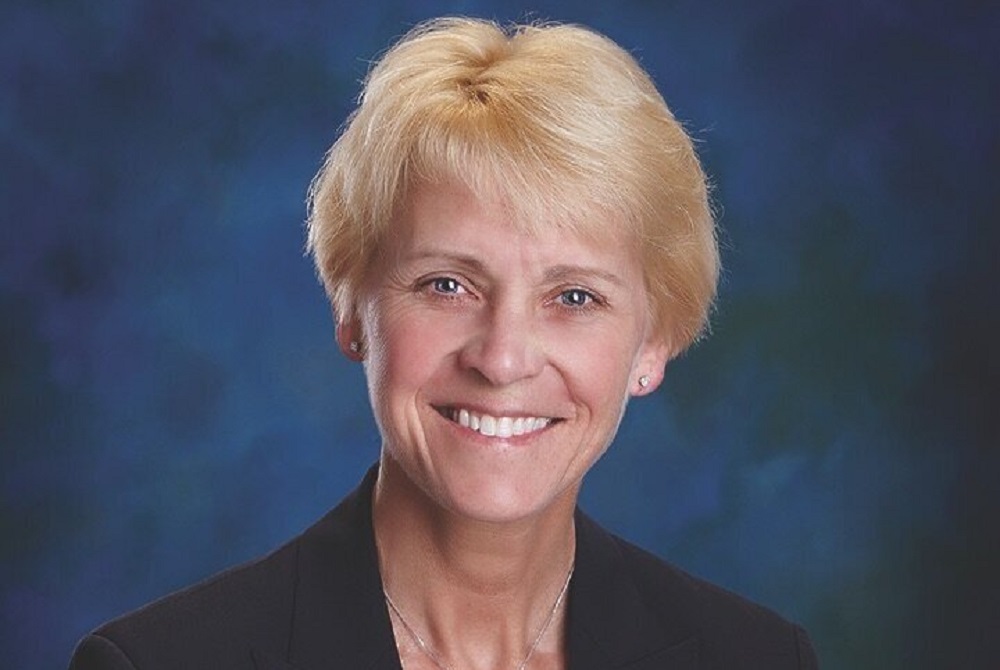
Dr. Karissa L. Niehoff is in her third year as executive director of the National Federation of State High School Associations (NFHS) in Indianapolis, Indiana. She is the first female to head the national leadership organization for high school athletics and performing arts activities and the sixth full-time executive director of the NFHS, which celebrated its 100th year of service during the 2018-19 school year. She previously was executive director of the Connecticut Association of Schools-Connecticut Interscholastic Athletic Conference for seven years.
Working Together to Give Teams Their Best, Dechow & Crew Win Every Time Out
By
Tom Spencer
Special for MHSAA.com
October 22, 2021
Football historians can debate this forever.
 Tonight at Rodes Field in Kingsley – perhaps for the first time in Michigan High School Athletic Association history – three teams with perfect records will meet each other on the same football field in the same game.
Two of them, Traverse City St. Francis, and Kingsley, are playing for the right to boast of an undefeated regular season and an outright conference championship. The third team and its captain — better known as the referee crew — has already been assigned a first-round playoff game by the MHSAA.
Where they will go hasn’t been determined, but Joe Dechow’s crew knows it will referee at least two rounds this postseason. The veteran crew already has assignments from MHSAA but just like the schools, the crew is waiting for the postseason pairings to be announced Sunday.
Dechow, the crew leader and an MHSAA 41-year veteran official, will put on his white cap and be ready for the 7 p.m. kickoff tonight knowing Kingsley/St. Francis is a big, big game. Dechow’s crew members will go into kickoff confident they know at least one team that will win, just like every game they’ve done together for about the last 20 years are so.
“We always win,” Dechow jested.
But how officials define their victories is different, Dechow explained.
Taking the field with Dechow tonight will be umpire Joe Johnson, back judge Roark Pargeon, line judge Brett Spalding, head linesman Jeff Bretzke, side judge Peter Moss, and field judge Rick Zych. All seven officials worked together in the Betsie Valley Officials Association for many years and have continued together as a crew with the Northern Sport Officials Association after the two combined a few years ago.
 “We don’t win or lose, but we’re a still a team,” he said. “One of the great things about working with the same guys for years and years is you know where people are going to be, and you know how they’re going to take care of things.
“It is a trust factor, ‘cuz it’s a team.”
Dechow’s team has taken the field every week for decades for the benefit of student-athletes. Moss has been an MHSAA registered official for 44 years. Spalding and Zych have been registered 36 years. Bretzke, Johnson and Paragon follow with 22, 20 and 16 years of MHSAA service, respectively. All officiate at least two sports.
Dechow was on the wrestling and football teams at Maple City Glen Lake High School. Upon graduating, he started officiating wrestling — at the age of just 18.
“That got interesting, you know, because you go from a player to a ref all at once and all these old coaches are looking at you like ‘Who are you, kid?’” Dechow recalled.
Dechow has been officiating football for 36 years and was a registered wrestling official for 15. There have been a few times he’s considered giving up the white cap that signals he’s the game’s referee. (The white cap originated to benefit television viewers for college and the National Football League.)
The referee has general oversight and control of the game. Dechow is the final authority for the score, the number of a down in case of a disagreement, and all rule interpretations when a debate arises among the other officials. He’s also the only official who wears a white hat; all the other officials wear black hats.
The “white hat” also announces all penalties and confers with the offending team’s captain, monitors the quarterback area during the game, requests the linesmen to bring the yardage chains in for first down measurements and notifies the head coach of player ejections.
Dechow was ready to put his white hat down for a while when he first attempted to give up refereeing due to family and career demands. He was planning to get out and was asked to help another crew for a “few” games.
“I was going to just do a couple of games, and then somebody else quit and I wound up getting back into it,” he said. “There was another white hat that had left just before the season started … so all of sudden I started hearing ‘Do you still have a white hat? Would you like to maybe …’
“So I did.”
 Dechow’s crew has seen a lot of changes in MHSAA football during their careers. Rules to improve safety have been their favorites. They have also seen the addition of 8-player football and the use of two-way radios.
But it’s positive changes in sportsmanlike conduct among players, coaches and fans Dechow excitedly singles out.
Everyone, Dechow notes, is noticing the lower number of recruits joining the current officials in all MHSAA sports.
“More people appreciate the fact that we have to be out there, and we’re not out there to get anybody,” he said. “By and large the coaches are great.
“Of course they are emotional and of course they are pulling for their team and they’re going to argue for the right outcome for them,” he continued. “Over the last several years we have seen an absolutely marked change in people – spectators, players and coaches — all providing a lot more respect the officials.”
The crew had tonight’s game on its schedule at the beginning of the season. The guys couldn’t help looking ahead to how big a game it could be.
St. Francis coach Josh Sellers and Kingsley coach Tim Wooer probably had a better idea of how big a game it could be when they — and football enthusiasts all over Northern Michigan — likely circled it on the calendar. Kingsley won last year’s match 36-23 at Thirlby Field, the Gladiators’ home turf.
This year the Stags host with the Northern Michigan Football Conference’s Legends division championship on the line.
“Sports mean a lot to kids,” Dechow pointed out. “They meant a lot to us.
“That’s why we’re out there.”
 Tom Spencer is a longtime MHSAA-registered basketball and soccer official, and former softball and baseball official, and he also has coached in the northern Lower Peninsula area. He previously has written for the Saginaw News, Bay County Sports Page and Midland Daily News. He can be reached at [email protected] with story ideas for Manistee, Wexford, Missaukee, Roscommon, Ogemaw, Iosco, Alcona, Oscoda, Crawford, Kalkaska, Grand Traverse, Benzie, Leelanau, Antrim, Otsego, Montmorency, Alpena, Presque Isle, Cheboygan, Charlevoix and Emmet counties.
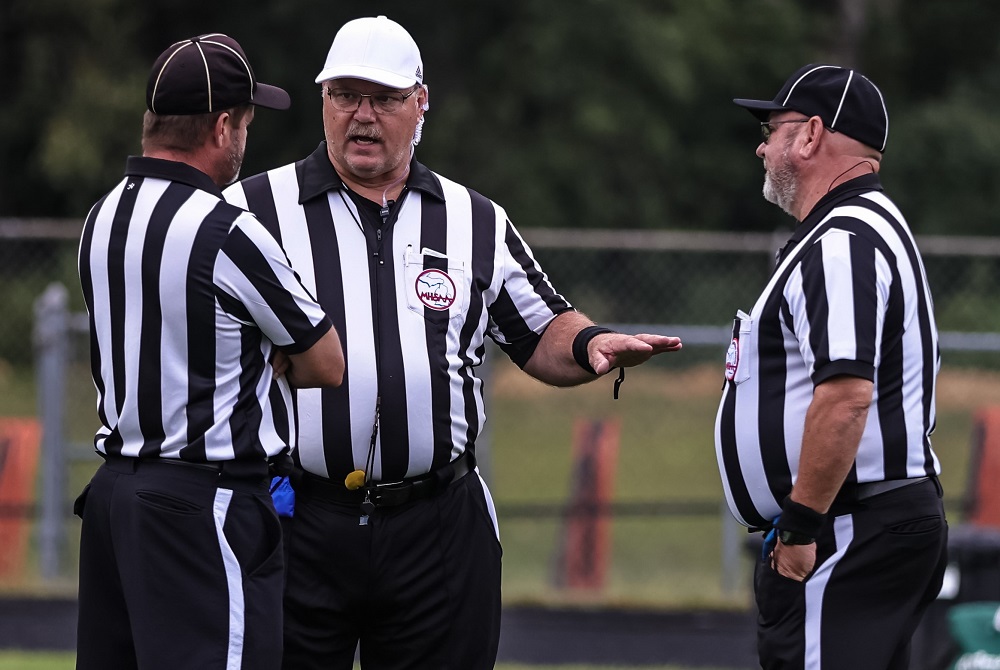
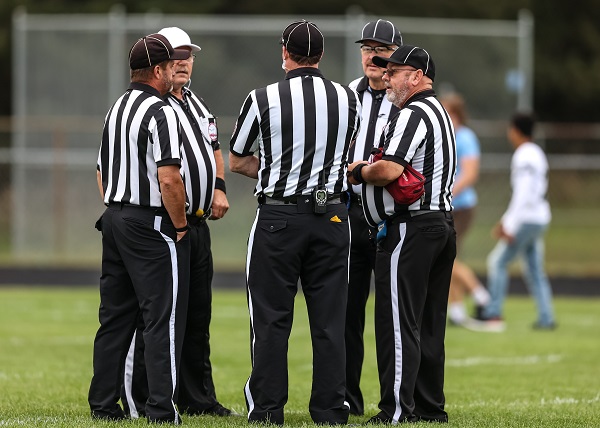
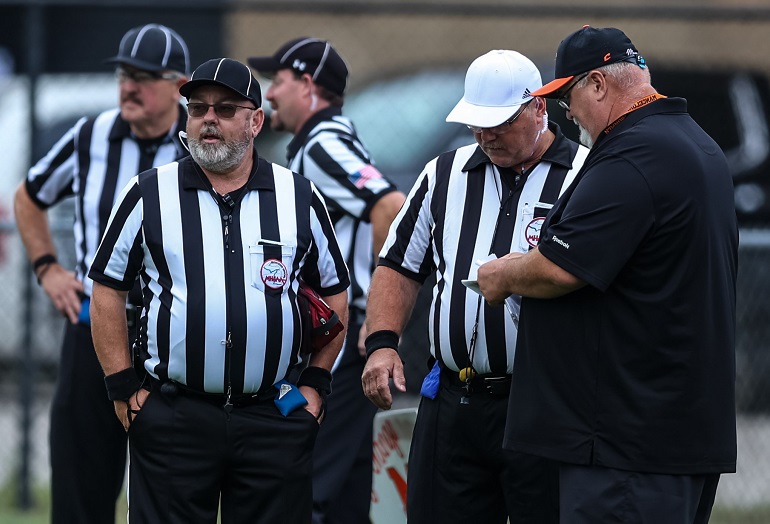
PHOTOS (Top) “White hat” Joe Dechow talks things over with crew members Roark Pargeon (left) and Brett Spalding during this season’s Mancelona/LeRoy Pine River varsity football game. (Middle) Those three plus Jeff Bretzke (middle) and Joe Johnson (second from right) huddle up. (Below) Dechow and Johnson confer with Mancelona coach Dan Derrer. (Photos by Miles Postema.)