


NFHS Voice: Campaign Touts Benefits of High School Football
By
Karissa Niehoff
NFHS Executive Director
May 21, 2021
A full return to high school sports and performing arts programs – that’s the hope for this fall in schools across the country.
After a year of unprecedented challenges in keeping these programs going due to the pandemic, which included 11 states that conducted their primary football season this spring, there is great optimism as we look to a new school year.
Even in those states that were able to conduct activities last fall, attendance restrictions kept many fans out of stadiums and watching games online. However, with vaccine eligibility now at 12 years of age and older and with vaccinations continuing during the next three months, the likelihood of routines and traditions returning this fall grows stronger each day.
And there is no tradition more anticipated than the full-scale return of high school football. While there were 34 states there were fortunate enough to conduct football at some level last fall, the routines were anything but normal.
This fall, however, we anticipate a return to the energy and excitement of the 2019 season when 1,003,524 boys participated in 11-player football. That total marked a decline of only 2,489 from the previous year and was a good sign of a renewed confidence on the part of parents and student-athletes that concerns about the risk of injury were being addressed.
While boys participation in 11-player football has exceeded one million participants every year since 1999 and is overwhelmingly the most popular boys sport, there have been concerns about declines in past years.
Last fall, the NFHS and the National Football League announced a partnership to promote the growth, understanding and support for football at the high school level. The NFHS and NFL have been studying participation trends, developing educational tools and striving to restore confidence in students and parents that the sport is, in fact, more focused on risk minimization than ever before.
As a result, the springboard to the return of high school football next fall begins this week with the launch of the #ThisIsHSFootball campaign. Through this effort over the next few months, the NFHS will be reaching out to coaches, students, parents, officials, athletic directors and others with research information, participation trends and data on various risk mitigation efforts that, we believe, continues to make high school football safer than it has ever been.
As a part of this effort, the NFHS produced a video entitled “This is High School Football” designed to detail the benefits of participation in high school football.
As the video states, more so than at any other level of play, parents should feel good about their kids playing high school football.
>Here are some of the many educational and medical safeguards put in place the past 12 years to offer parents a comfort level about the safety standards that are a part of high school football.
► Concussion research and education. All NFHS high school playing rules require a student who is exhibiting signs of a concussion to be removed from the game and not allowed to return until the student has been cleared by a medical professional. Thanks to education and training on the part of students, coaches, trainers, parents and others, research data has shown positive trends in concussion rates. In a recent five-year period, concussion rates during practices dropped from 5.47 to 4.44 concussions per 10,000 athletic exposures.
► Concussion in Sport Course. This free online education course has been available through the NFHS Learning Center since 2010, and millions of individuals have taken the course for a deeper understanding about concussions.
► Concussion Laws. By 2014, every state had adopted state concussion laws that established mandatory protocols, and every state high school association has adopted policies that limit contact during preseason drills and in practices during the season.
► Football equipment. Manufacturers continue to produce higher quality equipment every year, and high school coaches are doing a much better job at teaching and coaching the rules of the game and making attempts to minimize risk of injury for players.
► Emergency Action Plans. Thanks to the NFHS Foundation, a copy of the “Anyone Can Save a Life” emergency action plan originally developed by the Minnesota State High School League was sent to all state high school associations and their high schools, and all schools have access to an AED to help save lives.
► Playing Rules. Risk minimization is a major focus of every NFHS sports rules committee. In football, helmet-to-helmet hits are not allowed.
High school football has been a significant part of schools, towns and communities across America for almost 100 years. The NFHS is committed to making the sport as safe as possible for the millions of kids who will play the sport in the years to come.
Dr. Karissa L. Niehoff is in her third year as executive director of the National Federation of State High School Associations (NFHS) in Indianapolis, Indiana. She is the first female to head the national leadership organization for high school athletics and performing arts activities and the sixth full-time executive director of the NFHS, which celebrated its 100th year of service during the 2018-19 school year. She previously was executive director of the Connecticut Association of Schools-Connecticut Interscholastic Athletic Conference for seven years.
Playmakers Make Way for GRCC Repeat
By
Paul Costanzo
Special for MHSAA.com
January 23, 2021
DETROIT – Frankenmuth came into Saturday’s Division 5 Football Final with staggering defensive numbers.
The Eagles had held opponents to 6.8 points and 27 yards rushing per game, and 1.1 yards per carry. Just three opponents had scored in double digits, and Frankenmuth had won each of those games comfortably.
Grand Rapids Catholic Central was well aware of those numbers – so much so that coach Todd Kolster recited them off the top of his head after the game. But the Cougars were also aware of the playmakers they had on offense, and the opportunities they would have to make plays.
Behind a six-touchdown performance from junior quarterback Joey Silveri, Catholic Central did just that, claiming a 48-21 victory against the Eagles at Ford Field. It’s the second-straight title for the Cougars, and fourth in five years. The previous three came in Division 4.
“They are a great defense; they don’t give up a lot of rush yards,” Silveri said. “We knew going into this game that we were going to have to win our matchups one on one to make some big plays, and I was very confident in our guys.”
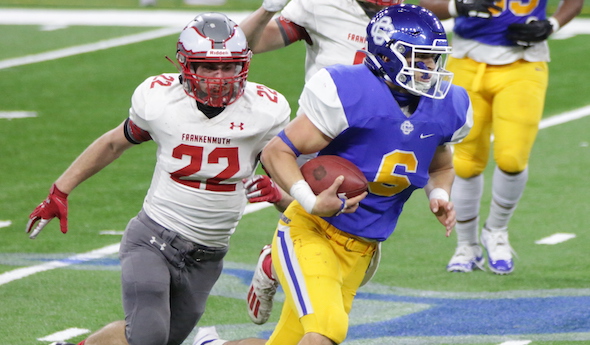
It was the second-straight year that Silveri accounted for six touchdowns in the Finals, as he did the same against Detroit Country Day in 2019. On Saturday, he threw for three touchdowns and ran for three more. He finished the night with 172 yards on 9 of 15 passing, and 104 yards on the ground.
“I love playing in big games,” Silveri said. “It’s what you play for; it’s a lot of fun. All the preparation we did through this week, it all paid off. When you play a defense that’s basically man-on-man coverage, they bring a lot of pressure, it leaves a lot of chances for big plays, and we took advantage of that tonight.”
Silveri and the Cougars (11-0) wasted little time spreading the field and putting their athletes in space to keep Frankenmuth’s aggressive defense off balance. He hit senior running back Nick Hollern for a 30-yard pass on the first play from scrimmage, and each of the first two drives ended with touchdown passes to the Cougars’ Division I-bound receivers – an 11-yard pass to junior tight end Nolan Ziegler (Notre Dame) and a 13-yard pass to senior receiver Jace Williams (Miami of Ohio).
 The Cougars built a 28-7 lead by the half and went up 35-7 early in the third quarter.
“I thought our guys really came out aggressive, and that was the big thing for us,” Kolster said. “We knew they were a heck of a football team, they’re very physical, they play hard, so we had to be able to match that intensity and get some matchups early. We were able to do that, and we were able to continue to go.”
The hill was too high to climb for Frankenmuth (11-1), which was making its first Finals appearance. The Eagles have been a near-constant playoff presence, making it in each of the past 10 years and qualifying for seven Semifinals since 1987. This year’s group was able to take a big step, even if it wasn’t the final one.
“Today, leaving town was amazing,” Frankenmuth coach Phil Martin said. “Our community rallied around this team. It was a sendoff like no other. I want to say it was probably close to 14 miles long with people lined up showing support for this team. The community was outstanding. They stepped up and supported us for this state championship with contributions for buses and meals. It’s just been awesome.”
While Frankenmuth finally broke through this season, Grand Rapids Catholic Central has entered elite territory, with five titles since 2010 and its recent dominant stretch. With key players like Silveri and Ziegler coming back, it might not be over – although Silveri wasn’t quite ready to think beyond Saturday’s accomplishment.
“I’m just trying to enjoy tonight – enjoy the win,” he said. “We’ll worry about next season when we get there, and hopefully we’ll win another one.”
Ziegler had a pair of touchdown catches on the night, adding a 35-yarder early in the second quarter. Silveri’s rushing touchdowns came on runs of two, one and 12 yards. Hollern, who had 192 yards rushing, added a one-yard touchdown. Ziegler and Dan Mikolay each had seven tackles to lead the Catholic Central defense.
Daniel Barger, Davin Reif and Konnor Roche had touchdown runs of four, seven and four yards, respectively, for the Eagles. Cole Lindow led the team with 99 yards rushing, while Reif had 85. Ben Reinert led the Frankenmuth defense with 12 tackles, while Dalton DeBeau had eight.
Barger’s touchdown was set up by an Ashton Benkert fumble recovery, with the ball sprung loose by Ethan Jacobs. That made the score 14-7 late in the first quarter, but Catholic Central scored the game’s next 21 points to pull away.
“I can’t ask any more of our kids; they came out and fought hard,” Martin said. “We got a little behind early. Field position kind of put us in a bind, and we didn’t convert a couple first downs early, and they were able to take advantage of that field position. We made a couple pretty good adjustments at half, but it just wasn’t enough.”
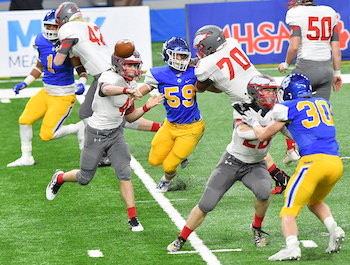
PHOTOS: (Top) Grand Rapids Catholic Central’s Joey Silveri (6) makes a move upfield as Michael Carter gives chase. (Middle) Frankenmuth quarterback Davin Reif (4) unloads a pass as GRCC’s Ryan Beggs (59) works to break free of Zach Adkins’ block. (Click for more from Hockey Weekly Action Photos.)