


NFHS Voice: Campaign Touts Benefits of High School Football
By
Karissa Niehoff
NFHS Executive Director
May 21, 2021
A full return to high school sports and performing arts programs – that’s the hope for this fall in schools across the country.
After a year of unprecedented challenges in keeping these programs going due to the pandemic, which included 11 states that conducted their primary football season this spring, there is great optimism as we look to a new school year.
Even in those states that were able to conduct activities last fall, attendance restrictions kept many fans out of stadiums and watching games online. However, with vaccine eligibility now at 12 years of age and older and with vaccinations continuing during the next three months, the likelihood of routines and traditions returning this fall grows stronger each day.
And there is no tradition more anticipated than the full-scale return of high school football. While there were 34 states there were fortunate enough to conduct football at some level last fall, the routines were anything but normal.
This fall, however, we anticipate a return to the energy and excitement of the 2019 season when 1,003,524 boys participated in 11-player football. That total marked a decline of only 2,489 from the previous year and was a good sign of a renewed confidence on the part of parents and student-athletes that concerns about the risk of injury were being addressed.
While boys participation in 11-player football has exceeded one million participants every year since 1999 and is overwhelmingly the most popular boys sport, there have been concerns about declines in past years.
Last fall, the NFHS and the National Football League announced a partnership to promote the growth, understanding and support for football at the high school level. The NFHS and NFL have been studying participation trends, developing educational tools and striving to restore confidence in students and parents that the sport is, in fact, more focused on risk minimization than ever before.
As a result, the springboard to the return of high school football next fall begins this week with the launch of the #ThisIsHSFootball campaign. Through this effort over the next few months, the NFHS will be reaching out to coaches, students, parents, officials, athletic directors and others with research information, participation trends and data on various risk mitigation efforts that, we believe, continues to make high school football safer than it has ever been.
As a part of this effort, the NFHS produced a video entitled “This is High School Football” designed to detail the benefits of participation in high school football.
As the video states, more so than at any other level of play, parents should feel good about their kids playing high school football.
>Here are some of the many educational and medical safeguards put in place the past 12 years to offer parents a comfort level about the safety standards that are a part of high school football.
► Concussion research and education. All NFHS high school playing rules require a student who is exhibiting signs of a concussion to be removed from the game and not allowed to return until the student has been cleared by a medical professional. Thanks to education and training on the part of students, coaches, trainers, parents and others, research data has shown positive trends in concussion rates. In a recent five-year period, concussion rates during practices dropped from 5.47 to 4.44 concussions per 10,000 athletic exposures.
► Concussion in Sport Course. This free online education course has been available through the NFHS Learning Center since 2010, and millions of individuals have taken the course for a deeper understanding about concussions.
► Concussion Laws. By 2014, every state had adopted state concussion laws that established mandatory protocols, and every state high school association has adopted policies that limit contact during preseason drills and in practices during the season.
► Football equipment. Manufacturers continue to produce higher quality equipment every year, and high school coaches are doing a much better job at teaching and coaching the rules of the game and making attempts to minimize risk of injury for players.
► Emergency Action Plans. Thanks to the NFHS Foundation, a copy of the “Anyone Can Save a Life” emergency action plan originally developed by the Minnesota State High School League was sent to all state high school associations and their high schools, and all schools have access to an AED to help save lives.
► Playing Rules. Risk minimization is a major focus of every NFHS sports rules committee. In football, helmet-to-helmet hits are not allowed.
High school football has been a significant part of schools, towns and communities across America for almost 100 years. The NFHS is committed to making the sport as safe as possible for the millions of kids who will play the sport in the years to come.
Dr. Karissa L. Niehoff is in her third year as executive director of the National Federation of State High School Associations (NFHS) in Indianapolis, Indiana. She is the first female to head the national leadership organization for high school athletics and performing arts activities and the sixth full-time executive director of the NFHS, which celebrated its 100th year of service during the 2018-19 school year. She previously was executive director of the Connecticut Association of Schools-Connecticut Interscholastic Athletic Conference for seven years.
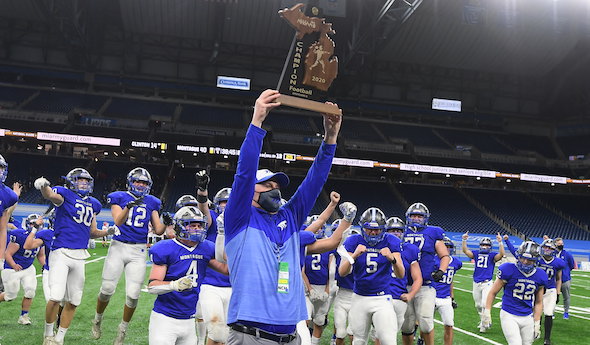
Montague Follows QB's Unstoppable Lead
By
Paul Costanzo
Special for MHSAA.com
January 22, 2021
DETROIT – Montague football coach Patrick Collins was well prepared Friday night.
After a week of getting emotional when asked what it would be like coaching his son, Drew, for the final time in the MHSAA Division 6 Final, he told himself that he wouldn’t cry again if asked the question after the game.
He accomplished that feat, making him perfect on the night.
The Collins family will be celebrating their final game together forever, as they claimed Montague’s third Finals title with a 40-14 victory over Clinton at Ford Field.
“You can’t finish any better than that,” said Patrick Collins, who has been at the helm for all three Montague titles. “How does it get any better? It’s been a phenomenal run. Just pinch me, man. I just can’t believe it. I think all the coaches feel like (the players are) all our sons. We treat them all the same. … It’s special, because we’re tight. There’s a lot of love and a lot of guys playing for each other.”
While the postgame press conference was tear free, the Montague sideline was not as the clock ticked down in the final quarter. A program that had come agonizingly close in each of the past two years – losing in the Final in 2018 and losing a thriller of a Semifinal in 2019 – had broken through for the first time since winning back-to-back titles in 2008 and 2009.
“Everybody on this football team, coaches, players, trainers – everybody on this football team loves high school football,” said Drew Collins, the Montague senior quarterback who accounted for five touchdowns on the night. “I love high school football. I love these coaches. I love my friends on the team. I love everybody on the team. I love the community. It’s bittersweet when you win a state championship when you’re a senior because it’s all over.”
Drew Collins, who was The Associated Press Division 5-6 Player of the Year, made the most of his final game in a Montague uniform, throwing for 244 yards and three touchdowns on 15-of-19 passing. He also rushed for 51 yards and two scores.
That led an offensive attack which put up 390 total yards and scored on all but two of its possessions – one of which ended on downs late in the fourth quarter as the Wildcats were attempting to run out the clock.
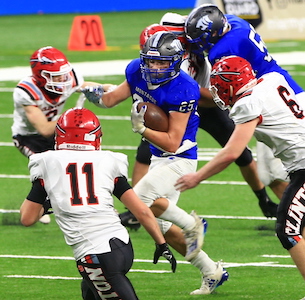 “I just think they can do it all,” Clinton coach Jeremy Fielder said. “When you look at their team, look at what they have up front, look at the athletes they have in space, then you put a quarterback on that team, and you put a very experienced team out there, as well. That’s a lot to deal with. They’re a great football team, and I give them a lot of credit; they’re a great program.”
All three of Collins’ touchdown passes went to Sam Smith (nine, 44 and 26 yards), who had five receptions for 96 yards total. Tugg Nichols added five catches of his own for 89 yards, while Dylan Everett had 52 yards and a touchdown on nine carries.
While Montague’s dynamic offense put on a show, it was the defense’s second-half performance that allowed the Wildcats to pull away. Clinton (10-2) trailed 19-14 at the half but had put together a pair of 80-yard drives. The first finished with an eight-yard George Ames run, and was fueled by a long Brayden Randolph run. The other was a clock-killing masterpiece fullhouse backfields are known for and was closed out with a two-yard Bradyn Lehman run.
Each of those drives followed a Montague drive that ended with a touchdown pass from Collins to Smith. The Wildcats took the halftime lead with Everett’s two-yard touchdown run.
Clinton’s first two drives of the second half, however, ended with turnovers – the first on downs, and the second an interception by Montague’s Trey Mikkelsen. The Wildcats turned both turnovers into touchdowns – Collins’ third TD pass to Smith, and a nine-yard Collins TD rush – and started to put the game away. Collins’ final touchdown run of the game, a 23-yarder in the fourth quarter, erased any doubt.
“I thought the coaches did a great job – our staff is phenomenal,” Patrick Collins said. “We did some adjustments. But really, this team is run by the players, and it starts with the seniors. Their determination is what makes a difference. It was about their heart coming out in the second half and finding the energy to stack up to a great Clinton team, honestly. That Clinton team can bring it, and they brought it today.”
Randolph led the way for Clinton in his final game, rushing for 194 yards on 23 carries. He also had eight tackles, while Lehman led the Clinton defense with nine tackles, and Nik Shadley had six.
“We’re fortunate, we have about 15 or 16 seniors, and at our level, you win with seniors,” Fielder said. “We were able to make some key plays at some key times, and I think it was really big for us, too, when we got shut down (for the statewide pause), we had that senior leadership. We had a group of seniors who had won a wrestling state championship together last year, so they’ve been here before. As a coach, you’re looking at these guys in the huddle, and you’re looking at these guys on the sidelines, you know you’re in pretty good shape. We just ran into a team that was outstanding.”
Izac Jarka and Colton Blankstrom each had eight tackles to lead the Montague defense, while Mikkelsen and Alex Waruszewski each had seven.
PHOTOS: (Top) Montague celebrates its first Football Finals championship Saturday since 2009. (Middle) The Wildcats’ Samuel Smith breaks through an opening as Clinton’s Bradyn Lehman (6) and others close in. (Click for more from Hockey Weekly Action Photos.)