


NFHS Voice: Campaign Touts Benefits of High School Football
By
Karissa Niehoff
NFHS Executive Director
May 21, 2021
A full return to high school sports and performing arts programs – that’s the hope for this fall in schools across the country.
After a year of unprecedented challenges in keeping these programs going due to the pandemic, which included 11 states that conducted their primary football season this spring, there is great optimism as we look to a new school year.
Even in those states that were able to conduct activities last fall, attendance restrictions kept many fans out of stadiums and watching games online. However, with vaccine eligibility now at 12 years of age and older and with vaccinations continuing during the next three months, the likelihood of routines and traditions returning this fall grows stronger each day.
And there is no tradition more anticipated than the full-scale return of high school football. While there were 34 states there were fortunate enough to conduct football at some level last fall, the routines were anything but normal.
This fall, however, we anticipate a return to the energy and excitement of the 2019 season when 1,003,524 boys participated in 11-player football. That total marked a decline of only 2,489 from the previous year and was a good sign of a renewed confidence on the part of parents and student-athletes that concerns about the risk of injury were being addressed.
While boys participation in 11-player football has exceeded one million participants every year since 1999 and is overwhelmingly the most popular boys sport, there have been concerns about declines in past years.
Last fall, the NFHS and the National Football League announced a partnership to promote the growth, understanding and support for football at the high school level. The NFHS and NFL have been studying participation trends, developing educational tools and striving to restore confidence in students and parents that the sport is, in fact, more focused on risk minimization than ever before.
As a result, the springboard to the return of high school football next fall begins this week with the launch of the #ThisIsHSFootball campaign. Through this effort over the next few months, the NFHS will be reaching out to coaches, students, parents, officials, athletic directors and others with research information, participation trends and data on various risk mitigation efforts that, we believe, continues to make high school football safer than it has ever been.
As a part of this effort, the NFHS produced a video entitled “This is High School Football” designed to detail the benefits of participation in high school football.
As the video states, more so than at any other level of play, parents should feel good about their kids playing high school football.
>Here are some of the many educational and medical safeguards put in place the past 12 years to offer parents a comfort level about the safety standards that are a part of high school football.
► Concussion research and education. All NFHS high school playing rules require a student who is exhibiting signs of a concussion to be removed from the game and not allowed to return until the student has been cleared by a medical professional. Thanks to education and training on the part of students, coaches, trainers, parents and others, research data has shown positive trends in concussion rates. In a recent five-year period, concussion rates during practices dropped from 5.47 to 4.44 concussions per 10,000 athletic exposures.
► Concussion in Sport Course. This free online education course has been available through the NFHS Learning Center since 2010, and millions of individuals have taken the course for a deeper understanding about concussions.
► Concussion Laws. By 2014, every state had adopted state concussion laws that established mandatory protocols, and every state high school association has adopted policies that limit contact during preseason drills and in practices during the season.
► Football equipment. Manufacturers continue to produce higher quality equipment every year, and high school coaches are doing a much better job at teaching and coaching the rules of the game and making attempts to minimize risk of injury for players.
► Emergency Action Plans. Thanks to the NFHS Foundation, a copy of the “Anyone Can Save a Life” emergency action plan originally developed by the Minnesota State High School League was sent to all state high school associations and their high schools, and all schools have access to an AED to help save lives.
► Playing Rules. Risk minimization is a major focus of every NFHS sports rules committee. In football, helmet-to-helmet hits are not allowed.
High school football has been a significant part of schools, towns and communities across America for almost 100 years. The NFHS is committed to making the sport as safe as possible for the millions of kids who will play the sport in the years to come.
Dr. Karissa L. Niehoff is in her third year as executive director of the National Federation of State High School Associations (NFHS) in Indianapolis, Indiana. She is the first female to head the national leadership organization for high school athletics and performing arts activities and the sixth full-time executive director of the NFHS, which celebrated its 100th year of service during the 2018-19 school year. She previously was executive director of the Connecticut Association of Schools-Connecticut Interscholastic Athletic Conference for seven years.
Moment: Fee Sets Stage with Record Kick
November 5, 2020
By John Johnson
MHSAA Director of Broadcast Properties
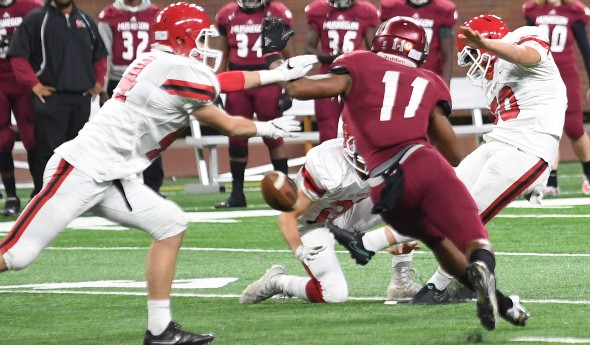
In keeping with the theme of 50-yard field goals written in this space earlier this week by MHSAA historian Ron Pesch, let’s take this week’s "Moment" to remember the longest field goal ever in an MHSAA Playoff Championship.
No one has ever gone over 50 yards. Heck, no one has ever tired a field goal over 50 yards that I can remember. But Ben Fee came as close as you could in the 2016 Division 3 Final for Orchard Lake St. Mary’s against Muskegon with a 49-yard boot in the Eaglets’ 29-28 victory.
The call on FOX Sports Detroit was cute – Fee was wearing Number 50, and while his holder straddled the 40-yard line, giving the appearance of a 50-yard attempt – the kicking block was a good half-foot in front of the 40, and by rule making it a 49-yard attempt. The kick broke a record set in the previous game of 47 yards by Liam Putz of Grand Rapids West Catholic and tied a record for most field goals in the final game with three also set by Jake Townsley from Warren DeLaSalle in 2014. Fee also had field goals of 32 and 35 yards in the contest.
The kick gave St. Mary’s a 23-21 lead with 4:47 left in the fourth quarter, setting the stage for one of the most dramatic finishes in playoff history. Muskegon would return the ensuing kickoff to near midfield and then score six plays later, on a La’Darius Jefferson three-yard run, with the extra point making it a 28-23 game in favor of the Big Reds with 1:55 to play.
Starting on its own 20-yard line, St. Mary’s got three runs from Rashawn Allen for 37 yards and reeled off a total of nine plays in 1:51, culminating with Caden Prieskorn’s 18-yard pass to Ky'ren Cunningham for the game-winning score with four ticks left on the clock.