


NFHS Voice: Campaign Touts Benefits of High School Football
By
Karissa Niehoff
NFHS Executive Director
May 21, 2021
A full return to high school sports and performing arts programs – that’s the hope for this fall in schools across the country.
After a year of unprecedented challenges in keeping these programs going due to the pandemic, which included 11 states that conducted their primary football season this spring, there is great optimism as we look to a new school year.
Even in those states that were able to conduct activities last fall, attendance restrictions kept many fans out of stadiums and watching games online. However, with vaccine eligibility now at 12 years of age and older and with vaccinations continuing during the next three months, the likelihood of routines and traditions returning this fall grows stronger each day.
And there is no tradition more anticipated than the full-scale return of high school football. While there were 34 states there were fortunate enough to conduct football at some level last fall, the routines were anything but normal.
This fall, however, we anticipate a return to the energy and excitement of the 2019 season when 1,003,524 boys participated in 11-player football. That total marked a decline of only 2,489 from the previous year and was a good sign of a renewed confidence on the part of parents and student-athletes that concerns about the risk of injury were being addressed.
While boys participation in 11-player football has exceeded one million participants every year since 1999 and is overwhelmingly the most popular boys sport, there have been concerns about declines in past years.
Last fall, the NFHS and the National Football League announced a partnership to promote the growth, understanding and support for football at the high school level. The NFHS and NFL have been studying participation trends, developing educational tools and striving to restore confidence in students and parents that the sport is, in fact, more focused on risk minimization than ever before.
As a result, the springboard to the return of high school football next fall begins this week with the launch of the #ThisIsHSFootball campaign. Through this effort over the next few months, the NFHS will be reaching out to coaches, students, parents, officials, athletic directors and others with research information, participation trends and data on various risk mitigation efforts that, we believe, continues to make high school football safer than it has ever been.
As a part of this effort, the NFHS produced a video entitled “This is High School Football” designed to detail the benefits of participation in high school football.
As the video states, more so than at any other level of play, parents should feel good about their kids playing high school football.
>Here are some of the many educational and medical safeguards put in place the past 12 years to offer parents a comfort level about the safety standards that are a part of high school football.
► Concussion research and education. All NFHS high school playing rules require a student who is exhibiting signs of a concussion to be removed from the game and not allowed to return until the student has been cleared by a medical professional. Thanks to education and training on the part of students, coaches, trainers, parents and others, research data has shown positive trends in concussion rates. In a recent five-year period, concussion rates during practices dropped from 5.47 to 4.44 concussions per 10,000 athletic exposures.
► Concussion in Sport Course. This free online education course has been available through the NFHS Learning Center since 2010, and millions of individuals have taken the course for a deeper understanding about concussions.
► Concussion Laws. By 2014, every state had adopted state concussion laws that established mandatory protocols, and every state high school association has adopted policies that limit contact during preseason drills and in practices during the season.
► Football equipment. Manufacturers continue to produce higher quality equipment every year, and high school coaches are doing a much better job at teaching and coaching the rules of the game and making attempts to minimize risk of injury for players.
► Emergency Action Plans. Thanks to the NFHS Foundation, a copy of the “Anyone Can Save a Life” emergency action plan originally developed by the Minnesota State High School League was sent to all state high school associations and their high schools, and all schools have access to an AED to help save lives.
► Playing Rules. Risk minimization is a major focus of every NFHS sports rules committee. In football, helmet-to-helmet hits are not allowed.
High school football has been a significant part of schools, towns and communities across America for almost 100 years. The NFHS is committed to making the sport as safe as possible for the millions of kids who will play the sport in the years to come.
Dr. Karissa L. Niehoff is in her third year as executive director of the National Federation of State High School Associations (NFHS) in Indianapolis, Indiana. She is the first female to head the national leadership organization for high school athletics and performing arts activities and the sixth full-time executive director of the NFHS, which celebrated its 100th year of service during the 2018-19 school year. She previously was executive director of the Connecticut Association of Schools-Connecticut Interscholastic Athletic Conference for seven years.
Hill's Return Aids Onsted Playoff Climb
November 22, 2019
By Doug Donnelly
Special for Second Half
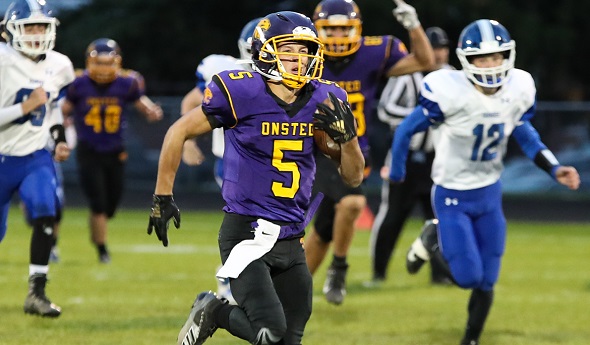
ONSTED – Travis Hill only played in three games for the Onsted football team last season.
 But it was those three games that helped pave the way for the senior to rush for more than 1,300 yards and help the Wildcats reach this weekend’s Division 6 Semifinals.
Hill broke his collarbone at practice the Wednesday before Onsted’s season opener in 2018.
“They told me I wouldn’t be back that season,” Hill said. “I recovered quick, I guess.”
Hill’s competitive drive put him on the fast track. He was back on the field for the final three games of the season. The Wildcats finished 3-6 on the year, but Hill’s return was important.
“It was pretty difficult (to come back),” Hill said. “But, those three games helped me be mentally prepared. … The first couple of plays, I was hesitant. But ever since then, I’ve felt good and confident in it.”
Last football season wasn’t the first time Hill had to miss time from the court or field. He broke the same collarbone during his sophomore basketball season. He was one of the key players on Brad Maska’s varsity hoops team when he went down with the injury.
“Travis is as competitive as any athlete I’ve ever coached, and I’ve coached a lot of really competitive guys,” said Maska. “He’s one of those rare athletes who could be all-state in baseball, all-state in basketball and all-state in football. He works hard and has a lot of drive.”
A healthy Hill has paid huge dividends for the Wildcats football team. Onsted started this season 2-0, slipped to 2-2 and hasn’t lost since. Two playoff wins avenged the Wildcats’ two regular-season losses – against Blissfield and Lenawee County Athletic Association champion Hillsdale.
“It’s been great and so much fun,” Hill said.
“We had a hot start, and then lost two games in a row. We could have either went up north and played really well, or we could have went south. We decided to get our stuff together and play well as a team. We’ve been playing pretty well since then.”
Hill has been a big reason why.
Through the Regional Final win over Hillsdale, Hill has 186 carries for 1,312 yards on the ground and another 23 receptions for 390 yards receiving. He has rushed for 14 touchdowns, caught four passes for touchdowns and returned a kick for a score.
On defense, he has 52 tackles, four interceptions and a forced fumble. He returned one of those interceptions for a touchdown.
He seldom takes a play off.
“He’s very talented but, more than that, it’s his competitive spirit,” Onsted coach Dan Terryberry said. “He just wants to win so bad. He’s explosive and doesn’t want to be denied.”
The Wildcats will face Monroe St. Mary Catholic Central in their Division 6 Semifinal at 1 p.m. Saturday at Ypsilanti Lincoln High School. For Onsted, this has been the deepest run in the playoffs since Hill’s uncles – including one of the most prolific passers in Lenawee County history John Hutchinson – led the Wildcats to the 1993 Class CC championship game.
Hill isn’t the only 1,000-yard back in the Wildcats’ backfield. Terryberry also leans heavily on Rourke Barth (1,025 yards). Junior quarterback Dylan Terryberry has more than 1,000 yards passing.
Coach Terryberry credits the Wildcats offensive line for much of the success.
“This is the first year that line has played all together, and a couple of them are playing new positions,” said Coach Terryberry. “They have grown a lot this season. They’ve bought in and are playing well.”
Dylan Stevens is one of those linemen. He’s a senior, like Hill, and is glad to have his classmate back for this season.
“It’s made a huge difference,” Stevens said. “Travis is an outstanding athlete on both sides of the ball. Not having him last year hurt us quite a bit.”
Terryberry, in his 16th season as Onsted’s head coach, is from Charlevoix. A former high school quarterback, he walked on at Michigan State. He started teaching and coaching at Tecumseh, where he served as offensive coordinator for the varsity football team and as the junior varsity head coach.
Having Hill play in those three games at the end of the 2018 season, Terryberry said, put any fears about the injury to rest.
“He’s pretty fearless and super competitive,” Terryberry said.
Hill has had numerous big games. He had 190 yards rushing against Dundee, and more than 175 against Blissfield in the first round of the playoffs. The Onsted faithful are hoping for at least one more big game Saturday against the Falcons (10-1), who were the No. 1-ranked team in the final regular-season Associated Press poll.
“It’s been a great experience so far, and we hope we aren’t done yet,” Hill said. “… I think it’s a mindset. We’ve played well. We knew we had the opportunity; if we put the work in, we could just keep going and keep going farther.”
 Doug Donnelly has served as a sports and news reporter and city editor over 25 years, writing for the Daily Chief-Union in Upper Sandusky, Ohio from 1992-1995, the Monroe Evening News from 1995-2012 and the Adrian Daily Telegram since 2013. He's also written a book on high school basketball in Monroe County and compiles record books for various schools in southeast Michigan. E-mail him at [email protected] with story ideas for Jackson, Washtenaw, Hillsdale, Lenawee and Monroe counties.
PHOTO: Onsted's Travis Hill (No. 5) rushed for more than 1,300 yards this season, a year after missing six games due to breaking his collarbone. (Photo courtesy of Onsted Athletics/T.J. Olsen.)